

The idea that AI will render most software engineers obsolete is a common but exaggerated concern. While AI is transforming software development, it’s unlikely to replace the majority of software engineers in the near future. Here’s a balanced projection based on current trends and expert analysis:
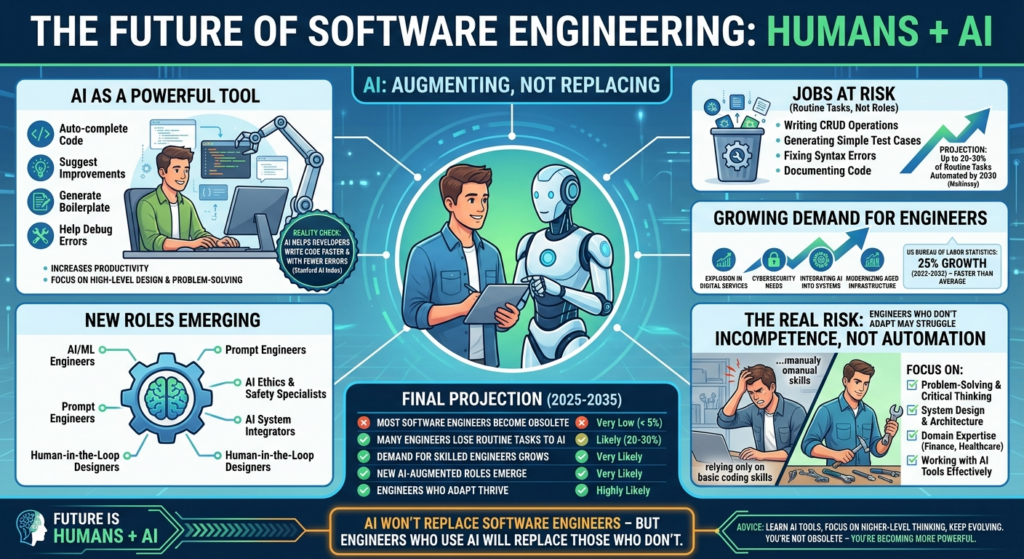
1. AI Is Augmenting, Not Replacing, Engineers
AI tools like GitHub Copilot, Amazon CodeWhisperer, and Google’s AI-powered coding assistants are becoming powerful aids. They can:
-
Auto-complete code snippets
-
Suggest improvements
-
Generate boilerplate code
-
Help debug errors
These tools increase productivity—not eliminate jobs. Engineers can now focus more on high-level design, architecture, and problem-solving rather than repetitive coding.
🔍 Reality Check: A 2023 Stanford AI Index report found that AI tools are helping developers write code faster and with fewer errors—but not replacing them.
2. Jobs at Risk Are Not All Software Engineering
Certain routine, repetitive tasks are most vulnerable:
-
Writing basic CRUD operations
-
Generating simple test cases
-
Fixing syntax errors
-
Documenting code
These tasks may be automated, but they represent only a portion of a software engineer’s role.
📌 Projection: Up to 20–30% of routine coding tasks could be automated by 2030, according to McKinsey & Company.
3. Demand for Engineers Is Still Growing
Despite AI advances, demand for software engineers remains strong due to:
-
Explosion in digital services (apps, cloud, IoT, AI itself)
-
Cybersecurity needs
-
Integration of AI into existing systems
-
Aging infrastructure needing modernization
📈 U.S. Bureau of Labor Statistics (2023): Software developer jobs are projected to grow 25% from 2022 to 2032—much faster than average.
4. New Roles Are Emerging
AI isn’t just destroying jobs—it’s creating new ones:
-
AI/ML engineers
-
Prompt engineers (for AI systems)
-
AI ethics and safety specialists
-
AI system integrators
-
Human-in-the-loop system designers
Engineers who adapt and learn to work with AI will be in high demand.
5. The Real Risk: Incompetence, Not Automation
The biggest threat isn’t AI taking jobs—it’s engineers who don’t adapt. Those who rely only on basic coding skills without understanding architecture, system design, or problem-solving may find it harder to stay relevant.
✅ Survival Strategy: Focus on:
Problem-solving & critical thinking
System design & architecture
Domain expertise (e.g., finance, healthcare)
Working with AI tools effectively
Final Projection (2025–2035):
| Outcome | Likelihood |
|---|---|
| Most software engineers become obsolete | ❌ Very Low (less than 5%) |
| Many engineers lose routine tasks to AI | ✅ Likely (20–30%) |
| Demand for skilled engineers grows | ✅ Very Likely |
| New AI-augmented roles emerge | ✅ Very Likely |
| Engineers who adapt thrive | ✅ Highly Likely |
Bottom Line:
AI won’t replace software engineers—but engineers who use AI will replace those who don’t.
The future isn’t about humans vs. AI. It’s about humans + AI working together to build better software faster.
💡 Advice: Learn to use AI tools, focus on higher-level thinking, and keep evolving. You’re not obsolete—you’re becoming more powerful.