

When students study business strategy, the PEST analysis is a cornerstone framework. It stands for Political, Economic, Social, and Technological factors. However, a comprehensive strategic view often requires looking beyond these four pillars. One critical component frequently overlooked or treated as a secondary concern is the legal landscape. For business courses, understanding how laws and regulations intersect with these macro-environmental factors is essential for accurate risk assessment.
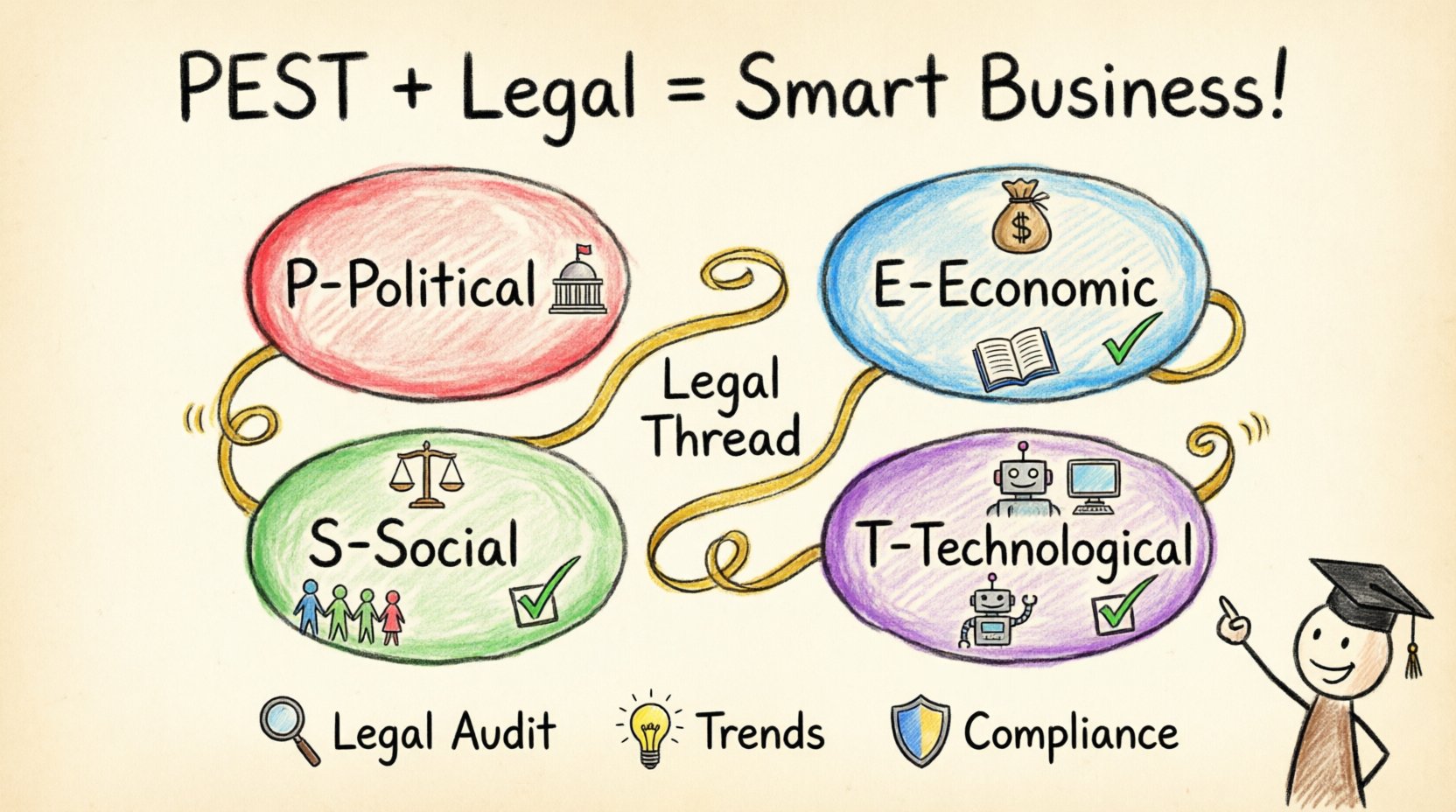
Legal considerations do not exist in a vacuum. They are woven into the fabric of every PEST category. A change in tax policy is economic, but it is also statutory. A new data privacy law is technological, but it is also social and political. This article explores how legal factors integrate into the PEST framework, providing a robust foundation for academic analysis and real-world application.
🏛️ Political Factors and Regulatory Frameworks
The P political component of the analysis deals with government intervention in the economy. This includes tax policy, trade restrictions, and labor laws. However, the legal aspect here is about the enforceability and stability of these policies.
- Trade Regulations: International trade is governed by treaties and bilateral agreements. Students must analyze how tariffs and import quotas are codified into law. A change in administration can lead to immediate legislative shifts that impact supply chains.
- Political Stability: The rule of law is a measure of political stability. In regions where legal frameworks are inconsistent or where contracts are not upheld reliably, investment risk increases significantly.
- Lobbying and Influence: Corporations engage in lobbying to shape legislation. Understanding the legal boundaries of political donations and advocacy is crucial for compliance.
- International Treaties: Agreements like the WTO rules or regional trade blocs create a legal structure that dictates market access.
When evaluating political factors, business students should look for the legislative history of current policies. What is the legal trajectory? Is the government moving toward deregulation or increased oversight? This trend analysis provides a clearer picture than a static snapshot of current laws.
💰 Economic Factors and Compliance Obligations
Economic factors involve inflation, exchange rates, and economic growth. While these are market-driven, the legal framework dictates how these forces are managed and regulated. Compliance costs can eat into profit margins, making them a direct economic concern.
- Tax Legislation: Corporate tax rates are set by law. Changes in tax codes affect cash flow and capital investment decisions. Students should examine how tax incentives are legally structured and if they are temporary or permanent.
- Employment Law: Minimum wage laws, overtime regulations, and benefits mandates are economic in nature but legally enforced. These impact the cost of labor significantly.
- Antitrust and Monopoly Laws: Regulations prevent unfair market practices. Businesses must ensure their pricing strategies and mergers do not violate competition laws.
- Banking and Currency Controls: Central banks operate within legal mandates. Restrictions on capital movement can affect international business operations.
In this context, legal considerations act as a constraint or an enabler. A favorable legal environment might reduce the cost of doing business, while a stringent one might increase operational overhead. Students should quantify these compliance costs where possible.
👥 Social Factors and Consumer Protection
Social factors encompass demographics, cultural trends, and lifestyle changes. The legal dimension here focuses on human rights, consumer protection, and non-discrimination. These laws protect stakeholders and define the ethical boundaries of business operations.
- Data Privacy and Protection: Laws like the GDPR in Europe or similar regulations globally dictate how companies handle personal data. This is a massive legal consideration for any business dealing with customer information.
- Consumer Rights: Warranty laws, product safety standards, and advertising regulations protect the buyer. Violations can lead to class-action lawsuits and reputational damage.
- Labor and Human Rights: Modern social expectations are backed by law. Forced labor, child labor, and workplace discrimination are illegal in most jurisdictions. Supply chain audits are often required to ensure compliance.
- Accessibility Standards: Laws regarding physical and digital accessibility ensure that businesses are inclusive. This affects product design and marketing strategies.
Ignoring social legalities can lead to boycotts and legal sanctions. In business courses, students must consider how cultural shifts are codified into legislation. For example, a shift in public opinion regarding environmental sustainability often leads to new environmental laws that impact business operations.
🚀 Technological Factors and Intellectual Property
Technological factors include automation, R&D activity, and technology incentives. The legal framework surrounding technology is complex and rapidly evolving. Intellectual property rights are the bedrock of innovation protection.
- Intellectual Property (IP): Patents, copyrights, and trademarks protect inventions and branding. Students must understand the legal process of securing IP and the risks of infringement.
- Cybersecurity Laws: Governments are mandating stricter cybersecurity protocols. Breaches can result in heavy fines under laws designed to protect critical infrastructure.
- Software Licensing: The legal terms of software usage dictate how technology can be deployed. Open source licenses have specific legal obligations that must be followed.
- Emerging Tech Regulations: Artificial Intelligence, blockchain, and biotechnology are areas where laws are still being written. Businesses must navigate uncertainty while remaining compliant with current statutes.
The speed of technological change often outpaces the law. This creates a gray area where businesses must exercise caution. Legal considerations here involve risk management and ethical governance of new technologies.
📊 Comparative Overview of Legal Impacts
To better understand the intersection of these factors, consider the following table which outlines specific legal implications within each PEST category.
| PEST Category | Key Legal Consideration | Business Impact |
|---|---|---|
| Political | Trade Tariffs & Sanctions | Market Access Restrictions |
| Economic | Tax Codes & Labor Standards | Operational Cost Increases |
| Social | Data Privacy & Consumer Rights | Compliance & Reputation Risk |
| Technological | IP Rights & Cybersecurity | Innovation Protection & Liability |
🎓 Application in Business Courses
For students undertaking business strategy projects, integrating legal considerations requires a specific methodology. It is not enough to list laws; one must analyze their impact on strategic decisions.
- Conduct a Legal Audit: Begin by identifying the specific jurisdictions where the business operates. Laws vary by country and state.
- Identify Regulatory Bodies: Know which agencies enforce the relevant laws. This helps in understanding enforcement priorities.
- Analyze Trends: Look at pending legislation. A law that has not yet passed may still influence investor sentiment.
- Scenario Planning: Develop scenarios based on potential legal changes. What happens if a new data law is introduced? How does that affect the technology plan?
- Stakeholder Communication: Legal risks must be communicated clearly to investors and boards. Transparency builds trust.
⚠️ Common Pitfalls in Legal Analysis
Even experienced analysts can miss critical legal nuances. Below are common errors to avoid when writing PEST analyses for academic or professional purposes.
- Ignoring Local Laws: Assuming national laws apply globally is a mistake. Local municipal regulations can override broader policies.
- Focusing Only on Compliance: Viewing law merely as a checklist misses the strategic opportunity. Compliance can be a competitive advantage if others lag behind.
- Static Analysis: Laws change. A static report is outdated quickly. Continuous monitoring is required.
- Overlooking International Treaties: Global businesses must adhere to international agreements, not just domestic statutes.
- Neglecting Enforcement: A law exists on paper, but how is it enforced? In some regions, enforcement is lax; in others, it is strict.
🔄 The PESTLE Evolution
It is worth noting that many business frameworks expand PEST to PESTLE by adding Legal and Environmental factors. In this context, Legal is often separated to highlight its importance. However, integrating legal considerations into the original four factors provides a more cohesive view of the macro-environment.
- Integration Benefits: It prevents siloing. Legal issues are rarely isolated to one category.
- Clarity: It clarifies the relationship between policy and regulation.
- Comprehensiveness: It ensures no major risk factor is overlooked during the analysis phase.
🛡️ Future-Proofing Strategies
As the global business environment becomes more regulated, the legal component of PEST analysis will grow in importance. Students and professionals must adopt strategies to stay ahead of these changes.
- Continuous Learning: Regulations evolve. Keeping abreast of legal news is part of the job.
- Consult Experts: Legal counsel should be part of the strategic planning team, not an afterthought.
- Adaptive Planning: Business strategies should include contingency plans for legal shifts.
- Ethical Alignment: Laws reflect societal values. Aligning business ethics with legal standards ensures long-term viability.
By treating legal considerations as a core pillar of the PEST analysis, business students can develop strategies that are not only profitable but also sustainable and compliant. This approach reduces risk and enhances the credibility of the strategic plan. The goal is to build resilience against regulatory shocks while capitalizing on opportunities created by legal frameworks.
Understanding these dynamics allows for a more nuanced view of the market. It moves the analysis from simple observation to critical evaluation. In a world where regulations are tightening, the ability to navigate legal complexities is a key competency for future business leaders.