

Strategic planning is a cornerstone of organizational survival and growth. Within the academic study of business management, few frameworks hold as much prominence as the PESTEL analysis. While often treated as a practical tool for corporate strategists, its roots lie deep in environmental scanning theory and macroeconomic modeling. This article explores the PESTEL framework from an academic standpoint, dissecting its theoretical underpinnings, methodological application, and critical limitations within scholarly research.
The PESTEL analysis serves as a structured method for identifying and analyzing the macro-environmental factors that impact an organization. Unlike internal analysis tools that focus on resources and capabilities, PESTEL looks outward. It provides a comprehensive view of the external landscape, ensuring that strategies are not formulated in a vacuum. For researchers and students, understanding this framework is essential for analyzing market entry, policy shifts, and long-term sustainability.
🏛️ Theoretical Foundations and Origins
The conceptualization of environmental scanning dates back to the mid-20th century. The specific acronym PEST was first attributed to Francis X. Aguilar in 1967, in his work Scanning the Business Environment. Over time, the framework evolved to include Legal and Environmental factors, becoming PESTEL. This evolution reflects the changing nature of global business, where regulatory compliance and ecological responsibility became central to strategic viability.
In academic literature, the framework is often categorized under External Environmental Analysis. It relies on the contingency theory of management, which posits that there is no single best way to organize or manage. Instead, the optimal course of action depends on the internal and external situation. Therefore, the PESTEL analysis acts as a diagnostic tool to assess the specific context in which an organization operates.
Key theoretical concepts associated with this framework include:
- Environmental Uncertainty: The degree to which the environment is complex and dynamic.
- Strategic Fit: The alignment between organizational capabilities and external opportunities.
- Stakeholder Theory: How external factors influence various groups beyond shareholders.
🔍 Deconstructing the Acronym
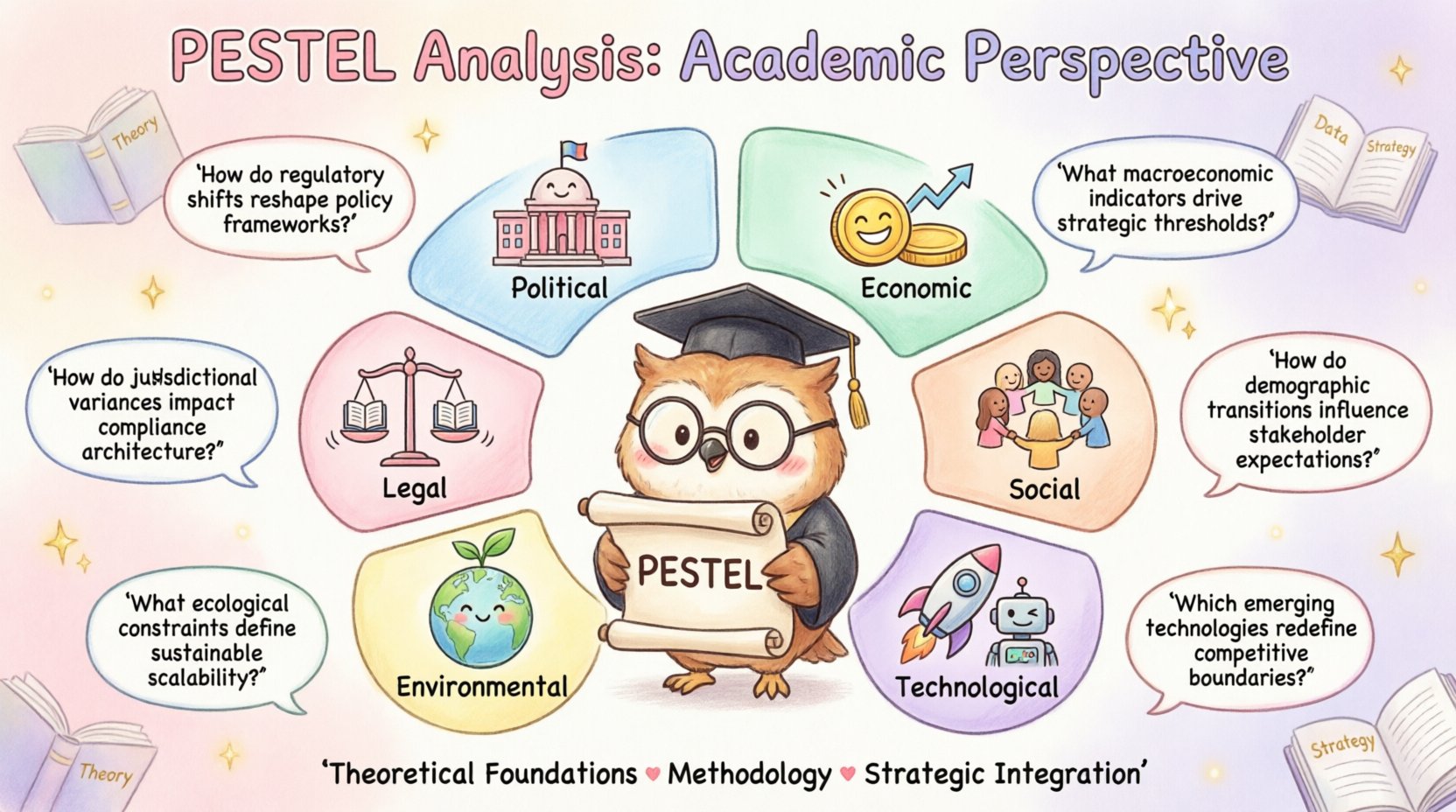
To apply this framework rigorously, one must understand each component. In an academic context, these are not just buzzwords but distinct categories of data collection and analysis. The table below outlines the core factors and their specific academic focus.
| Factor | Focus Area | Key Research Questions |
|---|---|---|
| Political | Government influence | How do trade regulations or political stability affect operations? |
| Economic | Financial performance | What is the impact of inflation or exchange rates on demand? |
| Social | Cultural and demographic | How do population trends or lifestyle changes shift consumer behavior? |
| Technological | Innovation and R&D | What new technologies could disrupt the current market model? |
| Environmental | Ecological and sustainability | How do climate policies or resource scarcity impact supply chains? |
| Legal | Regulatory compliance | Are there new laws regarding labor or intellectual property? |
🌍 Political Factors
Political factors refer to the extent to which a government intervenes in the economy. In academic research, this often involves analyzing policy stability, corruption indices, and trade restrictions. It is not merely about which party is in power, but the ideological direction of governance.
Researchers examining this sector often look at:
- Tax Policy: Corporate tax rates influence profitability and investment decisions.
- Trade Restrictions: Tariffs and quotas can limit market access for international firms.
- Political Stability: Countries with high instability present higher risks for long-term capital investment.
- Government Subsidies: Financial support for specific industries can alter competitive dynamics.
💰 Economic Factors
Economic factors directly affect the purchasing power of potential customers and the cost of capital. This section of the analysis requires quantitative rigor. Academic studies often integrate macroeconomic indicators such as GDP growth, interest rates, and unemployment levels.
Key considerations include:
- Economic Cycle: Is the economy in a recession, expansion, or stagnation?
- Inflation Rates: High inflation can erode margins and reduce consumer spending.
- Exchange Rates: For multinational corporations, currency fluctuation impacts revenue repatriation.
The amount of money households have available for spending.
👥 Social Factors
Social factors encompass the demographic and cultural aspects of the external environment. This area is increasingly vital as consumer behavior shifts towards ethical consumption and wellness. Academic inquiry here often draws from sociology and psychology.
Important dimensions include:
- Population Growth: Affects the size of the potential market.
- Age Distribution: An aging population requires different products than a youthful one.
- Health Consciousness: Trends in fitness and diet impact industries like food and insurance.
- Attitude towards Work: Shifts in work-life balance preferences affect labor markets.
🚀 Technological Factors
Technological factors have become perhaps the most dynamic element of the PESTEL framework. The speed of innovation means that what is relevant today may be obsolete tomorrow. This factor is critical for industries like telecommunications, manufacturing, and services.
Strategic questions involve:
- Automation: The potential for robotics to replace human labor.
- Research & Development: The rate of innovation in the specific sector.
- Internet Infrastructure: The availability of connectivity in target markets.
- Technology Transfer: The ease with which new technologies move from research to commercial application.
🌱 Environmental Factors
Once a peripheral concern, environmental factors are now central to strategic planning. This includes climate change, weather, and environmental policies. The academic perspective here emphasizes sustainability and corporate social responsibility (CSR).
Key areas of analysis:
- Climate Change: Risks associated with extreme weather events.
- Carbon Footprint: Regulatory pressure to reduce emissions.
- Waste Management: Regulations regarding disposal and recycling.
- Resource Scarcity: The availability of raw materials needed for production.
⚖️ Legal Factors
Legal factors differ slightly from political factors in that they concern the laws and regulations that businesses must follow. This includes employment law, consumer protection, and health and safety regulations. Compliance is not optional; it is a prerequisite for operation.
Focus areas include:
- Employment Laws: Minimum wage, working hours, and discrimination policies.
- Health and Safety: Standards for protecting workers and consumers.
- Intellectual Property: Patents, copyrights, and trademarks.
- Data Protection: Regulations regarding the handling of personal information.
📝 Methodology in Academic Research
Conducting a PESTEL analysis within a research context requires a systematic approach. It is not enough to list factors; one must evaluate their impact. The following steps outline a rigorous methodology.
- Define the Scope: Determine the industry, geographic region, and time horizon. A global analysis differs significantly from a local one.
- Data Collection: Gather information from primary and secondary sources. Academic journals, government reports, and industry white papers are standard sources.
- Identification: List all relevant factors under the six headings. Avoid vague statements; be specific.
- Impact Assessment: Determine whether each factor is a threat or an opportunity. Use a scoring system to prioritize.
- Integration: Combine findings with internal analysis (such as SWOT) to formulate strategy.
🔄 Integration with Other Frameworks
PESTEL is rarely used in isolation. It is most powerful when integrated with other strategic tools. The most common pairing is with SWOT analysis. The PESTEL analysis provides the External inputs for the Opportunities and Threats sections of the SWOT matrix.
This integration ensures that:
- Internal strengths are matched against external opportunities.
- Internal weaknesses are protected from external threats.
- Strategies are grounded in reality rather than internal bias.
⚠️ Limitations and Critiques
While widely taught, the PESTEL framework is not without criticism. Academic rigor demands an acknowledgment of these limitations. Understanding where the framework fails is as important as knowing where it succeeds.
Static Nature: The analysis is often conducted at a single point in time. The macro-environment is dynamic, and a snapshot may quickly become outdated.
Subjectivity: The identification of factors is often subjective. Different analysts may prioritize different factors based on their background or bias.
Complexity Management: With so many variables, it can be difficult to determine which factors are truly significant. Noise can drown out signal.
Lack of Interconnectivity: The framework treats factors as separate categories. In reality, political decisions often drive economic outcomes, which in turn affect social structures.
🔮 Future Trends in Environmental Scanning
As the global landscape becomes more interconnected, the application of PESTEL is evolving. Future research is likely to focus on the speed of change and the volume of data involved.
Potential developments include:
- Real-Time Scanning: Using data analytics to monitor environmental factors continuously rather than annually.
- Scenario Planning: Combining PESTEL with scenario planning to visualize multiple future outcomes.
- Global-Local Linkage: Better integration of global trends with local micro-environments.
The framework remains a foundational element of strategic thought. However, its application must be flexible. Researchers and practitioners must adapt the model to fit the specific nuances of the industry and the era in which they operate.
🎓 Conclusion for Students and Practitioners
For those studying strategic management, the PESTEL analysis offers a structured way to think about the world outside the organization. It encourages a broad view, preventing tunnel vision on internal operations alone. By mastering the application of this framework, one gains the ability to anticipate change rather than simply react to it.
When applied with academic rigor, it transforms from a simple checklist into a powerful diagnostic instrument. It forces the analyst to confront uncomfortable truths about external risks and hidden opportunities. Whether for a thesis, a business plan, or a policy proposal, the PESTEL framework provides the necessary scaffolding for sound strategic decision-making.
Ultimately, the value lies not in the framework itself, but in the depth of insight derived from it. A superficial scan yields little value. A deep, critical analysis of political, economic, social, technological, environmental, and legal factors provides the clarity needed to navigate complex environments. This remains the core lesson of the PESTEL approach in strategic planning.