


Managing financial resources effectively is a constant challenge for modern development teams. When the cost of building and delivering software outpaces the value it generates, burn rate becomes a critical issue. Lean Agile methodologies offer a robust framework for addressing this challenge. By focusing on value delivery, waste reduction, and continuous learning, organizations can align their spending with tangible outcomes. This approach does not merely cut costs; it optimizes the entire value stream to ensure every dollar spent contributes to the product’s success.
This guide explores practical strategies to lower burn rate without compromising quality or team morale. We will examine how to identify inefficiencies, prioritize work that matters, and build a culture of financial responsibility. The goal is sustainable growth, not short-term savings that lead to long-term debt.
Understanding Burn Rate in Software Development 🧐
Burn rate is the speed at which a company spends its capital before generating positive cash flow. In the context of software development, this includes salaries, infrastructure costs, tools, and overhead. A high burn rate can indicate inefficiency, such as building features nobody uses or spending excessive time on low-priority tasks. Conversely, a controlled burn rate ensures longevity and flexibility.
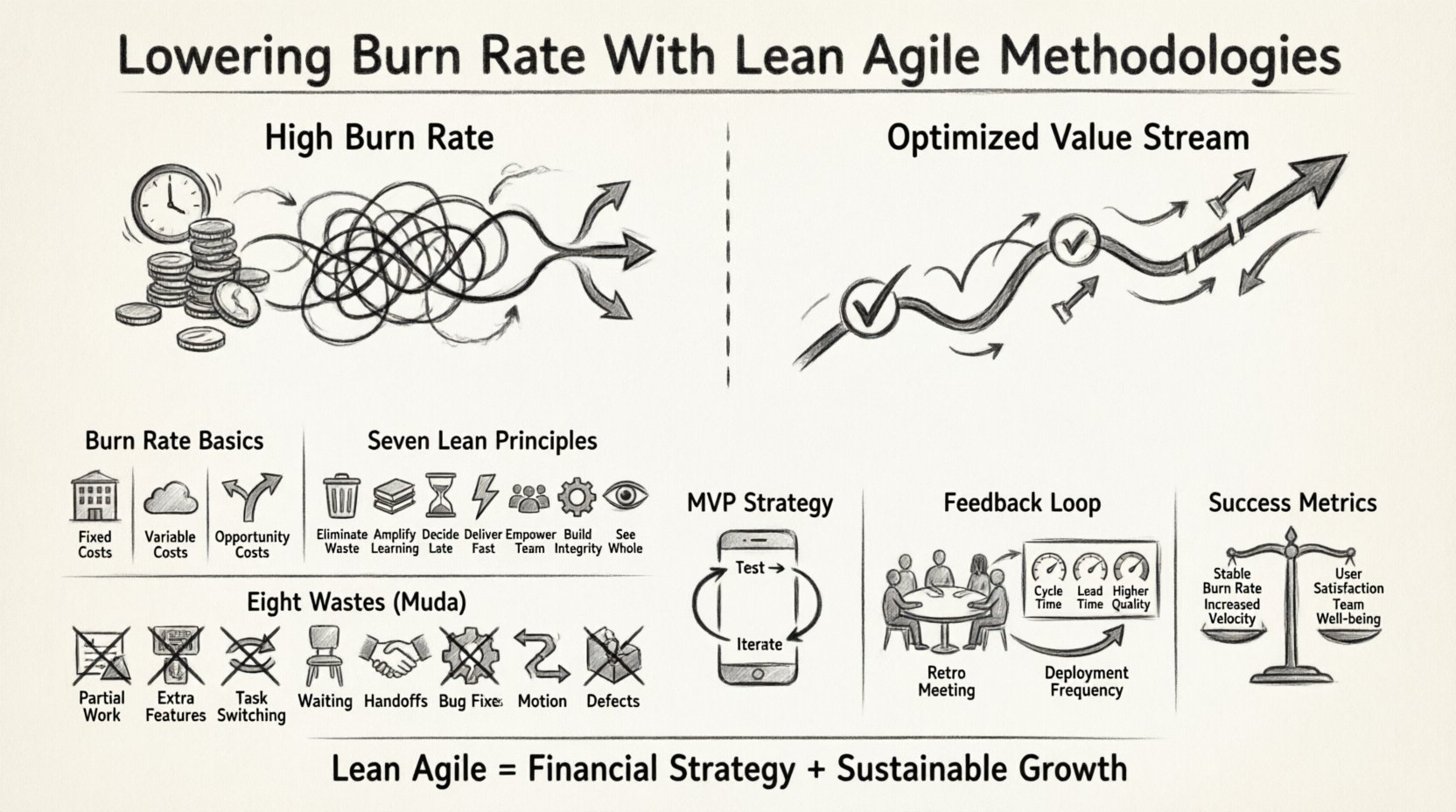
- Fixed Costs: Salaries, office space, and licenses that remain constant regardless of output.
- Variable Costs: Cloud infrastructure, third-party services, and contractor fees that fluctuate with usage.
- Opportunity Costs: The value lost by choosing one project over another, often hidden in the backlog.
Reducing burn rate is not about working harder or faster. It is about working smarter. It requires a shift in mindset from output-based metrics (lines of code, tickets closed) to outcome-based metrics (value delivered, problems solved). When teams focus on outcomes, resources are naturally directed toward high-impact activities.
Core Principles of Lean Thinking ⚙️
Lean methodology originated in manufacturing but has proven highly effective in software development. The core philosophy revolves around maximizing value while minimizing waste. Applying these principles helps organizations stop doing things that do not add value, which directly impacts the burn rate.
The seven principles of Lean software development include:
- Eliminate Waste: Remove anything that does not contribute to the final product.
- Amplify Learning: Shorten feedback loops to validate assumptions quickly.
- Decide as Late as Possible: Keep options open to avoid committing to the wrong path early.
- Deliver as Fast as Possible: Reduce cycle time to get value to users sooner.
- Empower the Team: Trust those doing the work to make decisions.
- Build Integrity In: Ensure quality is maintained throughout the process.
- See the Whole: Understand how parts interact within the larger system.
When these principles are applied, the focus shifts from activity to value. Teams stop measuring success by how much they produce and start measuring it by how much value they create. This shift is the first step toward lowering operational costs.
Identifying and Eliminating Waste (Muda) 🗑️
In Lean terminology, waste is any activity that consumes resources but creates no value. Identifying these wastes is crucial for controlling burn rate. There are eight common types of waste in software development. Recognizing them allows teams to target specific areas for improvement.
| Waste Type | Description | Impact on Burn Rate |
|---|---|---|
| Partially Done Work | Features started but not completed | High. Wasted effort and delayed value. |
| Extra Features | Functionality not requested or needed | High. Direct cost of development without return. |
| Task Switching | Context switching between multiple projects | Medium. Reduces productivity and increases time. |
| Waiting | Delays in approvals, dependencies, or feedback | High. Idle time costs money without progress. |
| Handoffs | Transferring work between teams or roles | Medium. Increases communication overhead and errors. |
| Bug Fixes | Time spent correcting errors made earlier | High. Rework is expensive and delays delivery. |
| Motion | Unnecessary movement or searching for information | Low. Friction that slows down the team. |
| Defects | Issues found late in the cycle | High. Exponential cost increase as release nears. |
Addressing these wastes requires deliberate action. For example, to reduce partially done work, teams should limit work in progress (WIP). To minimize extra features, product owners must rigorously prioritize the backlog. By systematically attacking these areas, the organization saves significant capital.
The Power of Minimum Viable Products (MVP) 🎯
Building a Minimum Viable Product (MVP) is a strategy to test hypotheses with minimal investment. Instead of building a full-featured product, teams release the smallest version that provides value. This approach drastically reduces the upfront cost of development.
The benefits of MVPs for financial efficiency include:
- Early Validation: Confirm market demand before committing large budgets.
- Reduced Risk: If the idea fails, the financial loss is contained.
- Faster Feedback: Real user data replaces assumptions.
- Resource Focus: Teams concentrate only on essential features.
Many organizations fail by over-engineering their initial releases. They spend months building complex systems that users do not need. An MVP approach allows for iteration. Teams can add features based on actual usage patterns rather than predictions. This prevents the burn rate from skyrocketing on unused functionality.
Continuous Improvement and Feedback Loops 🔄
Continuous improvement is the engine that drives efficiency. Without regular feedback, teams may continue inefficient practices for months. Agile ceremonies provide structured opportunities to review performance and adjust course.
Retrospectives
Regular retrospectives allow the team to discuss what went well and what needs improvement. This is not just a meeting for morale; it is a financial tool. Teams can identify bottlenecks that waste time and budget. For instance, if a deployment process takes too long, automating it can save hours of engineer time every week.
Key Metrics
Tracking the right metrics is essential for managing burn rate. Focus on metrics that reflect efficiency and value:
- Cycle Time: How long it takes to complete a task from start to finish.
- Lead Time: The time from request to delivery.
- Deployment Frequency: How often changes are released to production.
- Change Failure Rate: The percentage of deployments causing failure.
- Mean Time to Recovery: How long it takes to restore service after a failure.
Improving these metrics often leads to cost reductions. Faster deployment times mean less infrastructure overhead for testing. Lower failure rates mean less time spent on emergency fixes. These improvements compound over time to significantly lower the burn rate.
Strategic Resource Allocation 🧠
Human resources are often the largest expense in software development. Allocating these resources effectively is critical. This involves ensuring the right people are working on the right tasks at the right time.
Capacity Planning
Overloading a team leads to burnout and reduced productivity. Underloading a team wastes money. Accurate capacity planning ensures that the team is utilized efficiently without being stretched too thin. This involves understanding the actual velocity of the team and adjusting expectations accordingly.
Prioritization Frameworks
Using frameworks to prioritize work ensures that high-value tasks get resources first. Common frameworks include:
- Value vs. Effort: Plotting tasks on a matrix to identify quick wins and major projects.
- Cost of Delay: Estimating the financial impact of not delivering a feature immediately.
- Risk Reduction: Prioritizing work that reduces technical or business risk.
When resources are allocated based on data rather than intuition, the return on investment improves. This reduces the likelihood of spending money on low-impact initiatives.
Common Pitfalls to Avoid ⚠️
While Lean Agile offers a path to efficiency, there are common mistakes that can worsen the burn rate. Understanding these pitfalls helps teams stay on track.
- Cutting Corners: Reducing quality to save time often leads to technical debt. Fixing this debt later costs more than the initial savings.
- Ignoring Technical Debt: Accumulated shortcuts slow down future development, increasing the cost of change over time.
- Micro-management: Excessive oversight reduces team autonomy and slows down decision-making.
- False Efficiency: Focusing on speed alone can lead to poor outcomes. Speed must be balanced with quality.
- Lack of Transparency: Hiding financial data prevents the team from making informed decisions about resource usage.
Avoiding these traps requires a commitment to long-term health over short-term gains. It is better to move slower with a solid foundation than to move fast and collapse later.
Building a Sustainable Financial Culture 💸
Lowering burn rate is not a one-time project; it is a cultural shift. Every team member should understand how their work impacts the financial health of the organization. Transparency plays a key role here.
When teams understand the cost of their work, they make better decisions. For example, a developer might choose a simpler solution if they know the complexity will require expensive infrastructure to support. This shared understanding fosters accountability and innovation.
Steps to Cultivate this Culture:
- Educate Teams: Share financial data and explain how it relates to daily work.
- Empower Decisions: Allow teams to make trade-off decisions based on value and cost.
- Recognize Efficiency: Celebrate improvements in efficiency, not just feature delivery.
- Review Regularly: Make financial reviews a standard part of the planning process.
By embedding financial awareness into the workflow, the organization creates a self-correcting system. Teams naturally seek ways to reduce waste because they understand the impact. This leads to sustainable growth and a healthier bottom line.
Measuring Success Without Hype 📊
It is important to measure success accurately. Avoiding hype ensures that the improvements are real and not just perceived. Focus on hard data rather than optimistic projections.
Success in this context is defined by:
- Stable Burn Rate: Expenses remain within budgeted limits over time.
- Increased Velocity: More value is delivered with the same resources.
- Higher Quality: Fewer defects and less rework are observed.
- User Satisfaction: Users find value in the delivered features.
- Team Well-being: Sustainable pace prevents burnout and turnover.
Tracking these metrics over quarters provides a clear picture of progress. If the burn rate drops while value increases, the strategy is working. If the burn rate drops but value also drops, the strategy may be cutting too deep. Balance is key.
Long-Term Financial Health 🏦
The ultimate goal is not just to survive but to thrive. Lean Agile methodologies provide the tools to achieve long-term financial health. By continuously optimizing the value stream, organizations can adapt to market changes without financial stress.
This approach requires patience. It is not about a quick fix. It is about building a system that works efficiently by design. Over time, the cumulative effect of small improvements leads to significant financial stability.
Investing in people, processes, and tools that support efficiency is an investment in the future. The return on this investment is a resilient organization capable of weathering economic shifts. Lean Agile is not just a development methodology; it is a financial strategy.
Final Thoughts on Efficiency 💡
Lowering burn rate is a continuous journey. It requires vigilance, discipline, and a commitment to value. By applying Lean principles, teams can eliminate waste, optimize resources, and deliver better products. The result is a healthier organization that can sustain growth without risking its future.