

The shift to distributed work is not merely a logistical change; it is a fundamental restructuring of how value is created, delivered, and iterated upon. For startups adopting Agile methodologies, the distance between team members introduces friction that can stall velocity if not managed with precision. Establishing robust remote work protocols requires a deliberate approach to communication, trust, and process adaptation. This guide outlines the essential frameworks needed to maintain Agile integrity across geographical boundaries.
Foundations of Distributed Agile Culture 🌍
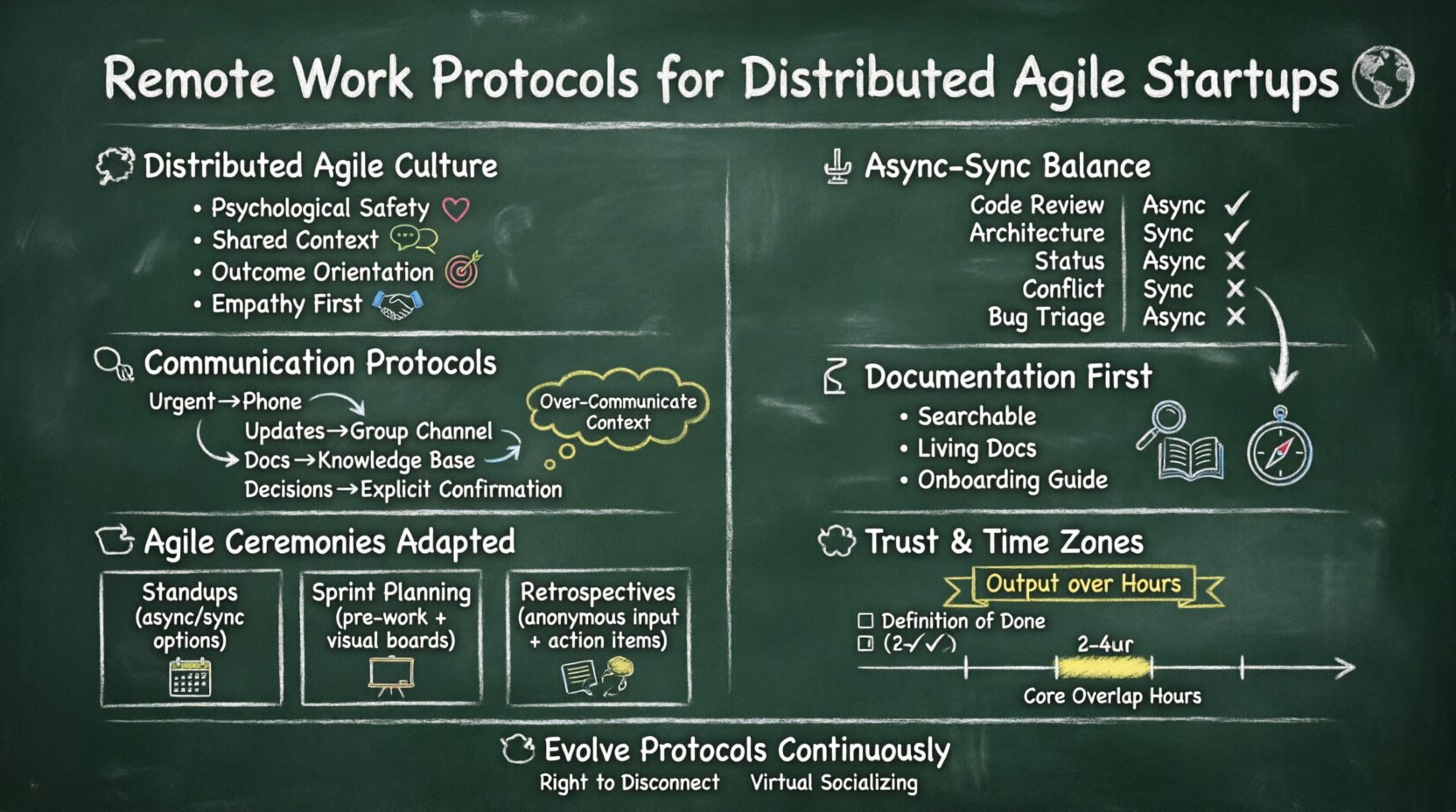
Agile relies on individuals and interactions over processes and tools. In a physical office, these interactions happen organically. In a distributed environment, they must be engineered. The first step is defining the cultural baseline. Without shared physical space, the team must share a digital space that fosters transparency and psychological safety.
- Psychological Safety: Team members must feel safe to admit mistakes, ask questions, and propose ideas without fear of retribution. This is harder to gauge remotely.
- Shared Context: Information silos form quickly when people cannot overhear conversations. Documentation becomes the single source of truth.
- Outcome Orientation: Focus shifts from hours logged to value delivered. Time zones make tracking hours irrelevant; tracking output becomes critical.
- Empathy First: Recognize that a colleague in a different time zone is not ignoring you; they are sleeping or handling local obligations.
Building this foundation requires intention. It is not enough to say you are an Agile team; you must demonstrate it through consistent behavior. The following sections detail how to operationalize these cultural values into daily protocols.
Communication Protocols: The Lifeblood of Remote Agile 🗣️
Communication in a distributed team must be explicit. In an office, a glance across a desk can convey urgency or confusion. Remote work eliminates these non-verbal cues, requiring clearer, more deliberate communication channels. The goal is to reduce noise while increasing signal.
Defining Channel Usage
Not all communication requires the same medium. Establishing clear rules prevents context switching and notification fatigue.
- Urgent Issues: Use direct phone calls or instant messaging for immediate, time-sensitive matters affecting active work.
- Team Updates: Use dedicated group channels for general announcements, wins, or blockers.
- Documentation: Long-form discussions, requirements, and decisions belong in a persistent knowledge base, not chat logs.
- Decision Making: Explicitly state when a decision is final. Remote teams often suffer from “decision drift” where consensus is assumed but never confirmed.
The Principle of Over-Communication
In remote settings, under-communication is the default state. To counter this, adopt a principle of over-communication regarding context. When sharing a file or a task, explain the “why” behind it. If you post an update, explain what action, if any, is required from the reader. This reduces the cognitive load on teammates who need to parse intent.
Adapting Agile Ceremonies for Distance 🔄
Standard Agile ceremonies were designed for co-located teams. To maintain velocity, these rituals must be adapted to respect time zones and digital fatigue. The objective is to retain the value of the meeting while minimizing the overhead.
Daily Standups
The daily standup is often the most challenging ceremony to replicate remotely. Video calls every morning can lead to burnout and scheduling conflicts across time zones.
- Async Standups: Consider text-based updates posted to a project management system by a specific deadline. This allows everyone to read updates on their own schedule.
- Synchronous Video: If video is required, keep it strictly to 15 minutes. No slides, no long stories. Focus on blockers and progress.
- Recording: Record the session for those who cannot attend due to time zone differences.
Sprint Planning
Planning requires high collaboration and energy. In a remote setting, this energy is harder to generate.
- Pre-work: Ensure user stories are refined and ready before the meeting. Do not use planning time to clarify requirements.
- Visual Boards: Use virtual whiteboards that allow simultaneous editing. This mimics the whiteboard sessions of the past.
- Timeboxing: Strict timeboxing is essential. Remote meetings tend to drift. Assign a dedicated facilitator to keep the agenda on track.
Retrospectives
Retrospectives are for improvement, not just celebration. In a remote environment, they are the primary mechanism for course correction.
- Anonymous Input: Use anonymous voting or sticky notes to encourage honest feedback about process or interpersonal issues.
- Focus on Action: Do not end a retro without defined action items. Assign owners and deadlines for improvements.
- Virtual Breaks: Incorporate breaks or icebreakers to combat screen fatigue and rebuild social connection.
Managing the Async-Sync Balance ⚖️
One of the biggest pitfalls in distributed startups is over-reliance on synchronous meetings. This creates a “9-to-5” mentality that ignores the benefits of asynchronous work. The ideal balance allows deep work to happen without interruption, with meetings reserved for collaboration that cannot happen via text.
| Activity | Mode | Reasoning |
|---|---|---|
| Code Review | Async | Allows for deep thought and reduces meeting load. |
| Architecture Decisions | Synchronous | Requires immediate feedback and alignment. |
| Status Updates | Async | Information consumption is not time-sensitive. |
| Conflict Resolution | Synchronous | Nuance and tone are lost in text. |
| Bug Triage | Async | Can be handled by those on the clock at that time. |
Implementing this balance requires clear SLAs (Service Level Agreements) for communication. For example, a message sent on Slack should receive a response within 4 hours during core hours. This prevents the anxiety of waiting for replies while respecting deep work blocks.
Documentation as a First-Class Citizen 📝
In a physical office, knowledge is often tacit, held in the heads of team members. In a distributed team, knowledge must be explicit. Documentation is not an administrative task; it is the infrastructure of the team.
Knowledge Base Standards
- Searchability: Content must be organized logically so information can be found without asking a human.
- Living Documents: Documentation should be updated alongside code or feature releases. If it is not updated, it is considered incorrect.
- Onboarding: Create a comprehensive guide for new hires. This reduces the burden on existing team members to explain basic concepts repeatedly.
Meeting Documentation
Every meeting must have a record. This includes decisions made, action items assigned, and context discussed. If a decision was made in a meeting, it should be summarized in the project management system immediately after.
Trust and Accountability Mechanisms 🤝
Managing remote teams requires a shift from monitoring activity to measuring output. Micromanagement destroys trust and kills productivity. Instead, establish clear accountability structures.
Output over Hours
Do not ask how many hours someone worked. Ask what they produced. This aligns incentives. If a developer finishes a task in 4 hours, they should not be penalized for having free time.
Clear Definitions of Done
Agile relies on the Definition of Done (DoD). In a remote setting, this definition must be even more precise to avoid ambiguity. What constitutes “complete”? Does it include testing? Documentation? Deployment?
- Visual Progress: Use Kanban boards to visualize work status. This creates transparency without constant check-ins.
- Regular Check-ins: Schedule one-on-one meetings focused on well-being and career growth, not just task status.
- Peer Reviews: Encourage code and design reviews to ensure quality standards are met collaboratively.
Navigating Time Zone Challenges 🌐
Time zone differences are the most significant logistical hurdle for distributed startups. The goal is to maximize overlap without forcing everyone to work odd hours.
Core Overlap Hours
Define a window of time where all team members are expected to be online. This is typically 2-4 hours. Outside this window, async work is the norm.
Cross-Time Zone Handoffs
When teams span multiple time zones, handoffs become critical. Ensure that work is handed off with context. The next person in the time zone should not have to guess what was happening.
- Written Handoff Notes: Leave a summary of current status, pending decisions, and next steps.
- Automated Notifications: Use system alerts to notify the next person when a task is ready for their attention.
- Follow the Sun Model: If applicable, structure work so that one team hands off to another, creating a 24-hour development cycle.
Scaling Remote Agile Practices 📈
As the startup grows, the protocols must evolve. What works for a team of five may break for a team of fifty. Scaling requires maintaining the core principles while adding structure.
Team Structure
- Squads: Organize into small, cross-functional teams (squads) that can operate independently.
- Chapters: Create groups of people with similar skills (e.g., all designers) to share best practices across squads.
- Guilds: Form communities of interest to tackle broader organizational problems.
Reducing Cognitive Load
As the organization grows, communication paths increase exponentially. To manage this:
- Limit Meeting Attendance: Only invite necessary stakeholders to meetings.
- Decentralize Decision Making: Push decisions down to the teams closest to the work.
- Standardize Tools: Ensure everyone uses the same project management and communication systems to reduce friction.
Building Resilience Against Burnout 🔋
Remote work can blur the lines between professional and personal life. Burnout is a significant risk for distributed teams. Protocols must include safeguards for mental health.
- Right to Disconnect: Encourage employees to turn off notifications after hours. Do not expect immediate responses to emails sent late at night.
- Virtual Socializing: Dedicate time for non-work interactions. Coffee chats or game sessions help build the social bonds that happen naturally in offices.
- Workload Monitoring: Leaders must actively monitor workloads. If a team is consistently working late, the process is likely broken.
Conclusion on Protocol Evolution 🔄
Remote work protocols are not static. They must evolve as the team grows and as the organization learns what works best. The goal is not to enforce rigid rules, but to create an environment where agility can thrive regardless of location. By prioritizing clear communication, respecting time zones, and fostering trust, distributed startups can achieve the same velocity and innovation as their co-located counterparts.
Success in this environment comes from continuous improvement. Regularly review your own protocols. Ask the team what is working and what is friction. Adapt the process to fit the people, not the other way around. This flexibility is the true essence of Agile, applied to the unique challenges of the modern digital workplace.