

Every organization starts somewhere. Often, that beginning is characterized by high energy, rapid decision-making, and a lack of formalized process. Teams rely on intuition, verbal agreements, and the sheer effort of individuals to deliver value. This approach is known as ad hoc process. While it can feel efficient in the short term, the lack of structure often leads to burnout, inconsistent quality, and an inability to scale. Moving from this chaotic state to a structured agile framework is not about adding bureaucracy. It is about creating a predictable environment where value flows smoothly.
This guide provides a deep dive into the mechanics of this transition. It focuses on the practical steps, the psychological shifts required, and the structural changes needed to build a sustainable workflow. We will avoid the noise of software hype and focus on the fundamental principles of organizing work.
📉 Understanding the Ad Hoc Trap
Ad hoc processes are characterized by their reactive nature. Work is assigned as needs arise, priorities shift daily without a central plan, and information is siloed within individuals rather than teams. The initial speed is attractive. There are no meetings to attend, no tickets to fill out, and no formal gates to pass. However, this speed is an illusion.
- Dependency Chaos: Team members often wait for others without knowing why. Bottlenecks form silently.
- Context Switching: Without a structured backlog, individuals are pulled in ten different directions daily.
- Knowledge Loss: If a key person leaves, the process stops because the knowledge was in their head, not in the system.
- Unpredictable Delivery: Stakeholders cannot rely on dates or quality standards because the process varies by day.
Transitioning away from this requires admitting that the current state is not sustainable. It is not a failure of talent, but a failure of system design. The goal is to replace randomness with repeatability.
🏗️ Defining Structured Agile
Structured agile is not merely adopting a set of ceremonies. It is a system of work designed to manage complexity and uncertainty. It prioritizes the delivery of functional increments over comprehensive documentation. The structure provides the guardrails that allow for high-speed movement without crashing.
Key characteristics include:
- Iterative Development: Work is broken into small, manageable chunks that can be completed in short timeframes.
- Feedback Loops: Regular checkpoints allow the team to adjust direction based on real-world usage rather than assumptions.
- Transparency: Progress, risks, and blockers are visible to everyone involved.
- Continuous Improvement: The process itself is subject to regular review and refinement.
When implemented correctly, this structure does not slow you down. It prevents the rework that slows you down later. It shifts the focus from “finishing tasks” to “delivering value”.
🚀 The Transition Roadmap
Moving from chaos to structure is a journey, not a flip of a switch. Attempting to implement everything at once usually leads to resistance and failure. The following roadmap outlines a phased approach to integration.
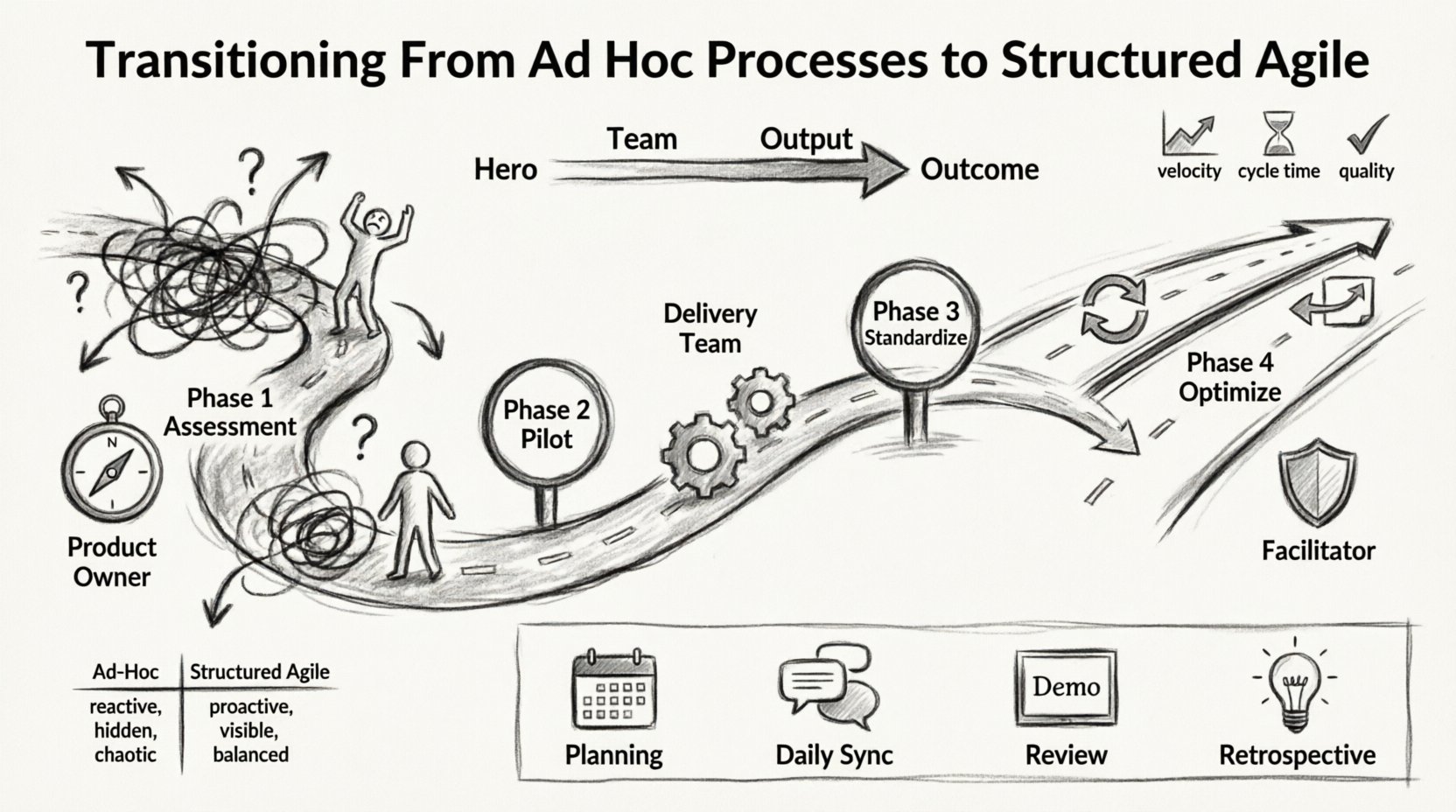
Phase 1: Assessment and Baseline
Before changing the process, you must understand the current state. This phase involves gathering data on how work actually flows, not how it is supposed to flow.
- Identify Bottlenecks: Where does work pile up? Is it waiting for approval? Is it waiting for technical review?
- Measure Cycle Time: How long does a task take from start to finish currently? This establishes a baseline for improvement.
- Interview Stakeholders: Understand their pain points. Are they happy with the quality? Do they feel informed?
- Map the Workflow: Create a visual representation of the current process. This reveals hidden steps and redundant approvals.
Phase 2: Pilot and Experimentation
Do not roll out the new process to the entire organization immediately. Select a single team or a specific project to act as a pilot.
- Define the Rules: Agree on a limited set of rules for the pilot. Keep them simple. Avoid complex definitions of done.
- Establish Roles: Assign clear ownership for the workflow. Who is gathering requirements? Who is reviewing the output?
- Limit Work in Progress: Restrict how many items can be active at once. This forces focus and highlights capacity issues.
- Gather Data: Track the metrics defined in Phase 1. Compare the pilot results against the baseline.
Phase 3: Standardization and Scaling
Once the pilot proves value, the process can be standardized across other teams. This involves documenting the agreed-upon practices and training others.
- Create a Playbook: Document the workflow, roles, and ceremonies in a living document.
- Training: Ensure all team members understand the “why” behind the rules, not just the “what”.
- Gradual Rollout: Bring in teams one by one, allowing the pilot team to act as mentors.
- Tooling Support: Introduce systems to support the process, ensuring they do not dictate the process.
Phase 4: Optimization and Culture
The final phase is ongoing. The structure must evolve as the organization grows and market conditions change.
- Regular Retrospectives: Hold sessions specifically to discuss the process, not just the product.
- Remove Waste: Continuously look for steps that add no value and eliminate them.
- Empower Teams: Give teams the autonomy to adjust their specific workflow within the broader framework.
👥 Roles and Responsibilities
In an ad hoc environment, roles are often fluid and undefined. In a structured agile environment, clarity is essential. Ambiguity in roles leads to duplicated effort and gaps in responsibility.
The Product Owner
This role focuses on the what. They are responsible for maximizing the value of the product. They maintain the backlog, prioritize work based on value and risk, and ensure the team understands the requirements.
- Defines the vision and strategy.
- Ensures the backlog is clear and prioritized.
- Acts as the bridge between stakeholders and the delivery team.
The Delivery Team
This group focuses on the how. They are cross-functional, meaning they possess all the skills necessary to complete the work without relying on external dependencies.
- Commits to the work during planning.
- Self-organizes to solve problems.
- Produces a potentially shippable increment at the end of each cycle.
The Facilitator
Often called a Scrum Master or Agile Coach, this role focuses on the process. They ensure the team adheres to the agreed-upon practices and remove impediments that slow them down.
- Protects the team from external interruptions.
- Facilitates ceremonies and ensures they are productive.
- Coaches the team on continuous improvement.
📅 Ceremonies and Artifacts
Ceremonies are not meetings for the sake of meetings. They are time-boxed events designed to create synchronization and clarity. Each ceremony has a specific purpose.
Planning
This event occurs at the start of a cycle. The team reviews the top items in the backlog and selects what they can commit to delivering. This ensures the workload is realistic and agreed upon by the people doing the work.
Daily Sync
A short, daily stand-up allows team members to synchronize. They discuss what they did yesterday, what they will do today, and if they have any blockers. This keeps the flow visible and immediate.
Review
At the end of the cycle, the team demonstrates the completed work to stakeholders. This is not a status report; it is a working demonstration. Feedback is gathered immediately to inform the next cycle.
Retrospective
This is the most critical ceremony for improvement. The team discusses how the process worked. What went well? What went wrong? What will we change next time? This ensures the structure evolves over time.
⚖️ Ad Hoc vs. Structured Agile Comparison
Understanding the differences is crucial for recognizing the value of the transition. The table below contrasts the two approaches across key dimensions.
| Dimension | Ad Hoc Process | Structured Agile |
|---|---|---|
| Prioritization | Reactive; highest voice wins | Proactive; value-based backlog |
| Visibility | Low; status is hidden | High; work is visible to all |
| Change Management | Chaotic; frequent context switching | Balanced; changes managed between cycles |
| Quality | Variable; often tested at the end | Integrated; tested continuously |
| Team Focus | Individual task completion | Shared team goals |
| Feedback | Delayed; often after release | Immediate; after every increment |
📊 Measuring Success
Without measurement, improvement is guesswork. In a structured environment, metrics provide objective data on performance. However, these metrics must be used to help the team, not to police them.
- Velocity: The amount of work a team completes in a cycle. This is used for forecasting, not for comparing teams.
- Cycle Time: The time it takes for a task to move from start to finish. Lower cycle time indicates higher efficiency.
- Lead Time: The time from when a request is made to when it is delivered. This measures responsiveness to the market.
- Defect Rate: The number of bugs or issues found after release. This measures quality.
- Team Satisfaction: Regular surveys to gauge morale and burnout levels. A happy team is a productive team.
🧱 The Human Element
The hardest part of this transition is not the process; it is the people. Moving from ad hoc to structured agile requires a shift in mindset. It requires trust and accountability.
Resistance is natural. Team members may feel that the new rules are bureaucratic or slow. Leaders must address these concerns directly. Explain that the structure is there to protect the team from chaos, not to control them.
Key psychological shifts include:
- From Hero to Team: Success is no longer about one person working late. It is about the team delivering together.
- From Output to Outcome: Focus shifts from counting hours worked to counting value delivered.
- From Blame to Learning: When things go wrong, the focus is on fixing the process, not finding the person to blame.
- From Certainty to Adaptability: Accepting that plans change and having a mechanism to handle that change.
Change management is an ongoing effort. It requires patience. Expect setbacks. The transition is rarely a straight line. There will be days when the process feels heavier than the old way. This is normal. It is the friction of building a new habit. Persist through the friction, and the benefits will compound over time.
🛠️ Implementing the Structure
To make this work, you need physical or digital spaces to capture the work. This does not mean buying expensive tools. It means having a single source of truth.
- The Backlog: A prioritized list of work items. It must be visible to the whole team.
- The Board: A visual representation of the workflow. Columns should represent states like “To Do”, “In Progress”, “Review”, and “Done”.
- The Definition of Done: A checklist of criteria that must be met for a task to be considered complete. This prevents technical debt from accumulating.
- Communication Channels: Dedicated spaces for team communication, separate from general company noise.
Remember, tools serve the process. If a tool hinders the flow, it is the wrong tool. The goal is clarity. If a stakeholder asks, “Where does this work stand?”, the answer should be immediate and obvious.
🌱 Sustainability and Growth
Once the structure is in place, the focus shifts to sustainability. How do you keep this going when the initial enthusiasm fades?
- Onboarding: New team members must be trained on the process immediately. Do not let them fall back into ad hoc habits.
- Community of Practice: Create groups where practitioners from different teams share knowledge and solve common problems.
- Leadership Alignment: Ensure leadership supports the process. If leadership bypasses the process, the structure will collapse.
- Continuous Learning: Encourage the team to learn new techniques and refine their workflow regularly.
The transition from ad hoc to structured agile is one of the most significant steps an organization can take. It moves the focus from surviving the day to planning for the future. It replaces anxiety with predictability. It replaces heroics with teamwork. While the path requires effort and discipline, the destination is a more resilient, capable, and efficient organization.
By following these steps, defining clear roles, and measuring the right outcomes, you build a foundation that can withstand market shifts and internal growth. The structure is not the enemy of agility; it is the enabler. With the right framework, teams can move fast without falling apart.