


Startups often adopt Agile methodologies to navigate uncertainty and accelerate product development. The promise is simple: faster feedback loops, adaptability, and continuous delivery. However, as a startup grows, the very framework designed to help can become a bottleneck. Scaling an organization requires more than just running more sprints; it demands a structural and cultural evolution that many teams overlook.
This guide examines the specific Agile pitfalls that frequently hinder startup expansion. We will explore how rigid adherence to process, misaligned metrics, and technical debt can slow growth. Understanding these patterns allows leadership to adjust course before they become critical failures.
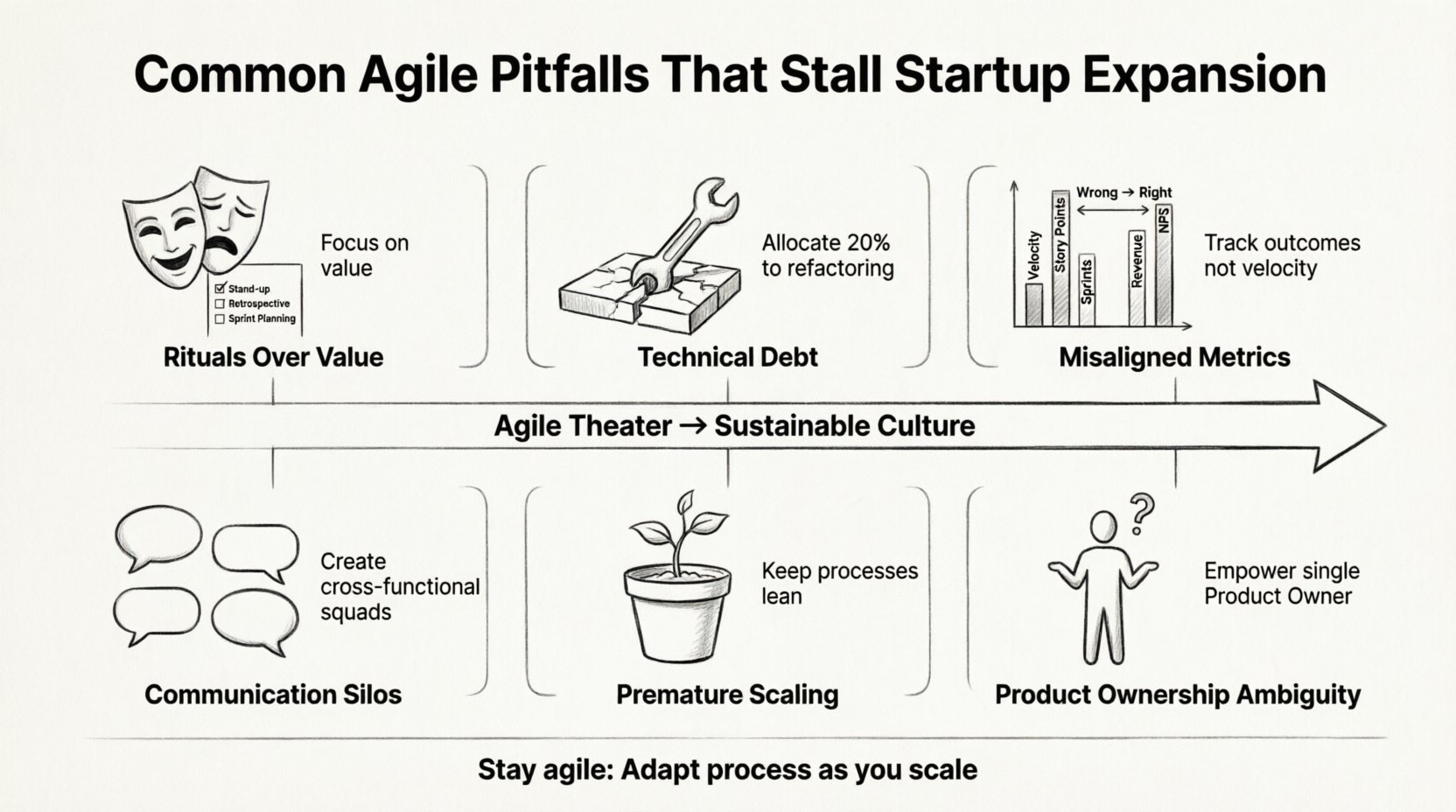
1. Rituals Over Value 🎭
One of the most common traps is prioritizing the ceremony of Agile over the delivery of value. Teams begin to view the process itself as the goal rather than a means to an end. This is often referred to as “Agile Theater”.
- Stand-ups become status reports: Instead of discussing blockers and collaboration, engineers simply report what they did yesterday to management.
- Planning meetings drag on: Estimation becomes an exercise in debate rather than a commitment to a shared goal.
- Retrospectives lack action: Teams identify the same issues repeatedly without implementing concrete changes.
When the team focuses on checking boxes, they lose agility. The cost is time. Every hour spent in a meeting that does not produce a tangible outcome is an hour subtracted from development. In a startup environment, speed of execution is often the only competitive advantage. If the process slows the team down, the process must change.
To correct this, leadership must enforce a value-first mindset. Ask every meeting question: “Does this directly contribute to shipping value?” If the answer is no, cancel it or shorten it. Focus on the outcome of the sprint, not the completion of the ritual.
2. Ignoring Technical Debt 🛠️
Agile encourages shipping quickly. However, rapid shipping without attention to code quality accumulates technical debt. In the early days of a startup, this is manageable. But as the team expands and the codebase grows, the debt compounds.
Technical debt is not just bad code; it is the cost of future work. When developers spend 80% of their time fixing bugs or working around legacy logic, they have 20% left for new features. This creates a negative feedback loop where the product becomes harder to change.
- Refactoring is deprioritized: Management sees refactoring as “not working on features” and cuts it from the roadmap.
- Documentation is non-existent: New hires struggle to understand the system, leading to errors and slower onboarding.
- Testing coverage drops: Without automated tests, fear of breaking existing functionality prevents necessary changes.
As the startup seeks to expand into new markets or add complex features, the fragile foundation cracks. Sustainable expansion requires a dedicated capacity for maintenance. Ideally, 20% of every sprint should be reserved for technical improvement, security patches, and debt reduction.
3. Misaligned Metrics 📊
Startups love data. However, measuring the wrong things leads to the wrong behaviors. A common mistake is focusing on output metrics rather than outcome metrics.
If a team is measured by “Velocity” (story points completed), they will inflate their estimates or break tasks into smaller pieces to increase the number. This creates a false sense of progress. The team is busy, but the product is not improving.
Consider the following metrics that often mislead:
- Lines of Code: More code does not mean more value; it often means more complexity.
- Story Points: These are relative estimates, not absolute measures of productivity.
- Commit Frequency: Many small commits do not equal progress if they do not deliver user value.
Shift the focus to outcome-based metrics:
- Time to Market: How long does it take from idea to deployment?
- Customer Retention: Are users staying after using the new feature?
- Feature Usage: Are the new capabilities actually being used?
When metrics align with business value, teams naturally optimize for the right things. They stop gaming the system and start solving user problems.
4. Communication Silos 🗣️
Small teams communicate informally. As the startup grows, this informal channel breaks down. Departments begin to operate in silos, where Engineering, Product, and Design do not share information effectively.
When silos form, the definition of “done” becomes ambiguous. Designers hand off to Engineering without context. Product Managers write requirements without technical feasibility checks. The result is rework and confusion.
- Information Hoarding: Senior engineers keep knowledge in their heads rather than documenting it.
- Lack of Shared Context: New hires do not understand the “why” behind decisions.
- Handoff Delays: Teams wait for other departments to finish their part before starting work.
Breaking silos requires intentional structural changes. Cross-functional teams should own the entire lifecycle of a feature, from idea to support. Regular cross-team syncs should focus on dependencies and blockers, not just status updates.
5. Premature Scaling 📈
Startups often try to scale their Agile processes before they have found product-market fit. They implement complex frameworks intended for enterprise environments too early.
Complexity kills agility. If you are a team of five, you do not need a dedicated Scrum Master for every two people. You need collaboration. As you add more people, you add more communication paths. If the process does not scale, the overhead becomes unmanageable.
Common signs of premature scaling:
- Too many layers of management: Decisions get stuck in approval chains.
- Excessive documentation: Processes are written down before they are understood.
- Specialized roles too early: Creating distinct QA or DevOps roles before the workload justifies them.
Scale the process only as the team size and complexity demand. Keep it lean for as long as possible. Add structure only when the chaos becomes unmanageable.
6. Product Ownership Ambiguity 👤
In many startups, the Product Owner role is either vacant or held by someone who cannot commit time to it. Without a clear Product Owner, the backlog becomes a wish list rather than a prioritized plan.
When multiple stakeholders have equal say, the team receives conflicting directives. Engineers waste time building features that are not aligned with the current strategic goal. This leads to feature bloat and a confused user experience.
- Lack of Prioritization: Everything is “high priority,” so nothing is.
- Scope Creep: New requirements are added mid-sprint without removing old ones.
- Decision Fatigue: The team waits for consensus that never comes.
A strong Product Owner acts as the voice of the customer. They make the tough calls on what to build and what to defer. They protect the team from distraction. If you do not have a dedicated Product Owner, assign this responsibility clearly to one person.
Pitfall Comparison Table 📋
The following table summarizes the common pitfalls and the necessary shifts to correct them.
| Pitfall | Signs | Consequence | Correction |
|---|---|---|---|
| Ceremonial Rigidity | Meetings run long, no action items | Loss of time, low morale | Focus on value, cut unnecessary meetings |
| Technical Debt | High bug rate, slow deployments | Reduced velocity, system instability | Allocate 20% capacity to refactoring |
| Wrong Metrics | Focus on velocity, not value | Busy work, no business growth | Track outcomes, retention, and time to market |
| Silos | Departments do not talk | Rework, delays, confusion | Create cross-functional squads |
| Premature Scaling | Overly complex processes | Bureaucracy, slow decision making | Keep processes lean until necessary |
| Weak Ownership | Conflicting priorities | Feature bloat, wasted effort | Empower a single Product Owner |
Building a Sustainable Culture 🌱
Agile is not just a set of rules; it is a culture. A culture that values transparency and adaptability. When expansion stalls, it is often because the culture has hardened. The team becomes risk-averse. They stop experimenting because they are afraid of breaking the process.
To maintain momentum:
- Encourage Psychological Safety: Team members must feel safe to admit mistakes. Blameless post-mortems help here.
- Invest in Learning: Allow time for training and experimentation. Innovation comes from learning.
- Empower Teams: Let the people closest to the work make the decisions. This increases ownership and speed.
- Review the Process Regularly: Every few months, ask the team: “Is this process helping us or hurting us?”
Expansion is not just about adding headcount. It is about adding capacity to deliver value. If the process prevents value delivery, the expansion will fail. The goal is to remain as agile as a team of three while operating as a team of thirty.
Leadership Responsibility 👔
Leaders play a crucial role in preventing these pitfalls. They set the tone. If leadership values speed over quality, the team will cut corners. If leadership values process over people, the team will burn out.
Leaders must model the behavior they expect. Show that you value the team’s time by respecting their boundaries. Show that you value quality by protecting their capacity for technical improvement. Show that you value outcomes by celebrating shipped value, not just busy work.
When leaders intervene correctly, they remove obstacles rather than creating new ones. They ensure that the Agile framework serves the business, not the other way around.
Final Thoughts on Growth 🏁
Startup expansion is a complex challenge. Adopting Agile is a step in the right direction, but it is not a silver bullet. There are no magic frameworks that guarantee success. Success comes from understanding the pitfalls that come with growth and actively managing them.
By focusing on value over ritual, maintaining technical health, aligning metrics with business outcomes, and fostering open communication, startups can scale without losing their edge. The process must evolve as the company grows. What worked for ten people will not work for one hundred.
Stay vigilant. Monitor your team’s health and performance. Be willing to change your approach when it stops serving the goal. Growth is a continuous journey of adaptation, not a destination reached by following a rigid plan.