


Designing a robust data model is one of the most critical skills for a backend engineer or data architect. At the heart of this process lies the Entity-Relationship Diagram (ERD). It serves as the blueprint for how information is stored, retrieved, and related within a system. Despite its fundamental importance, many junior engineers approach ERD creation with misconceptions that can lead to structural debt later in the project lifecycle.
This guide addresses the most persistent misunderstandings surrounding database schema design. By clarifying these points, you can build systems that are scalable, maintainable, and logically sound. Let us explore the reality behind the noise.
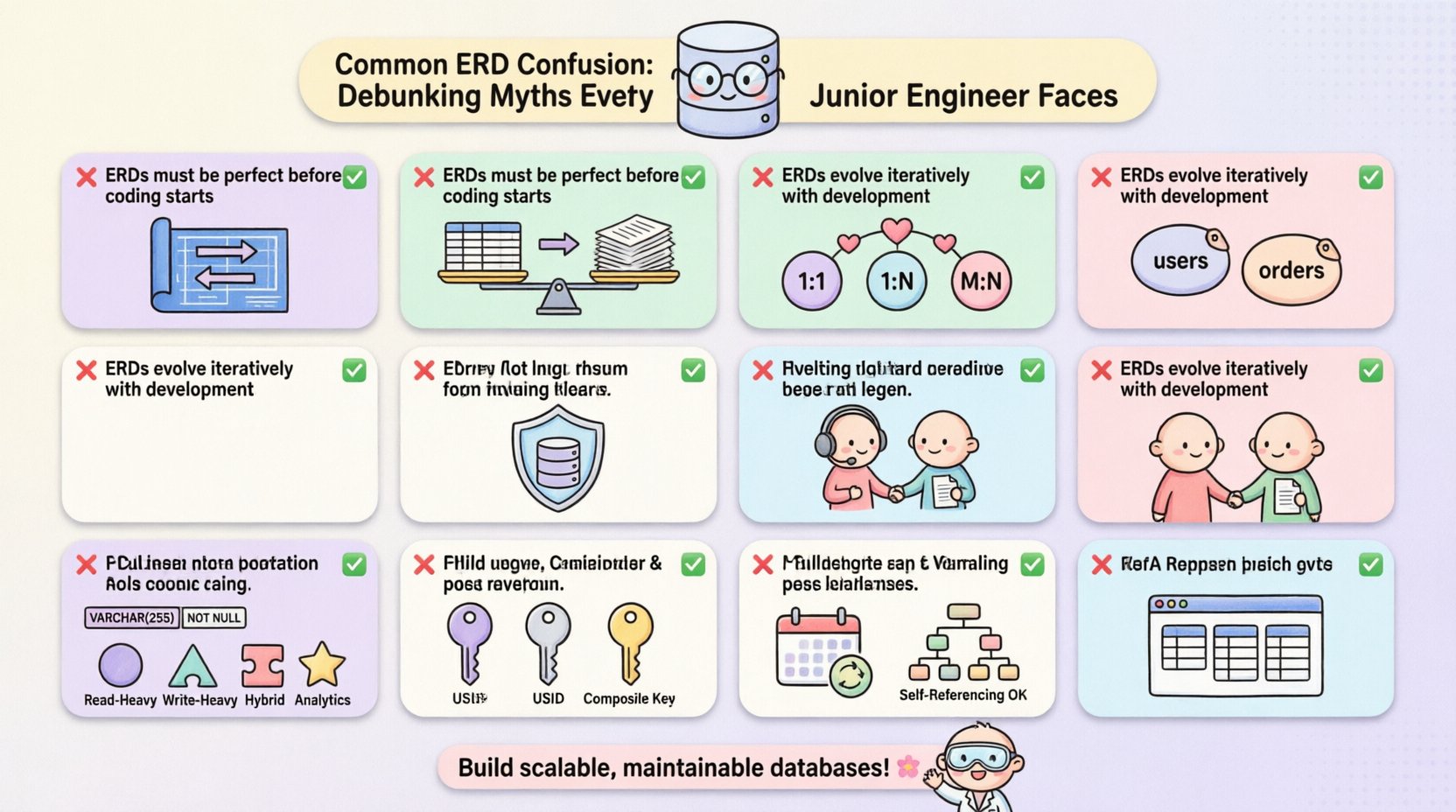
1. The ERD Represents the Final Database Structure 📐
A common misunderstanding is that the initial diagram drawn during the planning phase must remain unchanged throughout development. Many juniors believe the ERD is a contract that cannot be modified without significant cost. While consistency is vital, treating the diagram as a rigid stone tablet often leads to poor adaptability.
- Iterative Design: Database modeling is an iterative process. As requirements evolve, the schema must evolve with them.
- Refactoring: It is often better to refactor a table structure early than to carry technical debt for years.
- Documentation: The ERD serves as living documentation. It should be updated whenever a structural change occurs.
Instead of viewing the diagram as the final destination, treat it as a snapshot of the current understanding. Agile methodologies encourage flexibility. If a new requirement emerges that requires a different relationship between entities, the diagram should reflect that shift immediately. Rigid adherence to an early sketch can stifle innovation and make future feature integration significantly harder.
2. More Tables Are Always Better for Organization 🗂️
There is a tendency among newcomers to over-normalize. The logic goes that creating a specific table for every single concept will keep the database clean. However, excessive fragmentation can harm performance and query complexity.
Consider the trade-offs when deciding whether to create a new table:
- Query Complexity: Every new table introduces a new join. Too many joins slow down read operations.
- Maintainability: A schema with hundreds of tables can become difficult to navigate and understand.
- Storage Overhead: While storage is cheap, index overhead and transaction log growth can become issues at scale.
The goal is not to maximize the number of tables, but to maximize data integrity and retrieval efficiency. Sometimes, a denormalized structure is the correct choice for read-heavy applications. The decision depends on the specific access patterns of your application.
Normalization vs. Denormalization Trade-offs
| Aspect | Normalization | Denormalization |
|---|---|---|
| Data Integrity | High | Lower (requires application logic) |
| Write Performance | Slower (more constraints) | Faster |
| Read Performance | Slower (more joins) | Faster |
| Use Case | OLTP (Transaction Systems) | OLAP (Reporting & Analytics) |
3. Cardinality is Optional Information 📉
One of the most damaging errors in ERD creation is ignoring cardinality. Cardinality defines the relationship count between two entities (e.g., one-to-one, one-to-many). Some engineers focus solely on the attributes and forget the connections.
Without defined cardinality, the database engine cannot enforce data rules effectively. This leads to orphaned records and inconsistent states.
- One-to-One (1:1): Rare, but useful for security or splitting large tables.
- One-to-Many (1:N): The most common relationship (e.g., a User has many Orders).
- Many-to-Many (M:N): Requires a junction table to resolve (e.g., Students and Courses).
When you define these relationships, you communicate intent to other developers. A foreign key constraint is not just a technical requirement; it is a semantic declaration of how data relates to itself.
4. Naming Conventions Don’t Matter 🏷️
It is tempting to use short, cryptic names like tbl_usr or col_id_1 to save typing time. However, code and schema names are read far more often than they are written.
Clear naming conventions reduce cognitive load. When a new developer joins the team, they should be able to understand the schema structure within minutes.
Best practices include:
- Consistency: Use the same style (snake_case, camelCase) throughout the entire project.
- Descriptiveness: Table names should represent the entity (e.g.,
users, nott1). - Plurality: Generally, tables represent collections, so plural names are often clearer (e.g.,
ordersvsorder). - Avoid Reserved Words: Do not use keywords like
groupororderwithout escaping.
Investing time in naming conventions pays dividends in reduced debugging time and fewer misunderstandings during code reviews.
5. Foreign Keys Break Performance ⚡
A prevalent myth suggests that foreign key constraints add too much overhead to write operations, and therefore should be removed in favor of application-level validation. While it is true that constraints add processing time, the cost is often negligible compared to the risk of data corruption.
Application-level validation is prone to race conditions and bugs. A database constraint is atomic and enforced by the engine itself.
- Integrity: Foreign keys prevent orphaned data automatically.
- Optimization: Modern database engines optimize join operations based on these relationships.
- Cascading:
CASCADEdeletes help manage complex relationships without manual cleanup code.
Only disable constraints in specific high-throughput bulk loading scenarios where performance is the absolute bottleneck and data integrity is managed externally. For standard transactional systems, keep them enabled.
6. ERD Design is Only for Database Administrators 🤖
Junior engineers often assume that schema design is someone else’s job, specifically the DBA. This creates a disconnect between the application logic and the data storage layer.
Application developers must understand the data model because they write the queries that interact with it. If the schema does not align with the application logic, the code becomes inefficient and brittle.
- Collaboration: Developers and DBAs should collaborate early in the design phase.
- Code Generation: Many ORMs (Object-Relational Mappers) rely heavily on the ERD to generate repository classes.
- Debugging: Understanding the relationships helps in diagnosing slow queries and data inconsistencies.
Ownership of the data model is a shared responsibility. An application that cannot access data efficiently is a failed application, regardless of how well the front end works.
7. One Schema Fits All Use Cases 🔄
There is no single “best” way to design a database. A schema optimized for a social media feed will differ significantly from one designed for financial ledgers.
Understanding the access patterns is more important than following a rigid template.
- Read-Heavy: Prioritize denormalization and caching strategies.
- Write-Heavy: Prioritize normalization and strict integrity constraints.
- Complex Queries: Ensure indexes are placed on columns frequently used in
WHEREclauses.
Every system has unique requirements. A generic approach often leads to a solution that works “okay” but fails under specific load conditions. Analyze your specific workload before finalizing the structure.
8. The Diagram is Complete Without Attributes 📝
It is common to see diagrams that show entities and relationships but lack detailed attribute definitions. A complete ERD must specify data types, constraints, and default values.
Without this level of detail, the diagram is merely a sketch. It cannot be used to generate actual database migration scripts.
Essential attributes to define include:
- Data Types: Integer, Varchar, Boolean, Timestamp.
- Constraints: Not Null, Unique, Default.
- Lengths: Character limits for string fields.
- Indexes: Which fields require search optimization.
Missing attribute details often result in ambiguity during the implementation phase, leading to last-minute changes and potential errors.
9. Primary Keys Must Be Integers 🔢
While auto-incrementing integers are the most common primary key strategy, they are not the only option. In distributed systems, integer keys can lead to collisions.
- UUIDs: Universally Unique Identifiers are useful for microservices architectures.
- Composite Keys: Sometimes a combination of columns is the true unique identifier.
- Surrogate vs. Natural: Surrogate keys (generated) separate identity from business logic.
Choosing the right key type impacts clustering, indexing, and foreign key performance. Integers are generally faster for joins, but UUIDs offer better distribution in sharded environments.
10. ERD Design is a One-Time Task 🚫
Designing the schema and moving on is a dangerous approach. Systems change, and data needs evolve. What was a good design three years ago might be a liability today.
- Regular Audits: Periodically review the schema for unused tables or columns.
- Version Control: Treat schema changes as code. Use migration tools to manage versions.
- Feedback Loops: Listen to application performance data to identify structural bottlenecks.
Maintaining a healthy database requires continuous attention. Ignoring schema health until performance issues arise is a reactive strategy that often causes outages.
11. Complex Relationships Are Always Bad 🚫
Some engineers fear complex relationships (like recursive relationships or deep hierarchies) and simplify them too aggressively. While simplicity is good, oversimplification can break business logic.
Consider the hierarchy of an organizational chart. A manager manages multiple employees, and an employee is managed by one manager. This is a standard recursive relationship. Trying to flatten this into a single table can make reporting on team structures impossible.
- Recursive Tables: Useful for categories, comments, and organizational structures.
- Adjacency Lists: A common pattern for storing tree structures.
- Path Enumeration: Storing the full path for faster traversal in specific read scenarios.
Do not fear complexity if the data model requires it. Focus on ensuring the complexity is well-documented and supported by appropriate indexes.
12. Views Replace the Need for Tables 📊
Some believe that creating a view for every complex query eliminates the need for a well-designed underlying table structure. Views are derived data, not storage.
While views are excellent for security and abstraction, they cannot replace the fundamental normalization of the base tables.
- Storage: Views do not store data; they query it.
- Performance: Complex views can be slow if the base tables are not optimized.
- Maintenance: Relying on views for business logic hides data dependencies.
Use views to simplify access, but ensure the underlying tables are robust and normalized.
Final Thoughts on Schema Integrity 💡
Avoiding these common pitfalls requires experience and discipline. There is no magic formula, but there are established principles that guide effective design. Focus on clarity, consistency, and alignment with business needs.
When you encounter a new requirement, pause and evaluate how it affects the existing model. Does it introduce redundancy? Does it complicate queries? Is it necessary for integrity?
By adhering to sound principles and avoiding the myths outlined above, junior engineers can transition into confident data architects. The database is the foundation of your application. Treat it with the respect it deserves.
Remember to document your decisions. If you choose a specific design pattern, explain why. This context is invaluable for future maintainers. A well-documented schema is a sign of a mature engineering culture.
Continue to learn from production data. Monitor query performance and adjust the schema as needed. The best design is one that adapts to the reality of how the data is actually used.