

In the fast-paced environment of modern software development, speed is often mistaken for efficiency. Agile methodologies have revolutionized how teams deliver value, emphasizing iterative progress and responsiveness to change. However, this velocity frequently collides with the structural rigidity required for robust data architecture. When Entity Relationship Diagrams (ERDs) are treated as an afterthought or rushed during sprint planning, the consequences ripple through the entire codebase. 📈
Data modeling is not merely a preliminary step; it is the backbone of application stability. Yet, many teams fall into the trap of prioritizing feature delivery over schema integrity. This guide explores the specific pitfalls that occur when ERD design is compromised in agile cycles, offering a clear path to maintaining data integrity without sacrificing velocity.
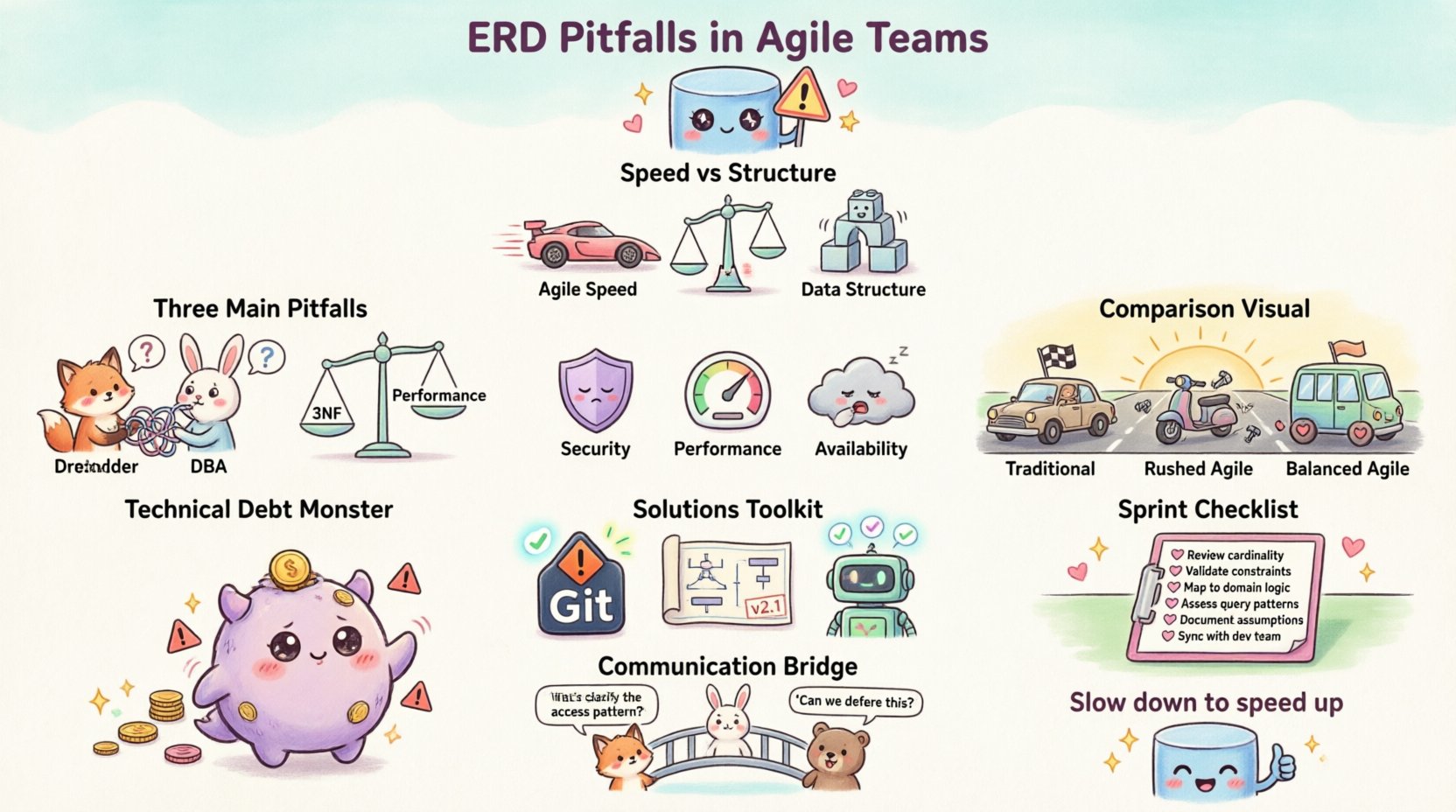
The Tension Between Speed and Structure 🏁
Agile frameworks encourage “working software over comprehensive documentation.” While this principle is valuable, it is often misinterpreted to mean “working software over comprehensive data design.” In reality, a poorly designed data model creates technical debt that compounds with every sprint. The database becomes the bottleneck, slowing down deployments and increasing the risk of data corruption.
When teams rush the Entity Relationship Diagram, they often ignore the following critical dynamics:
Relationship Complexity: Simple one-to-one mappings evolve into complex many-to-many relationships that were not anticipated.
Data Integrity: Constraints are left out, allowing invalid data to enter the system early.
Scalability: The schema is designed for current load, not future growth.
Refactoring Costs: Changing the data structure later requires expensive migrations and potential downtime.
Common Pitfalls in Agile Data Modeling 🚨
Understanding where things go wrong is the first step to fixing them. Below are the most frequent errors observed when ERDs are rushed.
1. Ignoring Cardinality and Optionality 🔗
Cardinality defines the relationship between entities (e.g., one user has many orders). In a rush, developers often default to simplistic relationships to save time. This leads to ambiguity in the application logic.
The Mistake: Treating all relationships as optional when they are mandatory, or vice versa.
The Consequence: Queries become inefficient, and referential integrity is compromised. Foreign keys may not enforce rules correctly, leading to orphaned records.
The Fix: Explicitly define minimum and maximum cardinality during the design phase. Ensure every foreign key has a clear purpose.
2. Premature Normalization vs. Denormalization ⚖️
Normalization reduces redundancy, while denormalization improves read performance. Agile teams often swing too far in one direction without a clear strategy.
The Mistake: Over-normalizing to the Third Normal Form (3NF) immediately, resulting in excessive joins that slow down read-heavy operations.
The Mistake: Denormalizing too early without understanding the write patterns, leading to data inconsistency.
The Consequence: Either the database struggles with complex queries, or the application struggles to maintain consistent data states.
3. Neglecting Non-Functional Requirements 💾
Functional requirements dictate what the system does. Non-functional requirements dictate how well it does it (performance, security, availability). Rushed ERDs often ignore these constraints.
Indexing Strategy: Failing to plan indexes for common query paths leads to slow retrieval times.
Partitioning: Ignoring how data will be partitioned as it grows.
Soft Deletes: Not accounting for audit trails or the need to retain historical data.
Comparing Agile vs. Traditional Modeling Approaches 📊
To understand the gap, consider how data modeling differs between traditional waterfall approaches and modern agile iterations.
Aspect | Traditional (Waterfall) | Agile (Rushed) | Agile (Balanced) |
|---|---|---|---|
Timing | Complete design before coding | Design during coding (ad-hoc) | Design in parallel with features |
Documentation | Heavy upfront documentation | Minimal or non-existent | Living documentation via code |
Changes | Expensive to change | Easy to change, high risk | Managed via migration scripts |
Focus | Perfection | Speed | Stability + Velocity |
The Cost of Technical Debt 💸
When an ERD is rushed, the cost is not just immediate time lost. It is the accumulation of technical debt that manifests months later. This debt slows down new feature development and increases the likelihood of production incidents.
Performance Degradation
Poorly designed schemas lead to full table scans. As data volume grows, query performance drops exponentially. Without proper indexing strategies defined in the ERD, the database becomes a bottleneck for the entire application stack.
Data Integrity Issues
Without strict constraints (e.g., unique constraints, check constraints, foreign keys), invalid data can enter the system. Cleaning this data later requires complex scripts that are prone to failure and data loss.
Deployment Friction
When the schema evolves without a clear migration plan, deployment pipelines break. Teams spend more time fixing database errors than building features. This creates a culture of fear around database changes.
Strategies for Balanced Modeling 🧠
It is possible to maintain data quality while moving fast. The key lies in adopting a “just enough” design philosophy. Here are actionable strategies to improve your team’s approach.
1. Iterative Schema Evolution
Instead of trying to design the perfect database upfront, treat the schema as a living artifact. Use version control for your database definitions. This allows you to track changes over time and revert if necessary.
Version your migration scripts.
Keep schema definitions in the repository alongside application code.
Review schema changes during code reviews, not just in isolation.
2. Implement a Model-Driven Development Workflow
Define the data model before writing the application logic. This ensures that the application code aligns with the data constraints. It does not mean waiting weeks for a final diagram, but rather agreeing on the core entities early in the sprint.
Identify core entities for the feature.
Define relationships and constraints.
Generate code or migrations based on this agreement.
3. Automate Schema Validation
Use automated tools to check for common anti-patterns in your schema. This reduces the cognitive load on developers and ensures consistency.
Check for missing indexes on foreign keys.
Verify that primary keys are defined for all tables.
Ensure naming conventions are followed.
Communication Gaps Between Roles 🗣️
One of the biggest causes of ERD pitfalls is the disconnect between developers, database administrators, and product owners. Each group has a different priority.
Developers: Focus on feature delivery and API endpoints.
DBAs: Focus on performance, security, and backup strategies.
Product Owners: Focus on business value and user stories.
When these groups do not communicate, the ERD suffers. For example, a developer might create a table to satisfy a UI requirement without considering how the database will query it. A DBA might optimize for read performance without considering the write load required by the new feature.
Bridging the Gap
To resolve this, integrate data modeling into the sprint planning process. Include a data specialist or a senior developer in the refinement sessions. Ask specific questions about data flow and storage requirements during the story grooming phase.
Refactoring Without Breaking Things 🔧
Eventually, you will need to change the schema. This is inevitable in agile development. The challenge is to do so without disrupting the running system.
Zero-Downtime Migration Strategies
When modifying tables, avoid locking the table for long periods. Use strategies that allow the application to run during the change.
Expand and Contract: Add the new column, populate it, then switch the application to use it, and finally remove the old column.
Dual Writes: Write to both old and new structures during a transition period.
Feature Flags: Use flags to toggle between old and new logic based on the schema state.
A Checklist for Sprint Planning 📝
To ensure your ERD remains robust, add these checks to your sprint definition of done.
Have all entities been defined? Ensure every new feature has corresponding tables or views.
Are relationships clear? Verify cardinality and optionality for all links.
Is the naming consistent? Use a standard convention for tables and columns.
Are indexes planned? Identify fields that will be queried frequently.
Are constraints enforced? Check for nullability and uniqueness rules.
Is the migration script versioned? Ensure the change can be rolled back.
The Long-Term View of Data Architecture 📈
Investing time in the ERD early pays dividends later. A well-structured model reduces the time spent debugging data issues and makes onboarding new team members easier. New developers can look at the diagram and understand the domain immediately.
Data is the most valuable asset in any software system. It outlives the code. If the code is rewritten, the data must remain intact. Therefore, protecting the integrity of your data model is protecting the business itself.
Final Thoughts on Sustainable Engineering 🚀
Agile does not mean skipping design. It means designing just enough to move forward without creating unnecessary barriers. By acknowledging the pitfalls of rushing the ERD, teams can build systems that are both fast to develop and stable to operate.
Focus on clarity. Focus on documentation that evolves with the code. Focus on communication between roles. These are the pillars of a sustainable data architecture in an agile environment.
When you slow down to get the model right, you actually speed up the journey to production. The data foundation supports every feature that comes after. Treat it with the respect it deserves.