


Enterprise architecture requires a structured approach to visualize complex systems. The ArchiMate modeling language serves as a standard for describing, analyzing, and visualizing enterprise architecture. Developed by The Open Group, it provides a framework that bridges the gap between business strategy and IT implementation. This guide explores the architecture language from foundational elements to sophisticated modeling techniques.
Archimate is not just a diagramming tool; it is a specification for describing enterprise architecture. It enables architects to communicate design decisions clearly across different departments. By using a standardized notation, organizations ensure consistency in how their systems are documented and understood.
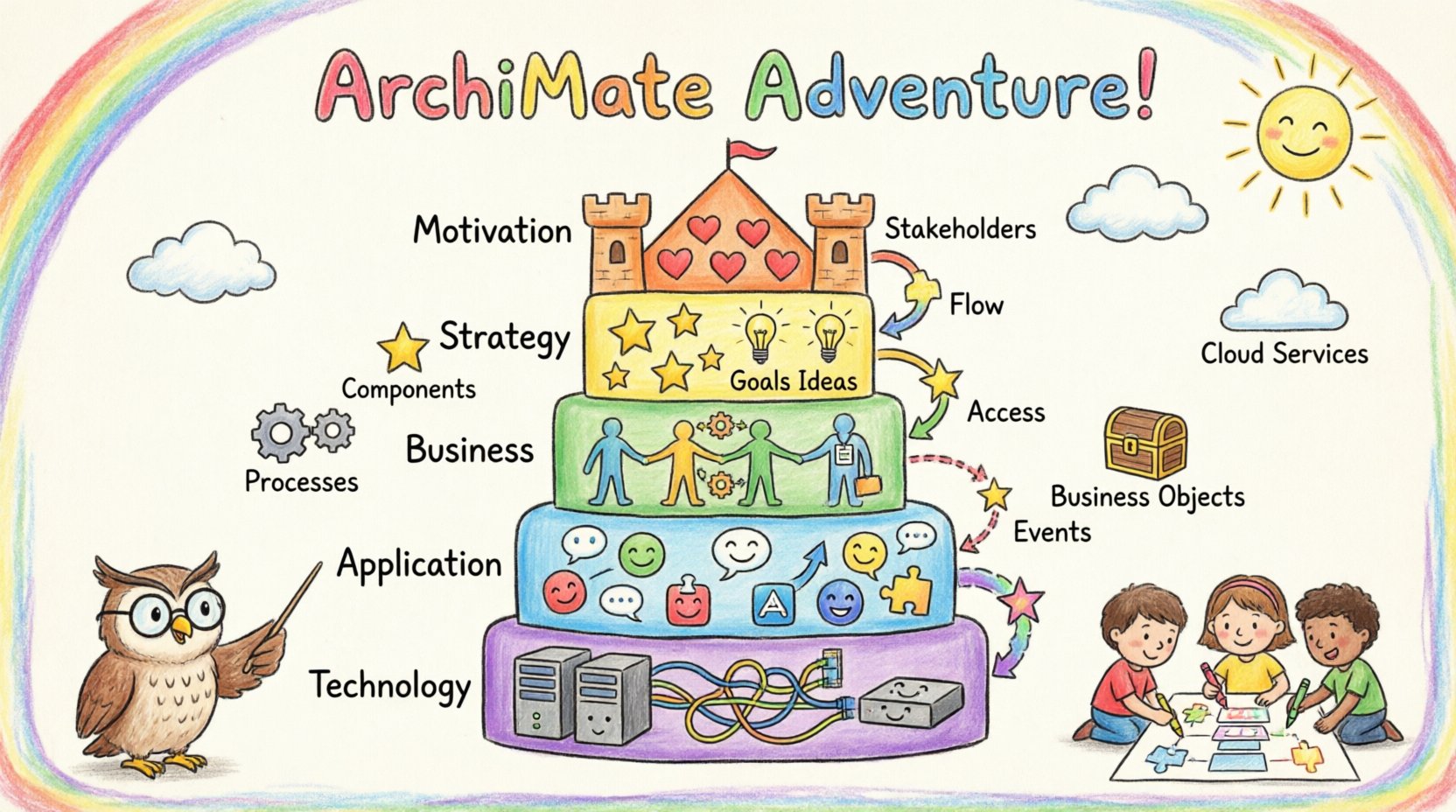
Foundations of the ArchiMate Language 📘
At its core, ArchiMate defines a set of concepts and relationships. These concepts represent the building blocks of an enterprise. Unlike generic flowcharts, ArchiMate elements have specific meanings tied to enterprise domains. This specificity allows for rigorous analysis of how changes in one area impact another.
Why Standardization Matters
- Common Vocabulary: Stakeholders across IT, business, and management speak the same language.
- Interoperability: Models can be exchanged between different tools without losing semantic meaning.
- Traceability: Links between strategy and execution become visible and analyzable.
The language is structured into domains. While the original versions focused on business, application, and technology, modern versions include motivation and implementation domains. This structure ensures that the “why” and the “how” are as important as the “what”.
Core Layers of Enterprise Architecture 🏢
The most recognizable feature of ArchiMate is its layered architecture. Each layer represents a specific domain of the enterprise. Understanding the distinction between these layers is critical for accurate modeling.
1. Strategy Layer
This layer defines the goals and drivers of the organization. It answers questions about why the enterprise exists and what it aims to achieve.
- Driver: A factor that motivates a change.
- Goal: An objective to be achieved.
- Principle: A rule or guideline.
- Assessment: A judgment on the current state.
2. Business Layer
The business layer describes the functional capabilities of the organization. It focuses on processes, roles, and objects that deliver value to customers.
- Business Process: A structured set of activities.
- Business Function: A capability to perform a business activity.
- Business Role: An actor within the business context.
- Business Object: A thing of value to the business.
- Business Service: A function that delivers value to a stakeholder.
3. Application Layer
This layer represents the software systems that support the business processes. It does not focus on hardware but on the logical capabilities provided by software.
- Application Function: A capability provided by an application.
- Application Service: A function exposed to the business layer.
- Application Component: A logical software unit.
- Data Object: Data used or produced by the application.
4. Technology Layer
The technology layer defines the infrastructure required to run the applications. This includes servers, networks, and physical devices.
- Device: A physical or virtual computing resource.
- System Software: Software that manages hardware resources.
- Network: Communication infrastructure.
- Node: A computing resource that can be networked.
5. Physical Layer
Often included in the technology domain, this layer represents the actual physical infrastructure, such as cabling, rooms, and environmental controls.
| Layer | Focus | Key Element Example |
|---|---|---|
| Strategy | Goals & Drivers | Reduce Costs |
| Business | Processes & Roles | Invoice Processing |
| Application | Software Logic | Accounting Module |
| Technology | Infrastructure | Database Server |
Relationships: Connecting the Elements 🔗
Elements alone do not tell the whole story. Relationships define how elements interact. ArchiMate specifies several relationship types, each with a specific direction and meaning. Using the correct relationship is essential for accurate analysis.
Structural Relationships
These relationships define static connections between elements.
- Association: A general link between two elements (e.g., a role associated with an object).
- Specialization: A “is a” relationship (e.g., a manager is a type of employee).
- Aggregation: A “has a” relationship where parts can exist independently.
- Composition: A strong “has a” relationship where parts cannot exist without the whole.
Behavioral Relationships
These relationships define dynamic interactions or flows.
- Flow: Data or material moves from one element to another.
- Access: One element accesses or uses the data of another.
- Communication: Information exchange between two active elements.
Dependency Relationships
These relationships define logical dependencies.
- Triggering: One event initiates another (often used in process flows).
- Realization: One element implements or instantiates another (e.g., a process realizes a function).
- Dependency: A general dependency where change in one affects the other.
Advanced Concepts: Motivation & Implementation 🚀
While the core layers describe the structure, the Motivation and Implementation layers describe the context and change management.
The Motivation Layer
This layer provides context for the architecture. It explains why changes are proposed. Without this layer, an architecture model is just a map without a destination.
- Requirement: A need or expectation.
- Stakeholder: An individual or group with an interest.
- Outcome: The result of an action.
- Deliverable: A tangible output.
Linking requirements to goals and drivers allows architects to trace the origin of a specific system component. If a requirement changes, the impact on the goals can be assessed immediately.
The Implementation & Migration Layer
Enterprise change does not happen instantly. This layer models the transition from the current state to the target state.
- Implementation Event: A specific point in time.
- Work Package: A set of activities to be performed.
- Phase: A grouping of work packages.
- Gap: The difference between current and target states.
Using this layer helps in planning roadmaps. It allows organizations to sequence changes logically, ensuring that dependencies are respected during the migration.
Views and Viewpoints 👁️
A single model can become overwhelming. Not every stakeholder needs to see every detail. The concept of Views and Viewpoints addresses this complexity.
Viewpoints
A viewpoint defines the perspective from which an architecture is viewed. It specifies:
- The stakeholder concerns.
- The modeling language or notation used.
- The specific elements relevant to that stakeholder.
For example, a CTO might need a viewpoint focused on technology constraints, while a business owner needs a viewpoint focused on process efficiency.
Views
A view is the actual representation of the architecture from a specific viewpoint. It is a subset of the total model tailored to the needs of the audience.
- Business View: Focuses on processes and roles.
- Technology View: Focuses on infrastructure and networks.
- Security View: Focuses on access and protection mechanisms.
Creating multiple views from a single model ensures consistency. Changes made to the core model automatically reflect in all relevant views, reducing the risk of documentation drift.
Alignment with Frameworks 🤝
ArchiMate is often used alongside other frameworks, most notably TOGAF (The Open Group Architecture Framework). Understanding this alignment is crucial for enterprise architects.
TOGAF and ArchiMate
TOGAF provides a methodology for developing architecture. ArchiMate provides the language to document it. Together, they form a powerful combination.
- Architecture Development Method (ADM): TOGAF’s phased approach to development.
- Architecture Content: ArchiMate provides the artifacts for the ADM phases.
When using ArchiMate within a TOGAF context, the layers map to the specific phases of the ADM cycle. This integration ensures that the documentation produced during the planning phase aligns with the execution phase.
Best Practices for Modeling 📝
To maintain a useful model, certain practices should be followed. A model that is too complex becomes unusable, while one that is too simple lacks value.
1. Keep it Simple
Start with the high-level view. Do not model every single detail in the initial draft. Focus on the critical paths and major components. Refine the details only when necessary.
2. Maintain Consistency
Use terminology consistently across all layers. A “Customer” in the business layer should map logically to the “Customer” entity in the data model or application layer. Consistency prevents confusion.
3. Focus on Value
Every element should serve a purpose. If a diagram element does not help answer a specific business question, consider removing it. Value-driven modeling ensures that the architecture supports decision-making.
4. Document Assumptions
Models are abstractions. They are not the real world. Documenting assumptions helps stakeholders understand the boundaries of the model. This prevents misinterpretation of the architecture.
Common Challenges and Solutions ⚠️
Adopting a modeling language comes with hurdles. Recognizing these challenges early can help teams navigate them effectively.
Challenge: Complexity
Solution: Use views to hide complexity. Do not try to show everything on one canvas. Break the model down into logical domains.
Challenge: Maintenance
Solution: Treat the model as a living document. Establish a governance process for updates. Regular reviews ensure the model stays current with the enterprise.
Challenge: Adoption
Solution: Train stakeholders on the language. If business users do not understand the notation, the model will not be effective. Invest time in education and workshops.
Future Trends in Architecture Modeling 📈
The landscape of enterprise architecture is evolving. New technologies and methodologies influence how modeling languages are applied.
Automation
Tools are increasingly capable of generating models from code or infrastructure configurations. This reduces the manual effort required to maintain models and improves accuracy.
Integration
Models are becoming more integrated with DevOps pipelines. Architecture definitions are used to validate deployments automatically. This ensures that the physical system matches the designed architecture.
Cloud-Native Architectures
As organizations move to the cloud, the technology layer changes. ArchiMate adapts to this by allowing modeling of cloud services and virtualized resources within the existing framework.
Summary of Key Takeaways 🎯
Understanding ArchiMate requires a grasp of its layered structure, relationship types, and the motivation behind the architecture. It is a tool for clarity and alignment. By using the language effectively, organizations can ensure that their IT investments support their business goals.
Key points to remember include:
- Layers define scope: Strategy, Business, Application, Technology.
- Relationships define logic: Realization, Flow, Access, Triggering.
- Views define audience: Tailor the model to the stakeholder.
- Motivation defines purpose: Connect goals to requirements.
Mastering this language takes practice. It is not about memorizing every symbol, but understanding the relationships between them. When used correctly, ArchiMate transforms abstract strategy into concrete, actionable plans.
Conclusion on Architecture Modeling
The journey from basic concepts to advanced application involves a shift from drawing diagrams to analyzing systems. The value of ArchiMate lies in its ability to facilitate this analysis. It provides the structure needed to handle the complexity of modern enterprise environments.
By adhering to the standards and principles outlined in this guide, architects can create models that are robust, understandable, and valuable. The focus remains on clarity and alignment, ensuring that the architecture serves the enterprise rather than complicating it.