


Enterprise architecture (EA) serves as the blueprint for organizations navigating complex digital landscapes. It bridges the gap between business strategy and IT implementation, ensuring that technology investments align with organizational goals. Among the various frameworks available, ArchiMate stands out as a standard for modeling this architecture. This guide explores the core concepts, layers, and relationships that define ArchiMate, providing a clear understanding of how it structures information for better decision-making. 📐
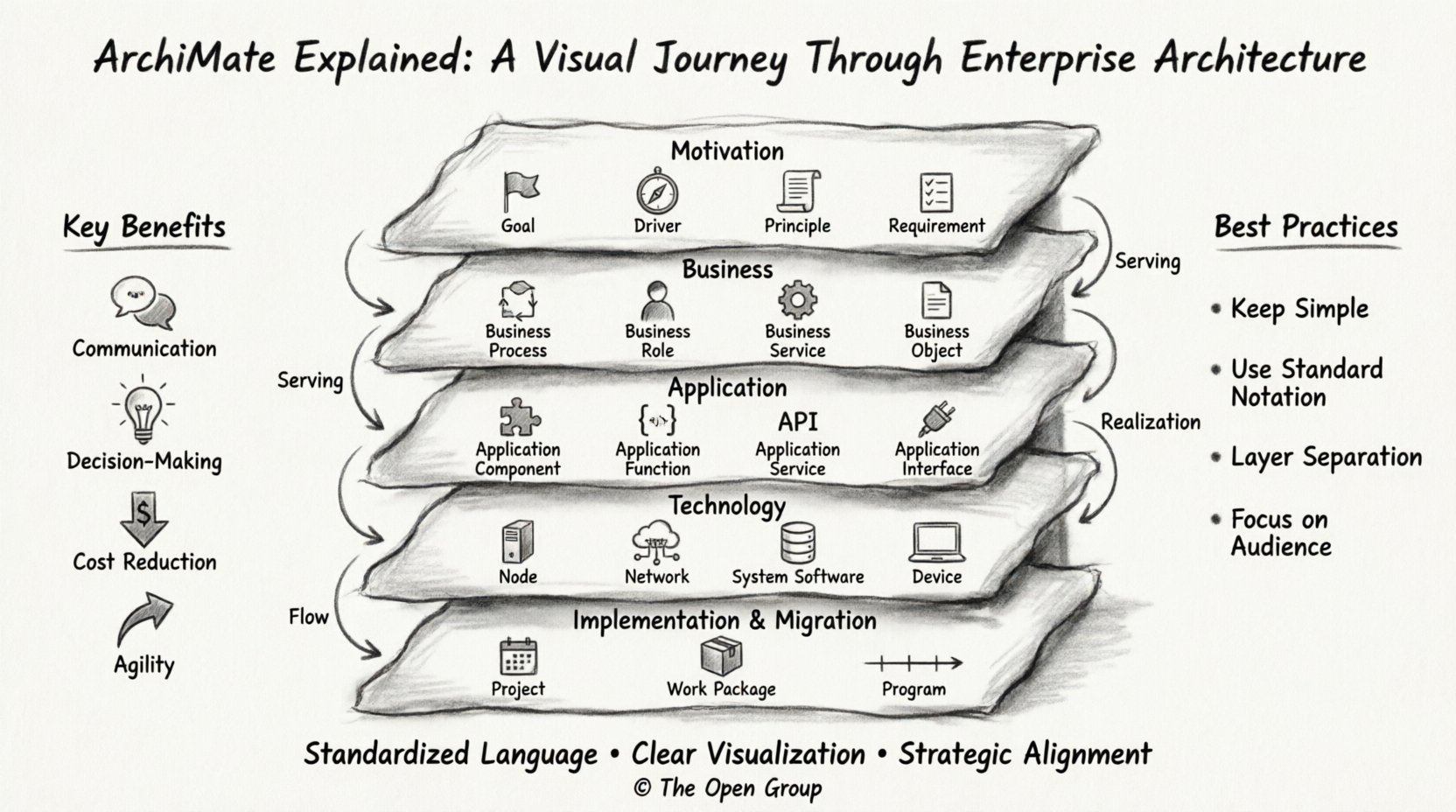
What Is ArchiMate? 🤔
ArchiMate is an open and independent enterprise architecture modeling language. It provides a framework to describe, analyze, and visualize business architecture, information systems architecture, and technology infrastructure. The language was developed by The Open Group, a global consortium that leads the development of open standards.
Unlike proprietary tools that might lock users into specific software ecosystems, ArchiMate remains neutral. It focuses on the structure and behavior of the enterprise itself. By using standardized symbols and concepts, teams can communicate complex architectural changes without ambiguity. This shared language is essential for stakeholders ranging from business executives to technical engineers.
Why Adopt This Framework?
- Common Understanding: It creates a unified vocabulary for discussing architecture across different departments.
- Alignment: It helps ensure that IT capabilities support business objectives effectively.
- Change Management: It visualizes the impact of changes before they are implemented.
- Documentation: It provides a structured way to document the current and future state of the enterprise.
The ArchiMate Layers 🧱
The framework organizes architecture into distinct layers. This separation allows architects to focus on specific aspects of the enterprise without becoming overwhelmed by the complexity of the whole. Each layer has its own set of concepts, and they interact with one another to form a complete picture.
1. The Strategy Layer (Motivation)
At the top of the hierarchy lies the Strategy layer. This layer defines the driving forces behind the enterprise. It answers the questions of why the organization exists and where it is heading. Key concepts here include:
- Goal: A high-level statement of the direction the enterprise wants to take.
- Principle: A rule or guideline that influences design and behavior.
- Requirement: A condition or capability that must be met.
- Assessment: A measure of the current status against a requirement.
- Driver: An internal or external force that influences the enterprise.
Understanding these elements helps organizations justify investments and ensure that every technical change supports a strategic intent.
2. The Business Layer
The Business layer describes the core activities of the organization. It focuses on how value is created and delivered to customers. This layer is often the starting point for transformation projects because business requirements drive technical needs.
Key Business Concepts:
- Business Actor: A person or organization that performs business activities (e.g., a customer, a supplier).
- Business Role: A position within an organization that performs activities.
- Business Object: A physical or logical thing relevant to the business (e.g., an invoice, a product).
- Business Process: A sequence of activities that achieve a specific business goal.
- Business Function: A collection of related capabilities (e.g., Sales, Human Resources).
- Business Service: A unit of functionality provided to a business actor.
- Business Event: A significant occurrence that triggers an activity.
3. The Application Layer
The Application layer represents the software systems that support the business processes. It details the logical structure of the applications without necessarily specifying the underlying hardware. This layer acts as the intermediary between business logic and technical infrastructure.
Key Application Concepts:
- Application Function: A function provided by an application (e.g., Calculate Tax).
- Application Component: A modular part of an application system.
- Application Service: A set of functions provided to a business process.
- Application Interface: A point of access to an application service.
- Application Interaction: A communication between two application functions.
- Application Event: A trigger or occurrence within the application.
4. The Technology Layer
The Technology layer describes the physical infrastructure required to run the applications. This includes hardware, networks, and system software. It is the foundation upon which the application layer rests.
Key Technology Concepts:
- Node: A computational resource (e.g., a server, a mobile device).
- Device: A physical device capable of processing information.
- System Software: Software that manages hardware resources (e.g., OS, Database).
- Data Object: A piece of data stored or processed by the system.
- Network: A communication medium connecting nodes.
- Path: A logical connection between nodes.
- Physical Environment: The physical location where the technology resides.
5. The Implementation & Migration Layer
Architecture is not static; it evolves. This layer captures the details of projects, programs, and portfolios that implement changes. It helps manage the transition from the current state to the target state.
- Implementation Event: An event that triggers an implementation.
- Work Package: A group of related activities to achieve a goal.
- Project: A temporary endeavor undertaken to create a unique result.
- Program: A group of related projects managed in a coordinated way.
Layer Comparison Table
| Layer | Focus | Primary Stakeholders |
|---|---|---|
| Strategy | Goals, Drivers, Principles | Executives, Strategists |
| Business | Processes, Services, Roles | Business Managers, Analysts |
| Application | Software, Interfaces, Functions | Application Architects, Developers |
| Technology | Hardware, Network, Infrastructure | Infrastructure Engineers, Ops |
Relationships and Connections 🔗
Layers do not exist in isolation. Relationships define how elements in one layer connect to elements in the same or different layers. These connections are critical for understanding dependencies and impacts.
Types of Relationships
- Association: A generic relationship showing a link between elements.
- Specialization: Shows that one element is a specific type of another (e.g., a Manager is a type of Employee).
- Aggregation: A “part-of” relationship where the part can exist independently.
- Composition: A strong “part-of” relationship where the part cannot exist without the whole.
- Flow: Represents the movement of data or objects between elements.
- Trigger: Indicates that one event triggers another.
- Realization: Shows that an element implements another (e.g., a Process realizes a Service).
- Access: Shows that one element uses or accesses another.
- Serving: Indicates that a lower layer provides a service to an upper layer.
Layer Relationships
The framework defines specific rules for how layers interact:
- Business to Application: Business processes use Application services.
- Application to Technology: Application functions run on System Software or Nodes.
- Strategy to Business: Goals drive Business processes.
- Business to Technology: Direct links are generally discouraged to maintain abstraction layers.
Visualizing the Architecture 🎨
One of the greatest strengths of ArchiMate is its ability to create clear diagrams. These visualizations help stakeholders grasp complex systems quickly. A well-constructed diagram can replace hundreds of pages of text.
Diagram Types
- Business Process Diagram: Shows the flow of activities and responsibilities.
- Application Component Diagram: Illustrates the structure of software systems.
- Technology Deployment Diagram: Maps applications to physical infrastructure.
- Value Stream Diagram: Visualizes how value is delivered to a customer.
- Capability Map: Shows the capabilities of the organization.
Best Practices for Diagramming
- Keep it Simple: Avoid cluttering the view with too many elements.
- Use Standard Notation: Adhere to the visual conventions of the framework.
- Layer Separation: Clearly distinguish between layers using background colors or zones.
- Focus on the Audience: Tailor the level of detail to the readers (e.g., executives need high-level views, engineers need detail).
Benefits of Implementation 🚀
Organizations that adopt this framework often see tangible improvements in how they manage change. The structured approach reduces ambiguity and aligns technical teams with business leaders.
1. Improved Communication
When everyone uses the same terminology, misunderstandings decrease. A business analyst can discuss a “Business Process” with a developer who understands the corresponding “Application Function” without confusion.
2. Better Decision Making
With a clear view of dependencies, leaders can assess the risk of proposed changes. If a technology upgrade is planned, the impact on business processes can be modeled before spending begins.
3. Cost Reduction
Identifying redundant applications or processes helps streamline operations. Eliminating unnecessary complexity often leads to direct cost savings in maintenance and licensing.
4. Agility
As the market changes, organizations need to adapt quickly. A well-maintained architecture allows for rapid reconfiguration of systems to meet new demands.
Common Challenges and Pitfalls ⚠️
While powerful, the framework is not without difficulties. Organizations must be aware of common traps to avoid failure.
1. Over-Modeling
Creating detailed models for every single element can lead to maintenance nightmares. It is better to model what is relevant to the current project or decision.
2. Lack of Governance
Without a process to keep models up to date, they become obsolete quickly. Architecture artifacts must be treated as living documents that reflect the current state.
3. Tool Dependency
While the language is standard, the tools used to model it vary. It is important to ensure that the chosen tool supports the standard exports and imports to avoid vendor lock-in.
4. Ignoring the Business Layer
Focusing too much on technology and ignoring the business layer leads to solutions that do not solve actual problems. Always start with the business need.
Real-World Application Scenarios 🌍
To understand how this works in practice, consider the following scenarios where the framework adds value.
Scenario 1: Digital Transformation
An organization wants to move from manual paper processes to a digital platform. Using the framework, they can map the current manual process (Business Layer), design the new digital workflow (Business Layer), define the required software (Application Layer), and select the cloud infrastructure (Technology Layer). This end-to-end view ensures no step is missed.
Scenario 2: System Integration
Two companies merge and need to combine their IT systems. The framework helps identify overlapping applications and conflicting processes. Architects can model the target state where data flows seamlessly between the merged entities.
Scenario 3: Compliance and Security
Regulatory requirements often demand specific controls. By mapping security controls (Technology Layer) to business risks (Strategy Layer), organizations can demonstrate compliance clearly to auditors.
Future Trends in Enterprise Architecture 📈
The landscape of enterprise architecture continues to evolve. As cloud computing, artificial intelligence, and microservices become standard, the framework adapts to these changes.
- Cloud-Native Architectures: Models are increasingly focusing on cloud services rather than physical servers.
- DevOps Alignment: Architecture models are becoming more dynamic to support continuous integration and deployment.
- Data-Centric Views: With the rise of data analytics, the data model within the architecture is receiving more attention.
- Automation: Tools are becoming smarter, automatically generating models from existing code or infrastructure.
Getting Started with the Framework 🛠️
For organizations ready to begin, there are several steps to follow to ensure success.
- Training: Ensure key team members understand the concepts and notation.
- Define Scope: Decide which parts of the enterprise will be modeled first.
- Establish Governance: Create rules for how models are created, reviewed, and maintained.
- Iterate: Start with a high-level model and add detail over time as needed.
- Engage Stakeholders: Involve business and IT leaders in the modeling process to ensure buy-in.
Final Thoughts on Standardization ✅
Enterprise architecture is complex, but it does not need to be confusing. By using a standardized language, organizations can bring clarity to their operations. The ability to visualize the connection between business goals and technical implementation is a significant competitive advantage.
Whether the goal is cost optimization, innovation, or risk reduction, a solid architectural foundation supports the journey. The framework provides the vocabulary and the structure needed to build that foundation. As technology continues to advance, the need for clear communication and strategic alignment will only grow stronger. 🏗️
By focusing on the core layers and relationships, teams can navigate change with confidence. The investment in understanding and applying these concepts pays dividends in efficiency and agility. It is a path toward a more organized and responsive enterprise.