


Enterprise Architecture (EA) serves as the bridge between business strategy and IT execution. To navigate this complex landscape effectively, architects require a standardized language. ArchiMate stands as the leading open standard for modeling enterprise architecture. It provides a structured approach to describe, analyze, and visualize the relationships within an organization. This guide explores the core principles, layers, and best practices for integrating ArchiMate into your professional toolkit. 🧭
Success in this field relies on understanding the underlying logic rather than simply learning a tool. By grasping the semantics of the framework, you can create models that communicate intent clearly across stakeholders. This document outlines the essential components of ArchiMate, focusing on practical application and structural integrity.
Understanding the Standard 📜
ArchiMate is an open and independent enterprise architecture modeling language. It is maintained by The Open Group and is widely adopted across industries. The language is designed to be vendor-neutral, ensuring that models remain valid regardless of the specific software used to create them. This neutrality is crucial for long-term sustainability in enterprise planning.
Key characteristics of the framework include:
- Standardization: Provides a common vocabulary for architects.
- Interoperability: Supports integration with other frameworks like TOGAF.
- Visualization: Enables clear graphical representation of complex systems.
- Comprehensive Coverage: Spans from business strategy to physical infrastructure.
When approaching a modeling initiative, the focus should remain on the business value the model delivers. A diagram is not an end in itself but a means to facilitate understanding and decision-making.
The Core Layers of Architecture 🏛️
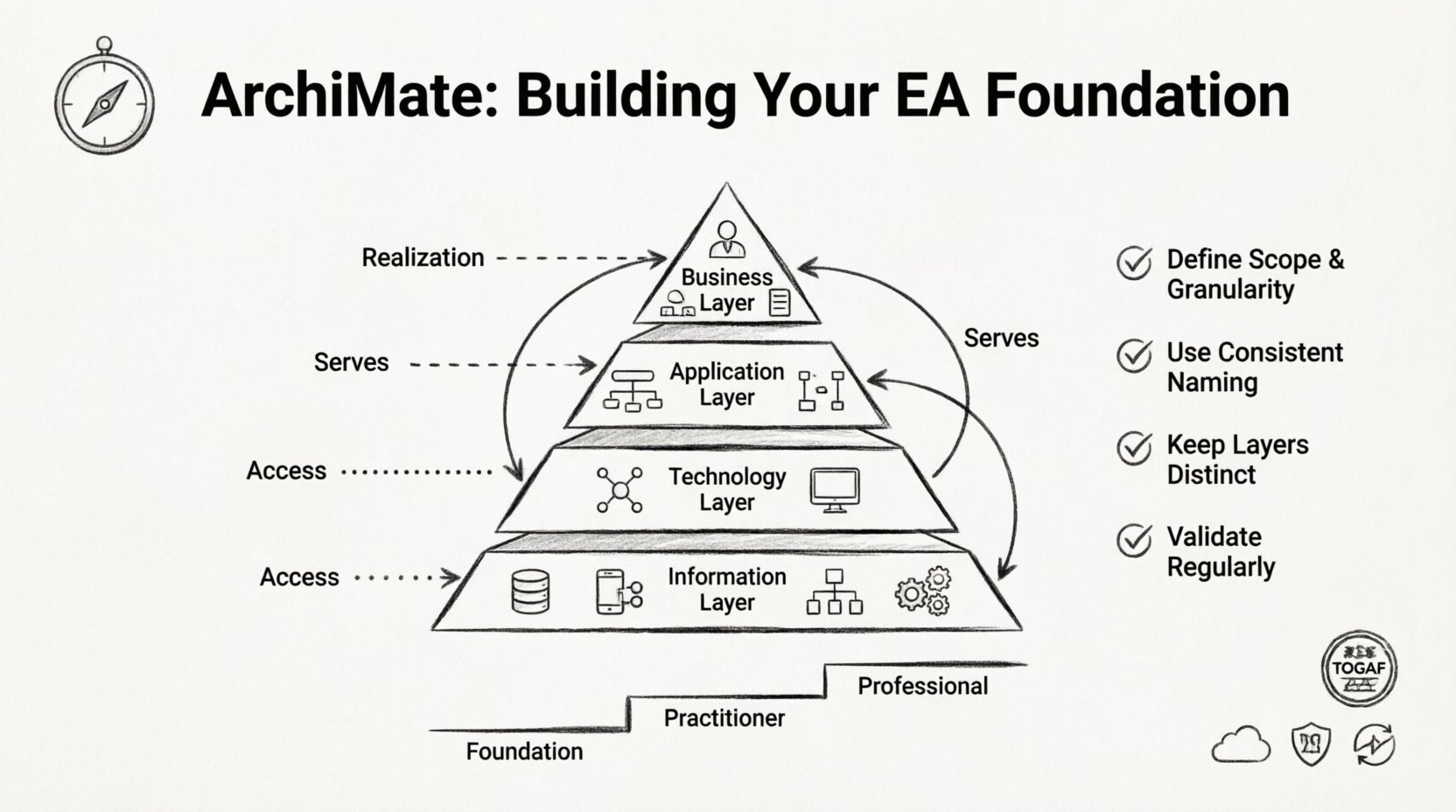
ArchiMate organizes architecture into distinct layers. This stratification allows architects to manage complexity by isolating specific domains while maintaining visibility into cross-layer interactions. Understanding these layers is fundamental to constructing accurate models.
1. Business Layer
The business layer represents the highest level of abstraction. It focuses on the organization’s operational capabilities without regard to the technology used. Key concepts within this layer include:
- Business Process: A collection of related activities that produce a specific result.
- Business Function: A capability of an organization to perform an activity.
- Business Actor: A role played by an individual or organization that participates in a process.
- Business Object: A description of information used in a business process.
2. Application Layer
This layer describes the software systems that support the business layer. It defines how applications interact with each other and the data they manage. Elements here include:
- Application Function: A specific function performed by an application.
- Application Component: A modular part of an application system.
- Application Interface: A boundary between an application component and its environment.
3. Technology Layer
The technology layer represents the hardware and software infrastructure required to run the applications. It includes the physical and logical resources that host the application layer. Key elements are:
- Node: A computational resource where artifacts are executed.
- Artifact: A physical representation of software or information.
- Device: A hardware resource that can run artifacts.
4. Information Layer
While often integrated into the other layers, the information layer focuses on the data structures themselves. It defines how data is organized and accessed independently of the application or technology that processes it.
Below is a summary table of the primary layers and their focus areas:
| Layer | Focus | Key Elements |
|---|---|---|
| Business | Operations & Strategy | Processes, Actors, Functions |
| Application | Software Systems | Components, Interfaces, Functions |
| Technology | Infrastructure | Nodes, Devices, Artifacts |
Relationships and Flow 🔗
Connecting elements within the layers is where the true power of ArchiMate lies. Relationships define how elements interact, flow, or depend on one another. Correctly modeling these connections ensures the architecture reflects reality.
Primary Relationship Types
- Association: A weak connection between two elements. Used to show general relationships without implying direct control or flow.
- Aggregation: A “whole-part” relationship. The parts can exist independently of the whole.
- Composition: A strong “whole-part” relationship. The parts cannot exist without the whole.
- Specialization: An “is-a” relationship. A specific element is a type of a general element.
Cross-Layer Relationships
Understanding how layers interact is critical for mapping business needs to technical solutions. The following relationships facilitate this:
- Realization: Indicates that a lower-level element implements a higher-level element (e.g., a technology node realizes an application function).
- Serves: Indicates that one element provides a service to another.
- Access: Indicates that one element reads or writes data used by another.
When defining flows, ensure that the directionality makes logical sense. Data should flow from a source to a destination, and control should flow to indicate process steps. Avoid creating circular dependencies unless they represent a specific feedback loop.
Implementation and Modeling Best Practices 🛠️
Creating a model is a disciplined process. It requires planning, consistency, and adherence to established conventions. Following a structured approach prevents the model from becoming a confusing collection of shapes.
1. Define Scope and Granularity
Before opening a modeling environment, define the boundaries of the project. Are you modeling a specific department or the entire enterprise? Granularity refers to the level of detail. Too much detail creates noise, while too little obscures important nuances. Aim for a level of detail that answers the specific questions stakeholders have.
2. Naming Conventions
Consistency in naming is vital for readability. Use a standardized format for all elements. For example, avoid mixing singular and plural terms. If you use “Process,” use “Process” for all items, not “Processes.” Clear naming reduces cognitive load for anyone reviewing the architecture.
- Prefixes: Use consistent prefixes for different domains (e.g., “BP_” for Business Process).
- Clarity: Ensure names are self-explanatory.
- Uniqueness: Avoid duplicate names within the same layer.
3. Layer Separation
Keep layers distinct. Do not mix business actors with technology devices in the same diagram unless you are explicitly showing a cross-layer relationship. Separation allows stakeholders to focus on their specific domain without distraction. Use views to filter the model for different audiences.
4. Validation and Review
Regular reviews ensure the model remains accurate. Conduct peer reviews to check for logical errors and consistency. Validate the model against actual business processes. If the model does not match reality, it loses its value as a planning tool.
Common Pitfalls to Avoid ⚠️
Even experienced architects can fall into traps when working with modeling languages. Recognizing these pitfalls early can save significant time and effort.
Over-Modeling
Creating models that are too complex is a common issue. Every detail does not need to be captured. Focus on the elements that drive the specific decision you are making. If a relationship is not currently influencing a change, it may not need to be modeled in detail.
Inconsistent Notation
Using different shapes or colors for the same type of element confuses readers. Adhere strictly to the standard notation rules. If you customize the notation for a specific project, document those changes clearly.
Neglecting the Business Context
Focusing solely on technology leads to solutions that do not meet business needs. Always start with the business layer. Understand the business processes and functions before defining the applications or infrastructure required to support them.
Ignoring Change Management
Architecture is not static. Models must evolve as the organization changes. Establish a process for version control and change management. Ensure that updates to the model are communicated to all relevant stakeholders.
Integration with Other Frameworks 🤝
ArchiMate is often used in conjunction with other enterprise architecture frameworks. The most common integration is with TOGAF (The Open Group Architecture Framework). TOGAF provides the process and methodology, while ArchiMate provides the language for the content.
Key integration points include:
- Architecture Development Method (ADM): Use ArchiMate to document the artifacts produced in each phase of the ADM cycle.
- Content Metamodel: Ensure that the concepts in your ArchiMate model align with the content metamodel defined in TOGAF.
- Stakeholder Views: Use ArchiMate views to present specific aspects of the TOGAF architecture to different groups.
This combination allows for a robust approach to architecture development. The process ensures that the work is structured, while the language ensures that the work is clear.
Career Development and Certification 📚
For those pursuing a career in enterprise architecture, understanding ArchiMate is a significant asset. Certification programs exist to validate knowledge of the standard. These certifications demonstrate competence to employers and peers.
Typical certification paths include:
- Foundation Level: Tests knowledge of concepts and basic modeling.
- Practitioner Level: Tests the ability to apply concepts in practical scenarios.
- Professional Level: Demonstrates advanced skills in complex modeling and integration.
Preparing for these exams involves studying the official reference material and practicing with modeling examples. Hands-on experience is often more valuable than theory alone. Building personal models or contributing to open-source architecture projects can provide this practical experience.
Future Trends and Evolution 🚀
The landscape of enterprise architecture is evolving. Digital transformation, cloud computing, and data analytics are reshaping how organizations operate. ArchiMate continues to adapt to these changes.
Emerging areas of focus include:
- Cloud Integration: Defining cloud services and infrastructure within the technology layer.
- Data Governance: Strengthening the information layer to address data privacy and quality.
- Agility: Supporting iterative architecture development rather than purely waterfall approaches.
Staying updated with these trends ensures that your skills remain relevant. Engage with the community, attend conferences, and read the latest documentation to keep pace with developments.
Summary of Key Takeaways 📝
Building a strong foundation in ArchiMate requires dedication and a structured approach. By mastering the layers, relationships, and best practices, you can create models that drive organizational success. Remember that the goal is clarity and alignment, not complexity.
Focus on these core principles:
- Use the layers to manage complexity.
- Define relationships clearly to show flow and dependency.
- Maintain consistency in naming and notation.
- Align the architecture with business needs.
- Plan for change and evolution.
With these tools and techniques, you are well-equipped to contribute to the architectural discipline. The path forward is clear. Proceed with confidence and precision. 🎯