
Enterprise Architecture (EA) has long sought a common language to describe complex organizational structures. Before the standardization of modeling languages, organizations struggled to communicate technical realities with business stakeholders. The result was often fragmented documentation, misaligned strategies, and siloed IT landscapes. In this context, ArchiMate emerged as a vital framework. It provides a structured approach to designing, analyzing, and visualizing enterprise architectures. This guide explores the historical trajectory of ArchiMate, analyzing how it adapted to changing technological needs and where it is heading next.
Understanding the lineage of this modeling language is not merely an academic exercise. It provides context for why certain elements exist and how to apply them effectively in modern digital transformation initiatives. By examining the versions, extensions, and community contributions, architects can make informed decisions about how to utilize the standard today.
1. The Genesis of a Standard 🌍
The origins of ArchiMate trace back to the early 2000s. At that time, the Open Group was actively developing the TOGAF framework, which defined the architecture development method. However, there was a gap in the specific language used to represent the artifacts produced during that process. The need was for an open, neutral modeling language that could describe the business, application, and technology layers of an enterprise.
- 2003: The Netherlands Organization for Applied Scientific Research (TNO) initiated the project.
- 2004: The first version was released, establishing the core concepts.
- 2005: The Open Group officially adopted the specification.
This collaboration between a research institute and a major industry consortium ensured that the language was both theoretically sound and practically applicable. The goal was interoperability. By creating a neutral language, organizations could exchange architectural information without relying on proprietary tools or formats.
2. Major Version Releases 📅
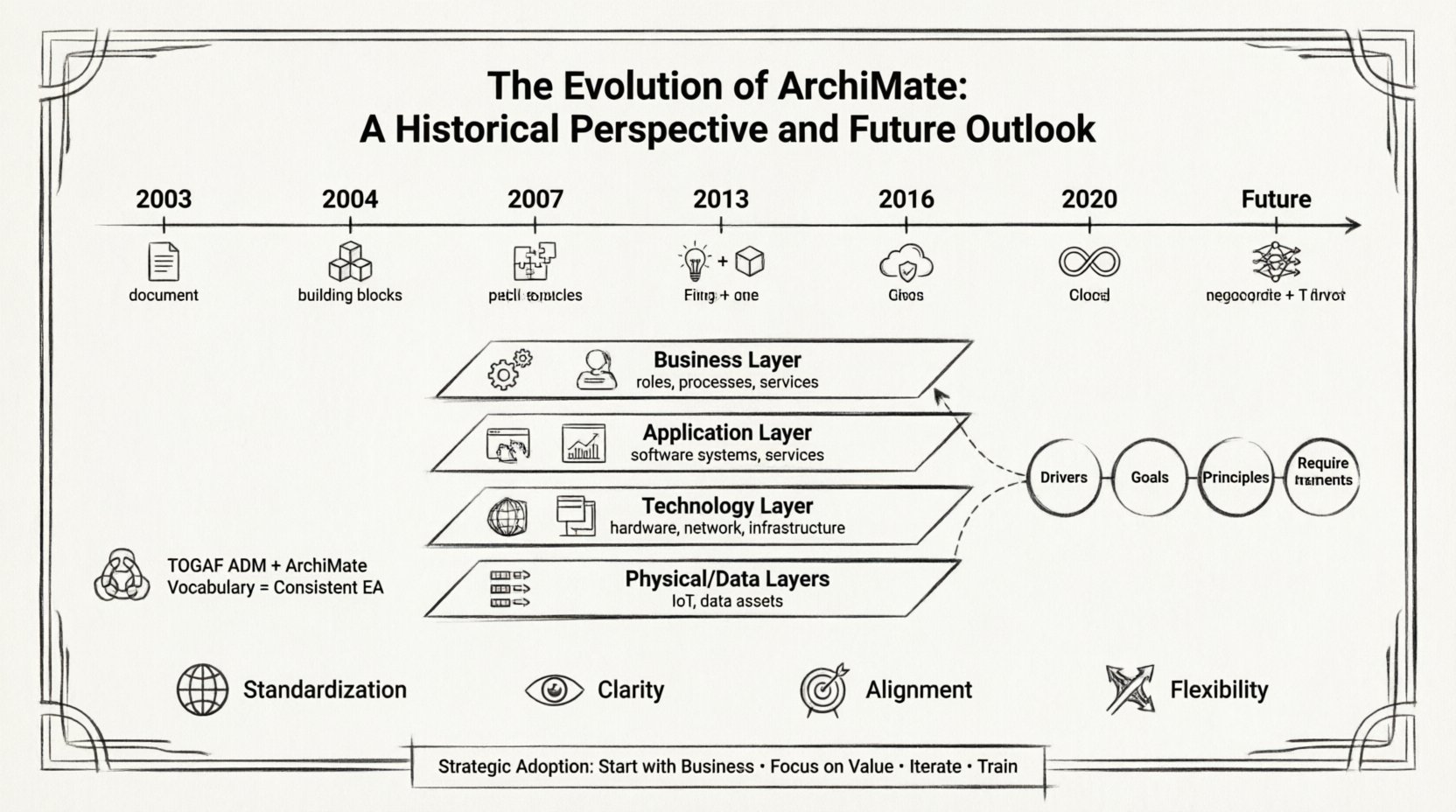
The evolution of the specification is marked by distinct versions. Each release addressed limitations in the previous iteration and incorporated feedback from the global community of practitioners. The following table summarizes the key milestones.
| Version | Release Year | Key Focus Area |
|---|---|---|
| 1.0 | 2004 | Foundational Layer Model |
| 2.0 | 2007 | Extensibility & Integration |
| 3.0 | 2013 | Motivation Extension & Physical Layer |
| 3.1 | 2016 | Cloud & Security Enhancements |
| 3.2 | 2020 | DevOps & Modernization |
Each iteration refined the syntax and semantics, ensuring the language remained relevant. The shift from 1.0 to 2.0 introduced a more flexible structure. Version 3.0 represented the most significant paradigm shift by adding the Motivation Extension. This allowed architects to link business strategy directly to technical implementation.
3. The Motivation Extension 🧠
Before version 3.0, models focused heavily on structural elements. They showed how a server connected to an application, or how a process supported a function. However, they did not explicitly capture the why. Why is the application being built? What business goal does it serve? What constraints must be adhered to?
The Motivation Extension filled this gap. It introduced concepts such as:
- Drivers: Internal or external factors necessitating change.
- Goals: Desired states that the architecture aims to achieve.
- Principles: Rules and guidelines that constrain design decisions.
- Requirements: Specific needs that must be met.
By linking these abstract concepts to concrete architectural elements, architects could demonstrate value. A stakeholder could trace a specific software module back to a high-level business objective. This traceability is crucial for governance and justification of IT investments.
4. Layer Expansion and Integration 🏗️
The core of ArchiMate is the layered model. This structure separates concerns, allowing different aspects of the enterprise to be modeled without unnecessary complexity. The primary layers include Business, Application, and Technology. Over time, the definition of these layers has been refined.
Business Layer
This layer represents the visible operations of the enterprise. It includes roles, business processes, and business services. It is the interface between the organization and its environment.
Application Layer
Here, software systems are modeled. The focus is on functionality and the services they provide to the business layer. It does not concern itself with the underlying hardware.
Technology Layer
This layer describes the infrastructure. It includes hardware, network devices, and system software. It supports the execution of applications.
In version 3.0 and later, the Physical and Data layers received more attention. The Physical layer accounts for hardware and physical locations, which is critical for IoT and edge computing scenarios. The Data layer manages the flow and storage of information, acknowledging that data is now a primary asset rather than a byproduct.
5. Alignment with TOGAF 🤝
ArchiMate was never intended to replace the TOGAF framework. Instead, it was designed to work alongside it. TOGAF provides the process (the Architecture Development Method), while ArchiMate provides the vocabulary (the modeling language).
This relationship is symbiotic. TOGAF Phase C (Business Architecture) and Phase D (Information Systems Architectures) rely heavily on visualizations that ArchiMate can provide. The alignment ensures that the artifacts produced during the ADM cycle are consistent and reusable.
- Consistency: Using a single language across projects reduces ambiguity.
- Portability: Models created in one phase can be referenced in another.
- Communication: Stakeholders familiar with TOGAF can easily understand ArchiMate diagrams.
This integration has contributed to the longevity of the standard. As TOGAF evolved, ArchiMate kept pace, ensuring that the combined toolkit remained robust.
6. Navigating Digital Transformation ☁️
The landscape of technology has shifted dramatically since the early 2000s. The move from monolithic systems to microservices, and from on-premise data centers to cloud environments, presented new challenges for architecture modeling.
Cloud Computing
Version 3.1 specifically addressed cloud computing. It introduced concepts to model cloud services and their consumption. This allowed architects to represent the abstraction layers inherent in cloud infrastructure. It distinguished between internal cloud resources and external service providers.
DevOps and Agility
Modern development practices emphasize speed and iteration. Architecture cannot be a bottleneck. The 3.2 release acknowledged this by refining how changes are modeled. The focus shifted towards how architecture supports continuous delivery and automated deployment pipelines.
Key considerations for modern environments include:
- Dynamic Scaling: Modeling how resources expand or contract based on demand.
- Service Orientation: Ensuring services are loosely coupled and independently deployable.
- Security: Integrating security controls directly into the architectural design rather than as an afterthought.
7. Future Trajectories 🔮
Looking ahead, the standard must continue to evolve to remain useful. Several trends are shaping the future direction of ArchiMate.
Artificial Intelligence and Automation
As AI becomes more prevalent in software development, architecture models will need to represent AI components. This includes machine learning models, data pipelines, and decision logic. Future updates may include specific elements to model the lifecycle of AI assets within the enterprise.
Real-Time Architecture
Current modeling is often static. It represents the state of the system at a specific point in time. Future developments aim to support dynamic modeling. This would allow architects to simulate changes and observe outcomes in real-time. This capability is essential for complex, distributed systems where manual analysis is insufficient.
Interoperability with Other Standards
Enterprise architecture does not exist in a vacuum. It intersects with ITIL, COBIT, and ISO standards. Further alignment with these frameworks will improve cross-functional collaboration. For instance, better integration with IT service management standards could streamline the transition from design to operations.
8. Strategic Adoption Guidelines 🛠️
Implementing ArchiMate requires a strategic approach. It is not a tool to be bought and installed; it is a discipline to be adopted. Organizations often struggle with the sheer volume of detail required to maintain accurate models.
Start with the Business
Begin by modeling the business architecture. Understand the value streams and capabilities before diving into applications. If the business context is unclear, the technical model will lack direction.
Focus on Value
Do not model everything. Prioritize elements that drive decision-making. Use the Motivation Extension to ensure every technical component has a business justification. This prevents the accumulation of unnecessary complexity.
Iterative Refinement
Architectures are living documents. They must be updated as the organization changes. Establish a governance process for model maintenance. Define who is responsible for updating specific layers and how often reviews should occur.
Training and Competency
Invest in training for architects and stakeholders. Ensure that everyone understands the notation. Misinterpretation of symbols leads to errors in execution. A common vocabulary is essential for effective communication.
9. Challenges in Adoption 🚧
Despite its benefits, adoption faces hurdles. The learning curve can be steep for those unfamiliar with formal modeling. There is often a perception that modeling is bureaucratic and slows down development.
To overcome this, organizations should focus on lightweight modeling. Use diagrams to communicate, not to document every detail. The goal is clarity, not completeness. When the model serves a clear purpose, resistance decreases.
Another challenge is tooling. While many modeling environments exist, they vary in quality and support for the latest specification. It is important to select a platform that adheres to the standard and supports export formats that ensure longevity.
10. Summary of Impact 📊
The impact of ArchiMate on the industry has been significant. It has provided a common ground for architects, developers, and business leaders. By bridging the gap between strategy and execution, it has reduced the risk of failed transformation projects.
- Standardization: Created a universal language for EA.
- Clarity: Improved visualization of complex systems.
- Alignment: Ensured IT supports business goals.
- Flexibility: Adapted to cloud, security, and agile needs.
As the digital landscape continues to mature, the need for structured architectural thinking will only grow. ArchiMate has proven its ability to adapt. Its future depends on the continued engagement of the community to refine and expand its capabilities.
For practitioners, staying updated with the latest specifications is essential. The language is not static. It evolves to meet the challenges of the time. By understanding its history and trajectory, architects can leverage it more effectively to drive innovation and stability within their organizations.