
Enterprise Architecture is a discipline that often draws sharp lines between strategy and execution. At the center of this discipline stands ArchiMate, a modeling language designed to describe, analyze, and visualize the relationships between business, information technology, and enterprise architecture. Despite its widespread adoption, the framework is frequently misunderstood. These misconceptions can lead to inefficient implementation, wasted resources, and a failure to capture the true value of the architecture.
This guide addresses the most persistent myths surrounding the ArchiMate specification. By clarifying what the language is and what it is not, stakeholders can approach enterprise architecture with a clearer perspective. We will explore the layers, the dynamics, and the practical application of the framework without the noise of marketing hype.
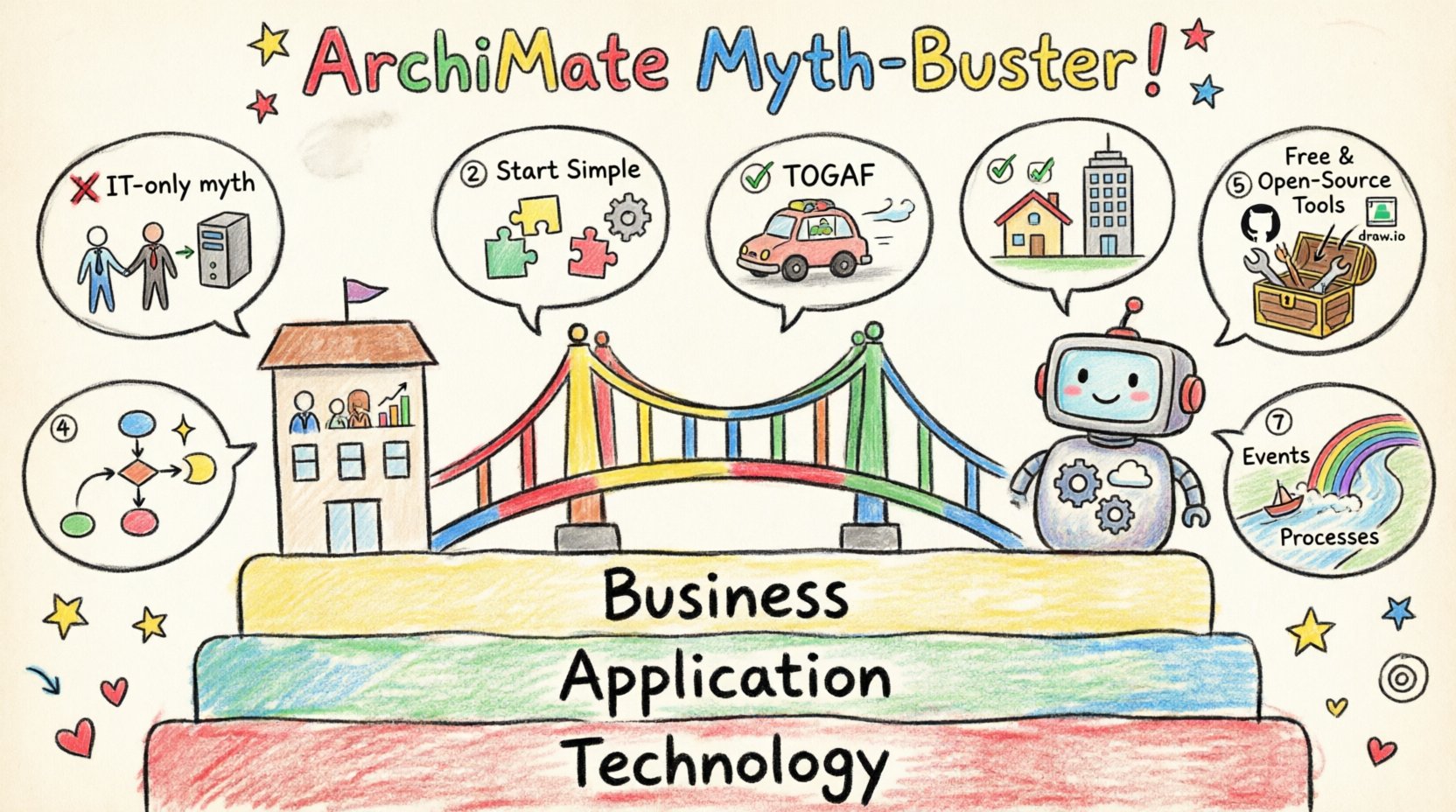
1. Myth: ArchiMate Is Only for IT 🖥️
One of the most enduring misconceptions is that ArchiMate is a technical tool exclusively for the IT department. This view suggests that business architects or strategy teams do not need to understand the language. This separation creates silos where business goals and technical capabilities are described in different dialects, often leading to misalignment.
ArchiMate was explicitly designed to bridge the gap between business and technology. It provides a unified language that allows stakeholders from different domains to communicate effectively. The framework is structured in layers that reflect the enterprise structure, not just the technology stack.
- Business Layer: Focuses on business processes, business functions, business roles, and business objects. This is the domain of business architects.
- Application Layer: Describes the software applications that support the business processes.
- Technology Layer: Details the hardware, networks, and infrastructure that run the applications.
By modeling the Business Layer first, organizations can define their strategic intent before worrying about the software required to achieve it. This ensures that IT investments are driven by business needs rather than technology availability.
2. Myth: The Language Is Too Complex to Learn 🧩
Another common barrier to adoption is the perception that ArchiMate is overly complex. Critics often point to the number of concepts, relationships, and layers as a deterrent. While the specification is comprehensive, it is modular. You do not need to master every concept on day one.
The framework supports a layered approach to learning and implementation. Teams can start with a subset of concepts relevant to their immediate goals.
- Start Simple: Begin with basic business processes and the applications that support them.
- Add Depth: Introduce motivation elements (drivers, goals, principles) as the need for strategic alignment grows.
- Specialize: Develop specific viewpoints for different audiences, such as security views or migration views.
Complexity is often a result of trying to model everything at once. Proper scoping reduces the learning curve significantly. The goal is clarity, not exhaustive documentation.
3. Myth: ArchiMate Replaces Methodologies Like TOGAF 🤝
There is a frequent confusion between the methodology and the language. TOGAF (The Open Group Architecture Framework) is a method for planning and managing enterprise architecture. ArchiMate is a modeling language used to express the results of that planning.
They are complementary, not competitive. Think of TOGAF as the process for driving the car and ArchiMate as the dashboard and maps used to navigate.
| Concept | TOGAF | ArchiMate |
|---|---|---|
| Nature | Methodology / Framework | Modeling Language |
| Purpose | Defines the ADM cycle and steps | Visualizes the architecture artifacts |
| Output | Plans, Roadmaps, Guidelines | Diagrams, Models, Views |
Using TOGAF without ArchiMate often results in textual descriptions that are harder to visualize. Using ArchiMate without a structured method can lead to disconnected diagrams. The combination provides a robust architecture capability.
4. Myth: It Is Primarily for Static Documentation 📄
Many organizations use ArchiMate solely to create static diagrams for compliance or archival purposes. Once the diagrams are drawn and saved, the modeling effort ends. This misses the opportunity to use the model as an analytical tool.
ArchiMate models can represent dynamic behavior and interactions. They allow architects to simulate scenarios and understand the impact of changes before they are implemented.
- Gap Analysis: Compare the current state architecture with the target state to identify missing capabilities.
- Impact Analysis: Trace dependencies to see how a change in one technology component affects business processes.
- Migration Planning: Visualize the transition path from the current state to the target state over time.
When used dynamically, the model becomes a living artifact that evolves with the organization. It supports decision-making rather than just recording history.
5. Myth: Only Large Enterprises Can Benefit 🏢
The perception exists that enterprise architecture is only necessary for massive corporations with thousands of employees and complex IT landscapes. While the scale of large enterprises demands formal architecture, the principles of alignment and clarity are valuable at any size.
Small and medium-sized enterprises (SMEs) often face rapid changes. Without a clear view of how business and technology fit together, SMEs risk technical debt and wasted spending on tools that do not support their core functions.
- Agility: A clear model helps SMEs pivot quickly when market conditions change.
- Cost Control: Identifying redundant applications or processes saves money regardless of company size.
- Scalability: Building a foundational architecture early prevents the need for a complete overhaul later.
The complexity of the model should match the complexity of the organization. A small company does not need a million-node graph, but it does need a clear map of its critical processes.
6. Myth: It Requires Expensive Proprietary Tools 💰
Another barrier is the belief that modeling ArchiMate requires specific, expensive software licenses. While many commercial tools support the standard, the ArchiMate specification itself is open.
The focus should remain on the methodology and the content of the model, not the software used to draw it. Many open-source options exist that support the standard format. Furthermore, the value of the model lies in the understanding it provides, not the software features.
Organizations can start with basic modeling capabilities to understand the relationships. As the sophistication of the architecture grows, investment in tooling can be justified based on specific needs like collaboration or version control, rather than the modeling language itself.
7. Myth: It Cannot Handle Dynamic Behavior 🔄
Some critics argue that ArchiMate is static and cannot represent the flow of data or events within a system. This is incorrect. The framework includes constructs for behavior, events, and flows.
- Behavior Elements: Processes, functions, and interactions that happen over time.
- Flow: Represents the movement of data or material between elements.
- Event: Represents a significant occurrence that triggers a change in state.
These elements allow architects to depict sequences and triggers. For example, a business event can trigger a business process, which invokes an application function, which accesses a technology service. This flow connects the layers dynamically.
Comparing the Layers: A Quick Reference 📊
To clarify the structure, here is a breakdown of the core layers and their primary elements. Understanding these distinctions helps avoid the myth that the layers are interchangeable or redundant.
| Layer | Key Elements | Focus |
|---|---|---|
| Motivation | Goal, Driver, Principle | Why are we doing this? |
| Business | Process, Function, Role, Object | What does the business do? |
| Application | Application Component, Interface | What software supports it? |
| Technology | Node, Device, System Software | What infrastructure runs it? |
| Physical | Device, Media, Signal | What is the physical reality? |
Addressing the Misconceptions: Myth vs Reality ✅
The following table summarizes the key myths discussed and contrasts them with the reality of the framework.
| Misconception | Reality |
|---|---|
| Only for IT | Unified language for Business and IT |
| Too Complex | Modular and scalable adoption |
| Replaces TOGAF | Complements TOGAF as a language |
| Static Documentation | Supports Analysis and Simulation |
| Only for Large Firms | Beneficial for Organizations of Any Size |
| Requires Expensive Tools | Open standard, tool-agnostic |
| Cannot Model Behavior | Includes dynamic flow and events |
The Value of Clarity in Enterprise Architecture 🧭
Resolving these misconceptions is not just about academic accuracy; it is about practical success. When stakeholders understand what ArchiMate is, they can utilize it effectively to drive transformation.
- Better Communication: A shared language reduces ambiguity between departments.
- Strategic Alignment: Ensures technology spending supports business goals.
- Reduced Risk: Understanding dependencies prevents unintended consequences during changes.
- Improved Efficiency: Identifying redundancies and gaps optimizes resource use.
The framework is a tool for thinking, not just a tool for drawing. It forces architects to define relationships explicitly. In many cases, the act of modeling reveals flaws in logic or gaps in strategy that were previously hidden in verbal descriptions.
Implementation Best Practices 🛠️
To avoid falling into the traps of these myths, consider the following approach when implementing ArchiMate within an organization.
Define the Scope Clearly
Do not attempt to model the entire enterprise in the first phase. Select a specific domain or business capability. This limits the complexity and delivers value quickly.
Involve the Business
Ensure business architects and domain experts are involved in the modeling process. Their input ensures the business layer accurately reflects reality, not just the IT view.
Iterate the Model
Treat the model as a draft that requires updates. As the organization changes, the architecture must evolve. Regular reviews keep the model relevant.
Focus on Viewpoints
Create specific views for specific audiences. A developer needs a different view than a CIO. ArchiMate supports the creation of these viewpoints to ensure the right information reaches the right people.
Conclusion on the Framework’s Role 🏁
Enterprise Architecture is a critical function in modern organizations. ArchiMate provides the structure to make this function effective. By dispelling the myths regarding complexity, scope, and purpose, organizations can leverage the framework to its full potential.
The goal is not to create a perfect diagram but to create a clear understanding of how the enterprise operates. This understanding enables better decisions, faster responses to change, and more efficient use of resources. The framework serves as a map for the journey, not the destination itself.
Continuing to refine the understanding of these concepts ensures that the discipline of enterprise architecture remains relevant and valuable. Clarity wins over complexity every time.