
Enterprise architecture has evolved from a theoretical exercise into a critical business function. Organizations worldwide are seeking ways to align their IT investments with strategic goals. One framework that has gained significant traction is the ArchiMate modeling language. Success is not automatic. It requires discipline, clear governance, and a deep understanding of the underlying principles. This guide examines real-world applications and the tangible lessons derived from organizations that have navigated this path successfully.
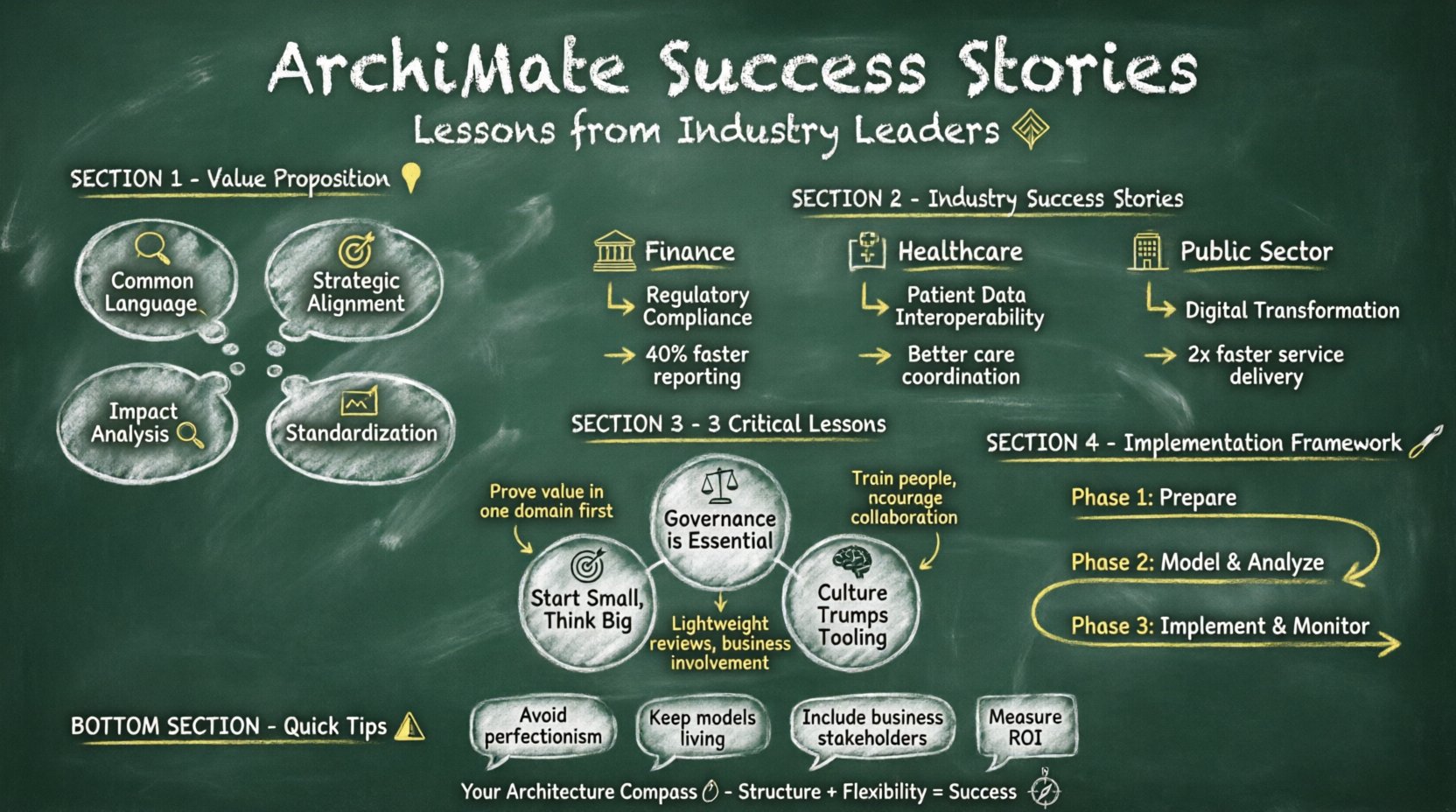
Understanding the Value Proposition 💡
Before diving into case studies, it is essential to understand why industry leaders choose this specific modeling language. It provides a structured way to visualize, analyze, and describe enterprise architecture. Unlike generic diagramming tools, it offers a standardized notation that bridges the gap between business strategy and IT implementation.
- Common Language: Stakeholders from different departments can communicate without ambiguity.
- Strategic Alignment: Links high-level business goals to specific technical components.
- Impact Analysis: Allows teams to predict the ripple effects of changes across the organization.
- Standardization: Provides a consistent approach that survives staff turnover.
When organizations implement this framework effectively, they often see a reduction in redundant projects and improved decision-making speed. However, the journey involves significant learning curves and pitfalls.
Sector-Specific Success Stories 🏦🏥🏢
Different industries face unique challenges. The following sections outline how leaders in finance, healthcare, and the public sector have applied these principles to solve complex problems.
1. Financial Services: Regulatory Compliance and Modernization 🏦
A global bank faced a critical challenge. New regulations required faster reporting of risk exposures. Their legacy systems were siloed, making data aggregation slow and error-prone. The architecture team decided to map the entire landscape using the modeling language.
The Approach:
- They created a unified view of the business services and their supporting applications.
- They identified dependencies between the reporting function and the underlying data stores.
- They simulated the impact of retiring legacy systems before any code was changed.
The Outcome:
- Regulatory reporting time reduced by 40%.
- Clear visibility into which applications were critical for compliance.
- Reduced risk of non-compliance fines during audits.
2. Healthcare: Patient Data Interoperability 🏥
A large healthcare network struggled with fragmented patient records. Different clinics used different systems, making it difficult to provide a holistic view of patient health. The goal was to enable seamless data exchange while maintaining strict privacy standards.
The Approach:
- Architects modeled the flow of patient information across the entire network.
- They defined clear interfaces for data sharing between internal systems and external partners.
- They prioritized the motivation layer to ensure patient privacy was a core business driver.
The Outcome:
- Improved patient care coordination.
- Reduced duplicate testing due to better data availability.
- Established a governance model for future system integrations.
3. Public Sector: Digital Transformation 🏢
A government department aimed to digitize citizen services. The initial plan was to build new applications without fully understanding the existing process landscape. This often leads to “paving the cow paths”—automating inefficient processes.
The Approach:
- The team mapped the current state of citizen interactions.
- They identified bottlenecks where manual workarounds were common.
- They designed a future state that streamlined these interactions before writing a single line of code.
The Outcome:
- Service delivery time cut in half.
- Higher citizen satisfaction scores.
- More efficient use of public funds.
Critical Lessons Learned from Implementation 📉📈
While success stories inspire, the challenges encountered along the way offer more practical value. The following table summarizes common obstacles and the strategies industry leaders used to overcome them.
| Challenge | Root Cause | Solution |
|---|---|---|
| Low Adoption by Architects | Perceived as too theoretical or bureaucratic | Focus on practical use cases and tangible value |
| Scope Creep | Attempting to model the entire enterprise at once | Adopt an iterative approach, starting with a specific domain |
| Lack of Executive Support | Viewed as a cost center rather than an investment | Measure and report on ROI and risk reduction |
| Model Decay | Models become outdated quickly after creation | Integrate modeling into the change management process |
| Tool Overhead | Focus shifts to the tool rather than the architecture | Ensure the tool serves the process, not the other way around |
Lesson 1: Start Small, Think Big 🎯
One of the most common mistakes is attempting to model the entire organization in the first year. This leads to exhaustion and stalled projects. Successful teams start with a specific domain, such as customer onboarding or supply chain management. They prove the value in that area before expanding.
- Identify a high-pain area where visibility is lacking.
- Build a focused model that addresses that specific pain point.
- Use the model to solve a real problem immediately.
- Expand the scope only after the initial success is documented.
Lesson 2: Governance is Essential, Not Optional ⚖️
Without governance, models become a graveyard of diagrams that no one trusts. Architecture boards must be established to review changes. However, this board should not be a bottleneck. It must be a facilitator that ensures quality and alignment.
- Define clear roles for who can update the models.
- Establish a review process that is lightweight but effective.
- Ensure the board includes business representatives, not just IT.
- Link model updates to project milestones.
Lesson 3: Culture Trumps Tooling 🧠
Organizations often buy expensive tools expecting them to fix cultural issues. If the culture does not value documentation or shared understanding, the tool will fail. The focus must be on changing how people collaborate.
- Train staff on the concepts, not just the software interface.
- Encourage collaboration during the modeling phase.
- Make the models accessible to all stakeholders.
- Recognize and reward teams that maintain high-quality models.
Implementation Framework for Success 🚀
Based on the experiences of industry leaders, a structured framework improves the likelihood of success. This framework avoids the need for complex methodologies and focuses on practical steps.
Phase 1: Preparation and Scope Definition
- Identify Stakeholders: Who needs to see the architecture? Who owns the data?
- Define Goals: What business problem are we solving? Is it cost reduction, speed, or compliance?
- Select Scope: Choose a specific business capability to model first.
- Choose Notation: Decide on the specific layers (Business, Application, Technology) to include.
Phase 2: Modeling and Analysis
- Document Current State: Capture how things work today, including workarounds.
- Identify Gaps: Where are the missing links or redundancies?
- Design Future State: Propose a solution that aligns with strategic goals.
- Validate: Review the models with business owners to ensure accuracy.
Phase 3: Implementation and Monitoring
- Translate to Projects: Convert architectural decisions into project requirements.
- Track Compliance: Ensure projects adhere to the designed architecture.
- Update Models: As changes occur, update the models to maintain accuracy.
- Review Metrics: Periodically assess if the architecture is delivering value.
Measuring Architectural Maturity 📊
How do you know if you are succeeding? Relying on intuition is not enough. Quantitative and qualitative metrics provide a clear picture of progress.
- Time to Market: Have new initiatives been deployed faster due to better planning?
- Cost Avoidance: Have redundant projects been identified and canceled?
- Decision Velocity: Is it faster to make decisions when the architecture is clear?
- Stakeholder Satisfaction: Do business leaders feel their needs are understood?
- Model Usage: Are the models actually being consulted during project work?
Common Pitfalls to Avoid ⚠️
Even with a good plan, things can go wrong. Being aware of these pitfalls helps in steering the initiative away from them.
- Perfectionism: Trying to make every diagram perfect before showing it to anyone. Aim for “good enough” to drive discussion.
- Isolation: Keeping the architecture team in a silo. Architecture must be a collaborative effort.
- Ignoring the Business: Focusing too much on technology and not enough on business capabilities.
- Static Models: Treating the model as a one-time deliverable rather than a living asset.
- Complexity: Creating overly complex diagrams that no one can read. Keep it simple.
The Role of Integration with Other Frameworks 🔗
ArchiMate is often used alongside other frameworks like TOGAF. Understanding how they fit together is crucial for a holistic approach.
- TOGAF: Provides the process and methodology.
- ArchiMate: Provides the language and visualization.
- Integration: Use TOGAF to manage the architecture development cycle and ArchiMate to document the output.
This combination allows organizations to manage the process while maintaining a clear, standardized view of the results.
Future Trends in Enterprise Architecture 🌐
The landscape is constantly changing. Organizations must stay adaptable to remain effective.
- Cloud-Native Architectures: Models must evolve to handle dynamic cloud environments.
- Data-Centric Design: The focus is shifting from applications to the data they manage.
- Automation: Tools are becoming more capable of auto-generating models from existing systems.
- Agile Alignment: Architecture must support rapid iteration without losing oversight.
Final Thoughts on Sustainable Growth 🌱
Building a successful enterprise architecture practice is a marathon, not a sprint. It requires patience, persistence, and a commitment to continuous improvement. By learning from the experiences of industry leaders, organizations can avoid common traps and focus on delivering real value.
The key lies in balancing the need for structure with the flexibility to adapt. When the framework serves the business rather than the other way around, true success is achieved. Organizations that invest in clear communication and robust governance will find themselves better positioned to navigate the complexities of the modern digital landscape.
Remember that the goal is not to create a perfect map, but to have a reliable compass. This compass guides decisions, reduces risk, and ensures that every investment contributes to the broader strategic vision. With the right mindset and approach, the journey toward architectural excellence is within reach.