
Enterprise Architecture (EA) provides the blueprint for aligning business strategy with IT capabilities. Among the various frameworks available, ArchiMate stands out as a standard for modeling and visualizing complex organizational structures. It offers a language that bridges the gap between business stakeholders and technical teams. This guide explores the practical application of ArchiMate within modern organizations, detailing how it supports transformation, governance, and strategic planning.
Organizations adopting this framework do not merely create diagrams; they build a shared understanding of their operational landscape. By standardizing terminology and relationships, teams reduce ambiguity and enhance decision-making. The following sections examine the core layers, real-world use cases, and implementation strategies that define successful adoption.
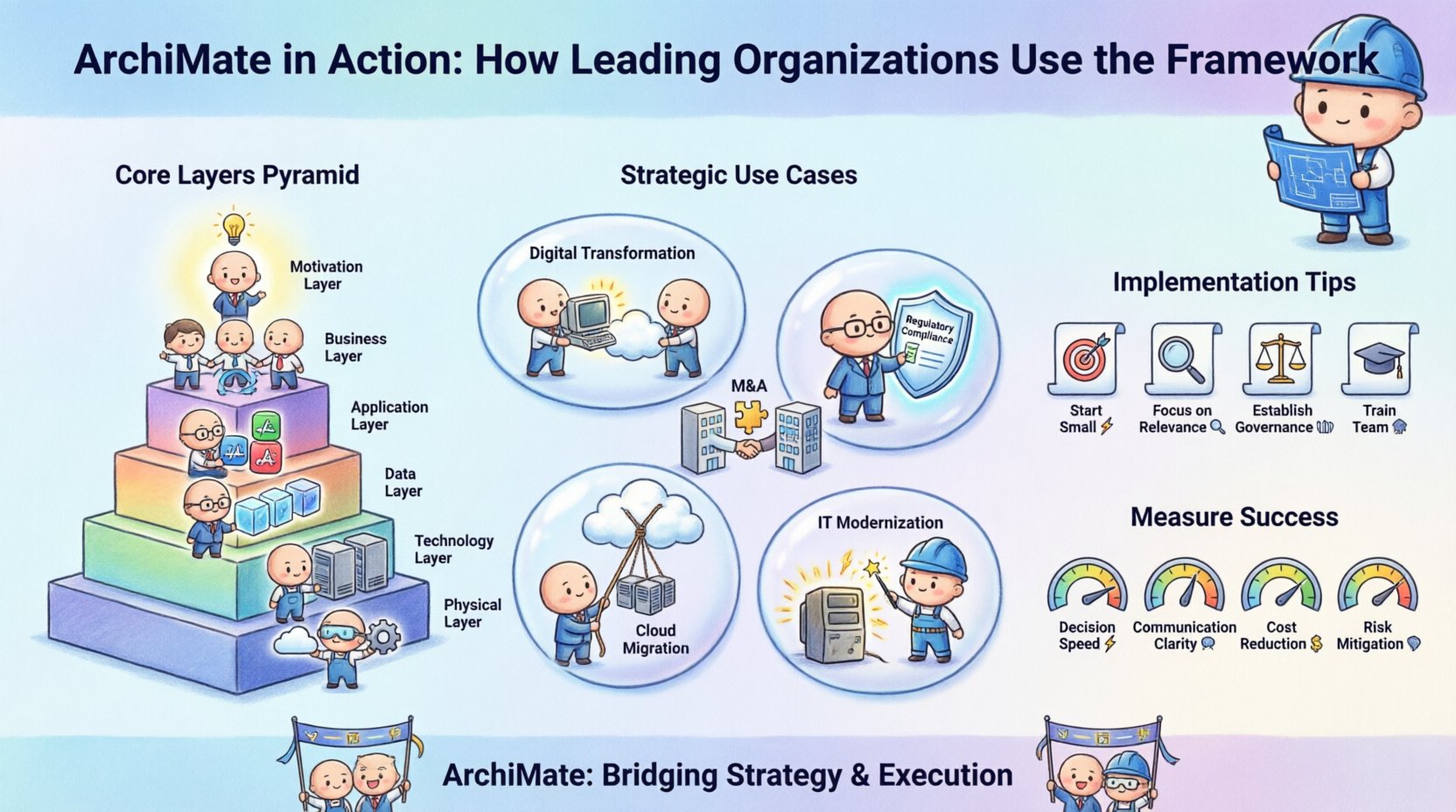
🧩 Understanding the Core Layers
ArchiMate structures enterprise architecture into distinct layers, each representing a specific aspect of the organization. This layered approach ensures that changes in one area can be analyzed for their impact on others. Understanding these layers is fundamental to using the framework effectively.
1. Motivation Layer
The Motivation Layer captures the drivers behind architectural decisions. It connects business goals to the actual implementation. Key elements include:
- Goal: What the organization aims to achieve.
- Principle: A rule or guideline that directs behavior.
- Requirement: A condition or capability needed to meet a goal.
- Assessment: An evaluation of whether a requirement is met.
By explicitly modeling motivations, organizations ensure that every technical investment ties back to a business objective. This prevents “technology for technology’s sake” initiatives.
2. Business Layer
This layer represents the visible business operations. It focuses on how the organization delivers value to its customers. Core components include:
- Business Actor: A role played by a person or organization.
- Business Function: A set of activities with a specific purpose.
- Business Process: A structured set of activities.
- Business Service: A unit of functionality provided to a stakeholder.
Leading companies use this layer to map value streams. They visualize how products move from concept to delivery, identifying bottlenecks and opportunities for efficiency.
3. Application Layer
The Application Layer describes the software systems that support business processes. It details the logical structure of the IT landscape. Key elements are:
- Application Component: A modular part of an application system.
- Application Service: A unit of functionality provided by an application.
- Application Function: A specific processing capability.
When planning digital transformation, teams model application interfaces and dependencies. This helps in understanding which systems can be retired, which need upgrading, and how they interact during a migration.
4. Data Layer
Data is the fuel for business operations. The Data Layer models the logical data structures used by applications. It includes:
- Data Object: A static concept or piece of information.
- Data Structure: A collection of data objects.
Mapping data objects across the application layer reveals data silos. Organizations can identify where data is created, stored, and consumed, ensuring consistency and compliance with data governance policies.
5. Technology Layer
This layer covers the physical infrastructure. It represents the hardware and software environments that host applications. Elements include:
- Node: A physical or logical computing resource.
- Device: A computing device.
- Software: A software system.
- Infrastructure: The underlying physical resources.
Mapping technology layers allows IT leaders to assess infrastructure capacity and reliability. It is crucial for disaster recovery planning and cloud migration strategies.
6. Physical Layer
The Physical Layer represents the actual hardware locations and physical resources. While often abstracted in logical models, it is vital for understanding latency and physical constraints.
📊 Comparison of ArchiMate Layers
| Layer | Focus Area | Primary Stakeholders | Key Output |
|---|---|---|---|
| Motivation | Goals & Drivers | Executive Leadership | Strategic Alignment |
| Business | Operations & Value | Business Managers | Value Streams |
| Application | Software Systems | IT Architects | System Landscape |
| Data | Information Assets | Data Stewards | Data Dictionary |
| Technology | Infrastructure | Infrastructure Ops | Network Topology |
🚀 Strategic Use Cases in Practice
Organizations do not use ArchiMate for modeling alone. They apply it to solve specific business problems. The following scenarios illustrate how the framework drives value in real-world contexts.
1. Digital Transformation
When shifting from legacy systems to modern platforms, organizations face significant risk. ArchiMate helps visualize the “As-Is” state and the “To-Be” state. By modeling the transition path, leaders can:
- Identify dependencies between old and new systems.
- Plan phased migration strategies.
- Communicate the impact of changes to non-technical staff.
- Ensure data integrity is maintained throughout the switch.
This clarity reduces downtime and prevents unexpected failures during critical upgrades.
2. Mergers and Acquisitions (M&A)
Integrating two companies involves merging disparate IT landscapes. ArchiMate provides a neutral language to describe both environments. During due diligence, architects can:
- Map overlapping business functions to identify redundancies.
- Analyze application compatibility between the two entities.
- Forecast the cost of integration based on technical complexity.
- Develop a unified roadmap for the combined organization.
This structured approach minimizes cultural and technical friction during the merger process.
3. Regulatory Compliance
Industries like finance and healthcare face strict regulations. ArchiMate models can demonstrate compliance by linking requirements to specific controls. Organizations use this to:
- Trace a regulation back to the specific business process.
- Verify that the underlying technology supports the control.
- Generate audit evidence showing alignment.
- Update models quickly when regulations change.
This traceability reduces the effort required for external audits and minimizes the risk of non-compliance penalties.
4. Cloud Migration
Moving to the cloud requires understanding current infrastructure constraints. Architects model the physical and technology layers to determine:
- Which workloads are suitable for public cloud.
- Where on-premise infrastructure must remain.
- How network connectivity will change.
- What security controls need to be reconfigured.
The visual output helps justify the investment to the board by showing clear ROI and risk mitigation strategies.
5. IT Modernization
Legacy systems often hinder agility. ArchiMate helps identify which components to refactor and which to retire. The process involves:
- Documenting the current technical debt.
- Defining the target architecture.
- Creating a portfolio of projects to bridge the gap.
- Ensuring business continuity during the modernization effort.
This prevents the common pitfall of replacing systems without understanding the business value they currently hold.
🛠️ Implementation Strategies
Adopting ArchiMate requires more than just buying a tool. It demands a cultural shift and a structured approach. Organizations that succeed typically follow these steps.
Start Small
Begin with a specific domain or project rather than modeling the entire enterprise immediately. Select a high-visibility area where the architecture can demonstrate value quickly. A successful pilot builds confidence and creates a template for future work.
Focus on Relevance
Do not model every detail. Only capture elements that are relevant to the current decision-making context. Over-modeling leads to maintenance burdens and outdated diagrams. Prioritize the elements that drive the specific strategy being discussed.
Establish Governance
Create a governance board to review and approve architectural changes. This ensures consistency across the organization. It also prevents the proliferation of conflicting models that confuse stakeholders.
Train the Team
Ensure that business and IT staff understand the notation. If stakeholders cannot read the diagrams, the framework fails. Provide training sessions that focus on interpretation rather than just drawing.
⚠️ Common Pitfalls to Avoid
Even experienced teams encounter obstacles. Recognizing these early can save significant time and resources.
- Ignoring the Motivation Layer: Many teams jump straight to technology models without defining goals. This results in solutions that do not address the actual business problem.
- Lack of Maintenance: Models become obsolete quickly if not updated. Commit to a review cycle to keep information current.
- Tool-Centric Thinking: Focusing on the software features rather than the architectural concepts. The tool is a means to an end, not the value itself.
- Complexity Overload: Creating diagrams with too many elements. Simplify visuals to highlight the key message.
📈 Measuring Success
How do organizations know if their use of ArchiMate is effective? They track specific metrics related to efficiency and alignment.
- Decision Speed: How much time is saved when making architectural decisions?
- Communication Clarity: Do stakeholders better understand the impact of changes?
- Cost Reduction: Are redundant systems identified and retired?
- Risk Mitigation: Has the frequency of incidents decreased due to better planning?
🔮 Future Outlook
The landscape of enterprise architecture continues to evolve. ArchiMate remains a cornerstone because it is open and vendor-neutral. As organizations face increasing pressure to integrate AI, IoT, and blockchain, the framework adapts to model these new capabilities.
Integration with other standards, such as TOGAF, ensures it remains compatible with broader management processes. The focus is shifting towards real-time architecture, where models are updated dynamically as the enterprise changes. This agility allows organizations to respond faster to market shifts.
🤝 Final Thoughts on Adoption
Using ArchiMate effectively requires patience and discipline. It is not a quick fix but a long-term investment in organizational clarity. By mapping the business, application, and technology layers, companies gain a holistic view of their operations.
Leading organizations leverage this framework to bridge the divide between strategy and execution. They use it to align IT investments with business goals, ensuring every dollar spent contributes to the mission. When implemented with care, ArchiMate transforms architecture from a bureaucratic exercise into a strategic asset.
For those looking to begin, the path is clear. Define the goals, select the scope, and build the model. With consistent application, the framework becomes an integral part of the organizational DNA, driving sustainable growth and resilience.