
Enterprise Architecture is undergoing a significant transformation. As organizations navigate complex digital landscapes, the need for a standardized language to describe, analyze, and design these systems becomes critical. ArchiMate stands at the forefront of this evolution. This guide explores the trajectory of the ArchiMate modeling language, focusing on how it adapts to modern technological shifts and organizational needs. We examine the intersection of traditional architecture frameworks with emerging technologies, ensuring a comprehensive understanding of where the discipline is heading.
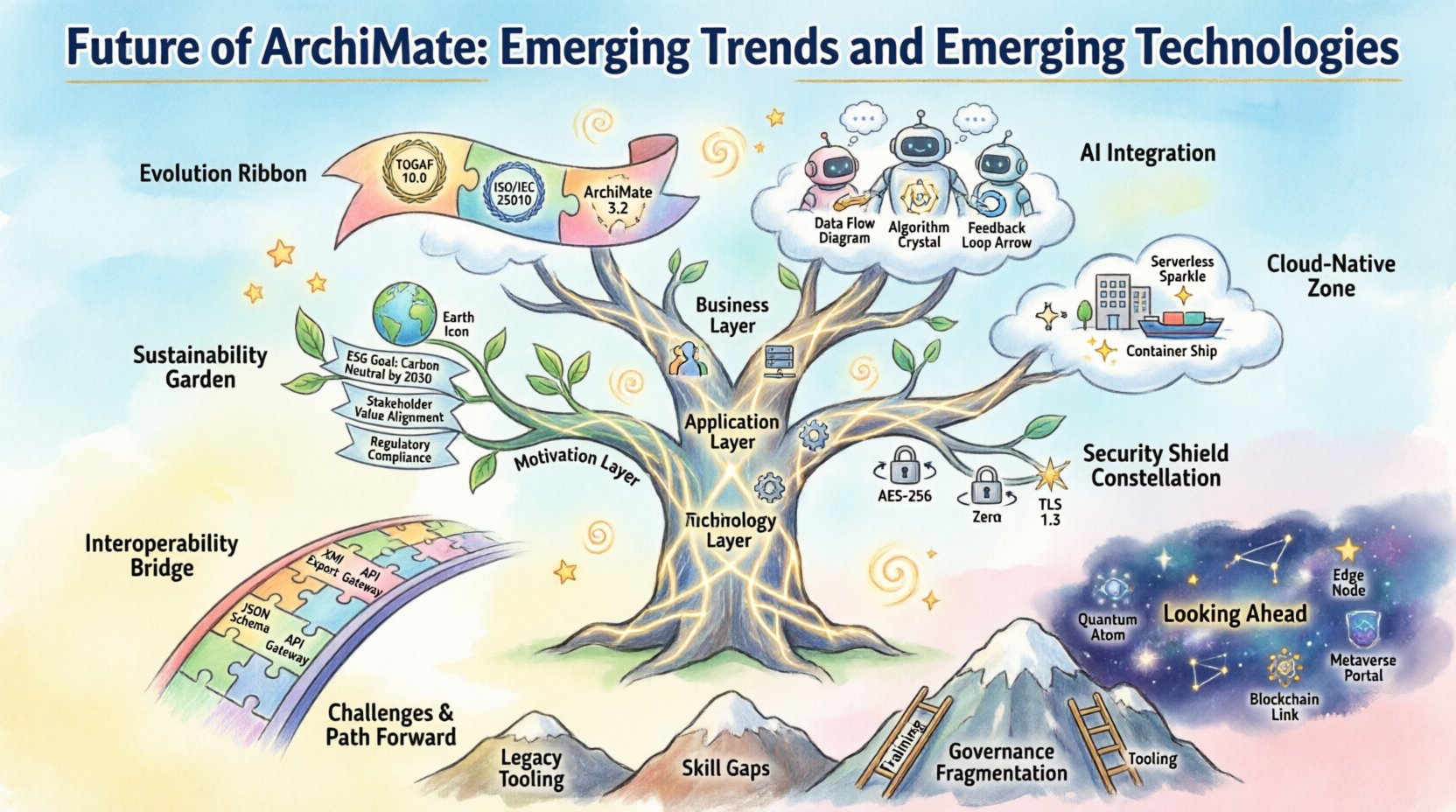
🔄 The Evolution of the Standard
The Open Group, which governs the ArchiMate specification, has consistently updated the language to reflect the changing IT landscape. Version 3.0 marked a major shift by unifying the business and IT layers under a common structure. Moving forward, the focus remains on usability and interoperability. The standard is not static; it evolves to support new paradigms in software development and infrastructure management.
Key developments in the standard include:
- Enhanced Motivation Layer: Greater emphasis on linking business drivers to technical implementation. This ensures that every architectural decision traces back to a strategic goal.
- Dynamic Modeling Capabilities: Moving beyond static diagrams to support process flows and state changes within the architecture.
- Integration with Other Standards: Better alignment with TOGAF, ISO/IEC 42010, and other enterprise frameworks to reduce silos.
- Tool Interoperability: Improved support for interchange formats like XMI and JSON to facilitate data exchange between different modeling platforms.
These updates ensure that the language remains relevant as organizations adopt new ways of working. The underlying principles of modeling relationships, layers, and viewpoints remain constant, but the application expands into new domains.
🤖 Integration with Artificial Intelligence
Artificial Intelligence (AI) and Machine Learning (ML) are reshaping how enterprises operate. ArchiMate must accommodate these technologies within its structure. This does not mean creating entirely new layers, but rather extending the Application and Technology layers to capture AI-specific assets.
Modeling AI Capabilities
Incorporating AI into architecture diagrams requires specific attention to data flow and decision logic. Architects need to represent:
- Data Sources: Where training data originates and how it is governed.
- Algorithmic Services: The specific machine learning models deployed as services.
- Inference Points: Where predictions are made and how they influence business processes.
- Feedback Loops: How outcomes are fed back into the model for continuous improvement.
This level of detail helps stakeholders understand the complexity hidden behind AI-driven applications. It prevents the “black box” syndrome where business leaders approve initiatives without understanding the underlying data dependencies.
Automated Architecture Generation
One of the most promising trends is the use of AI to assist in creating and maintaining architectural models. Automated analysis tools can scan existing systems and suggest ArchiMate representations. This reduces the manual effort required to keep models up to date.
Benefits of automation include:
- Consistency Checks: AI can verify that relationships follow defined rules and patterns.
- Gap Analysis: Identifying missing connections between business capabilities and IT services.
- Impact Analysis: Predicting how changes in one layer affect others across the enterprise.
- Documentation: Automatically generating narrative descriptions from the model elements.
While human oversight remains essential, automation accelerates the modeling process significantly. This allows architects to focus on strategy rather than diagram maintenance.
☁️ Cloud Native and Microservices Architecture
The shift from monolithic applications to cloud-native architectures changes how we visualize systems. Traditional architecture diagrams often struggle to capture the dynamic nature of microservices and containerized environments. ArchiMate is adapting to address these challenges.
Adapting the Technology Layer
In a cloud environment, the Technology Layer represents a mix of physical infrastructure, virtualization, and managed services. Architects must distinguish between:
- Infrastructure as Code (IaC): Representing the scripts and configurations that build the environment.
- Container Orchestration: Modeling the tools that manage container lifecycles.
- Serverless Functions: Capturing event-driven execution units.
- API Gateways: Defining the entry points and security policies for external access.
This granularity ensures that the architecture reflects the actual deployment reality. It helps in planning for scalability, resilience, and cost management.
Table: Traditional vs. Cloud-Native Modeling
| Feature | Traditional Architecture | Cloud-Native Architecture |
|---|---|---|
| Deployment Unit | Monolithic Application | Microservices / Containers |
| Infrastructure | Fixed Hardware | Elastic Cloud Resources |
| Scaling | Vertical (Hardware) | Horizontal (Service Replicas) |
| Management | Manual Configuration | Automated Orchestration |
| Failure Handling | Redundancy | Resilience Patterns |
Understanding these differences is crucial for accurate modeling. ArchiMate provides the flexibility to represent these shifts without losing the structural integrity of the framework.
🌱 Sustainability and the Motivation Layer
Environmental, Social, and Governance (ESG) goals are becoming central to enterprise strategy. The Motivation Layer in ArchiMate is perfectly suited to capture these objectives. It connects high-level values to specific architectural changes.
Modeling ESG Goals
Organizations are increasingly required to report on carbon footprints and resource usage. Architecture models can support this by:
- Energy Consumption: Mapping infrastructure components to their energy usage metrics.
- Data Privacy: Linking business drivers to compliance requirements like GDPR.
- Supply Chain: Visualizing the flow of goods and materials to identify inefficiencies.
- Carbon Targets: Setting specific reduction goals within the motivation layer.
By embedding these factors into the architecture, organizations ensure that sustainability is not an afterthought. It becomes a constraint and a driver for design decisions. This approach aligns IT strategy with broader corporate responsibilities.
🔗 Interoperability and Standards
Enterprise ecosystems are rarely monolithic. They consist of multiple systems, vendors, and platforms. Interoperability is the ability of these systems to exchange and make use of information. ArchiMate plays a vital role in defining these interfaces.
Exchange Formats
To facilitate data sharing between modeling tools, standardized exchange formats are essential. Current standards include:
- XMI (XML Metadata Interchange): A long-standing standard for model exchange.
- JSON Schema: A modern format gaining traction for its lightweight nature and compatibility with web technologies.
- Common Warehouse Metamodel (CWM): Supporting integration with data modeling tools.
Adopting these formats ensures that architecture models are not siloed. They can be imported, exported, and analyzed across different platforms. This flexibility is critical for large enterprises with diverse toolchains.
Real-Time Architecture
The future points towards real-time architecture management. Instead of static documents, models become living systems connected to the actual infrastructure. This requires:
- Continuous Integration: Updating models as code is deployed.
- Live Dashboards: Visualizing architecture health and compliance status.
- Event-Driven Updates: Triggering model changes based on system events.
This shift reduces the gap between the “as-is” and “to-be” states. It allows for faster decision-making and more responsive architecture governance.
🛡️ Security and Governance
Security is no longer a separate layer; it is woven into every aspect of the architecture. ArchiMate supports this by allowing security constraints to be applied to elements across all layers.
Embedding Security Controls
Architects can model:
- Authentication Mechanisms: How users and systems prove their identity.
- Authorization Policies: What resources specific identities can access.
- Encryption: Where data is protected in transit and at rest.
- Threat Modeling: Linking security risks to specific architectural components.
This holistic view ensures that security is designed in, not bolted on. It helps in identifying vulnerabilities early in the design phase, reducing remediation costs.
📈 Challenges and Considerations
Despite the advancements, several challenges remain. Adoption of these new capabilities requires training, cultural change, and investment in tooling.
Key Challenges
- Skill Gaps: Architects need to understand both traditional EA and modern DevOps practices.
- Tool Limitations: Not all modeling platforms support the latest ArchiMate extensions or automation features.
- Complexity Management: As models become more detailed, they can become difficult to maintain and consume.
- Standard Adoption: Ensuring all stakeholders agree on the meaning of specific model elements.
Addressing these challenges requires a balanced approach. It is important to prioritize value over perfection. Models should be fit for purpose, serving the specific needs of the organization at that time.
🔮 Looking Ahead
The trajectory of ArchiMate suggests a future where architecture is more integrated, automated, and dynamic. The language will continue to evolve to support the complexities of digital transformation. Organizations that invest in mastering these modeling techniques will be better positioned to navigate uncertainty.
Key areas to watch include:
- Quantum Computing: Potential impacts on infrastructure modeling.
- Edge Computing: Distributed architecture patterns.
- Blockchain: Decentralized trust mechanisms.
- Metaverse: New interaction models for business processes.
Staying informed about these developments ensures that the architecture function remains relevant. Continuous learning and adaptation are the only ways to keep pace with the industry. The goal is not just to document the future, but to shape it effectively.
Enterprise Architecture is a discipline of clarity and connection. By leveraging ArchiMate alongside emerging technologies, organizations can build robust, adaptable, and resilient systems. The journey is ongoing, and the potential for improvement is vast.