
Enterprise Architecture (EA) often feels like a labyrinth of complex diagrams and abstract concepts. Organizations struggle to align their business strategies with their technology investments. This disconnect creates silos, inefficiencies, and missed opportunities for innovation. To bridge this gap, a standardized language is essential. ArchiMate provides that structure. It is an open standard modeling language designed to describe, analyze, and visualize business architectures, IT architectures, and the relationships between them.
Using a formal modeling language removes ambiguity. It allows stakeholders to speak a common tongue, whether they are executives, business analysts, or software engineers. This guide explores how to apply ArchiMate principles practically to simplify your architecture efforts. We will look at the layers, domains, relationships, and implementation strategies without getting bogged down in unnecessary complexity.
🧩 Understanding the Core of Enterprise Architecture
Enterprise Architecture is not just about drawing boxes and arrows. It is the discipline of managing the complexity of an organization’s structure. It ensures that every system, process, and data point serves a strategic purpose. Without a coherent view, IT becomes a cost center rather than a driver of value.
Many organizations fail because they focus too much on technology and not enough on business value. ArchiMate corrects this balance by forcing a layered view. It separates concerns while maintaining the connections between them. This separation allows teams to work in parallel. For instance, a business unit can refine its processes while the IT team updates the underlying infrastructure, provided the interface definitions remain clear.
📐 The ArchiMate Modeling Language Explained
ArchiMate is an industry standard developed by The Open Group. It is designed to be vendor-neutral. This means it does not favor any specific tool, vendor, or methodology. This neutrality is crucial for long-term planning, as it prevents lock-in and ensures the models remain valid even as tools change.
The language consists of three main components:
- Meta-model: The core concepts and relationships that define the structure.
- Layers: Different levels of abstraction, from strategy to technology.
- Domains: Specific areas of focus within the architecture.
By adhering to these components, architects can create models that are both precise and flexible. The goal is clarity. A diagram should tell a story at a glance. If a stakeholder needs a legend to understand the arrows, the model is likely too complex.
🏗️ The Six ArchiMate Layers
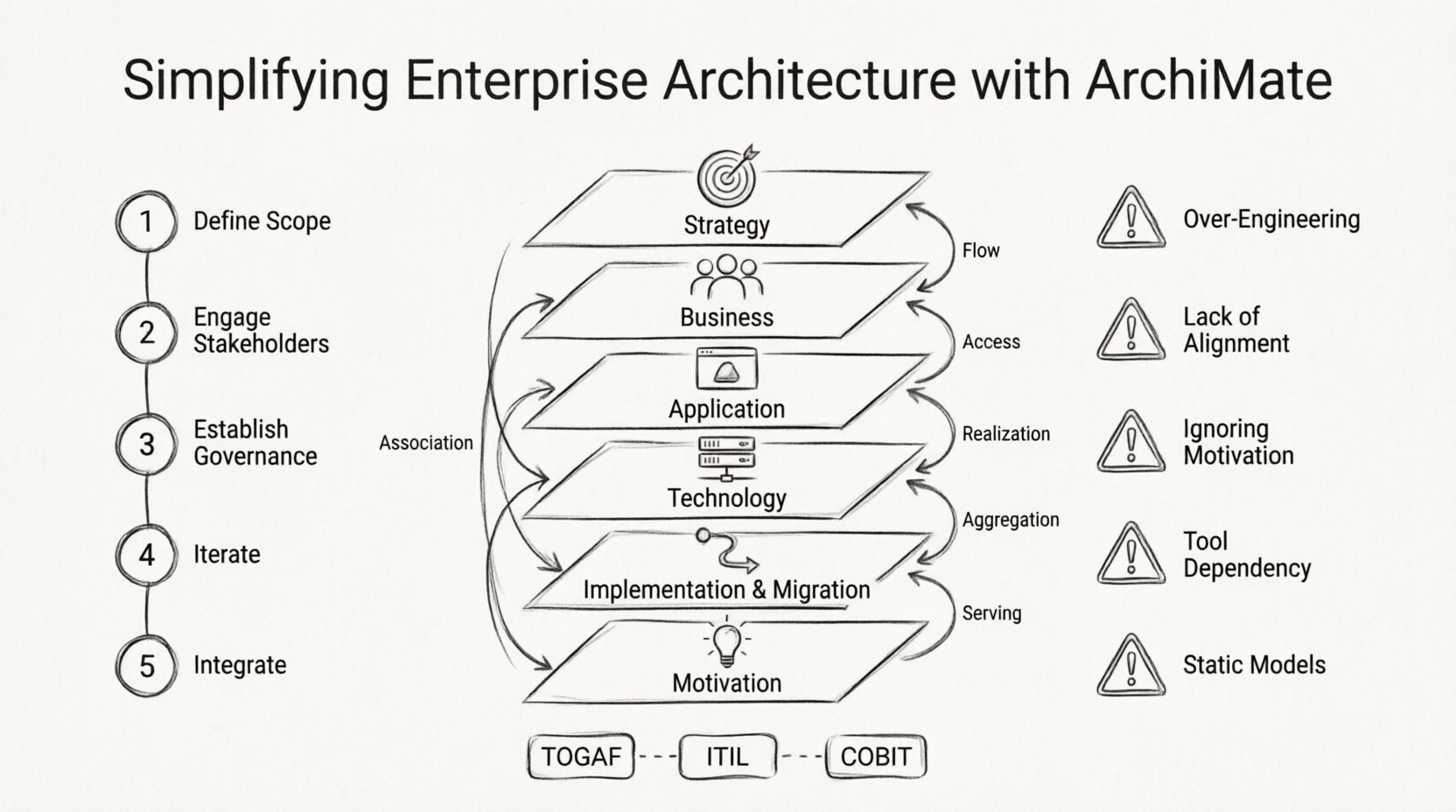
The power of ArchiMate lies in its layered structure. Each layer represents a specific perspective. This division helps manage complexity by isolating changes. If a technology stack changes, the business processes might remain unaffected. If a business strategy shifts, the technology might need adaptation, but the application layer serves as a buffer.
Below is a breakdown of the six standard layers used in the ArchiMate model.
| Layer | Focus Area | Key Elements |
|---|---|---|
| Strategy | High-level direction and intent | Principles, Goals, Requirements |
| Business | Organization, processes, and roles | Roles, Processes, Capabilities |
| Application | Software systems and services | Applications, Software Functions |
| Technology | Hardware and network infrastructure | Devices, Networks, System Software |
| Implementation & Migration | Transitioning between states | Projects, Work Packages, Deliverables |
| Motivation | Reasons for change | Stakeholders, Drivers, Assessments |
Notice the Strategy layer. It sits at the top, ensuring that all technical decisions trace back to a business goal. The Business layer translates these goals into actions. The Application and Technology layers provide the means to execute those actions. The Implementation & Migration layer manages the change itself. Finally, the Motivation layer explains the why.
🔗 Relationships and Connectivity
Static elements are not enough. An architecture is defined by how things interact. ArchiMate defines specific relationship types to describe these interactions accurately. Using the correct relationship prevents misinterpretation.
Key relationships include:
- Association: A general connection between two elements, such as a role using a capability.
- Flow: Describes the movement of data or material, like a process producing an output.
- Access: Indicates that one element uses or accesses another, such as an application accessing a database.
- Realization: A strong link where one element realizes or implements another, typically technology realizing an application.
- Aggregation: Shows that one element is composed of others, like a department containing several roles.
- Serving: Indicates that an element provides a service to another, often used between applications and business processes.
When building models, it is vital to limit the number of relationship types used in a single view. Too many arrows create a “spaghetti diagram” that confuses rather than clarifies. Use the relationships that best fit the story you are telling.
💡 The Motivation Layer
One of the most overlooked aspects of architecture is the Motivation Layer. Why are we doing this? Without this context, architecture becomes a technical exercise rather than a strategic one. The Motivation Layer connects the human and organizational drivers to the structural elements.
Key elements in this layer include:
- Stakeholders: People or groups who have an interest in the architecture. This includes executives, users, and regulators.
- Goals: Specific objectives that the organization wants to achieve.
- Principles: Rules or guidelines that constrain decision-making.
- Requirements: Conditions that the architecture must satisfy.
By mapping requirements to capabilities and processes, architects can demonstrate value. If a new requirement is added, the model shows exactly which capabilities and applications are impacted. This traceability is essential for impact analysis.
🛠️ Practical Implementation Steps
Adopting ArchiMate is a journey. It requires discipline and a phased approach. Rushing into detailed modeling without a clear scope often leads to failure. Here is a practical roadmap for implementation.
1. Define the Scope and Context
Start small. Do not attempt to model the entire organization in the first quarter. Select a specific domain, such as customer onboarding or supply chain management. Define the boundaries of the model. What is inside the scope? What is outside?
2. Engage Stakeholders Early
Architecture is not a solitary activity. Engage business leaders and technical teams from the start. Their input ensures the model reflects reality. Regular review sessions help keep the model aligned with current operations.
3. Establish Governance
Who owns the model? Who can approve changes? Governance ensures the architecture remains consistent over time. Without governance, the model becomes outdated quickly as systems evolve.
4. Iterate and Refine
Architecture is never finished. It evolves as the organization changes. Schedule regular reviews to update the models. Remove obsolete elements and add new ones as they emerge. Treat the model as a living document.
5. Integrate with Planning
Link the architecture to project planning. When a project is initiated, check the architecture model. Does it align with the target state? This ensures that new investments support the long-term strategy rather than creating technical debt.
⚠️ Common Pitfalls to Avoid
Even with a solid framework, mistakes happen. Recognizing these pitfalls early can save significant time and resources.
- Over-Engineering: Creating models that are too detailed for their purpose. A high-level map is often more useful than a low-level specification.
- Lack of Business Alignment: Focusing too much on technology and ignoring business processes. The business layer must always drive the IT layer.
- Ignoring the Motivation Layer: Failing to document why changes are happening. This leads to confusion when key personnel leave.
- Tool Dependency: Relying solely on software features rather than architectural thinking. The tool is a means to an end, not the end itself.
- Static Models: Creating models that are never updated. An outdated model is worse than no model at all.
🔄 Integrating with Broader Frameworks
ArchiMate does not exist in a vacuum. It often works alongside other frameworks. Understanding these integrations is key to a holistic approach.
- TOGAF: The Open Group Architecture Framework provides a methodology for developing architecture. ArchiMate is often used as the modeling language within TOGAF.
- ITIL: IT Infrastructure Library focuses on IT service management. ArchiMate can model the services and processes defined in ITIL.
- COBIT: Control Objectives for Information and Related Technologies focuses on governance. ArchiMate can visualize the governance structure.
Using these frameworks together creates a robust ecosystem. TOGAF provides the process, COBIT provides the governance, and ArchiMate provides the visual language. This combination ensures that strategy, execution, and control are all covered.
📈 Maintaining Model Health
Once the architecture is established, it requires maintenance. A healthy model supports decision-making. A neglected model becomes a graveyard of outdated information.
Best practices for maintenance include:
- Version Control: Keep track of changes. Know what the architecture looked like last year.
- Access Control: Ensure the right people can view and edit the models. Security is important.
- Documentation: Maintain metadata alongside the diagrams. Explain the context of each view.
- Training: Ensure the team understands how to use the models. Training reduces errors and improves adoption.
Regular audits help identify gaps. Compare the current state with the target state. This comparison reveals the migration path needed to reach the desired future.
🎯 Conclusion
Simplifying Enterprise Architecture requires a disciplined approach. ArchiMate offers the structure needed to manage complexity without losing sight of business value. By focusing on layers, relationships, and motivation, organizations can create a clear roadmap for their digital transformation.
The key is consistency. Use the language consistently across the enterprise. Avoid jargon that is not defined. Ensure every diagram tells a clear story. With practice, the architecture becomes a strategic asset rather than a bureaucratic burden.
Start with a clear scope. Engage your stakeholders. Govern your changes. And remember that the goal is not just to draw diagrams, but to enable better decision-making. When the architecture supports the business, the organization moves forward with confidence.