

Introduction
Artificial Intelligence is no longer a futuristic concept—it is actively transforming the landscape of software engineering. From automating routine coding tasks to enhancing testing, debugging, and deployment processes, AI tools are becoming indispensable in modern development workflows. Platforms like GitHub Copilot, Amazon CodeWhisperer, and AI-powered testing frameworks are enabling developers to write code faster, detect bugs earlier, and optimize entire development lifecycles. Yet, this technological shift is more than just a productivity boost—it is reshaping the very nature of software engineering roles, demanding new skills, ethical awareness, and a deeper understanding of human-AI collaboration. As AI becomes embedded in every stage of software development, the industry stands at a pivotal crossroads: embracing innovation while navigating challenges related to code quality, security, and workforce transformation.
Enhancing Productivity: AI as a Development Accelerator
AI is dramatically increasing software development efficiency by automating time-consuming, repetitive tasks and offering intelligent assistance throughout the development lifecycle.
1. Intelligent Code Generation and Autocompletion
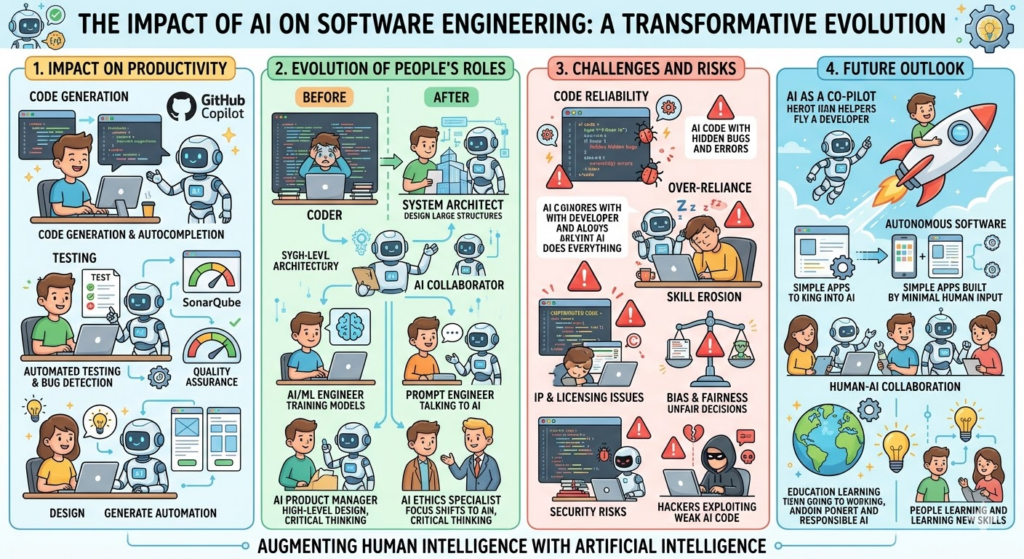
AI-powered tools such as GitHub Copilot and Amazon CodeWhisperer analyze code context and suggest entire functions, classes, or even full modules in real time. Developers can generate boilerplate code, handle API integrations, and prototype features up to 55% faster, according to GitHub’s 2023 developer survey. This reduces cognitive load and accelerates iteration cycles.
2. Automated Testing and Bug Detection
AI models analyze historical bug data and code patterns to predict failure-prone areas and generate targeted test cases. Tools like Stryker and Applitools use machine learning to detect visual regressions and functional anomalies, significantly improving test coverage and reducing manual testing efforts.
3. Smarter Code Reviews and Quality Assurance
AI-driven static analysis tools (e.g., SonarQube with AI enhancements) automatically flag security vulnerabilities, performance bottlenecks, and code style violations. These systems provide instant feedback, reducing the burden on peer reviews and improving code consistency across teams.
4. Accelerated Design and Requirements Analysis
AI can interpret natural language descriptions of user stories and generate initial system designs, database schemas, or even UI mockups. This enables faster prototyping and reduces time-to-market for new features.
5. Optimized DevOps and CI/CD Pipelines
AI analyzes build logs, deployment patterns, and system monitoring data to predict failures, recommend configuration changes, and optimize deployment strategies. This leads to more stable releases and faster incident response times.
Redefining Roles: The Evolving Software Engineer
AI is not replacing software engineers—it is transforming their roles. The focus is shifting from manual coding to strategic design, oversight, and ethical stewardship.
1. From Coder to AI Collaborator
Engineers are no longer just writers of code—they are now curators and validators of AI-generated output. The emphasis is on reviewing, refining, and ensuring the correctness and security of AI suggestions.
2. Rise of New Specialized Roles
-
AI/ML Engineers: Build and integrate machine learning models into software systems.
-
Prompt Engineers: Optimize interactions with AI tools to achieve desired outcomes.
-
AI Product Managers: Translate business needs into AI-driven features.
-
AI Ethics & Safety Specialists: Ensure fairness, transparency, and accountability in AI-powered systems.
3. Emphasis on AI Literacy
Understanding how AI models work, their limitations, and their potential biases has become essential. Developers must now be fluent in AI concepts, model evaluation, and responsible deployment practices.
4. Focus on Creativity and Problem-Solving
With routine tasks automated, engineers can dedicate more time to innovation, system architecture, and solving complex, non-trivial problems—areas where human judgment remains irreplaceable.
Challenges and Risks: Navigating the AI Frontier
Despite its benefits, AI integration in software engineering introduces significant challenges that must be addressed.
1. Code Quality and Reliability
AI can generate syntactically correct but logically flawed or insecure code. Known as “hallucinations,” these errors—such as suggesting non-existent APIs—can introduce bugs or security vulnerabilities.
2. Over-Reliance and Skill Erosion
Excessive dependence on AI may erode fundamental coding and debugging skills. Developers risk becoming passive consumers of AI output without understanding the underlying logic.
3. Intellectual Property and Legal Concerns
AI models trained on public codebases may reproduce copyrighted code, raising legal questions about ownership and licensing of AI-generated code.
4. Bias and Fairness
AI tools can inherit and amplify biases present in training data, leading to discriminatory or unfair software behavior—especially in critical systems like healthcare or finance.
5. Security Threats
Malicious actors can exploit AI to generate vulnerabilities, automate attacks, or create deceptive code. AI-powered tools can also be used to bypass traditional security checks.
The Future: Human-AI Synergy in Software Development
The future of software engineering lies not in replacing humans with machines, but in augmenting human intelligence with artificial intelligence. As AI continues to evolve, we can expect:
-
AI as a true co-pilot: Integrated into IDEs, CI/CD pipelines, and project management tools, providing real-time guidance and insights.
-
Autonomous application generation: For simple, well-defined tasks, AI may soon design, code, test, and deploy applications with minimal human input.
-
Ethical AI by design: Developers will be expected to build systems that are transparent, explainable, and accountable.
-
New educational paradigms: Software engineering curricula will increasingly emphasize AI literacy, ethics, and cross-disciplinary collaboration.
Conclusion
Artificial Intelligence is revolutionizing software engineering—not by replacing developers, but by empowering them. It boosts productivity, accelerates innovation, and frees engineers to focus on higher-value tasks. At the same time, it demands a fundamental shift in mindset and skill sets. The most successful engineers of tomorrow will be those who can collaborate effectively with AI, think critically about its outputs, and uphold ethical standards in an increasingly intelligent development ecosystem. As AI continues to evolve, the future of software engineering is not about machines taking over—but about humans and machines working together to build smarter, safer, and more scalable software for the world.
Key Takeaways:
-
AI dramatically increases development speed and code quality through automation.
-
Software engineers are evolving into AI collaborators, requiring new skills in ethics, AI literacy, and system design.
-
Challenges include code reliability, bias, security, and intellectual property—requiring proactive governance.
-
The future is one of human-AI synergy: where intelligence is amplified, not replaced.
The best code isn’t written by humans alone—or by AI alone. It’s written together.