

Understanding the external environment is crucial for any business strategy. The PEST Analysis Framework serves as a foundational tool for environmental scanning. It helps organizations identify key factors that influence performance. For business students, mastering this framework provides a clear lens through which to view market dynamics. This guide breaks down each component with precision and practical examples.
Whether you are analyzing a startup or a multinational corporation, these four pillars remain constant. This study guide covers the Political, Economic, Social, and Technological aspects. We will explore how to apply this model effectively in real-world scenarios.
What is the PEST Analysis Framework? 🧭
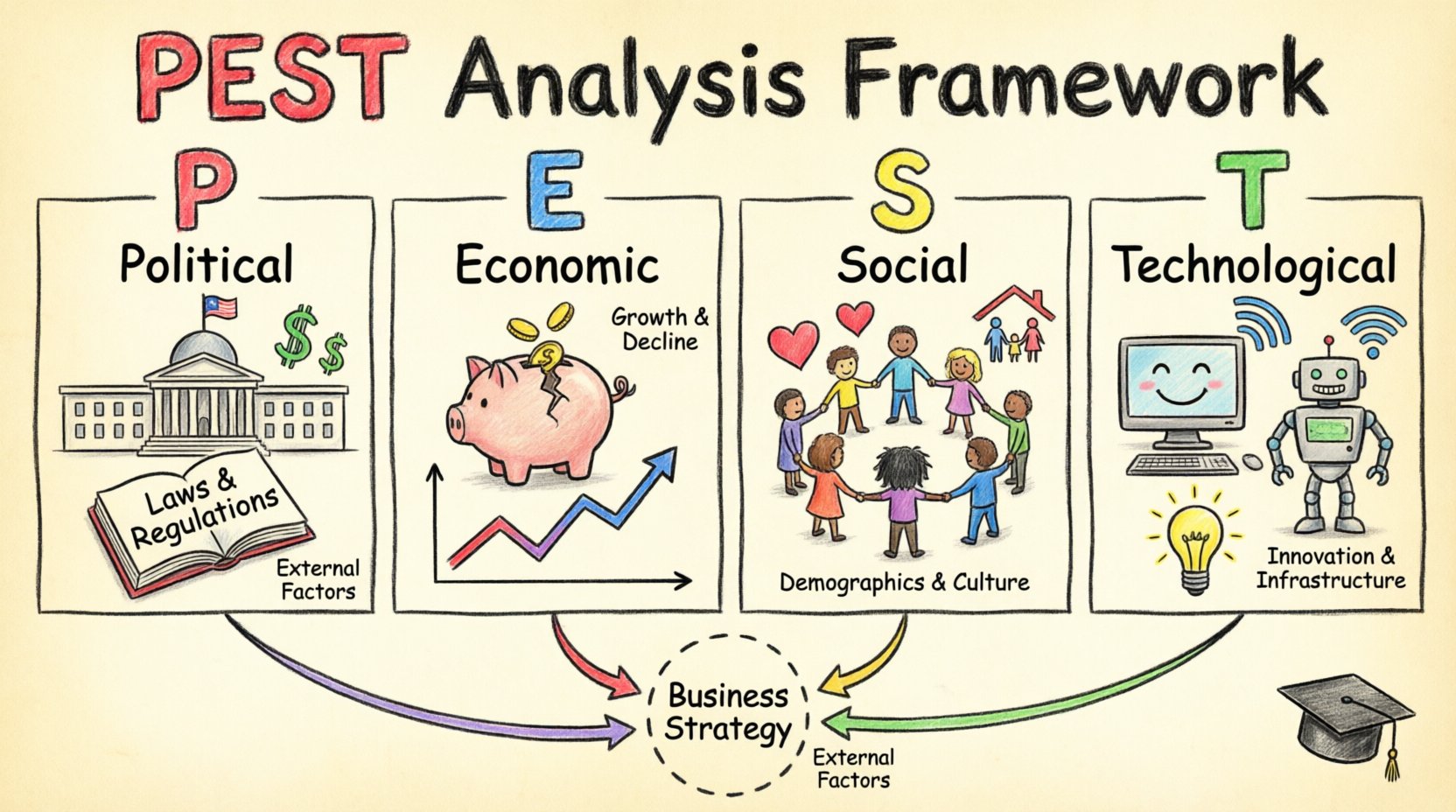
PEST stands for Political, Economic, Social, and Technological. It is a strategic framework used to scan the macro-environmental factors that impact an organization. Unlike internal analysis tools, PEST looks outward. It examines forces outside the control of the business.
Business students often encounter this model in strategic management courses. The primary goal is risk mitigation and opportunity identification. By understanding these external drivers, decision-makers can anticipate changes rather than react to them.
- Macro-Environmental: These factors affect all organizations within an industry.
- Non-Controllable: Companies cannot dictate these forces but must adapt to them.
- Strategic Planning: It informs long-term planning and resource allocation.
While often used alongside SWOT analysis, PEST specifically addresses the external context. SWOT combines internal strengths and weaknesses with external opportunities and threats. PEST provides the data needed to populate the Opportunities and Threats sections of a SWOT matrix.
The Four Pillars Explained 🔍
Each letter in the PEST acronym represents a specific category of external factors. Below is a detailed breakdown of what each pillar entails.
1. Political Factors 🏛️
Political factors relate to government intervention and influence on the economy. These elements can significantly alter market conditions. Stability in government is often a prerequisite for investment.
- Tax Policy: Changes in corporate tax rates directly impact profitability.
- Trade Restrictions: Tariffs and quotas affect import and export costs.
- Labour Laws: Regulations regarding hiring, firing, and wages.
- Environmental Regulations: Laws concerning sustainability and waste management.
- Political Stability: Risk of unrest or policy shifts.
For example, a government introducing a carbon tax will increase operational costs for manufacturing firms. Conversely, subsidies for renewable energy might benefit green technology startups. Students must analyze how policy shifts create barriers or incentives.
2. Economic Factors 💰
Economic factors determine the purchasing power of potential customers and the cost of capital. These variables fluctuate based on the broader economic climate.
- Economic Growth: GDP growth rates indicate market potential.
- Exchange Rates: Currency fluctuations affect international trade competitiveness.
- Inflation Rates: High inflation erodes consumer purchasing power.
- Interest Rates: Borrowing costs for expansion or inventory.
- Disposable Income: The amount of money households have for spending.
During a recession, consumers typically cut back on discretionary spending. Luxury goods brands face different challenges than essential service providers. Understanding the economic cycle helps businesses time their entry into new markets.
3. Social Factors 👥
Social factors encompass demographic and cultural aspects of the external environment. These trends influence consumer behavior and demand.
- Population Growth: Affects the size of the potential market.
- Age Distribution: An aging population requires different products than a youth-heavy market.
- Health Consciousness: Shifts toward organic or fitness-related products.
- Lifestyle Trends: Changes in work-life balance and remote work.
- Cultural Norms: Local customs and traditions affecting product acceptance.
Aging populations in developed nations create demand for healthcare and retirement services. Meanwhile, emerging markets often have younger demographics, driving demand for education and technology. Ignoring social shifts can lead to product obsolescence.
4. Technological Factors 💻
Technological factors relate to innovations that create new markets or destroy old ones. This area changes rapidly and requires constant monitoring.
- R&D Activity: The level of innovation within an industry.
- Automation: Impact on labor costs and efficiency.
- Internet Infrastructure: Connectivity levels in target regions.
- Disruptive Tech: AI, blockchain, or biotechnology advancements.
- Technology Incentives: Government grants for tech development.
Consider the rise of streaming services. Traditional media companies faced existential threats due to technological shifts. Businesses that failed to adapt to new digital platforms lost significant market share. Continuous technological scanning is vital for survival.
Comparative Overview of Factors 📋
To aid comprehension, the following table summarizes the key distinctions between each category.
| Factor | Key Focus | Example Metric | Impact Level |
|---|---|---|---|
| Political | Government Policy | Tax Rate % | High |
| Economic | Market Performance | GDP Growth Rate | Medium |
| Social | Demographics & Culture | Average Age | Medium |
| Technological | Innovation & R&D | Patents Filed | High |
How to Conduct a PEST Analysis 🔧
Executing this analysis requires a structured approach. Randomly listing factors rarely yields actionable insights. Follow these steps to ensure a comprehensive study.
Step 1: Define the Scope
Clearly state what you are analyzing. Is it a new product launch? A market entry strategy? Or a full corporate review? The scope dictates which factors are relevant. A global company must consider international politics, while a local business focuses on municipal regulations.
Step 2: Gather Data
Collect accurate and up-to-date information. Use government reports, industry publications, and market research. Avoid relying on outdated data. Economic conditions change quarterly, and social trends shift annually.
Step 3: Identify Key Factors
Filter the data. Not every statistic matters. Select the factors that have the most significant impact on your specific business context. Prioritize trends that are emerging rather than established.
Step 4: Analyze Implications
Determine how each factor affects operations. Does it increase costs? Does it open new revenue streams? Create a matrix to map threats against opportunities. This step transforms data into strategy.
Step 5: Monitor Continuously
External environments are dynamic. A one-time analysis becomes obsolete quickly. Establish a schedule to review these factors regularly. Quarterly reviews are common for fast-moving industries.
Common Limitations and Challenges ⚠️
While powerful, the PEST framework is not without drawbacks. Students must understand these limitations to apply the model correctly.
- Static Nature: The model can appear static if not updated frequently. It represents a snapshot in time.
- Subjectivity: Identifying relevant factors depends on the analyst’s perspective. Different teams may prioritize different data.
- Interconnectivity: Factors often overlap. Technological changes can drive social shifts. The model treats them separately, which may oversimplify reality.
- Lack of Specificity: It does not measure the magnitude of impact. It identifies the direction, not the intensity.
- Information Overload: Too much data can obscure the most critical signals. Filtering is essential.
PEST vs. PESTLE 🔄
Often, you will encounter the PESTLE framework. This is an extension of the original model. PESTLE adds two additional letters: Legal and Environmental.
- Legal: Focuses on specific laws such as consumer protection, health and safety, and employment legislation.
- Environmental: Focuses on ecological and environmental aspects, such as climate change and carbon footprint.
For business students, understanding the distinction is important. PEST is broader, while PESTLE is more specific regarding compliance and sustainability. Many modern contexts require the PESTLE approach due to increased regulatory scrutiny.
Practical Application Example 🌍
Let us apply this framework to a hypothetical electric vehicle (EV) manufacturer planning to enter a new market.
- Political: The government offers subsidies for EV purchases. However, import tariffs on battery components are high.
- Economic: Disposable income is rising, but interest rates are high, affecting car loans.
- Social: Consumers are increasingly concerned about climate change and prefer green brands.
- Technological: Charging infrastructure is expanding rapidly, reducing range anxiety.
In this scenario, the political subsidies and social trends are strong positives. The economic interest rates are a hurdle. The technological infrastructure supports the business model. The strategy would focus on leveraging subsidies while offering flexible financing to counter high interest rates.
Frequently Asked Questions ❓
Here are common questions regarding this framework.
Who uses PEST Analysis?
It is used by strategists, consultants, entrepreneurs, and business students. Any entity requiring a macro-environmental scan can benefit from it.
How often should it be updated?
Annually is standard. For volatile industries, quarterly updates are recommended.
Can it replace market research?
No. It complements market research. PEST looks at the macro level, while market research looks at specific customer needs.
Is it suitable for small businesses?
Yes. Small businesses face the same macro forces as large corporations, often with less buffer to absorb shocks.
Final Thoughts 🎓
The PEST Analysis Framework is an essential component of business education. It equips students with the ability to look beyond internal operations. By systematically evaluating external forces, future leaders can make informed decisions.
Remember that data is only useful if it leads to action. A completed analysis that sits on a shelf adds no value. Use these insights to shape strategy, allocate resources, and mitigate risk. As the global landscape evolves, so must your analytical tools. Keep this framework in your toolkit, and update it as the world changes around you.