

Strategic planning requires a clear view of the environment surrounding an organization. External factors often dictate market viability more than internal capabilities. The PEST framework provides a structured method to scan these external forces. This guide breaks down each component for quick reference and effective application.
Businesses operate within a dynamic ecosystem. Decisions made in isolation often fail when external shifts occur. Understanding the political, economic, social, and technological landscape allows leaders to anticipate change. This analysis is not a one-time event but a recurring practice. Regular revision ensures strategies remain relevant.
Understanding the PEST Framework 🧭
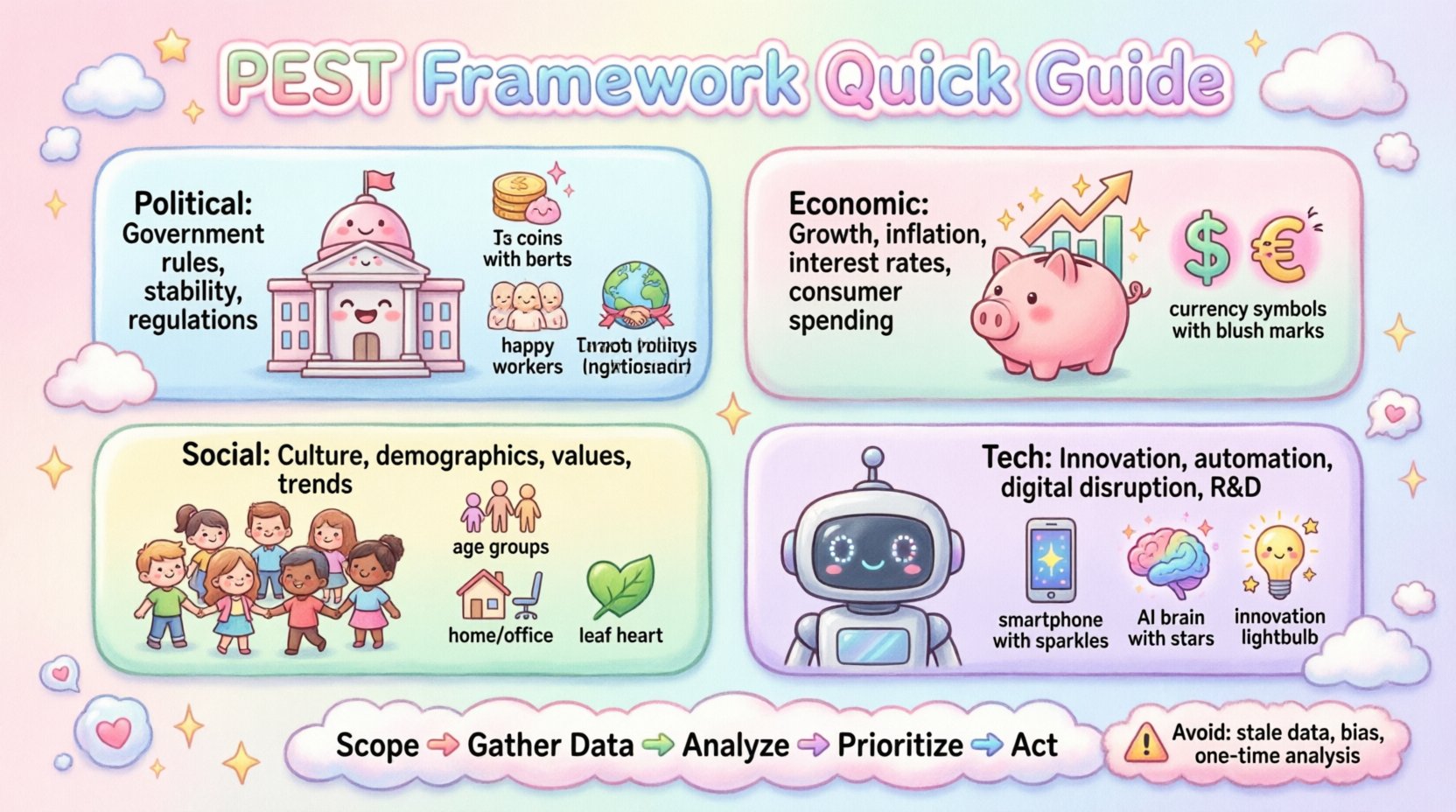
The PEST acronym stands for Political, Economic, Social, and Technological. It is a strategic tool used to identify external factors that impact an organization. Unlike internal analysis, this framework looks outward. It helps teams understand the macro-environment.
Using this framework helps in:
- Identifying market opportunities
- Recognizing potential threats
- Aligning resources with external realities
- Supporting long-term planning
Each letter represents a distinct category of influence. These categories are not isolated; they often overlap. For instance, political decisions directly affect economic conditions. Social trends can drive technological innovation. Recognizing these interconnections is vital for accurate analysis.
The Four Pillars Explained 🔍
Deep diving into each component reveals specific factors to monitor. Below is a detailed breakdown of what constitutes each pillar.
1. Political Factors (P) 🏛️
Political factors relate to government intervention in the economy. This includes tax policy, labor law, environmental regulation, and trade restrictions. The stability of the government is also a key consideration.
Key questions to ask include:
- Is the government stable or prone to unrest?
- What are the current tax rates for businesses?
- Are there restrictions on foreign investment?
- How do trade tariffs affect supply chains?
- What are the labor laws regarding hiring and firing?
For example, a change in tax law can alter profit margins significantly. Environmental regulations might require new equipment or processes. Political instability can disrupt operations or supply lines. Monitoring government announcements is essential for risk management.
Political factors are often the most volatile. A new administration can shift priorities overnight. Organizations must remain agile to adapt to regulatory changes.
2. Economic Factors (E) 💰
Economic factors influence the purchasing power of potential customers. They also affect the cost of capital for the business. This category includes growth, interest rates, exchange rates, and inflation.
Consider the following elements:
- Economic Growth: Is the economy expanding or contracting?
- Interest Rates: How does borrowing cost impact expansion?
- Exchange Rates: Are imports and exports affected by currency value?
- Inflation: Is the cost of raw materials rising?
- Disposable Income: How much money do consumers have to spend?
During a recession, consumers tighten their budgets. Luxury goods may suffer, while discount retailers thrive. Conversely, a booming economy increases spending power. Interest rates dictate the cost of loans. High rates can stifle investment in new projects.
Global economic trends also play a role. A downturn in a major trading partner can ripple through the supply chain. Economic indicators provide early warning signs of shifts.
3. Social Factors (S) 👥
Social factors examine the cultural and demographic aspects of the environment. This includes population growth, age distribution, career attitudes, and health consciousness. It is about understanding the people who buy the products.
Important social trends to track:
- Demographics: Is the population aging or growing younger?
- Cultural Norms: What values drive consumer behavior?
- Lifestyle Changes: Are people working remotely or commuting?
- Ethical Concerns: How important is sustainability to customers?
- Education Levels: Does the workforce have the required skills?
For instance, an aging population increases demand for healthcare services. A shift towards remote work changes the need for office space. Health consciousness drives demand for organic food options.
Social factors change slowly but consistently. Understanding these trends helps in product development. It also aids in marketing messaging. If a campaign ignores social values, it may fail to resonate.
4. Technological Factors (T) 📱
Technological factors involve innovation and the rate of technological change. This includes R&D activity, automation, and technological incentives. It also covers the infrastructure available to support new tech.
Key technological drivers include:
- Automation: Can tasks be performed by machines?
- Internet Connectivity: Is broadband access widespread?
- Data Security: What are the risks regarding cyber threats?
- Research & Development: What new technologies are emerging?
- Disruption: Is a new technology replacing an old one?
Technology can create new markets or destroy old ones. Streaming services disrupted traditional media. E-commerce transformed retail. Companies that ignore technological shifts risk obsolescence.
However, technology also lowers barriers to entry. Small startups can compete with large incumbents. Organizations must invest in their own digital capabilities to stay competitive.
Comparative Overview of Factors 📋
Visualizing the differences between factors helps in organizing the analysis. The table below summarizes the focus areas for each component.
| Factor | Focus Area | Example Question |
|---|---|---|
| Political | Government Intervention | How will new regulations affect compliance costs? |
| Economic | Financial Performance | How does inflation impact our pricing strategy? |
| Social | Human Behavior | Are consumers shifting towards sustainable products? |
| Technological | Innovation & Tools | Will AI replace our current customer support model? |
Conducting a PEST Analysis 📝
Executing a proper analysis requires a systematic approach. Random guessing leads to inaccurate results. Follow these steps to ensure a robust review.
Step 1: Define the Scope
Identify the specific market or product being analyzed. A global company needs a different analysis than a local startup. Define the time horizon. Are you looking at the next year or the next decade?
Step 2: Gather Data
Collect information from reliable sources. Use government reports, industry publications, and news outlets. Avoid relying on rumors. Data should be current and verifiable.
Step 3: Analyze the Factors
Review the collected data against each PEST category. Look for patterns. Determine which factors are most relevant to the specific business context. Some factors may be minor, while others are critical.
Step 4: Prioritize
Not all factors carry equal weight. Rank them by impact and likelihood. Focus resources on the high-priority items. Low-impact items can be monitored but do not require immediate action.
Step 5: Develop Strategies
Translate insights into action. If a threat is identified, create a mitigation plan. If an opportunity is found, allocate resources to capture it. Ensure the strategy aligns with the overall business goals.
Common Pitfalls to Avoid ⚠️
Even experienced analysts make mistakes. Being aware of common errors helps improve the quality of the output.
- Ignoring Interconnections: Factors do not exist in a vacuum. Economic shifts often drive social changes. Treat them as a system.
- Stale Data: Market conditions change rapidly. Outdated information leads to poor decisions.
- Too Broad: Trying to analyze every possible factor dilutes focus. Stick to the most relevant ones.
- Subjectivity: Avoid letting personal bias influence the assessment. Use facts and figures.
- One-Time Effort: The environment is dynamic. Set a schedule for regular reviews.
Expanding to PESTLE 🔄
Sometimes the basic PEST model is not enough. The PESTLE framework adds two more dimensions: Legal and Environmental. This provides a more comprehensive view.
- Legal: Specific laws regarding employment, health, safety, and consumer protection.
- Environmental: Ecological and environmental aspects such as climate change and waste.
Many organizations use PESTLE for regulatory-heavy industries. Environmental concerns are increasingly important for all sectors. Sustainability is no longer optional.
Final Thoughts on Strategic Review 💡
External analysis is a cornerstone of sound business management. It provides the context needed for internal planning. Without it, strategies are built on assumptions rather than reality.
Regular revision keeps the organization aligned with the market. It reduces risk and highlights opportunities. Leaders who prioritize this analysis are better prepared for change.
Implement the framework consistently. Train teams to think in terms of external factors. This creates a culture of strategic awareness. Continuous improvement in analysis leads to better long-term outcomes.
Use this guide as a reference point. Revisit the components whenever significant market shifts occur. Stay informed and adaptable. The business landscape will continue to evolve, and your strategy must evolve with it.