

Understanding the business landscape is fundamental to sustainable growth. Organizations cannot operate in a vacuum; they exist within a complex web of external forces that influence performance and strategy. External environment scanning provides the mechanism to identify, monitor, and evaluate these forces. Among the various frameworks available, the PEST analysis stands out as a robust method for structuring this intelligence. This approach categorizes macro-environmental factors into four distinct pillars: Political, Economic, Social, and Technological. By systematically examining these areas, decision-makers gain clarity on opportunities and threats before they materialize.
This guide details the mechanics of external environment scanning with a focus on PEST analysis methods. We will explore each component, discuss implementation steps, and highlight how this tool fits into broader strategic planning without relying on specific software solutions. The goal is to provide a clear, actionable understanding of how to leverage macro-environmental data for better business outcomes.
Understanding External Environment Scanning 🔍
External environment scanning is the process of gathering information about factors outside the organization that could impact its success. Unlike internal analysis, which looks at resources and capabilities within the company walls, external scanning looks outward. It involves continuous monitoring of trends, shifts, and developments in the wider world. This intelligence is critical because it helps organizations adapt to change rather than reacting to it after the fact.
When scanning the environment, businesses must distinguish between the micro-environment and the macro-environment. The micro-environment includes stakeholders like suppliers, customers, and competitors that interact directly with the firm. The macro-environment consists of broader forces that affect all organizations in an industry. PEST analysis is specifically designed to address these macro-environmental factors. It provides a structured way to filter noise and focus on high-impact variables.
Why Scanning Matters
- Risk Mitigation: Identifying potential regulatory changes or economic downturns early allows for contingency planning.
- Opportunity Identification: Emerging social trends or technological advancements can open new markets.
- Strategic Alignment: Ensures long-term goals match the reality of the operating environment.
- Resource Allocation: Helps direct investment toward areas with the highest potential return based on external conditions.
The PEST Framework Breakdown 🧩
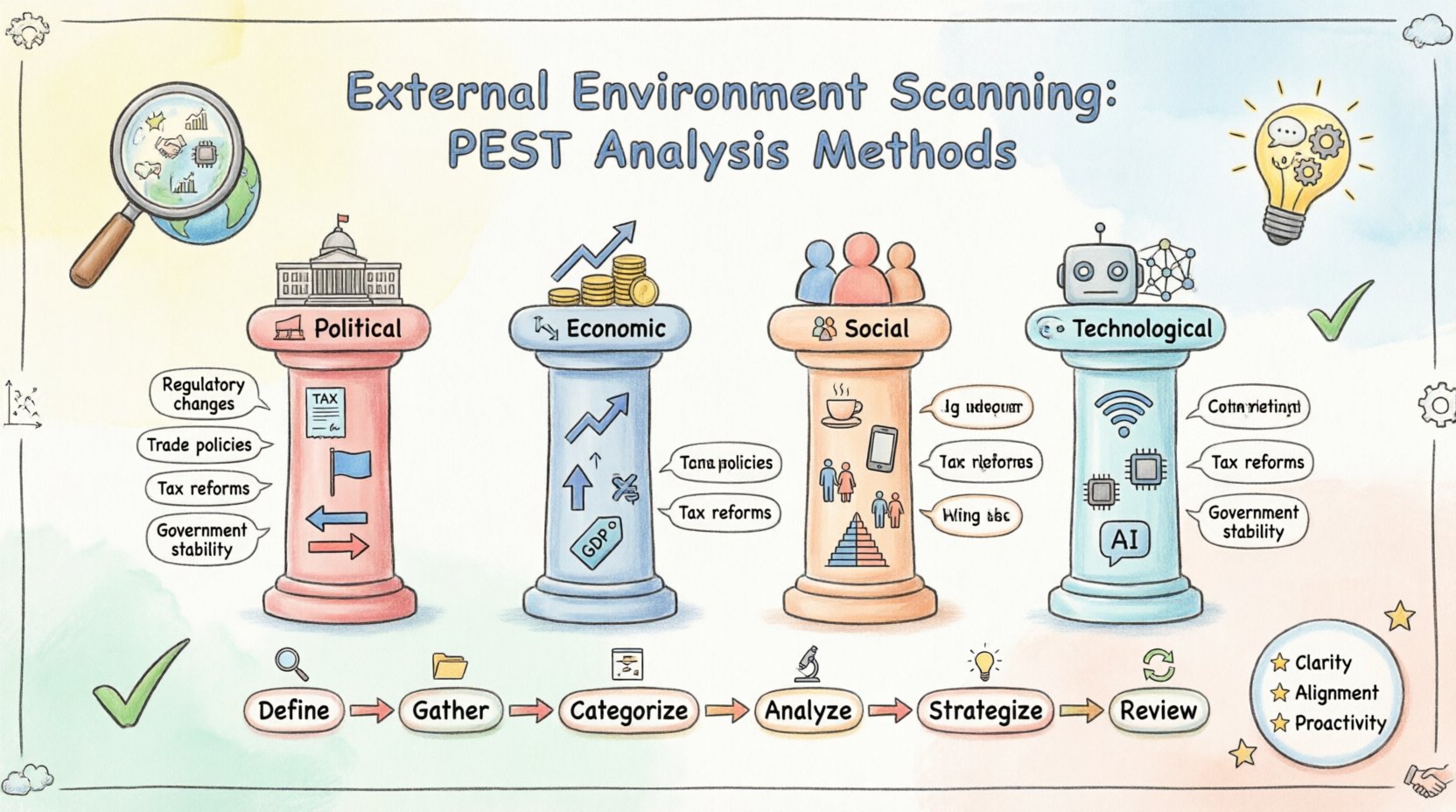
PEST analysis is a strategic tool used to identify and analyze the macro-environmental factors affecting an organization. The acronym stands for Political, Economic, Social, and Technological. While the framework is simple, its application requires depth and nuance. Each category represents a cluster of factors that, when combined, paint a picture of the external operating conditions.
Organizations often expand this model to PESTLE by adding Legal and Environmental factors. However, the core PEST structure remains the foundation for understanding the broad strokes of the business environment. Below is a detailed look at each pillar.
1. Political Factors 🏛️
Political factors relate to government intervention in the economy. These include tax policy, labor law, environmental law, trade restrictions, tariffs, and political stability. The influence of government on business is significant and can shift rapidly depending on election cycles or policy changes.
- Government Stability: Is the current administration likely to remain in power? Instability creates uncertainty for investors.
- Taxation Policies: Changes in corporate tax rates directly impact profitability and cash flow.
- Trade Regulations: Tariffs and quotas affect the cost of importing materials or exporting finished goods.
- Labor Laws: Minimum wage requirements and union regulations influence operational costs.
- Subsidies: Government support for specific industries can create competitive advantages.
For example, a shift in environmental policy might require a manufacturing firm to invest in cleaner technologies, altering capital expenditure plans. Conversely, a trade agreement might reduce costs for an importer. Understanding these dynamics is essential for compliance and strategic positioning.
2. Economic Factors 📉
Economic factors influence the purchasing power of potential customers and the cost of capital. These factors are often cyclical and can be difficult to predict. They determine the overall health of the economy and the specific conditions within an industry.
- Economic Growth: Measured by GDP, this indicates the overall health of the market. Growth usually drives demand.
- Interest Rates: High rates increase borrowing costs, potentially slowing expansion and investment.
- Inflation Rates: High inflation erodes purchasing power and increases input costs.
- Exchange Rates: Currency fluctuations affect the cost of international trade and profitability.
- Disposable Income: The amount of money households have available for spending influences consumer demand.
During a recession, consumers become more price-sensitive, favoring value over premium brands. In a boom, demand increases across the board. A PEST analysis must account for the current economic cycle and forecasts for the coming years.
3. Social Factors 👥
Social factors relate to the human aspects of the external environment. This includes demographic trends, cultural norms, health consciousness, and lifestyle changes. These factors often change slowly but have profound effects on consumer behavior and workforce availability.
- Demographics: Age distribution, population growth rates, and migration patterns.
- Health and Wellness: Increasing focus on fitness and diet affects food and beverage industries.
- Cultural Attitudes: Shifts in societal values regarding sustainability or diversity.
- Lifestyle Changes: Remote work trends or urbanization rates.
- Education Levels: The skill level of the available workforce impacts hiring strategies.
For instance, an aging population creates demand for healthcare services and retirement planning products. A shift toward remote work changes the need for commercial office space. Recognizing these social shifts allows businesses to tailor their offerings to meet evolving customer needs.
4. Technological Factors 💻
Technological factors involve innovations that create new markets, disrupt existing ones, or change production processes. This includes research and development activity, automation, and technology incentives. In the modern era, technology is often the fastest-moving and most disruptive element of the PEST analysis.
- Automation: Robotics and AI can reduce labor costs and increase efficiency.
- Internet Access: Connectivity levels determine the viability of e-commerce.
- Software Innovation: New tools can streamline operations or create new business models.
- Intellectual Property: Patent laws protect innovation but can also limit competition.
- Infrastructure: Availability of data centers and transport networks.
Disruption often comes from outside the industry. A technology company might render a traditional service obsolete. Therefore, scanning for technological trends is not just about internal R&D but about monitoring the broader tech landscape.
Conducting a PEST Analysis 📝
Implementing a PEST analysis requires a structured approach. It is not a one-time exercise but a periodic review to keep the strategy relevant. The process involves gathering data, categorizing it, and interpreting its impact.
Step-by-Step Implementation
- Define the Objective: Clarify what decision the analysis will support. Is it for a new product launch, market entry, or annual strategy review?
- Gather Data: Collect information from news sources, industry reports, government publications, and academic journals. Avoid relying on a single source.
- Categorize Factors: Sort the collected information into Political, Economic, Social, and Technological buckets.
- Analyze Impact: Determine the relevance and urgency of each factor. Does it pose a threat or an opportunity?
- Develop Strategies: Create action plans based on the findings. Adjust goals to align with external realities.
- Review Regularly: Update the analysis as conditions change. Macro-environments are dynamic.
Data Sources
Reliable data is the backbone of a valid analysis. Sources include government statistics, trade associations, financial news, and market research firms. It is important to verify the credibility of the source. Anecdotal evidence should be supplemented with hard data.
Integrating PEST with Other Tools 🤝
While PEST is powerful on its own, it works best when integrated with other strategic frameworks. Combining PEST with SWOT analysis, for example, allows organizations to translate external factors into internal strengths, weaknesses, opportunities, and threats. The external factors identified in PEST become the Opportunities and Threats in SWOT.
Porter’s Five Forces can also complement PEST. While PEST looks at the macro-environment, Porter’s Five Forces analyzes the micro-environment and industry competition. Using both provides a complete picture of the business landscape.
Comparison of Frameworks
| Framework | Focus | Best Used For |
|---|---|---|
| PEST Analysis | Macro-Environment | Strategic Planning, Market Entry |
| SWOT Analysis | Internal & External | Overall Health Assessment |
| Porter’s Five Forces | Industry Competition | Competitive Strategy |
| Scenario Planning | Future Uncertainty | Long-term Risk Management |
Common Mistakes to Avoid ❌
Even with a solid framework, errors can occur during the analysis process. Being aware of common pitfalls ensures the output is actionable and accurate.
- Overgeneralization: Treating factors as universal when they may be specific to certain regions or sectors.
- Static Analysis: Treating the environment as fixed rather than dynamic.
- Ignoring Weak Signals: Focusing only on obvious trends and missing subtle shifts that could become major disruptions.
- Lack of Cross-Functional Input: Limiting the analysis to the strategy team. Sales, operations, and HR should contribute their perspectives.
- Data Overload: Collecting too much information without filtering for relevance.
Benefits of PEST Analysis ✅
When executed correctly, PEST analysis offers significant advantages to an organization. It brings structure to chaos and turns vague concerns into concrete data points.
- Clarity: Simplifies complex external environments into manageable categories.
- Alignment: Ensures all departments understand the external context.
- Proactivity: Shifts the mindset from reaction to anticipation.
- Communication: Provides a common language for discussing strategic risks and opportunities.
- Efficiency: Streamlines the decision-making process by highlighting critical external factors.
Limitations and Considerations ⚠️
No tool is perfect. Understanding the limitations of PEST analysis helps in using it appropriately.
- Simplification: The four categories may oversimplify complex interactions between factors.
- Subjectivity: Interpretation of data can vary between analysts.
- Speed of Change: In rapidly evolving sectors, the analysis can become outdated quickly.
- Internal Focus: It does not account for internal capabilities or culture.
Organizations should view PEST as one input among many. It should not dictate strategy in isolation but inform the broader decision-making process.
Real-World Application Examples 🏢
To illustrate the utility of PEST analysis, consider a hypothetical scenario involving a renewable energy company expanding into a new region.
Political
The new region offers tax incentives for green energy projects. However, recent political instability suggests potential policy shifts. The company must weigh the incentives against the risk of regulatory uncertainty.
Economic
Inflation rates are high, increasing the cost of equipment installation. Interest rates are rising, making financing expensive. The company must adjust pricing models to maintain margins.
Social
Public awareness of climate change is growing in the region. There is high demand for sustainable solutions. This social trend supports a premium pricing strategy.
Technological
New battery storage technologies are becoming available. Adopting these early could provide a competitive edge over local competitors using older methods.
By synthesizing these factors, the company can make an informed decision to enter the market with a modified risk profile and specific operational adjustments.
Best Practices for Accuracy ✅
To ensure the PEST analysis yields high-quality insights, follow these best practices.
- Use Multiple Perspectives: Involve stakeholders from different departments to reduce bias.
- Validate Data: Cross-reference information from at least three independent sources.
- Focus on Relevance: Filter out noise. Only include factors that directly impact the business.
- Update Frequently: Schedule regular reviews, such as quarterly or annually.
- Document Assumptions: Clearly state the assumptions made during the analysis to allow for future adjustment.
Future Trends in Environmental Scanning 🔮
The landscape of external scanning is evolving. As data becomes more accessible, the speed and depth of analysis are increasing. Organizations are moving towards continuous scanning rather than periodic reviews. This shift allows for real-time adaptation to market changes.
Artificial intelligence is beginning to play a role in aggregating and analyzing large volumes of external data. While human judgment remains essential for interpretation, technology can handle the initial data processing. This combination allows teams to focus on strategic implications rather than data collection.
Furthermore, the definition of the external environment is expanding. Factors like climate change and geopolitical tensions are becoming central to strategic discussions. The PEST framework is adapting to include these critical dimensions, ensuring it remains relevant in a complex world.
Final Thoughts on Strategic Planning 📊
External environment scanning is not a luxury; it is a necessity for survival in competitive markets. PEST analysis provides a reliable method for organizing this information. By systematically examining Political, Economic, Social, and Technological factors, organizations can navigate uncertainty with greater confidence.
The value lies not just in the output but in the discipline of the process. Regularly engaging with the external environment fosters a culture of awareness and adaptability. As conditions change, so too must strategies. This dynamic relationship between the organization and its environment is the key to long-term resilience and success.
Start by integrating PEST analysis into your next strategic planning session. Gather your team, review the current landscape, and identify the factors that will shape your future. The insights gained will serve as the foundation for robust decision-making.