

Business strategy relies on more than just financial metrics and technological capabilities. To truly understand the environment in which an organization operates, one must look at the people themselves. The PEST analysis is a strategic tool used to scan the external macro-environmental factors affecting an industry. Within this framework, the “S” stands for Socio-Cultural factors. This component examines the social and cultural aspects of a market that influence consumer behavior, workforce dynamics, and long-term business viability.
Conducting a robust socio-cultural analysis allows organizations to anticipate shifts in demand, adapt marketing messages, and align internal policies with societal expectations. It moves beyond simple demographics to explore values, beliefs, and lifestyle trends. This article provides a comprehensive guide to integrating socio-cultural insights into your strategic planning.
🔍 What Defines Socio-Cultural Factors?
Socio-cultural factors encompass the attitudes, beliefs, customs, and lifestyle trends of a population. Unlike political or economic factors, which are often quantifiable through legislation or currency exchange rates, socio-cultural elements are qualitative and fluid. They evolve over time as societies progress, interact, and respond to global events. Understanding these factors is critical because they dictate what people buy, how they work, and where they live.
These factors do not exist in isolation. They interact with economic conditions and technological advancements. For instance, a shift in cultural values regarding health can drive economic spending on wellness products, which in turn stimulates technological innovation in fitness tracking. The goal of this analysis is to map these interactions.
Key Dimensions of Socio-Cultural Analysis
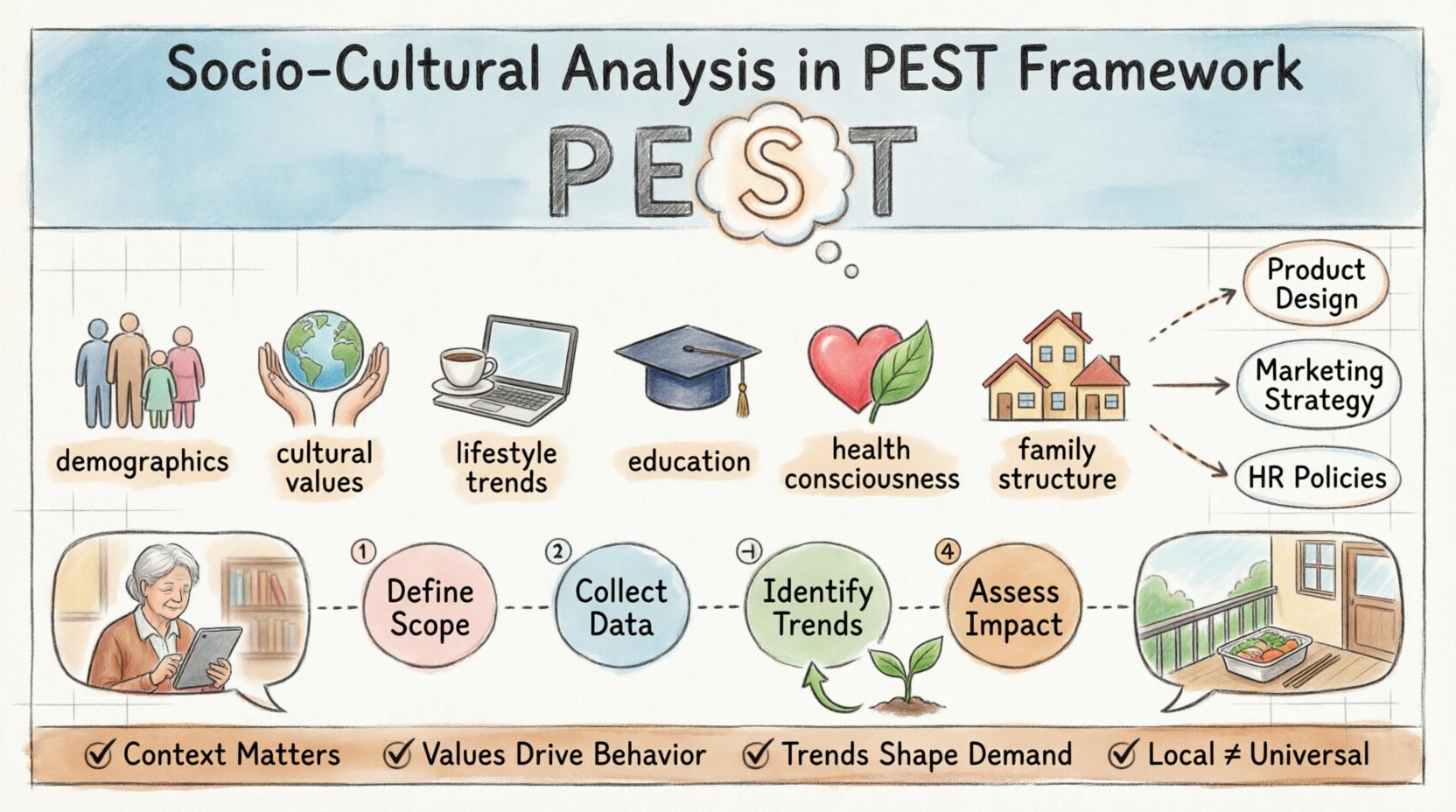
To ensure a thorough examination, analysts should break down socio-cultural factors into specific, actionable dimensions. The following areas provide a structured approach:
- Demographics: Population size, age distribution, gender ratios, and population growth rates.
- Cultural Values: Religious beliefs, ethical standards, and societal norms.
- Lifestyle Trends: Hobbies, leisure activities, and daily routines.
- Education Levels: Literacy rates, specialization of skills, and access to information.
- Health Consciousness: Attitudes toward physical well-being, diet, and mental health.
- Family Structure: Household sizes, single-parent households, and multi-generational living.
📊 Comparing Socio-Cultural Dimensions
Organizing these factors into a structured format helps in identifying patterns and correlations. The table below illustrates how different socio-cultural dimensions impact various business functions.
| Dimension | Key Indicator | Business Impact |
|---|---|---|
| Age Structure | Aging population vs. Youth bulge | Determines product lifecycle and workforce availability. |
| Income Distribution | Disposable income levels by segment | Drives pricing strategy and market segmentation. |
| Cultural Norms | Work-life balance preferences | Influences remote work policies and recruitment. |
| Ethical Values | Preference for sustainable goods | Affects supply chain sourcing and branding. |
| Education | Technical skill prevalence | Impacts talent acquisition and training costs. |
🚀 Why Socio-Cultural Analysis Matters
Ignoring the human element in strategic planning can lead to significant market failures. Products that fail to align with cultural values often struggle to gain traction, regardless of their technical merit. Conversely, companies that adapt to social shifts often capture new market share.
1. Predicting Consumer Behavior
Consumer behavior is rarely random. It is rooted in cultural conditioning. For example, a shift towards minimalism in developed markets reduces demand for fast fashion, pushing companies to focus on quality over quantity. Recognizing this trend early allows businesses to pivot their inventory and marketing strategies before competitors react.
2. Workforce Management
The workforce is not just a resource; it is a reflection of society. Changing attitudes towards diversity, inclusion, and mental health require updates to HR policies. Companies that ignore these cultural shifts risk high turnover rates and reputational damage.
3. Risk Mitigation
Societal backlash can occur if a company violates local customs. This is particularly relevant for multinational corporations entering new regions. A thorough socio-cultural analysis highlights potential friction points before they become crises.
🛠️ How to Conduct the Analysis
Executing a socio-cultural analysis requires a mix of quantitative data and qualitative research. The process involves gathering data, interpreting trends, and assessing impact. The following steps outline a reliable methodology.
Step 1: Define the Scope
Begin by determining the geographical and industry boundaries. A socio-cultural factor relevant to a tech startup in Silicon Valley may differ significantly from one in rural India. Narrowing the scope ensures the data remains relevant and actionable.
Step 2: Data Collection
Gather information from diverse sources. Avoid relying on a single dataset. Recommended sources include:
- Government Census Data: Provides accurate demographic breakdowns.
- Academic Research: Offers insights into sociological trends.
- Market Reports: Industry-specific analysis of consumer behavior.
- Social Listening: Monitoring online conversations for emerging sentiments.
Step 3: Identify Key Trends
Look for shifts rather than static snapshots. Ask questions such as: Is the population aging? Are people moving to urban centers? Is there a growing demand for ethical sourcing? Identify which trends are temporary fads and which are structural changes.
Step 4: Assess Impact
Translate findings into business implications. If the population is aging, how does that affect your product design? If remote work is normalized, how does that affect office lease agreements? Quantify the impact where possible to aid decision-making.
💡 Real-World Applications
Understanding theoretical concepts is one thing; applying them is another. Consider the following scenarios where socio-cultural analysis drives strategy.
Scenario 1: The Aging Population
In many developed nations, the median age is rising. This demographic shift creates demand for healthcare services, retirement planning, and age-friendly technology. Companies in the electronics sector might redesign interfaces to be more accessible for older users. Retailers might adjust inventory to suit the needs of seniors.
Scenario 2: The Rise of Sustainability
Modern consumers, particularly younger generations, prioritize environmental responsibility. This cultural shift forces companies to rethink their supply chains. Packaging must be biodegradable, and manufacturing processes must reduce carbon footprints. Brands that fail to adapt face boycotts and loss of brand loyalty.
Scenario 3: Changing Family Structures
As household sizes shrink and single-parent families become more common, the demand for convenience increases. Meal kits, smaller appliance sizes, and flexible payment plans become attractive. Businesses must tailor their offerings to fit these smaller, busier units.
⚠️ Common Pitfalls to Avoid
Even with a structured approach, errors can occur during the analysis. Being aware of these common mistakes helps maintain the integrity of the findings.
- Generalizing Too Broadly: Assuming all members of a culture think the same way. Subcultures exist within every society.
- Ignoring Time Lags: Cultural shifts take time. A trend today might not be the standard tomorrow. Avoid projecting current fads as permanent fixtures.
- Overlooking Local Nuances: Global data often hides local realities. A trend in one region might not apply to another, even within the same country.
- Confirmation Bias: Seeking only data that supports preconceived notions. Remain open to evidence that contradicts initial hypotheses.
🔮 Future Outlook
The landscape of socio-cultural factors is constantly evolving. Several long-term trends are likely to shape the next decade of business strategy.
- Globalization vs. Localization: While products become more global, consumer expectations for local relevance remain high. “Glocalization” will be key.
- Digital Integration: The line between physical and digital life is blurring. Social media influences cultural norms and purchasing decisions more than ever.
- Wellness Economy: Health will transition from a medical necessity to a lifestyle priority. Mental health will be discussed more openly, influencing workplace culture.
- Privacy Concerns: As data collection increases, cultural trust in technology will fluctuate. Companies must balance innovation with user privacy.
🤝 Integrating with Other Frameworks
Socio-cultural analysis should not stand alone. It works best when integrated with other strategic tools. Combining it with SWOT analysis allows you to identify Opportunities and Threats based on social trends. For instance, an aging population is a Threat for a youth-oriented fashion brand but an Opportunity for a healthcare provider.
When used alongside PESTLE analysis (adding Legal and Environmental factors), the socio-cultural component provides the “Human” context for the “Environmental” and “Legal” constraints. This holistic view ensures that strategies are not only compliant and profitable but also socially viable.
📝 Summary of Key Takeaways
To conclude this examination of socio-cultural analysis within the PEST framework, consider the following points:
- Human-Centric Strategy: Business success depends on understanding human needs and values.
- Data Diversity: Use multiple data sources to build a complete picture.
- Dynamic Monitoring: Socio-cultural trends change; monitoring must be continuous.
- Actionable Insights: Analysis is useless without translating findings into operational changes.
- Ethical Responsibility: Respect cultural nuances and avoid stereotypes.
By dedicating resources to understanding the socio-cultural environment, organizations build resilience. They become agile enough to navigate social shifts and empathetic enough to connect with their customers on a deeper level. This depth of understanding is often the differentiator between a commodity and a beloved brand.