

Understanding the macro-environment is essential for any organization operating within the technology sector. Markets shift rapidly, driven by external forces that often exist beyond the control of individual companies. To navigate this complexity, strategic planners utilize structured frameworks. The PEST analysis provides a comprehensive method for examining Political, Economic, Social, and Technological factors. When applied specifically to technology trends, this framework reveals the underlying currents that dictate innovation, adoption, and market viability.
This article explores how these four pillars influence the technology landscape. It moves beyond surface-level observations to examine the deep structural shifts occurring globally. By analyzing these elements, decision-makers can anticipate risks and identify opportunities before they become mainstream. The goal is not prediction, but preparation.
Understanding the PEST Framework in Tech 🧩
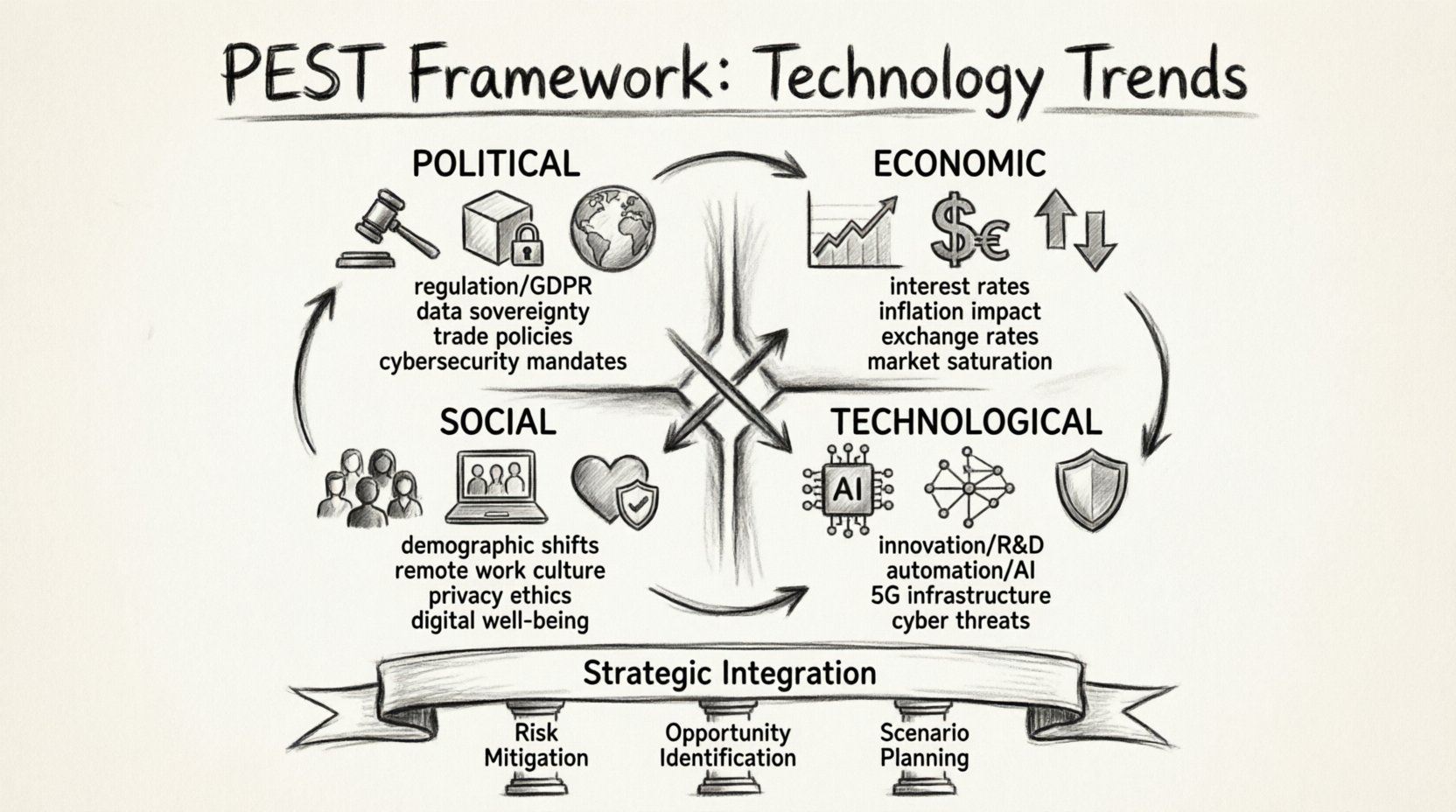
The PEST acronym stands for Political, Economic, Social, and Technological. Originally designed for general business strategy, its application to the technology sector requires a nuanced approach. Technology companies do not exist in a vacuum; they are heavily regulated, economically sensitive, culturally embedded, and inherently innovative.
When conducting a PEST analysis for technology, the focus shifts from general market conditions to specific drivers of digital transformation. For instance, a political decision regarding data sovereignty can alter the entire infrastructure strategy of a global cloud provider. An economic downturn might reduce R&D budgets across the board. Social shifts in privacy expectations can change how software handles user data. Technological breakthroughs can render entire product lines obsolete overnight.
This framework helps organizations map the external environment. It ensures that internal strategies align with external realities. Below is a breakdown of what each component entails within the context of modern technology trends.
1. Political Factors 🏛️
Political factors encompass the influence of government policy, legislation, and political stability on business operations. In the technology sector, this is perhaps the most volatile category. Governments worldwide are increasingly intervening in digital markets to protect national interests, citizens, and industries.
Regulation and Compliance
Data privacy has moved from a technical concern to a legal imperative. Regulations such as the General Data Protection Regulation (GDPR) and similar frameworks globally dictate how organizations collect, store, and process information. Non-compliance results in severe financial penalties and reputational damage. Technology firms must build compliance into their architecture from the ground up, rather than treating it as an afterthought.
- Data Sovereignty: Laws requiring data to be stored within specific geographic borders impact cloud infrastructure planning.
- Intellectual Property: Trade policies affect how software code and hardware designs are protected across borders.
- Cybersecurity Mandates: Governments are imposing stricter security standards for critical infrastructure, forcing vendors to upgrade their protocols.
Trade and Tariffs
The hardware supply chain is global. Semiconductors, raw materials, and components often cross multiple borders before assembly. Trade wars and tariffs can disrupt these flows. A sudden increase in import duties on electronic components can inflate production costs significantly. Companies must diversify their supply chains to mitigate these risks.
Political Stability
Investment in technology requires long-term horizons. Political instability in key markets can deter investment. Conversely, stable governments often provide grants or tax incentives for research and development. Political agendas also determine funding for public sector technology projects, such as smart city initiatives or digital government services.
2. Economic Factors 💰
Economic factors relate to the financial performance of a market and the purchasing power of consumers. Technology is capital intensive. It requires significant investment in research, development, and infrastructure. Therefore, economic conditions directly impact the velocity of innovation.
Interest Rates and Capital Costs
High interest rates increase the cost of borrowing. For startups and scale-ups reliant on venture capital or debt financing, this slows growth. Companies may delay hiring or pause new product development to preserve cash flow. Conversely, lower rates encourage investment in long-term projects. The cost of capital dictates which innovations get funded and which are shelved.
Inflation and Cost Structures
Inflation affects the cost of raw materials, energy, and labor. As the cost of electricity rises, data centers become more expensive to operate. Wages for skilled engineers and developers increase, impacting profitability. Companies must pass these costs to consumers or absorb them, which affects pricing strategies and margins.
Exchange Rates
Technology companies often earn revenue in multiple currencies while incurring costs in others. A fluctuation in exchange rates can erode profits. For example, a company headquartered in one country but selling services globally faces currency risk. Hedging strategies become essential for financial stability.
Market Saturation and Growth
In mature markets, growth slows. Companies must compete for existing users rather than acquiring new ones. This shifts focus from user acquisition to retention and monetization. In emerging markets, the potential for growth is higher, but purchasing power may be lower. Understanding these economic disparities helps in targeting the right demographics.
3. Social Factors 👥
Social factors involve the cultural and demographic aspects of the environment. Technology is used by people. Therefore, human behavior, attitudes, and values drive adoption rates. Understanding the social context is crucial for product-market fit.
Demographic Shifts
The aging population in developed nations creates a demand for health technology and accessibility features. Conversely, younger generations entering the workforce expect different tools. Digital natives require intuitive, mobile-first interfaces. These demographic trends dictate design choices and feature prioritization.
Remote Work and Lifestyle Changes
The shift toward remote work has fundamentally altered the software landscape. Collaboration tools, project management platforms, and cybersecurity solutions designed for home environments are now standard. Social acceptance of working from home has created a permanent demand for digital connectivity tools.
- Work-Life Balance: Users demand tools that integrate seamlessly with their personal lives without causing burnout.
- Digital Literacy: As technology becomes ubiquitous, the gap between those who can use it and those who cannot widens. Training and user experience design must account for varying skill levels.
Privacy and Ethics
Social attitudes toward privacy have hardened. Users are more aware of how their data is used. There is a growing skepticism regarding corporate data collection. Ethical considerations, such as algorithmic bias and AI transparency, are becoming social expectations rather than optional features. Companies that ignore these concerns risk public backlash.
Health and Well-being
There is a rising focus on digital well-being. Screen time limits and features that promote mental health are becoming valued attributes in consumer technology. The narrative has shifted from “more screen time” to “meaningful interaction”.
4. Technological Factors 🚀
Technological factors are the most dynamic component of the analysis. They include the rate of innovation, automation, and the lifecycle of technology. This is the engine of change within the PEST framework.
Innovation and R&D
The pace of technological advancement is accelerating. What is cutting-edge today may be legacy software in three years. Continuous investment in Research and Development is necessary to maintain competitiveness. Companies that fail to innovate risk obsolescence.
Automation and AI
Artificial Intelligence and machine learning are transforming operational efficiency. Automation reduces manual labor in manufacturing and service delivery. However, this raises questions about workforce displacement. Organizations must balance efficiency gains with social responsibility regarding employment.
- Process Optimization: AI can analyze vast datasets to improve decision-making and reduce errors.
- Customer Service: Chatbots and automated support systems handle routine inquiries, allowing human agents to focus on complex issues.
- Personalization: Algorithms tailor experiences to individual user preferences, increasing engagement.
Infrastructure and Connectivity
The availability of high-speed internet is a prerequisite for modern technology. The rollout of 5G and future networks enables new applications in IoT and real-time processing. Reliability and latency are critical factors for cloud computing and streaming services. Infrastructure gaps in certain regions limit market penetration.
Cybersecurity Threats
As systems become more interconnected, the attack surface expands. Cyber threats are evolving in sophistication. Ransomware, phishing, and data breaches pose significant risks. Security must be viewed as a continuous process rather than a one-time installation. Investing in threat detection and response capabilities is non-negotiable.
Comparative Analysis of PEST Factors 📋
To visualize how these factors interact, consider the following breakdown of their impact on technology strategy.
| Factor | Primary Impact | Strategic Question |
|---|---|---|
| Political | Regulatory Compliance & Market Access | How do laws affect our data architecture? |
| Economic | Investment Capacity & Pricing | Can we sustain R&D costs during inflation? |
| Social | User Adoption & Ethics | Does this product align with user values? |
| Technological | Innovation & Obsolescence | Will this technology last five years? |
Integrating the Analysis into Strategy 🎯
Gathering data is only the first step. The value lies in integration. Organizations must translate these findings into actionable plans. This involves cross-functional collaboration between legal, finance, product, and engineering teams.
Risk Mitigation
Identify the highest risks in each category. For example, if political instability threatens supply chains, diversify vendors. If economic downturns threaten cash flow, reduce fixed costs. If social trends shift against data collection, adopt privacy-by-design principles. If technological shifts occur, invest in upskilling staff.
Opportunity Identification
Look for gaps created by these factors. New regulations create demand for compliance software. Economic shifts create demand for cost-saving automation tools. Social changes create demand for remote collaboration platforms. Technological advances create demand for new application layers.
Scenario Planning
Develop multiple scenarios based on different outcomes. What happens if trade barriers increase? What if interest rates double? What if a new privacy law passes? Having plans for these scenarios allows for agile responses when events occur.
Limitations of the Framework ⚠️
While the PEST analysis is robust, it has limitations. It is primarily a static snapshot. The technology landscape changes so quickly that a report can be outdated by the time it is finalized. Additionally, it does not account for internal strengths or weaknesses. It focuses solely on the external environment.
To mitigate this, the analysis should be treated as a living document. It requires regular updates, perhaps quarterly or biannually. It should be combined with other strategic tools, such as SWOT analysis, to get a complete picture. Internal capabilities must be assessed alongside external pressures.
Future Outlook and Continuous Adaptation 🔮
The technology sector will continue to be shaped by these four forces. Political scrutiny on digital monopolies is likely to increase. Economic volatility may persist due to global uncertainties. Social demands for ethical AI and digital wellness will grow. Technological breakthroughs in quantum computing and biotechnology will emerge.
Organizations that treat strategic planning as a one-time exercise will fail. Those that embed environmental scanning into their culture will thrive. The ability to read these signals and adapt quickly is the defining characteristic of successful technology leaders.
Key Takeaways for Strategic Planners 📝
- Monitor Regulations Closely: Compliance is a competitive advantage, not just a cost center.
- Manage Capital Efficiently: Economic conditions dictate the pace of growth.
- Listen to Users: Social values drive product adoption and retention.
- Invest in Innovation: Technological stagnation is the fastest path to failure.
- Update Regularly: The environment is dynamic; your analysis must be too.
By rigorously applying the PEST framework, technology organizations can move from reacting to events to anticipating them. This proactive stance reduces uncertainty and positions the company for sustainable growth in an ever-changing digital ecosystem.