

Success in business strategy exams often depends on your ability to contextualize an organization within its broader environment. The PESTLE analysis is a foundational tool used to evaluate external factors influencing an entity. For students and candidates preparing for examinations, having a structured approach to this framework is essential. This guide provides a comprehensive PESTLE analysis checklist tailored for academic success. It breaks down each component with specific focus areas to ensure you can identify relevant variables quickly.
Many candidates struggle not because they lack knowledge, but because they fail to structure their answers effectively. By utilizing a standardized checklist, you can ensure that no critical macro-environmental factor is overlooked during an exam scenario. This article details each letter of the acronym, offers study techniques, and provides practical examples to solidify your understanding.
🧠 Understanding the PESTLE Framework
The PESTLE framework stands for Political, Economic, Social, Technological, Legal, and Environmental. It is a strategic tool used to scan the external macro-environmental factors that can impact an organization. In an academic setting, examiners look for evidence that you understand how these external forces shape internal strategy. A robust answer demonstrates the ability to link external data to internal decision-making processes.
When you approach a case study, the PESTLE analysis serves as the initial phase of environmental scanning. It prevents tunnel vision. Without this context, strategic recommendations often fail because they ignore the constraints or opportunities presented by the outside world. This checklist is designed to help you systematically interrogate the case study material for clues related to these six categories.
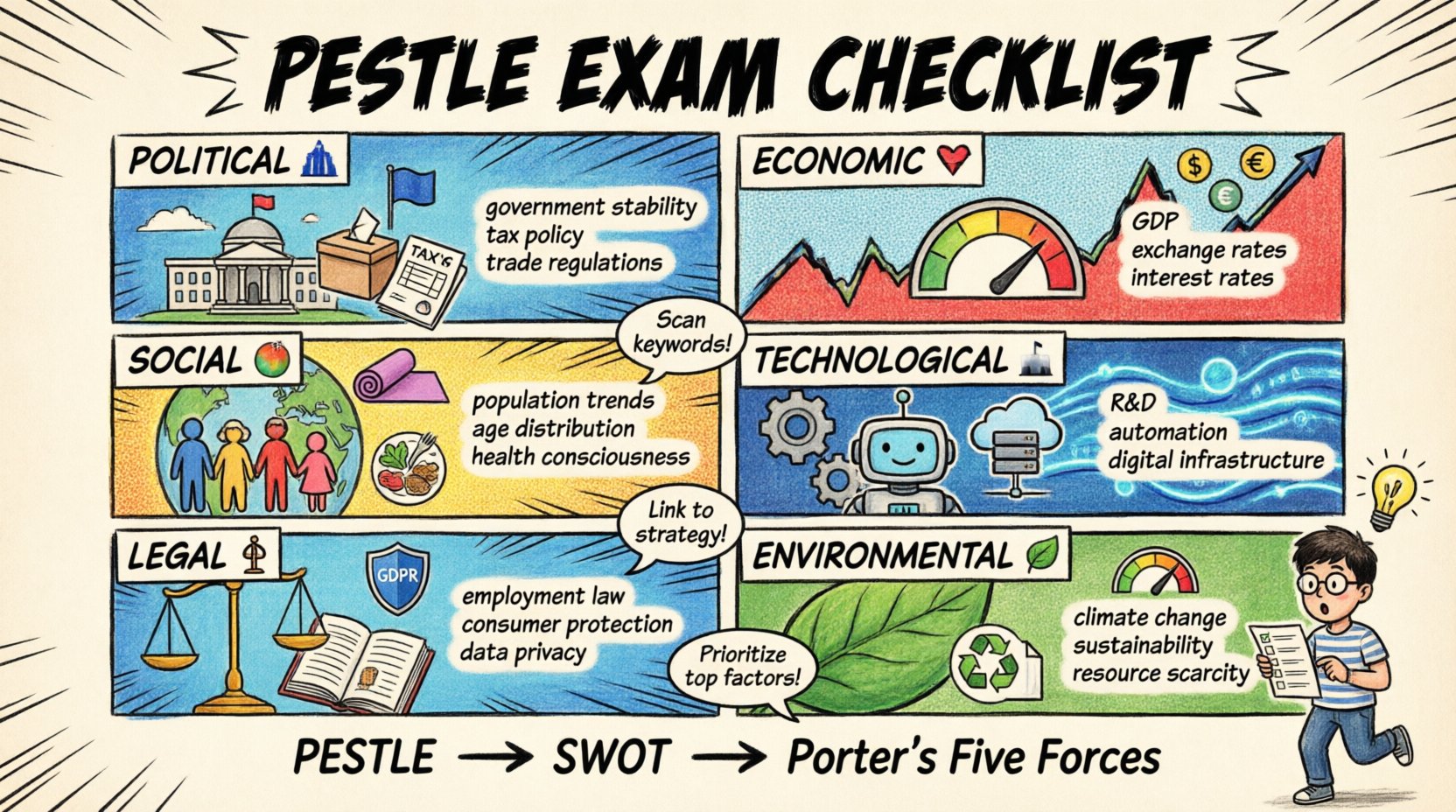
📋 The Comprehensive PESTLE Checklist
To excel in your exam, you need a mental or written map of what to look for. Below is a detailed breakdown of each factor. Use this section to create your own revision notes.
1. Political Factors 🏛️
Political factors refer to the extent to which a government intervenes in the economy or specific industries. These factors can create advantages or threats for businesses. In an exam context, look for government stability and policy shifts.
- Government Stability: Is the current administration stable? Frequent elections or regime changes can disrupt long-term planning.
- Tax Policy: Changes in corporate tax rates directly impact profit margins and cash flow.
- Trade Regulations: Tariffs, quotas, and trade embargoes affect supply chains and market access.
- Subsidies: Does the government provide financial support for specific sectors, such as green energy or agriculture?
- Political Interference: Nationalization of industries or price controls can limit operational freedom.
2. Economic Factors 📉
Economic factors determine the purchasing power of potential customers and the cost of capital. These are often the most volatile elements in a business environment. Examiners frequently test your understanding of macroeconomic indicators.
- Economic Growth: GDP growth rates indicate the overall health of the economy and consumer spending power.
- Exchange Rates: Fluctuations in currency value affect export competitiveness and import costs.
- Inflation Rates: High inflation increases input costs and may reduce consumer demand for non-essential goods.
- Interest Rates: The cost of borrowing influences expansion plans and capital investment decisions.
- Unemployment Levels: High unemployment may lower wage expectations but also reduce disposable income.
3. Social Factors 🌍
Social factors relate to the demographic and cultural aspects of the external environment. These factors influence demand for products and services. Understanding the target market’s values is crucial for marketing strategy questions.
- Population Growth: A growing population may expand the market size, while a shrinking one may require niche targeting.
- Age Distribution: An aging population creates different needs compared to a youthful demographic.
- Lifestyle Trends: Shifts towards health consciousness or remote work change product demand.
- Education Levels: Higher education levels often correlate with higher disposable income and different consumption patterns.
- Health Consciousness: Increasing focus on wellness impacts industries ranging from food to insurance.
4. Technological Factors 💻
Technological factors involve innovations that create new markets or disrupt existing ones. In modern exams, this section often carries significant weight due to the pace of digital transformation.
- R&D Activity: The rate of innovation in an industry determines its future competitiveness.
- Automation: The adoption of robotics and AI can reduce labor costs and increase efficiency.
- Technology Incentives: Government grants or tax breaks for technology adoption.
- Internet Infrastructure: The availability of high-speed internet affects e-commerce and remote operations.
- Obsolescence: How quickly current products or services might become outdated due to new tech.
5. Legal Factors ⚖️
Legal factors are similar to political factors but focus specifically on the laws and regulations that businesses must comply with. Non-compliance can lead to fines or operational shutdowns.
- Employment Laws: Regulations regarding hiring, firing, and working hours.
- Health and Safety: Standards required to protect workers and consumers.
- Consumer Protection: Laws regarding advertising claims and product safety.
- Intellectual Property: Patents, trademarks, and copyrights protect innovation.
- Data Protection: Regulations like GDPR regarding the handling of customer information.
6. Environmental Factors 🌱
Environmental factors consider ecological and physical aspects of the environment. Sustainability is increasingly a core component of business strategy and exam questions.
- Climate Change: Risks associated with extreme weather events and long-term climate shifts.
- Carbon Footprint: The impact of operations on the environment and regulatory pressure to reduce emissions.
- Waste Disposal: Laws and costs associated with recycling and hazardous waste management.
- Sustainability Trends: Consumer and investor demand for environmentally responsible practices.
- Resource Scarcity: Availability of raw materials like water, timber, or rare earth metals.
📝 How to Apply This Checklist in Exams
Knowing the factors is only half the battle. You must apply them under time pressure. Here is a strategic approach to using the checklist during an examination.
- Scan the Question First: Identify the industry and the specific problem. This helps you prioritize which PESTLE factors are most relevant.
- Highlight Keywords: Circle terms in the case study that hint at external factors. Words like “regulation,” “tax,” “currency,” or “culture” are signals.
- Structure Your Answer: Use subheadings for each PESTLE factor. This makes it easy for the examiner to see you have covered the framework.
- Link to Strategy: Do not just list factors. Explain how each factor influences the company’s strategy. For example, “High inflation (Economic) necessitates a cost-leadership strategy.”
- Prioritize: Not all factors are equal. Focus on the top two or three most critical factors for the specific scenario rather than listing every possible point.
🏢 Practical Example Table
To visualize how these factors interact in a real-world scenario, consider the following table. This demonstrates how to map abstract factors to concrete business impacts.
| Factor Category | Specific Issue | Impact on Business |
|---|---|---|
| Political | New Import Tariffs on Steel | Increases production costs for manufacturing firms. |
| Economic | Rising Interest Rates | Increases cost of loans, slowing down expansion. |
| Social | Shift to Remote Work | Reduces demand for office space; increases demand for home office tech. |
| Technological | AI Integration | Improves efficiency but requires workforce retraining. |
| Legal | Stricter Data Privacy Laws | Increases compliance costs for digital service providers. |
| Environmental | New Carbon Tax | Punishes high-emission industries; rewards green innovation. |
⚠️ Common Study Pitfalls
Even well-prepared students can lose marks due to common errors. Being aware of these pitfalls allows you to avoid them during your exam.
- Confusing Internal with External: PESTLE is strictly for external factors. Do not include company strengths or weaknesses here. Those belong in a SWOT analysis.
- Being Too Vague: Avoid generic statements like “Technology is changing.” Be specific. Mention “AI adoption in logistics” or “5G network rollout.”
- Ignoring the Context: A factor that matters in one country may not matter in another. Always tailor your analysis to the specific region mentioned in the case study.
- Lack of Evidence: Support your points with data or logic derived from the case study text. Do not rely solely on general knowledge if the case study contradicts it.
- Skipping the Link: Always explain the implication of the factor. Why does it matter to the company’s bottom line?
🔗 Linking PESTLE to Other Models
In advanced exams, you may be asked to integrate PESTLE with other strategic frameworks. This shows a deeper understanding of how strategic analysis works holistically.
Integration with SWOT Analysis
The PESTLE analysis feeds directly into the Opportunities and Threats section of a SWOT analysis. External factors identified in PESTLE become the opportunities (positive external factors) and threats (negative external factors) in SWOT. Strengths and Weaknesses are internal and should not be mixed with PESTLE.
Integration with Porter’s Five Forces
While PESTLE looks at the macro-environment, Porter’s Five Forces focuses on the industry environment. Political factors might influence the threat of new entrants (through regulations), and Economic factors influence the bargaining power of buyers. Using both frameworks provides a complete picture from the macro to the micro level.
Integration with Ansoff Matrix
When considering market development or product development strategies, PESTLE helps determine viability. For instance, if the Economic factor shows a recession, market penetration might be safer than market development. If the Social factor shows a new trend, product development might be the logical step.
📚 Final Revision Tips
To ensure you are ready for the exam day, incorporate these habits into your study routine.
- Flashcards: Create cards for each PESTLE factor with a definition and an example on the back.
- Case Study Practice: Find past exam papers and practice writing a PESTLE analysis within a set time limit.
- News Monitoring: Read business news regularly to keep up with current Political and Economic trends. This helps you generate relevant examples.
- Peer Review: Exchange your practice answers with a study partner. Ask them to check if you have confused internal and external factors.
- Summarization: Create a one-page summary of the checklist. Review this the night before the exam to keep the structure fresh in your mind.
Mastering the PESTLE analysis requires practice and attention to detail. By using this checklist, you build a reliable framework for answering exam questions. It transforms a complex task into a manageable series of steps. Remember, the goal is not just to list factors, but to demonstrate how they shape business reality. This depth of understanding is what distinguishes a passing grade from a top-tier result.
Keep this guide accessible during your revision. Use the tables and bullet points to quickly scan your knowledge gaps. With a solid grasp of the macro-environment, you will be better equipped to tackle any strategic management question that comes your way.