

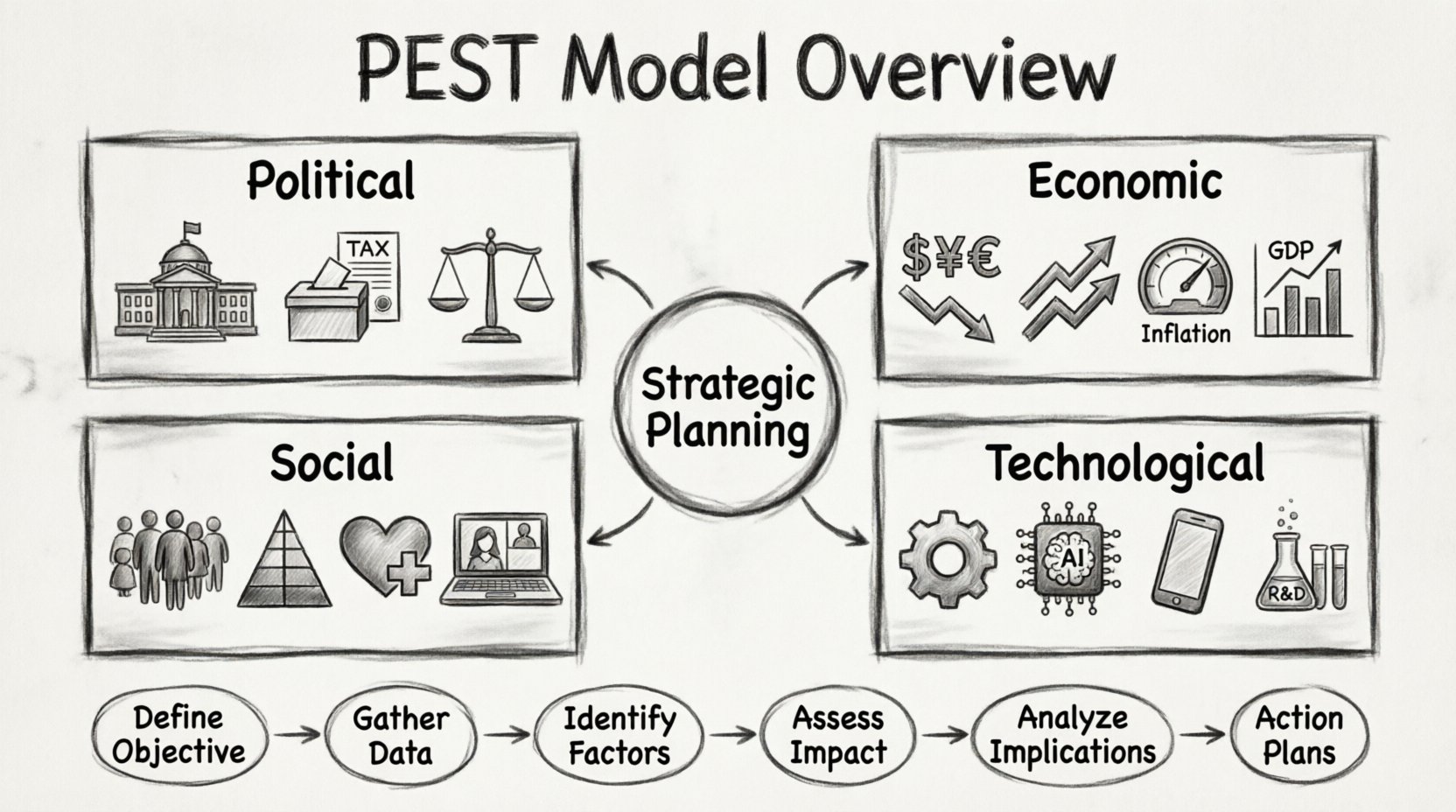
Businesses operate within a dynamic ecosystem where external forces constantly shift. To navigate these changes effectively, organizations require robust methods for gathering intelligence. Environmental scanning serves as the foundational process for identifying these external factors. Among the various frameworks available, the PEST model stands out as a critical tool for strategic planning. This approach allows teams to categorize macro-environmental influences into four distinct categories: Political, Economic, Social, and Technological.
Understanding these elements helps organizations anticipate market shifts, mitigate risks, and identify opportunities before competitors. This article provides a detailed examination of the PEST model, breaking down each component and outlining how to implement this analysis into your strategic workflow.
🔍 Understanding the PEST Framework
The PEST analysis is a strategic tool used to evaluate the key external factors affecting an organization. Unlike internal analysis tools that focus on resources or capabilities, PEST looks outward. It provides a structured way to assess the macro-environmental environment. This ensures that decision-makers do not overlook significant trends that could impact long-term viability.
- Political: Government policies, regulations, and stability.
- Economic: Growth rates, interest rates, and inflation.
- Social: Demographics, cultural trends, and lifestyle changes.
- Technological: Innovation, automation, and research and development.
By systematically reviewing these areas, teams gain a holistic view of the landscape. This clarity supports better resource allocation and risk management. The framework is particularly useful during periods of uncertainty or when entering new markets.
🏛️ Deep Dive: Political Factors
Political factors refer to the extent to which a government intervenes in the economy or specific industries. These factors are often the most volatile and can change rapidly with elections or policy shifts. When conducting a scan, consider the following elements:
- Tax Policy: Changes in corporate tax rates directly affect profitability and cash flow.
- Trade Restrictions: Tariffs, quotas, and embargoes can limit market access or increase costs.
- Labour Laws: Regulations regarding minimum wage, working hours, and unions impact operational expenses.
- Environmental Regulations: Laws regarding waste disposal and emissions compliance are increasingly significant.
- Political Stability: Regions with unstable governments present higher risks for investment.
For example, a sudden change in trade agreements could disrupt a supply chain that relied on imports from a specific region. Similarly, new data privacy laws might require significant changes to how a company handles customer information. Monitoring these signals early allows for proactive adaptation rather than reactive scrambling.
📈 Deep Dive: Economic Factors
Economic factors influence the purchasing power of potential customers and the cost of capital. These metrics determine the overall health of the market. Organizations must analyze both local and global economic conditions to understand demand fluctuations.
- GDP Growth: Indicates the overall health of the economy and consumer confidence.
- Interest Rates: Affect the cost of borrowing for expansion or inventory management.
- Inflation: High inflation erodes purchasing power and increases input costs.
- Exchange Rates: Crucial for businesses involved in international trade or sourcing.
- Disposable Income: Determines the spending capacity of the target demographic.
| Indicator | Impact on Business |
|---|---|
| High Inflation | Increases operational costs; reduces consumer spending. |
| Low Interest Rates | Encourages borrowing for growth; lowers cost of debt. |
| Recession | Decreases demand; increases risk of default. |
| Strong Employment | Boosts consumer spending; increases wage pressure. |
Understanding these dynamics helps in pricing strategies. For instance, during high inflation, a company might need to adjust prices to maintain margins without losing volume. Conversely, during a recession, value-oriented products may see increased demand.
👥 Deep Dive: Social Factors
Social factors encompass the demographic and cultural aspects of the external environment. These trends shape consumer behavior and brand perception. Unlike economic factors, social shifts often occur gradually but have profound long-term effects.
- Population Growth: Affects market size and labor supply.
- Age Distribution: An aging population requires different products than a youthful one.
- Health Consciousness: Trends in fitness and diet influence food and wellness sectors.
- Career Attitudes: Shifts in work-life balance expectations affect talent acquisition.
- Education Levels: Higher education levels often correlate with specific consumer preferences.
Consider the shift towards remote work. This social change altered demand for office space and increased demand for digital collaboration tools. Companies that ignored this trend faced talent retention issues. Conversely, those that adapted found new markets. Cultural values also play a role. Sustainability concerns are driving consumers to prefer brands with ethical supply chains.
💡 Deep Dive: Technological Factors
Technological factors include innovation, automation, and infrastructure. This category is often the most rapidly changing. Disruption in this area can render business models obsolete within a short timeframe.
- R&D Activity: The pace of innovation in your industry dictates competitiveness.
- Automation: Affects labor requirements and production efficiency.
- Infrastructure: Quality of internet and transport networks impacts logistics.
- Technology Access: Availability of hardware and software to the end-user.
- Regulatory Environment: Laws regarding technology usage and data security.
For example, the rise of mobile technology shifted retail strategies towards app-based shopping. Companies that failed to optimize for mobile devices lost significant market share. Artificial intelligence is another current driver. It automates customer service and data analysis, changing how resources are allocated. Staying updated on technological trends is essential for maintaining relevance.
🚀 Step-by-Step Implementation Guide
Conducting a PEST analysis requires a structured approach to ensure comprehensive coverage. Follow these steps to build a reliable framework for your strategic planning.
- Define the Objective: Clarify the specific business decision or project the analysis will support.
- Gather Data: Collect information from industry reports, government publications, and market research.
- Identify Factors: Brainstorm specific factors within the four PEST categories relevant to your context.
- Assess Impact: Determine the likelihood of occurrence and the potential impact of each factor.
- Analyze Implications: Discuss how these factors affect your current strategy and future plans.
- Develop Action Plans: Create specific responses to high-impact threats and opportunities.
During the data collection phase, rely on credible sources. Avoid speculation. Document assumptions clearly so they can be revisited later. Use a spreadsheet or document to organize findings by category. This ensures nothing is overlooked during the discussion.
⚖️ PEST vs. PESTLE Framework
While PEST is a standard model, some organizations prefer PESTLE. This variation adds two additional letters: Legal and Environmental. The inclusion of these factors addresses specific regulatory and sustainability concerns that have become more prominent in recent years.
- Legal: Focuses on consumer law, employment law, health and safety, and advertising standards.
- Environmental: Focuses on climate change, carbon footprint, waste disposal, and ecological impact.
| Model | Components | Best Used For |
|---|---|---|
| PEST | Political, Economic, Social, Technological | General market overview and broad strategy. |
| PESTLE | Political, Economic, Social, Technological, Legal, Environmental | Highly regulated industries or sustainability-focused strategies. |
If your industry faces strict compliance requirements, such as healthcare or finance, the Legal factor is critical. If your business model relies heavily on natural resources, the Environmental factor is non-negotiable. Choose the framework that aligns with your specific risk profile.
🛡️ Strategic Integration and Limitations
Integrating the findings into your strategy requires more than just a report. The data must drive decision-making. Map the external factors against your internal SWOT analysis. This connects external threats to internal weaknesses.
- Opportunities: If a social trend aligns with your product, invest in marketing to capture that demand.
- Threats: If a political change increases costs, look for suppliers in different regions or adjust pricing.
- Strengths: Leverage technological strengths to counter economic downturns through efficiency.
However, the PEST model has limitations. It focuses on the macro-environment and ignores internal capabilities. It does not account for competitor actions directly. Furthermore, the analysis can become static if not updated regularly. The external environment changes constantly, requiring periodic reviews.
Best Practices for Success
- Regular Updates: Schedule quarterly or annual reviews of the analysis.
- Cross-Functional Teams: Involve members from different departments to gain diverse perspectives.
- Specific Context: Avoid generic factors. Tailor the analysis to your specific market.
- Scenario Planning: Use the data to create scenarios for best-case, worst-case, and most likely outcomes.
By treating PEST as a living document rather than a one-time exercise, organizations maintain agility. This approach fosters a culture of continuous monitoring and adaptation. It ensures that strategic decisions are grounded in current reality rather than historical assumptions.
📝 Final Considerations
Environmental scanning is not a one-off task but a continuous discipline. The PEST model provides a reliable structure for this discipline. It forces leaders to look beyond the immediate horizon and consider the broader context in which they operate. By understanding Political, Economic, Social, and Technological forces, businesses can position themselves for sustainable growth.
Remember that data is only valuable if acted upon. Use this framework to inform your strategy, but remain flexible enough to pivot when new information emerges. The goal is not to predict the future with certainty, but to prepare for multiple possibilities. With a clear understanding of the macro-environment, your organization can navigate complexity with confidence.