

In the early stages of a startup, the landscape shifts daily. What worked last month may not work today. The ability to recognize this shift and adjust course without losing momentum is the defining trait of a resilient business. This capability is known as pivoting. However, pivoting is not a spontaneous act of panic; it is a strategic maneuver grounded in data and structured decision-making.
Founders often face decision fatigue. The sheer volume of choices—product features, pricing models, marketing channels—can lead to paralysis. By implementing specific frameworks, you can reduce uncertainty and move with clarity. This guide explores practical structures designed to help agile founders navigate change efficiently.
Why Speed Matters in Agile Environments ⏱️
Agility is not merely about moving fast; it is about moving correctly. In a traditional business model, a strategic shift might take months of planning and approval. In an agile context, the window for opportunity is narrow. If you wait too long to validate a new direction, you risk burning resources on a strategy that the market has already rejected.
Speed in decision-making offers several tangible benefits:
- Resource Allocation: You stop spending money on initiatives that do not yield returns.
- Team Morale: Clear decisions prevent the team from working on projects that are about to be scrapped.
- Market Position: Being the first to adapt to a trend gives you a competitive edge.
- Investor Confidence: Demonstrating the ability to course-correct based on data builds trust with stakeholders.
However, speed without structure leads to chaos. Random changes confuse customers and alienate employees. The goal is to create a rhythm of decision-making that feels intentional rather than reactive.
Core Frameworks for Strategic Pivots 🛠️
To pivot effectively, you need tools that translate raw information into actionable insight. Below are three proven frameworks that help structure the decision-making process.
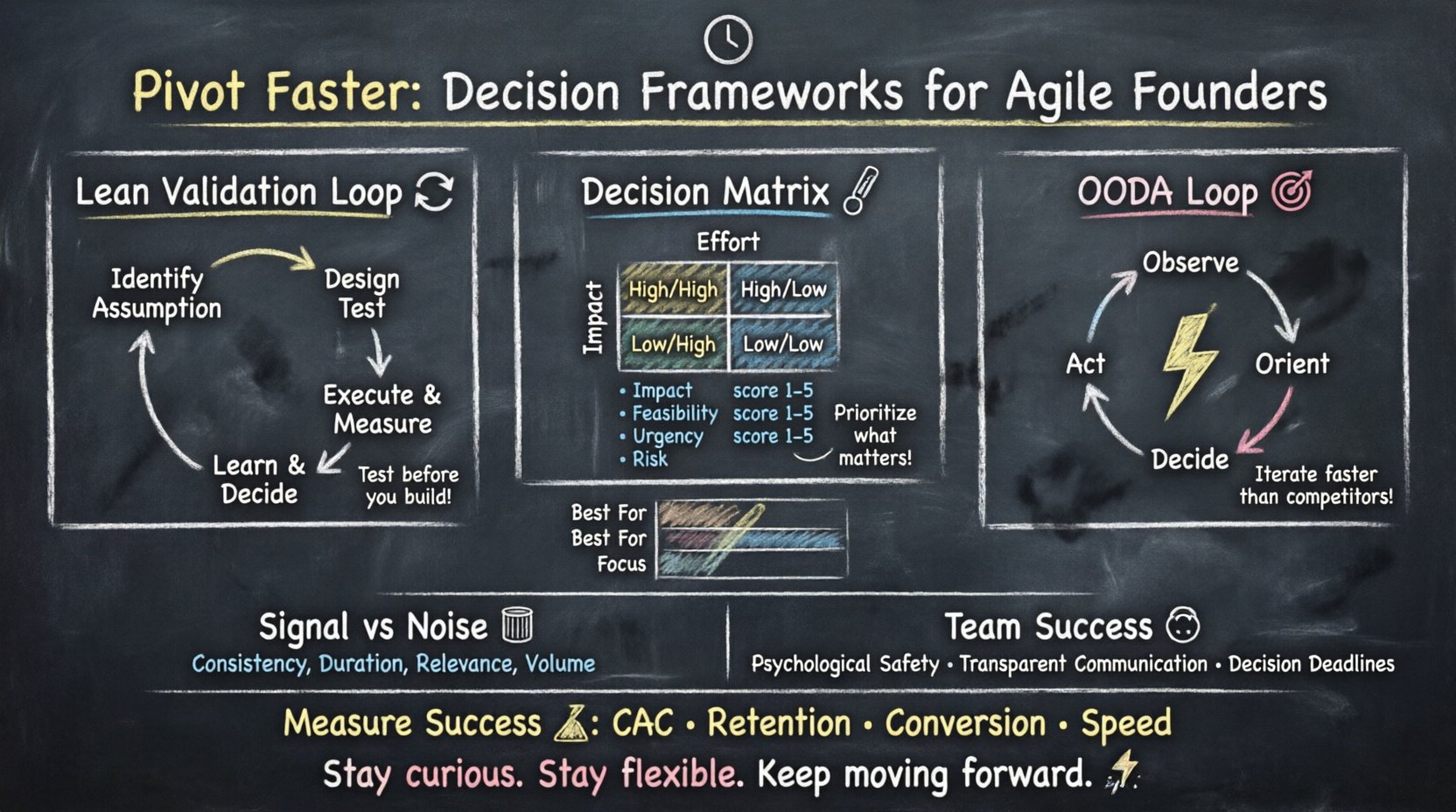
1. The Lean Validation Loop 🔄
This framework is rooted in the Build-Measure-Learn cycle. It focuses on minimizing waste by testing assumptions before building full-scale solutions.
- Identify the Assumption: Pinpoint the specific belief driving your current strategy. For example, “Users will pay $50 for this feature.”
- Design the Test: Create the smallest possible experiment to validate this. A landing page, a manual service, or a prototype.
- Execute and Measure: Run the experiment and collect quantitative and qualitative data.
- Learn and Decide: If the data supports the assumption, scale. If it does not, pivot or persevere based on the feedback.
This loop ensures that every pivot is backed by evidence rather than intuition alone. It forces you to define what success looks like before you begin.
2. The Decision Matrix 📊
When faced with multiple potential directions, the Decision Matrix helps prioritize options based on impact and effort. This prevents the “shiny object” syndrome where teams chase every new idea.
Assign a score from 1 to 5 for each option based on the following criteria:
- Impact: How much will this improve the business if successful?
- Feasibility: How easy is it to execute with current resources?
- Urgency: How critical is it to act now?
- Risk: What is the downside if it fails?
Calculate the weighted score for each option. The highest scoring option becomes the priority. This visual representation makes it easier to communicate decisions to the team and stakeholders.
3. The OODA Loop Application 🎯
Originally developed for military strategy, the OODA Loop (Observe, Orient, Decide, Act) is highly effective in business environments. It emphasizes the speed of the cycle rather than the quality of the initial observation.
- Observe: Gather data from the market, customers, and internal metrics.
- Orient: Analyze the data in the context of your current reality and biases.
- Decide: Choose a course of action based on the analysis.
- Act: Implement the decision immediately.
The key is to iterate through this loop faster than your competitors. If you can complete the cycle in days instead of weeks, you stay ahead of the curve.
Comparison of Frameworks 📋
Understanding when to use each framework is crucial. The table below outlines the best use cases for each method.
| Framework | Best Used When | Primary Focus |
|---|---|---|
| Lean Validation Loop | Testing new product features or hypotheses | Learning and Risk Reduction |
| Decision Matrix | Choosing between multiple strategic initiatives | Prioritization and Resource Management |
| OODA Loop | Responding to rapid market changes or crises | Speed and Reaction Time |
Identifying the Signal vs. The Noise 📡
Data is abundant, but information is scarce. One of the biggest challenges founders face is distinguishing between a genuine market signal and random noise. Noise can look like a sudden spike in traffic or a viral social media post that does not convert. Signals are consistent patterns that indicate a shift in user behavior or market demand.
To filter effectively, consider the following:
- Consistency: Does this trend appear across multiple channels or just one?
- Duration: Is this a one-off event or does it persist over time?
- Relevance: Does this impact your core value proposition?
- Volume: Is the scale of the data significant enough to warrant a change?
When you see a signal, do not jump to conclusions. Validate it with further testing. When you see noise, acknowledge it but do not let it derail your current strategy.
The Team Dynamics of Decision Making 👥
A decision framework is useless if the team does not understand or support it. Agile pivots require alignment across engineering, sales, marketing, and product. If one department is moving in one direction while another is moving in the opposite direction, friction occurs.
Building a Culture of Psychological Safety
For a team to pivot quickly, members must feel safe to voice dissenting opinions. If the founder makes all decisions, bottlenecks form. Encourage team members to challenge assumptions. When a pivot happens, ensure everyone knows the “why” behind it.
- Transparent Communication: Share the data that led to the decision.
- Defined Roles: Clarify who owns the implementation of the new direction.
- Feedback Loops: Create channels for the team to report issues with the new strategy.
Avoiding Decision Paralysis
Sometimes, the fear of making the wrong choice stops progress. To combat this, set a decision deadline. If the team cannot agree within a specific timeframe, the founder or a designated decision-maker must step in. This prevents endless debate.
Execution: From Decision to Action 🏃
Once a decision is made, the clock starts ticking. The gap between decision and execution is where value is lost. A clear plan must be established immediately.
- Define the Milestones: Break the pivot into small, achievable goals. Short-term wins build momentum.
- Assign Ownership: Every task must have a single point of accountability.
- Set Timelines: Use deadlines to create urgency. Agile sprints are useful here.
- Monitor Progress: Review the plan daily or weekly to ensure alignment.
Remember that execution is not linear. You will encounter obstacles. The framework you chose should help you adapt as you execute. If a milestone is missed, analyze why and adjust the plan without abandoning the core direction.
Common Pitfalls in Agile Pivoting 🚧
Even with a solid framework, mistakes happen. Being aware of common pitfalls can help you avoid them.
- Pivoting Too Early: Sometimes the data looks negative simply because the experiment was not long enough. Ensure you have gathered sufficient evidence before abandoning a strategy.
- Pivoting Too Late: Holding onto a failing strategy due to sunk costs. Let go of the past to secure the future.
- Vague Goals: Changing direction without a clear definition of success leads to confusion.
- Ignoring Customer Feedback: Internal data is important, but customer sentiment is the ultimate truth.
Measuring Pivot Success 📈
How do you know if the pivot worked? You need to establish Key Performance Indicators (KPIs) before you start. These metrics should be directly tied to the goals of the new direction.
Examples of relevant metrics include:
- Customer Acquisition Cost (CAC): Did the new strategy lower the cost to acquire a user?
- Retention Rate: Are users staying longer after the change?
- Conversion Rate: Is the percentage of users completing the desired action higher?
- Time to Market: Did the new process allow you to release features faster?
Review these metrics regularly. If the pivot is not moving the needle, you may need to refine the approach or return to the drawing board. Continuous improvement is the essence of agility.
Building Resilience into Your Strategy 🛡️
Resilience is not just about bouncing back; it is about growing through change. By embedding these frameworks into your daily operations, you build a culture that expects change rather than fearing it.
Start small. Pick one framework and apply it to a single project. Observe the results. Gradually expand the practice across the organization. Over time, the ability to pivot becomes second nature. You stop viewing change as a threat and start viewing it as an opportunity.
Final Thoughts on Strategic Agility 💡
The path to success is rarely a straight line. It is a series of adjustments, learnings, and corrections. Founders who master the art of decision-making gain a significant advantage. They navigate uncertainty with confidence and lead their teams through turbulent waters.
Focus on the quality of your decisions, not just the quantity. Use data to inform your choices, but trust your experience to interpret the data. Align your team around a shared vision, and ensure that every pivot serves the long-term health of the business.
Stay curious. Stay flexible. And keep moving forward.