

In the fast-paced environment of modern software development, speed and quality are often perceived as opposing forces. Teams frequently face the dilemma of whether to ship features rapidly or to pause for extensive quality assurance. However, this trade-off is a misconception. The true driver of high-quality output is not time spent testing, but the efficiency of the feedback mechanisms embedded within the workflow. By optimizing how information flows back to the creators, organizations can catch defects early, reduce rework, and ensure that the final product aligns perfectly with user needs.
This guide explores the mechanics of feedback loops within an Agile framework. It details how to structure, measure, and refine these loops to accelerate product quality without sacrificing speed. We will examine the psychological, technical, and procedural layers required to make feedback a seamless part of the development lifecycle.
🧠 Understanding the Anatomy of a Feedback Loop
At its core, a feedback loop is a system in which the output of a process is returned as input to control the behavior of that process. In the context of product development, this means that every action taken by a team member should generate a signal that informs future actions. A short loop provides information quickly, allowing for rapid correction. A long loop delays that information, often increasing the cost of fixing errors.
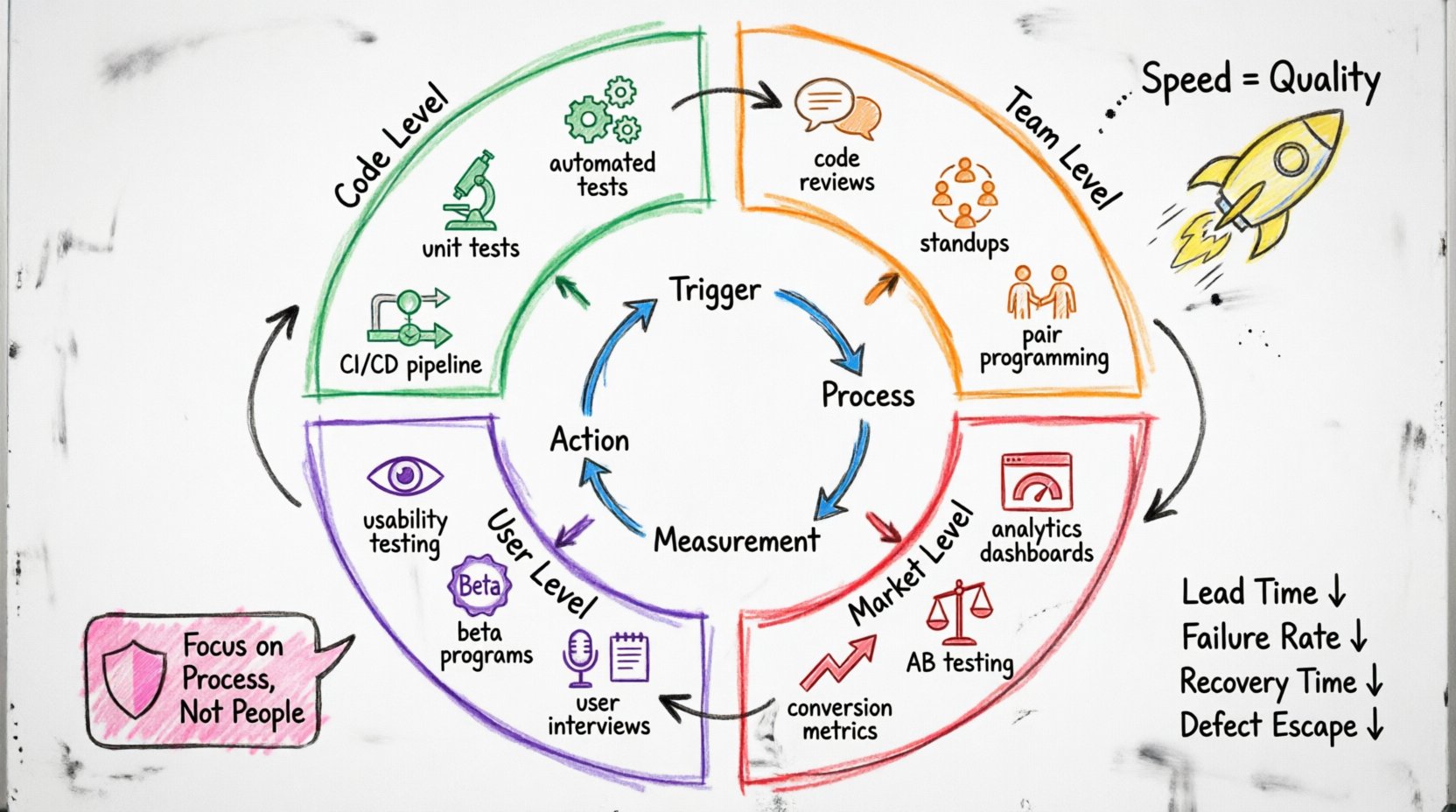
To visualize this, consider the following components:
- Trigger: A specific event, such as a code commit, a user story completion, or a market shift.
- Process: The work performed to address the trigger, including coding, designing, or testing.
- Measurement: The collection of data regarding the outcome of the process (e.g., pass/fail status, user engagement metrics).
- Action: The decision or adjustment made based on the measurement (e.g., fixing a bug, pivoting a feature).
When these components are tightly coupled, the time between the trigger and the action shrinks. This reduction in time is the primary factor in improving quality quickly. When a developer writes code and receives immediate validation, the mental context remains intact. When that validation takes days or weeks, the context degrades, and the likelihood of introducing new errors increases.
⚡ Why Speed Matters in Quality Assurance
Quality is not merely the absence of defects; it is the presence of alignment. Alignment happens when the product matches the intent of the user and the vision of the business. Speed in feedback accelerates alignment. If a team discovers a misunderstanding of requirements after a month of work, the cost of correction is high. If they discover it within a day, the cost is low.
The economic impact of delayed feedback is significant. Research indicates that the cost to fix a defect grows exponentially the later it is found in the lifecycle. This is due to the compounding effort required to trace the issue back through architecture, design, and documentation layers. Therefore, shortening the feedback cycle is a direct investment in quality assurance.
Key reasons why speed matters include:
- Cognitive Retention: Developers understand their own code better immediately after writing it.
- Momentum: Quick wins and corrections keep the team moving forward without frustration.
- Risk Reduction: Early detection prevents small issues from becoming systemic failures.
- User Confidence: Rapid iteration based on user input builds trust in the product.
📊 The Four Dimensions of Feedback
Feedback is not a monolith. It comes from various sources at different stages of development. To achieve comprehensive quality, teams must manage loops across four distinct dimensions. Each dimension requires specific mechanisms to ensure the signal is clear and actionable.
| Dimension | Source | Frequency | Primary Goal |
|---|---|---|---|
| Code Level | Automated Tests | Continuous | Technical Integrity |
| Team Level | Reviews & Standups | Daily | Process Efficiency |
| User Level | Usability Testing | Per Sprint | Experience Validation |
| Market Level | Analytics & Sales | Per Release | Business Value |
1. Code Level Feedback
This is the most immediate loop. It occurs the moment code is saved. Automated testing suites, static analysis tools, and continuous integration pipelines provide instant signals on syntax errors, security vulnerabilities, and logic failures. The goal is to prevent broken code from ever reaching a shared repository.
- Unit Tests: Verify individual functions work as expected.
- Integration Tests: Ensure different modules interact correctly.
- Linting: Enforces coding standards to reduce technical debt.
2. Team Level Feedback
Code does not exist in a vacuum. Team interactions provide feedback on clarity, architecture, and collaboration. Code reviews are a formalized loop where peers inspect work before it is merged. Daily synchronization meetings allow the team to identify blockers or misunderstandings early.
- Peer Reviews: Focus on logic, readability, and maintainability.
- Pair Programming: Real-time feedback during the creation process.
- Retrospectives: Periodic reflection on how the team works together.
3. User Level Feedback
Even if the code is perfect, the product may fail if it does not solve the user’s problem. This loop connects the team directly to the people using the software. It involves beta testing, user interviews, and usability studies. The data gathered here validates whether the assumptions made during planning were correct.
- Usability Sessions: Observing users interact with the interface.
- Beta Programs: Releasing to a small group for real-world stress testing.
- Support Tickets: Analyzing reports from live users for bugs.
4. Market Level Feedback
Finally, the product must succeed in the marketplace. This loop measures adoption, retention, and revenue. Analytics dashboards and sales data provide high-level signals about the product’s viability. This feedback often drives strategic pivots rather than tactical fixes.
- A/B Testing: Comparing different versions to see which performs better.
- Conversion Metrics: Tracking user journey completion.
- Customer Satisfaction Scores: Quantitative feedback on overall experience.
🚀 Implementing Short Feedback Cycles
Knowing the dimensions is not enough. Teams must actively work to shorten the time it takes for information to travel from the point of creation to the point of correction. Here are specific strategies to achieve this.
Automate Where Possible
Human intervention introduces latency. If a test requires a person to run it, the delay might be hours or days. Automating these processes ensures the feedback is available in minutes. Build pipelines that trigger automatically upon code submission. If a build fails, the developer should be notified instantly.
Reduce Batch Sizes
Larger batches of work take longer to process and contain more complexity. A single large feature is harder to test than ten small features. By breaking work into smaller chunks, you increase the frequency of feedback. Smaller batches also mean less risk per iteration.
- Split user stories into smaller, testable units.
- Commit code frequently rather than waiting for large milestones.
- Release small increments of functionality regularly.
Enhance Communication Channels
Technical barriers often slow down feedback. If the team relies on email or complex ticketing systems to report issues, information gets lost or delayed. Utilize real-time communication tools to discuss blockers. Ensure that the definition of “done” includes all necessary feedback mechanisms.
Shift Left Testing
Move testing activities earlier in the lifecycle. Instead of waiting for a complete build to test, test requirements and designs during the planning phase. This is known as “shift left.” By validating assumptions before code is written, you prevent entire classes of defects from being created.
🛡️ Creating a Blameless Environment
Feedback loops are only effective if the information flows freely. If team members fear punishment for reporting errors, they will hide them. This creates a culture of silence where quality issues fester until they become critical. A blameless culture encourages transparency.
To foster this environment:
- Focus on the Process: When an error occurs, ask “how did the process allow this?” rather than “who made this mistake?”
- Share Lessons Learned: Make post-mortems about improvements, not accusations.
- Encourage Vulnerability: Leaders should admit their own mistakes to set the tone.
- Separate People from Problems: The goal is to fix the defect, not the developer.
When developers feel safe, they report issues faster. This accelerates the feedback loop because the signal is not dampened by fear. It also encourages experimentation, which is necessary for innovation.
📈 Measuring the Impact on Product Quality
You cannot improve what you do not measure. To ensure feedback loops are working, you need specific metrics. These metrics should track the speed of the loop and the quality of the output.
Key Performance Indicators
- Lead Time for Changes: The time from code commit to code in production. A decreasing trend indicates a faster loop.
- Change Failure Rate: The percentage of deployments causing a failure in production. A lower rate indicates higher quality.
- Mean Time to Recovery: How long it takes to restore service after a failure. Faster recovery means better feedback on failures.
- Defect Escape Rate: The number of bugs found by users versus those found by the team. A lower rate means better internal testing.
Analyzing the Data
Collecting numbers is not enough. You must analyze trends over time. Look for correlations between feedback frequency and defect rates. If you introduce a new testing practice and the defect rate drops, you have evidence of improvement. If metrics stagnate, investigate whether the feedback is being acted upon.
🧩 Overcoming Common Implementation Barriers
Even with the right mindset and tools, teams often face obstacles when trying to implement robust feedback loops. Recognizing these barriers early allows for proactive mitigation.
1. Siloed Teams
When development, testing, and operations work in isolation, feedback stops at the boundaries. Information is handed off rather than shared. Break down silos by cross-functionalizing teams. Ensure every team member understands the full lifecycle of the product.
2. Tooling Friction
If the tools required to give feedback are difficult to use, people will avoid them. Streamline the workflow. Integrate tools so that data flows automatically. Avoid requiring manual data entry for status updates.
3. Lack of Context
Feedback is useless without context. A bug report that says “it broke” is not helpful. Feedback must include environment details, reproduction steps, and user impact. Train teams on how to document feedback effectively.
4. Resistance to Change
Changing how a team works is difficult. People prefer familiar routines. Introduce changes gradually. Start with one small loop and demonstrate its value before expanding. Show tangible results, such as reduced rework time, to build buy-in.
🌐 Scaling Feedback Across the Organization
Once a single team has mastered feedback loops, the challenge is to scale this capability across the entire organization. This requires alignment on standards and shared infrastructure.
- Standardized Definitions: Ensure all teams use the same definitions for “quality” and “done”.
- Shared Dashboards: Create a centralized view of quality metrics for leadership.
- Community of Practice: Establish groups where teams share best practices regarding feedback.
- Training Programs: Invest in training for new employees on feedback mechanisms.
Scaling is not about imposing rules. It is about creating a culture where feedback is valued as a core competency. When quality becomes a shared responsibility, the entire organization moves faster with less risk.
🛠️ Integrating Feedback into Planning
Feedback loops should not end at the release. They must inform the future. The insights gained from user testing and market analytics should directly influence the product roadmap. This creates a continuous cycle of improvement.
When planning the next phase of work, consider the following:
- Backlog Grooming: Review past defects to see if similar stories need prevention.
- Refinement: Ensure stories include acceptance criteria based on previous feedback.
- Prioritization: Rank features based on user value derived from market feedback.
This integration ensures that the product evolves in response to reality, not just assumptions. It turns the development process into a learning organization.
🔍 Deep Dive: The Psychology of Correction
Accepting feedback is a psychological challenge. Humans have a natural tendency to defend their work. This is known as the ego threat. When code is criticized, it can feel like a personal attack. To mitigate this, frame feedback as a collaboration rather than a critique.
Use language that focuses on the work product. Say “This function could be more efficient” instead of “You wrote this poorly.” This distinction is subtle but powerful. It separates the identity of the developer from the artifact they created. When the ego is not threatened, the brain is free to process the information logically.
Additionally, celebrate the catching of bugs. When a tester finds an issue before release, acknowledge that effort. This reinforces the behavior of finding errors early. It shifts the culture from “who broke it” to “who saved it.”
🎯 Final Thoughts on Continuous Improvement
The journey to high-quality products is never finished. New technologies, new requirements, and new users constantly emerge. The only way to stay ahead is to remain agile in your processes. Feedback loops are the engine of this agility. They provide the data needed to steer the ship in the right direction.
By focusing on speed, safety, and clarity, teams can build products that users love and businesses need. The goal is not perfection, but continuous improvement. Every loop closed is a step toward a better product. Every piece of feedback analyzed is an opportunity to learn.
Start small. Identify one loop in your current workflow that is too slow. Measure the time it takes. Find a way to cut that time in half. Repeat this process. Over time, these small improvements compound into a significant competitive advantage.
The path to quality is paved with information. Ensure your team has the tools and culture to gather it, understand it, and act on it. This is how products are built for the long term.