

Startups operate in a unique ecosystem defined by uncertainty, rapid iteration, and intense scrutiny. The margin for error is thin, and the stakes are often personal and financial. In this environment, the concept of psychological safety is not merely a soft skill or a nice-to-have HR initiative. It is a critical operational asset that determines whether a team survives the pressure or fractures under it. For Agile teams working in high-velocity environments, the ability to speak up, admit mistakes, and challenge ideas without fear of retribution is the difference between a resilient organization and one that collapses under its own weight.
This guide explores how to build and maintain psychological safety within the constraints of a high-pressure startup. We will move beyond surface-level definitions to examine the structural, behavioral, and cultural changes required to foster an environment where innovation can thrive without the cost of human burnout.
Understanding the Core Concept 🔍
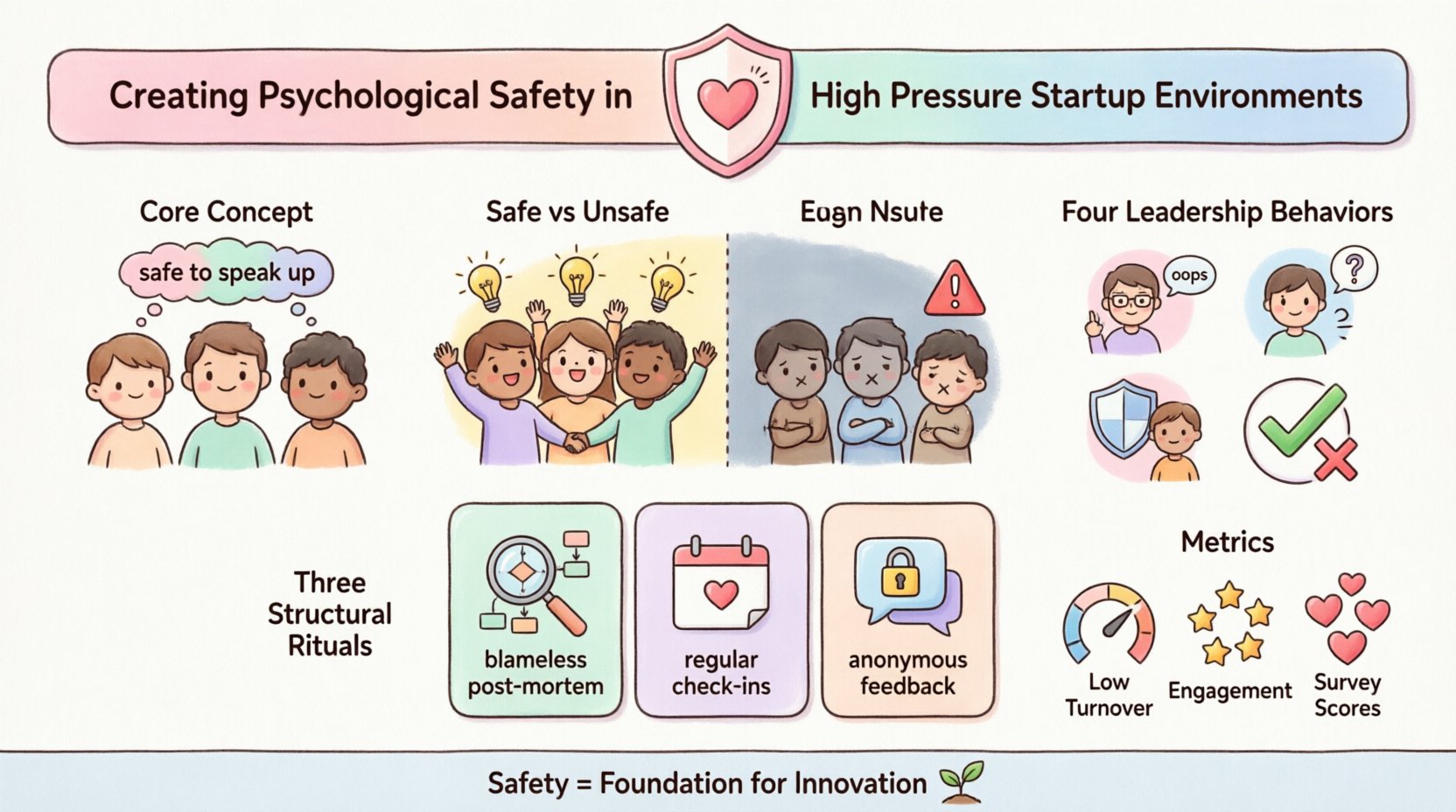
Psychological safety is the shared belief that the team is safe for interpersonal risk-taking. It is the confidence that one will not be punished or humiliated for speaking up with ideas, questions, concerns, or mistakes. In a startup context, this definition expands. It means the team trusts that their vulnerability will be met with support rather than judgment.
When psychological safety is absent, the energy of the organization is spent on self-protection. Employees spend mental cycles anticipating how to frame their messages to avoid blame. They withhold information that might be uncomfortable. They do not ask for help when they are stuck. This creates a facade of competence that eventually leads to catastrophic failure when the pressure peaks.
The Agile Connection 🏃
Agile methodologies rely heavily on transparency and frequent feedback loops. Scrum ceremonies, retrospectives, and daily stand-ups are designed to surface impediments early. However, these rituals fail if the team does not feel safe to disclose the truth.
- Retrospectives: Without safety, retrospectives become blaming sessions or empty pleasantries. Team members avoid discussing real friction points.
- Stand-ups: If a developer is blocked, they may hide it to avoid appearing incompetent. The blockage persists until it becomes a critical path failure.
- Code Reviews: If the culture is punitive, code reviews become personal attacks. Junior engineers stop asking questions. Senior engineers stop offering mentorship.
In high-pressure startups, the temptation to cut corners is high. Psychological safety acts as a brake on this impulse. It allows the team to say, “This is too risky,” or “We don’t have enough time for this feature,” without fear of being labeled a blocker.
Barriers to Safety in High Growth Environments 🚧
Building safety is difficult when the company is growing fast. The velocity of change often outpaces the development of trust. Several structural factors specifically hinder safety in startups:
- Hiring Velocity: Rapid hiring brings in people with different cultural norms. New hires may not understand the unwritten rules of communication.
- Resource Constraints: When teams are understaffed, the tolerance for error drops. There is less bandwidth to handle the emotional labor of supporting one another.
- Founder Dynamics: Founders often have high authority and strong opinions. If they are perceived as intolerant of dissent, the team will self-censor immediately.
- Equity Pressure: When equity is the primary motivator, failure feels like a loss of personal wealth. This increases the fear of making mistakes.
Comparing Safe vs. Unsafe Environments 📊
To understand the impact of safety, it helps to visualize the difference between a team that feels secure and one that does not. The following table outlines the behavioral differences observed in these two states.
| Dimension | Psychologically Safe Environment 🛡️ | Unsafe Environment ⚠️ |
|---|---|---|
| Handling Mistakes | Mistakes are analyzed for learning. Focus is on the process, not the person. | Mistakes are hidden. Focus is on assigning blame. |
| Meeting Participation | Diverse opinions are voiced. Silence is rare. | Only dominant voices speak. Others nod silently. |
| Feedback Reception | Feedback is viewed as data to improve performance. | Feedback is viewed as a personal attack. |
| Conflict Resolution | Conflict is focused on ideas and outcomes. | Conflict becomes personal and political. |
| Help Seeking | Asking for help is normalized as a sign of strength. | Asking for help is seen as a sign of weakness. |
Leadership Behaviors That Drive Safety 🎯
Leadership sets the tone. In a startup, the founders and engineering leads are the architects of the culture. Their daily actions signal what is acceptable. To build safety, leaders must engage in specific behaviors that invite vulnerability.
1. Modeling Fallibility
Leaders must admit when they do not know the answer. They must say, “I made a mistake in that decision,” or “I need your help to figure this out.” When a leader admits a mistake, it gives permission for the rest of the team to do the same without fear of losing status.
2. Active Inquiry
Instead of providing answers, leaders should ask questions. “What do you see happening here?” “What risks are you worried about?” “How can I support you?” This shifts the dynamic from authority to collaboration. It signals that the leader values the team’s perspective more than their own certainty.
3. Protecting Vulnerability
If a team member speaks up with a concern and is criticized, the leader must intervene. If a junior engineer raises a red flag about a deadline, and a manager pushes back aggressively, the safety is broken. The leader must ensure that the person who raised the concern is supported, even if the concern is ultimately deemed incorrect.
4. Removing Retribution
There must be a clear policy that speaking up does not lead to negative performance reviews. If a team member flags a compliance issue or a technical debt risk, their evaluation should not suffer. This requires separating the messenger from the message.
Structural Rituals for Safety 🔄
Behaviors alone are not enough. Structures must be put in place to reinforce the culture. Rituals create predictable spaces where safety can be practiced.
The Blameless Post-Mortem
When things go wrong, a post-mortem is essential. However, the standard version often turns into a witch hunt. A blameless post-mortem follows strict rules:
- Focus on Process: Analyze the workflow, not the individual.
- Ask “How” not “Who”: How did the system allow this error? How did the communication break down?
- Actionable Outcomes: Every post-mortem must result in a concrete change to prevent recurrence.
- Documentation: The findings are shared openly so others can learn.
Regular Check-Ins
Beyond the work, teams need to check on the humans. Regular one-on-ones should include questions about workload, stress levels, and morale. If a team member is burning out, the conversation should happen before they quit. This requires leaders to be observant and empathetic.
Anonymous Feedback Channels
Not everyone is comfortable speaking up in a room. Anonymous feedback tools allow employees to voice concerns without fear of identification. This is a safety net for those who cannot yet trust the open environment. Over time, as trust builds, reliance on anonymity should decrease.
Managing Conflict and Failure 💥
Conflict is inevitable in high-performance teams. The goal is not to eliminate conflict, but to manage it constructively. In a safe environment, conflict is about ideas, not people.
The Role of Disagreement
Startups need debate. If everyone agrees, it is likely a sign of groupthink. Leaders should encourage disagreement during the planning phase. However, once a decision is made, the team must execute with unity. This is the concept of “disagree and commit.” It requires a level of trust that everyone is acting in the best interest of the company.
Reframing Failure
In a high-pressure environment, failure is often viewed as a lack of effort. This mindset must shift. Failure is a necessary cost of innovation. If a team never fails, they are likely not taking enough risks.
- Small Failures: Encourage small experiments that can fail quickly. This reduces the cost of failure.
- Learning Loops: Connect every failure to a learning point. If nothing is learned, the failure was wasteful.
- Celebration of Learning: Recognize teams that fail but learn valuable lessons. This reinforces that the learning is the priority.
Measuring Psychological Safety 📉
You cannot improve what you do not measure. While culture is abstract, there are indicators that can be tracked over time.
| Metric | What It Indicates | How to Track |
|---|---|---|
| Turnover Rate | High turnover often signals a toxic or unsafe environment. | HR data on voluntary exits. |
| Meeting Engagement | Low participation suggests fear of speaking. | Observation of meeting dynamics. |
| Retrospective Output | High number of action items implies trust. | Tracking retrospective logs. |
| Employee Sentiment | Direct feedback on safety and support. | Anonymous surveys (e.g., eNPS). |
| Help Requests | Frequency of help requests indicates comfort. | Communication channel logs. |
It is important to note that these metrics are lagging indicators. They tell you what has happened. To be proactive, leaders must rely on qualitative feedback and direct observation.
Common Pitfalls to Avoid ⚠️
Even with good intentions, organizations can undermine safety. Here are common mistakes to watch out for.
- Performative Safety: Saying “safety is a priority” while punishing mistakes creates cynicism. Actions must match words.
- Forced Vulnerability: Leaders cannot demand that employees share personal struggles. Vulnerability must be invited, not mandated.
- Ignoring Power Dynamics: Safety is not uniform. A junior employee may feel safe talking to a peer but not a manager. Leaders must account for hierarchy.
- One-Off Training: A single workshop does not change culture. Safety is built through daily interactions, not a seminar.
Sustaining Safety Over Time 🌱
Psychological safety is not a destination; it is a practice. As the company grows, the culture can dilute. New hires bring new norms. Rapid scaling introduces complexity. Leaders must remain vigilant.
Onboarding Integration
From day one, new hires should be taught the norms of communication. They should be told, “We value candor,” and then demonstrated through action. Onboarding should include examples of how the team handles conflict and failure.
Consistent Reinforcement
Leaders must consistently reinforce the desired behaviors. When someone speaks up, acknowledge it publicly. When someone hides a mistake, handle it privately and constructively. The signal must be clear.
Adapting to Context
Different teams may have different needs. A sales team might require different safety mechanisms than an engineering team. Leaders should listen to the specific needs of their teams and adapt accordingly.
Final Thoughts on Culture Building 🏁
Balancing high performance with high safety is the central challenge of modern startup leadership. It is not a trade-off where you must choose one over the other. Research and experience show that the highest performing teams are those where members feel safe to take risks.
The path to safety requires humility. Leaders must accept that they do not have all the answers. They must accept that mistakes will happen. They must accept that the best ideas often come from the most junior members of the team.
By focusing on behaviors, rituals, and measurement, organizations can build a foundation that withstands pressure. This foundation allows the team to move fast without breaking. It allows innovation to happen without the fear of punishment. In the end, the goal is not just to build a product, but to build a team that can endure the journey together.
Start the work today. Listen to your team. Ask the hard questions. And remember that safety is the bedrock upon which all other success is built.