


In the dynamic landscape of modern software delivery and project management, the concept of the self-organizing team has become a cornerstone of Agile methodologies. However, the presence of a team that can direct its own work does not imply the absence of leadership. Instead, it demands a specific evolution in leadership behavior.
Many organizations struggle when they attempt to introduce self-organization without adjusting their management approach. They often replace a command-and-control structure with a vacuum of direction, leading to confusion rather than empowerment. True self-organization requires a foundation of trust, clear boundaries, and a leadership style that prioritizes enabling others over directing them.
This guide explores the specific leadership behaviors that foster autonomy, enhance team performance, and sustain high-performing groups without relying on rigid hierarchy. We will examine the nuances of servant, transformational, and situational leadership within an Agile context.
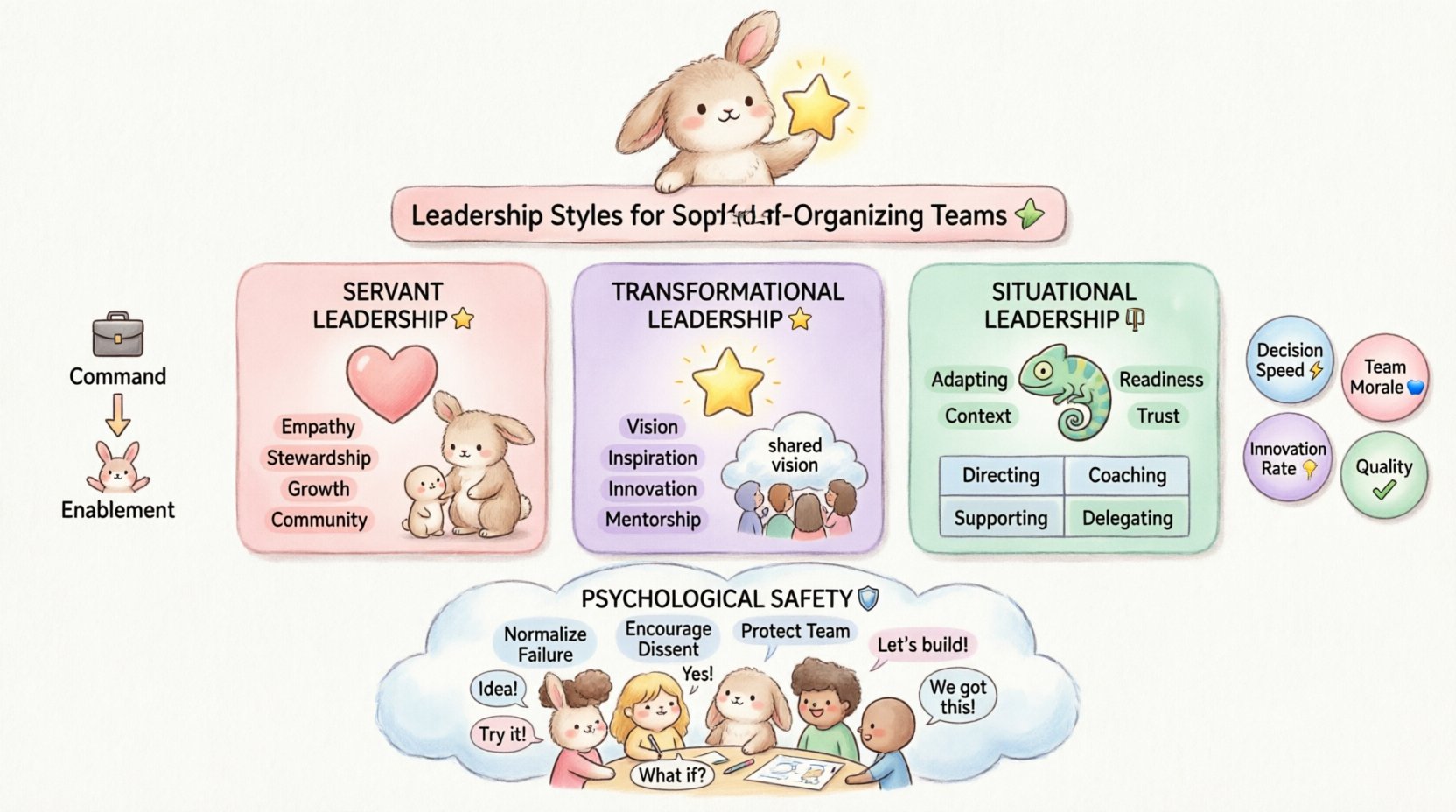
Understanding the Shift from Command to Enablement 🧭
Traditional management models often rely on the assumption that leaders possess the most accurate information and should dictate the path forward. In complex environments where work is unpredictable and knowledge is distributed among team members, this assumption breaks down. Self-organizing teams operate on the premise that the people closest to the work are best positioned to make decisions about how to execute it.
For this to work, the leader must shift their role from a commander to a facilitator. This transition involves several critical changes:
- Decision Making: Moving from top-down mandates to collaborative consensus.
- Information Flow: Ensuring transparency so the team has the context needed to decide.
- Feedback Loops: Creating mechanisms for continuous improvement rather than annual reviews.
- Resource Allocation: Shifting from assigning tasks to removing impediments.
Without this shift, a team may technically be self-organizing but remain constrained by invisible walls of approval and oversight. The leadership style must explicitly support the removal of these barriers.
Servant Leadership: The Foundation of Agile 🤝
Servant leadership is widely considered the most compatible style for self-organizing teams. Coined by Robert K. Greenleaf, this philosophy posits that the leader’s primary goal is to serve the team. The focus is not on the leader’s power but on the growth and well-being of the people they lead.
Core Behaviors of a Servant Leader
- Empathy: Actively listening to team members to understand their motivations, challenges, and perspectives.
- Stewardship: Holding the team and its work in trust, ensuring resources are used effectively for the greater good.
- Commitment to Growth: Prioritizing the professional development of each individual within the group.
- Building Community: Fostering a sense of belonging and shared purpose.
When a leader practices servant leadership, they do not ask, “What can my team do for me?” They ask, “What do I need to do so my team can succeed?” This subtle shift in mindset changes how meetings are run, how goals are set, and how conflicts are resolved.
Practical Application in Daily Work
In a practical setting, a servant leader removes obstacles before the team even identifies them. If a team member is blocked by a vendor contract issue, the leader intervenes to resolve it so the engineer can focus on coding. If the team lacks a testing environment, the leader advocates for the infrastructure needed.
This approach builds psychological safety. When team members know their leader is working in their interest, they are more likely to take calculated risks, admit mistakes early, and propose innovative solutions. In Agile frameworks, this aligns perfectly with the role of the Scrum Master or Agile Coach, though the principles apply to any management hierarchy.
Transformational Leadership: Inspiring Vision 🌟
While servant leadership focuses on the individual needs of the team, transformational leadership focuses on the collective vision. This style is characterized by the ability to inspire and motivate followers to achieve extraordinary outcomes and, in the process, develop their own leadership capacity.
Four Key Components
Transformational leaders operate through four main levers:
- Idealized Influence: Acting as a role model of high ethical standards and competence.
- Inspirational Motivation: Articulating a compelling vision of the future that gives meaning to the work.
- Intellectual Stimulation: Encouraging creativity and challenging assumptions to foster innovation.
- Individualized Consideration: Providing mentorship and support tailored to each team member.
For self-organizing teams, the “Vision” component is critical. A team needs to know the “Why” behind their work to make autonomous decisions that align with organizational goals. Without a clear vision, autonomy can lead to divergence, where teams build features that do not serve the broader business strategy.
Balancing Autonomy and Alignment
A transformational leader ensures alignment by communicating the destination, not the route. They define the problem space and the desired outcome, then trust the team to navigate the solution space. This requires a high degree of trust and clear communication channels.
For example, instead of specifying a technical stack, a leader might say, “We need a system that can handle high latency and scale globally.” The team then decides on the architecture, tools, and implementation strategy. This empowers technical decision-making while maintaining strategic alignment.
Situational Leadership: Adapting to Context ⚖️
Not every situation calls for the same level of delegation. Situational leadership suggests that the best approach depends on the maturity and competence of the team regarding a specific task. This model, developed by Hersey and Blanchard, argues that leaders must adapt their style based on the readiness of the followers.
The Four Leadership Styles
| Team Readiness | Leadership Style | Focus |
|---|---|---|
| Low Competence, High Commitment | Directing | Clear instructions and close supervision. |
| Some Competence, Variable Commitment | Catalyzing | High direction, high support. |
| High Competence, Low Confidence | Supporting | Low direction, high support. |
| High Competence, High Confidence | Delegating | Low direction, low support (Autonomy). |
In the context of self-organizing teams, the goal is to move the team toward the “Delegating” quadrant as quickly and safely as possible. However, this does not mean the leader disengages entirely. It means the leader provides a safety net rather than a steering wheel.
Dynamic Adjustment
Teams evolve. A group might be highly autonomous on one project but new to the domain on another. A situational leader recognizes this variance. They might provide more structure for a new technology adoption while stepping back for a maintenance release.
This flexibility prevents the “one size fits all” pitfall. It acknowledges that self-organization is a capability that is built over time, not a switch that is flipped. Leaders must be willing to step in temporarily to help stabilize a team that is struggling, without creating dependency.
The Role of Psychological Safety 🛡️
Regardless of the specific leadership style, a common denominator for successful self-organization is psychological safety. This is the belief that one will not be punished or humiliated for speaking up with ideas, questions, concerns, or mistakes.
Why It Matters
Self-organizing teams rely on rapid feedback. If a team member discovers a critical flaw in the architecture, they must feel safe to flag it immediately. If the culture is one of blame, that information will be hidden until it causes a failure.
Leaders play a pivotal role in establishing this safety. They must:
- Normalize Failure: Treat mistakes as learning opportunities rather than reasons for punishment.
- Admit Their Own Errors: Demonstrate vulnerability to show that imperfection is acceptable.
- Encourage Dissent: Actively invite differing opinions during planning and review sessions.
- Protect the Team: Shield the group from external politics and unreasonable demands.
When psychological safety is present, the team can self-correct. They do not need a manager to tell them when something is going wrong; they have the collective awareness to identify and address issues internally.
Common Pitfalls in Leadership Transition 🚧
Transitioning to a leadership style that supports self-organization is difficult. Even well-intentioned leaders often stumble. Recognizing these pitfalls is the first step to avoiding them.
1. The Vacuum of Authority
Sometimes, in an attempt to be less controlling, leaders withdraw completely. This creates a vacuum where no one knows who is responsible for decisions, leading to stagnation or chaos. Self-organization does not mean no structure; it means distributed structure.
2. Micromanagement in Disguise
A leader might claim to be servant-leading but still dictate the “how” of the work while pretending to be supportive. This often manifests as asking for daily status updates on every small task or insisting on code reviews for every line of code without context. This erodes trust and signals a lack of confidence in the team.
3. Ignoring Organizational Constraints
Leaders often forget that the team operates within a larger system. A team might be self-organizing, but if the procurement process takes six months to approve a tool, the team cannot function effectively. The leader must manage the environment around the team, not just the team itself.
4. Confusing Autonomy with Anarchy
Autonomy is granted within boundaries. Without clear guardrails regarding budget, compliance, or quality standards, autonomy can lead to technical debt or compliance violations. Leaders must define the boundaries clearly, then allow freedom within them.
Measuring Success Beyond Output 📊
In traditional management, success is often measured by adherence to a plan. In self-organizing environments, metrics must shift to reflect health and capability. Leaders should track indicators that show the team is functioning well without constant intervention.
- Decision Latency: How long does it take for the team to make a decision? A decreasing trend suggests growing confidence.
- Impediment Resolution Time: How quickly are blockers removed? This reflects the team’s ability to self-serve and the leader’s support.
- Team Morale and Retention: High-performing teams stay. If key members leave, it often indicates a leadership or cultural issue.
- Quality Metrics: Defect rates and technical debt levels. Self-organizing teams should maintain or improve quality without direct oversight.
- Innovation Rate: The number of new ideas or process improvements proposed by the team.
These metrics provide a feedback loop for the leader to adjust their approach. If decision latency is high, the leader might need to clarify boundaries. If morale is low, they might need to focus more on servant leadership behaviors.
Building Long-Term Sustainability 🌱
Implementing these leadership styles is not a one-time project. It is an ongoing practice of reflection and adjustment. Organizations that succeed in this area view leadership development as a continuous investment.
Coaching the Leaders
Leaders themselves need support. They are often promoted because they were excellent individual contributors, not because they were excellent people managers. Providing them with coaching, peer circles, and training in emotional intelligence is essential.
Culture Over Process
Many organizations try to copy Agile processes without changing the underlying culture. A self-organizing team cannot thrive in a culture that rewards individual heroism over collective success. The reward system must align with the leadership style. If you praise the person who works the longest hours, you undermine the team’s ability to self-regulate pace.
Patience with the Process
It takes time for a team to mature. There will be periods of instability. Leaders must have the patience to endure these phases without reverting to command-and-control behaviors at the first sign of trouble. Trust is built over time, and it can be lost in minutes.
Conclusion on Leadership Evolution
The path to effective self-organization is paved with intentional leadership choices. It requires moving away from the safety of control and stepping into the uncertainty of empowerment. By adopting servant, transformational, and situational leadership styles, leaders create the conditions necessary for teams to thrive.
When leaders focus on removing impediments, clarifying vision, and building psychological safety, they do not become obsolete. They become essential enablers. The team gains the autonomy to innovate, and the organization gains the agility to respond to change.
The ultimate goal is not to manage the work, but to manage the environment in which the work happens. When this shift occurs, the team transforms from a group of individuals following instructions into a cohesive unit capable of solving complex problems. This is the true promise of leadership in an Agile world.