


Moving from a small startup environment to a growing organization presents unique challenges. When you start with five employees, everyone knows everyone, and communication happens over a coffee cup. Reaching fifty employees changes the dynamic entirely. This is not merely about hiring more people; it is about adapting your operating model to maintain speed and quality. This guide explores how to scale agile practices effectively without losing the core benefits that made them valuable in the first place.
Many organizations fail during this transition. They introduce too much bureaucracy too quickly, or they try to keep the informal processes that worked at five people. The goal is to find a balance that supports growth without creating friction. We will look at structural changes, communication patterns, role evolution, and cultural preservation. This approach requires careful planning and a willingness to evolve.
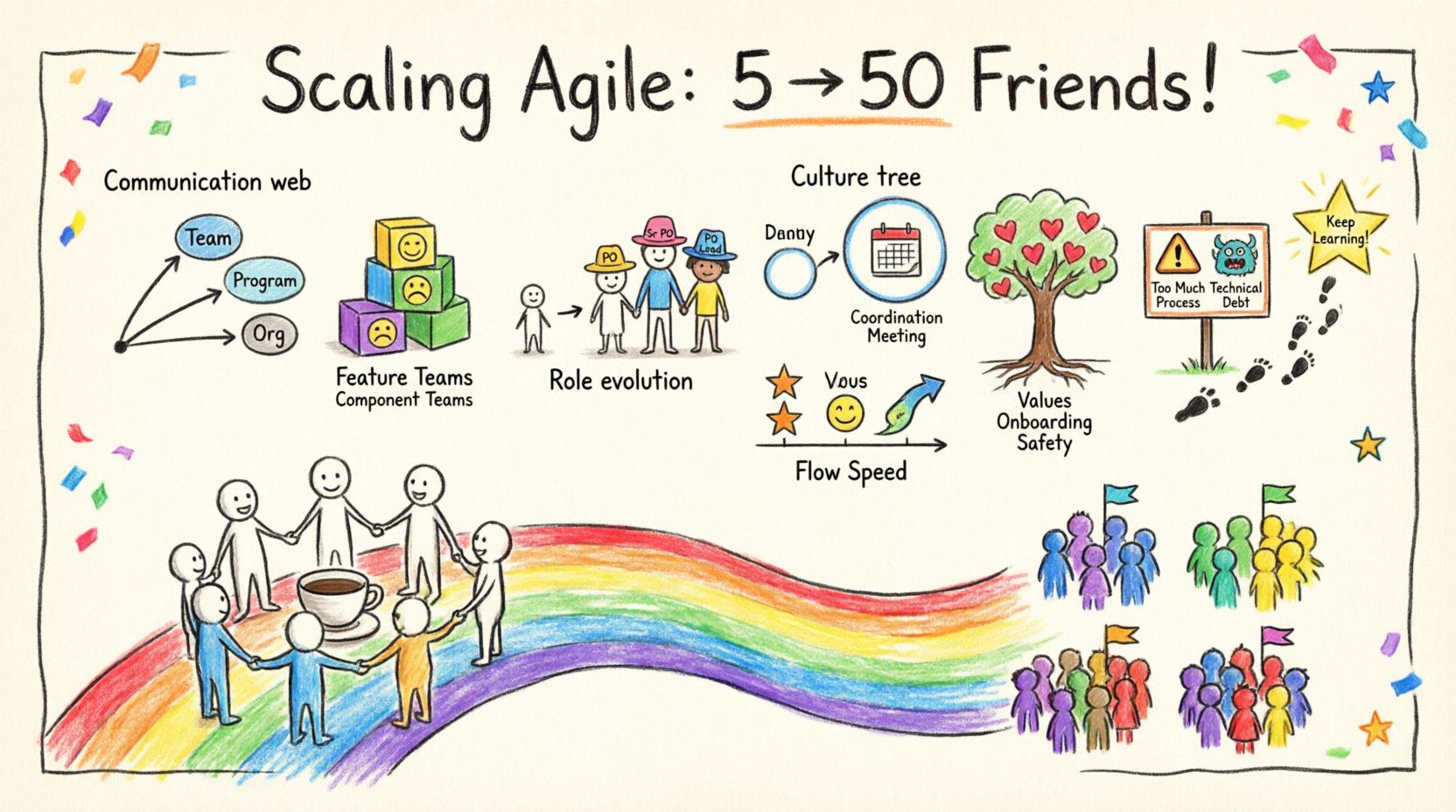
📈 Why the Five to Fifty Threshold Matters
The jump from five to fifty employees is often where the “Valley of Death” occurs for agile teams. At five people, a single product owner can manage the backlog. At fifty, that same person becomes a bottleneck. This phase is critical because it tests the flexibility of your framework. If you rely too heavily on tribal knowledge, you risk failure as new hires join. If you document everything rigidly, you lose the agility you sought.
Key characteristics of this transition include:
- Increased Complexity: Dependencies between individuals grow exponentially.
- Communication Overhead: The number of communication channels increases with every new person added.
- Role Specialization: Generalists must become specialists to handle specific domains.
- Process Formalization: Informal agreements need to become documented standards.
Understanding these shifts helps leadership anticipate problems before they disrupt delivery. It is not about predicting the future perfectly, but about building a system that can absorb change.
🗣️ Managing Communication Overhead
As the team grows, the number of potential communication paths increases. This is a well-known concept in systems engineering. In a five-person team, everyone talks to everyone. In a fifty-person team, this becomes impossible. If you do not structure communication, you will see a drop in productivity.
To manage this, you must introduce layers of information sharing:
- Team Level: Daily interactions remain focused on immediate work. Standups should stay small, ideally under ten people.
- Program Level: Representatives from different teams meet to discuss cross-team dependencies. This is often called a “Scrum of Scrums” or similar coordination forum.
- Organization Level: Leadership communicates vision and strategic goals. This ensures all teams are aligned toward the same outcome.
It is essential to document decisions. At five people, verbal confirmation is enough. At fifty, verbal confirmation leads to confusion. Written records of decisions, architectural choices, and product requirements become necessary. This does not mean writing novels, but ensuring key information is accessible.
🏗️ Structural Changes and Team Topology
When you have five people, a single team usually works on the whole product. When you reach fifty, you likely need multiple teams. How you organize these teams is crucial. You can organize by function (e.g., a backend team, a frontend team) or by feature (e.g., a payment team, a user profile team).
Feature-based organization is generally preferred for scaling. It allows a single team to deliver end-to-end value. Functional organization often creates handoffs and delays.
Consider the following comparison for team structures:
| Structure Type | Pros | Cons |
|---|---|---|
| Feature Teams | End-to-end delivery, faster feedback, ownership | Requires diverse skills, harder to manage specialized resources |
| Component Teams | Specialized expertise, shared infrastructure | Dependencies, bottlenecks, handoffs, slower delivery |
| Squad Model | Autonomy, clear ownership, aligned with business value | Requires strong product management, clear boundaries |
When transitioning to multiple teams, you must define boundaries. What does Team A own? What does Team B own? Ambiguity leads to duplicate work and conflict. Clear ownership of features or domains allows teams to move independently without stepping on each other’s toes.
👥 Evolution of Roles
Roles do not disappear when you scale, but their responsibilities change. The Product Owner (PO) role is a prime example. At five people, one PO can handle everything. At fifty, one PO cannot manage the backlog for five different teams. You will need a hierarchy of product ownership.
- Chief Product Officer: Sets the vision and strategy.
- Senior Product Owner: Manages the roadmap for a specific domain or business unit.
- Product Owner: Manages the backlog for a single team.
The Scrum Master role also evolves. In a small team, the Scrum Master might do administrative work and facilitate meetings. In a scaled environment, they become coaches and change agents. They focus on removing systemic impediments rather than just scheduling meetings. They help new hires understand the culture and the process.
Key shifts in responsibilities include:
- Coaching: Focus shifts from facilitation to mentoring.
- Impediment Removal: Focus shifts from team-level blockers to organizational blockers.
- Metrics: Focus shifts from team velocity to organizational throughput and value delivery.
🔄 Ceremonies at Scale
Ceremonies are the heartbeat of agile practice. However, holding every ceremony at the same level of detail becomes inefficient as the group grows. You need to tier your meetings.
Team Level Meetings: These remain focused on the specific work of the team. Daily standups, sprint planning, reviews, and retrospectives happen here. They should be time-boxed and strictly relevant to the participants.
Program Level Meetings: These focus on integration and alignment. Examples include:
- Integration Planning: When will different teams combine their work?
- Dependency Mapping: What does Team A need from Team B?
- Release Coordination: Managing the release train or deployment schedule.
It is common to see too many meetings at this stage. If you have ten teams, you cannot have ten separate planning meetings that last all day. You might use a rolling planning approach or a centralized planning event with breakout sessions. The goal is to reduce meeting time while increasing alignment.
🧠 Culture Preservation
Culture is often the hardest thing to scale. When you are five people, culture is the vibe in the room. When you are fifty, culture is the set of values and behaviors reinforced by leadership. If you lose culture, you lose agility. People become process-compliant rather than value-delivering.
To maintain culture:
- Hire for Values: Do not just hire for skills. Ensure new hires fit the working style and values.
- Onboarding: Create a structured onboarding process that teaches the agile mindset, not just the tools.
- Psychological Safety: Encourage experimentation and learning from failure. Do not punish mistakes that occur during learning.
- Transparency: Keep information visible. Everyone should know the goals and the progress.
Leadership must model the behavior. If leaders say “agile” but demand rigid plans and daily status reports, the team will adopt the behavior, not the words. Consistency between words and actions is vital.
📊 Metrics and Measurement
As the organization grows, you need better visibility into performance. However, be careful not to create vanity metrics. Measuring lines of code or hours worked is a trap. Focus on value and flow.
Use a mix of metrics to get a complete picture:
| Metric | Purpose | Risk |
|---|---|---|
| Throughput | Measures how many items are completed per time period. | Can encourage working on small items only. |
| Lead Time | Measures time from request to delivery. | Can be skewed by dependencies. |
| Quality Metrics | Defect rates, bug count, customer complaints. | Needs context to be meaningful. |
| Employee Satisfaction | Team health and morale. | Hard to track consistently. |
Review these metrics regularly. If throughput drops, investigate the cause. Is it a process issue? A skill issue? A tooling issue? Use data to drive improvements, not to judge individuals.
⚠️ Common Pitfalls to Avoid
Scaling is difficult, and mistakes are common. Being aware of these pitfalls can save you significant time and resources.
- Too Much Process: Adding processes to fix problems creates new problems. Keep it minimal.
- Ignoring Technical Debt: Growth often leads to shortcuts. If you ignore debt, the speed of development will slow down drastically over time.
- Centralized Decision Making: If every decision goes to the top, you lose the speed of a distributed team. Empower teams to decide.
- Assuming One Size Fits All: Different teams may need different workflows. Allow flexibility where possible.
- Skipping Retrospectives: If teams stop reflecting on how they work, they stop improving. Make retrospectives a priority.
🔮 Looking Forward
The transition from five to fifty employees is a journey, not a destination. You will need to adapt continuously. New challenges will arise as you grow beyond fifty. The principles of agility—adaptability, customer focus, and empowered teams—remain constant, but the implementation will change.
Success in this phase depends on patience and discipline. Do not rush to implement complex frameworks just because they look good on paper. Test changes, measure results, and iterate. Build a system that works for your specific context. The goal is to create an organization that can learn and grow faster than the market changes.
By focusing on clear communication, appropriate structure, and a strong culture, you can scale effectively. The numbers do not matter as much as the ability to deliver value consistently. Keep the focus on the work, and the growth will follow naturally.