

In modern business environments, the disconnect between product teams and revenue-generating departments often creates friction. Product teams move fast, iterating on features based on technical feasibility and user feedback, while sales and marketing require clear messaging, predictable roadmaps, and compelling value propositions to close deals. When these groups operate in silos, the organization suffers from wasted effort, confused customer messaging, and delayed revenue recognition. Aligning Sales and Marketing With Agile Product Development is not about slowing down the engineering pace; it is about creating a feedback loop where market intelligence directly informs product iteration.
This guide explores the structural and cultural shifts required to integrate these functions effectively. We will examine how to incorporate stakeholder voices into sprint cycles, define shared metrics, and build a culture of transparency without compromising the core principles of agility.
🧩 Understanding Agile Product Development
Agile Product Development is a methodology focused on iterative progress, collaboration, and adaptability. Unlike traditional waterfall models where requirements are fixed at the beginning, agile allows for changes based on real-world feedback. The core unit of work is the sprint, typically lasting two to four weeks, during which a cross-functional team delivers a potentially shippable increment of value.
For this methodology to succeed in a commercial context, the definition of “value” must extend beyond technical completion. It must encompass market viability and sales readiness. Here are the foundational pillars that support this alignment:
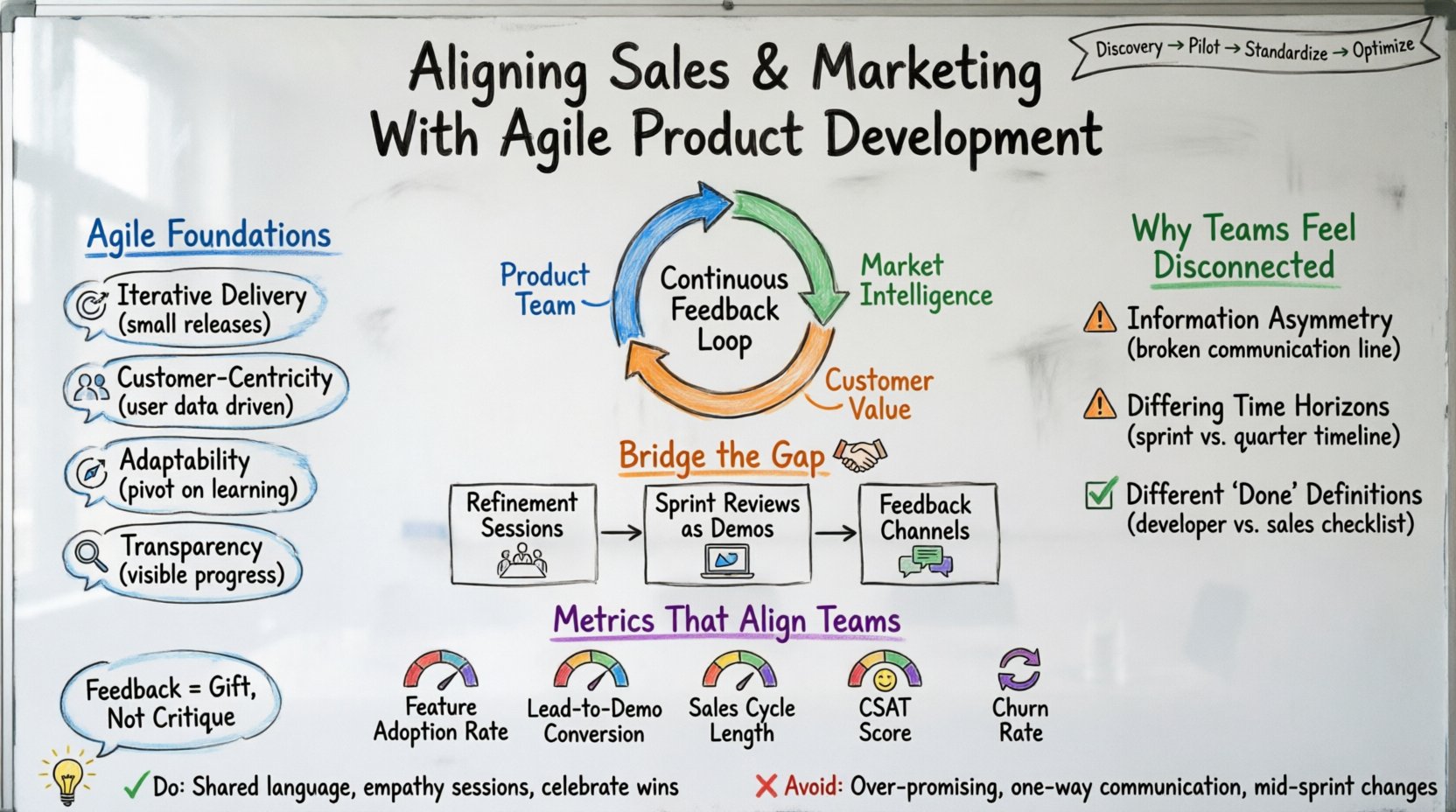
- Iterative Delivery: Product is released in small chunks to gather feedback early.
- Customer-Centricity: Decisions are driven by user data and market needs rather than internal assumptions.
- Adaptability: The team pivots strategies based on learning rather than sticking rigidly to a plan.
- Transparency: Work status, blockers, and progress are visible to all stakeholders.
When sales and marketing teams understand these pillars, they can stop viewing the product roadmap as a static document and start treating it as a dynamic conversation. This shift reduces the frustration often felt by account executives who promise features that do not exist and marketers who cannot articulate the current value of the solution.
📉 Why Sales and Marketing Often Feel Left Behind
The friction between commercial teams and product development usually stems from misaligned incentives and lack of visibility. Understanding these root causes is the first step toward resolution.
1. The Information Asymmetry
Product teams often work in “heads down” mode, focusing on code, architecture, and bug fixes. They may not communicate the status of a feature until it is ready for release. Sales teams, however, need to know early if a feature is coming so they can qualify leads. Marketing needs to know if a feature is delayed so they can adjust campaign timelines.
2. Differing Time Horizons
Agile operates in short sprints (2-4 weeks). Sales cycles often span months or even quarters. Marketing campaigns are planned months in advance. When a product team commits to a quarterly roadmap but works in weekly iterations, the commercial teams may feel the roadmap is unreliable. Conversely, product teams feel pressured to commit to dates that engineers cannot guarantee.
3. The Definition of “Done”
To a developer, “done” means the code is merged and tested. To sales, “done” means the documentation is written, the training is complete, and the feature is listed on the pricing page. To marketing, “done” means the launch announcement is scheduled and the demo environment is populated. These varying definitions lead to confusion about when a feature is actually ready to be sold.
🤝 Integrating Stakeholders Without Slowing Velocity
One common fear is that bringing sales and marketing into agile ceremonies will slow down the team. This is a misconception if managed correctly. The goal is to create structured touchpoints, not constant interruptions. Here is how to integrate commercial stakeholders effectively.
1. Refinement and Planning Participation
Invite representatives from sales and marketing to the Sprint Planning or Refinement sessions. They do not need to attend every meeting, but their input during backlog grooming is critical. They can clarify the business value of specific user stories. For example, a feature request from a key enterprise client might rank higher than a minor UI tweak because of the revenue potential.
Best Practices for Planning:
- Limit attendance to one representative per function to avoid group dynamics issues.
- Provide a summary of the sprint goal before the meeting to ensure attendees are prepared.
- Focus on the “Why” behind the work, not just the “What”.
2. The Sprint Review as a Demo
The Sprint Review is the most critical touchpoint. This is where the team demonstrates what was built. Traditionally, this is for stakeholders to inspect the increment. If sales and marketing are invited, this becomes a training opportunity. They can see the new functionality firsthand, ask questions about edge cases, and understand the limitations.
Make this session interactive. Do not just present slides. Walk through the application. Record the session for team members who cannot attend. This ensures that when a sales rep talks to a prospect, they are describing the product as it actually functions, not as it was promised in a spec sheet.
3. Feedback Loops
Create a formal channel for feedback after the sprint. Sales reps should report back on how the new features landed with prospects. Did the feature solve the pain point? Did the demo go well? This qualitative data is just as valuable as quantitative metrics.
📊 Structured Collaboration: Ceremonies and Artifacts
To maintain alignment, you need specific artifacts and ceremonies that bridge the gap. Below is a table outlining the key interaction points and their purpose.
| Ceremony / Artifact | Frequency | Commercial Team Role | Product Team Role |
|---|---|---|---|
| Backlog Refinement | Weekly | Provide market context and feature requests | Prioritize based on value and feasibility |
| Sprint Planning | Bi-Weekly | Attend for high-level context only | Commit to deliverables |
| Sprint Review | Bi-Weekly | Test features and provide immediate feedback | Demonstrate completed work |
| Product Roadmap | Quarterly | Align on launch windows and messaging | Share strategic themes and timelines |
| Release Notes | Per Sprint | Review for customer-facing communication | Technical documentation and changelog |
Using this table helps both sides understand expectations. For instance, sales teams should know they are not expected to attend Sprint Planning every time, but they are expected to attend the Review. This manages energy and prevents meeting fatigue.
📈 Metrics That Matter for Alignment
When teams align, they must measure success using shared metrics. If product teams are measured on velocity and sales teams on quota, they will optimize for different things. To align, you need metrics that reflect both product health and market success.
1. Feature Adoption Rate
This measures how many customers are actually using the new features released. High velocity is useless if no one adopts the features. Sales and marketing can contribute to this by tracking which features prospects ask about most often.
2. Lead-to-Demo Conversion
If the product team releases a feature that solves a major pain point, the number of qualified demos should increase. Tracking this metric helps product teams understand if their work is resonating in the market.
3. Sales Cycle Length
If new features make the product easier to sell, the sales cycle should shorten. Product teams can track if the time from initial contact to close decreases after a major release.
4. Customer Satisfaction Score (CSAT)
Post-release surveys can indicate if the product is meeting expectations. This is direct feedback that product teams can act on immediately in the next sprint.
5. Churn Rate
Ultimately, the product must retain customers. If churn increases after a release, the product team needs to investigate immediately. This metric ties product decisions directly to revenue retention.
🛑 Overcoming Cultural Friction
Processes and metrics are only half the battle. The human element often causes the most resistance. Sales and product teams often have different personalities and working styles. Sales is often extroverted, talkative, and focused on relationships. Product is often introverted, detail-oriented, and focused on logic. Bridging this gap requires intentional cultural work.
1. Empathy for Constraints
Salespeople often do not understand the complexity of technical debt or infrastructure changes. They need to understand why a simple request takes weeks. Product teams need to understand the pressure sales reps face to hit quota. Regular shadowing sessions can help. Have a sales rep sit in on a development stand-up, or have a developer join a sales call to hear the customer objections directly.
2. Shared Language
Eliminate jargon. Product teams should avoid technical terms like “refactoring” or “latency” when talking to sales. Instead, use terms like “improving system stability” or “faster load times.” Sales teams should avoid vague terms like “enterprise ready” without defining what that means technically.
3. Celebrate Shared Wins
When a feature launch drives significant revenue, celebrate it as a team victory, not just a sales win. When a product release fixes a major bug that was causing churn, celebrate it as a company win, not just a support win. This reinforces the idea that everyone is rowing the same boat.
🛠️ A Practical Implementation Plan
Changing how these teams work together does not happen overnight. It requires a phased approach to avoid overwhelming the organization. Here is a step-by-step plan to begin the alignment journey.
Phase 1: Discovery (Weeks 1-4)
- Conduct interviews with top-performing sales reps to understand their biggest pain points.
- Interview product managers to understand their biggest blockers regarding sales feedback.
- Map the current workflow of a feature request from idea to launch.
- Identify the key stakeholders who will lead the change.
Phase 2: Pilot Program (Weeks 5-12)
- Select one product squad and one sales region to test the new collaboration model.
- Implement the Sprint Review attendance policy for this group.
- Share the new definition of “Done” with the pilot group.
- Gather feedback on what is working and what is causing friction.
Phase 3: Standardization (Months 4-6)
- Document the agreed-upon processes and ceremonies.
- Roll out the practices to all squads and sales regions.
- Set up the shared dashboard for the metrics defined earlier.
- Begin regular retrospectives focused on the alignment process itself.
Phase 4: Optimization (Month 7+)
- Analyze the data from the shared metrics.
- Adjust the cadence of meetings if they are too frequent or too sparse.
- Continuously refine the definition of value based on market changes.
- Onboard new hires with this alignment model from day one.
🔍 Common Pitfalls to Avoid
Even with a plan, things can go wrong. Being aware of common pitfalls can help you navigate them before they become crises.
- Over-Promising: Sales teams may commit to features that are only in the backlog. This damages trust. Establish a rule that sales can only commit to features that are in the current sprint or approved for the next.
- Ignoring Technical Debt: Product teams cannot focus solely on new features if the foundation is crumbling. Marketing must understand that some sprints are dedicated to maintenance and stability, which indirectly supports sales by preventing outages.
- One-Way Communication: If information only flows from product to sales, alignment fails. Sales must provide the market feedback, not just receive announcements.
- Changing Priorities Mid-Sprint: Agile relies on stability. If a high-value sales request interrupts a sprint, velocity drops. Establish a clear policy for handling urgent requests, such as a “hotfix” track that does not disrupt the main sprint.
💡 Building a Feedback Culture
The ultimate goal is a culture where feedback is seen as a gift, not a critique. When a sales rep says a feature is confusing, it is not a failure of the product team; it is an opportunity to improve the user experience. When a product team says a request is too complex, it is not a rejection of the sales rep; it is an explanation of the cost-benefit analysis.
Implementing a “No-Blame” post-mortem culture is essential. When a launch fails or a feature is delayed, the focus must be on the process, not the person. Ask “How did our process allow this to happen?” rather than “Who messed up?” This psychological safety encourages honest communication across departments.
🔄 Continuous Improvement
Alignment is not a destination; it is a continuous process. Markets change, customer needs evolve, and technologies shift. The way sales and marketing align with product today may not be the right way in six months. You must build a mechanism for this evolution.
Conduct a quarterly “Alignment Retrospective.” Invite representatives from all three departments. Discuss the following questions:
- Did we communicate our roadmap clearly?
- Did sales feel supported by the features released?
- Did marketing have the assets they needed to launch?
- What was the biggest friction point this quarter?
- What is one change we will make next quarter?
This regular check-in ensures that the collaboration model remains healthy and responsive to the organization’s needs. It prevents the drift that often occurs as teams become comfortable with their routines and stop questioning their effectiveness.
🌟 Final Thoughts on Cross-Functional Success
Aligning Sales and Marketing With Agile Product Development requires patience, clear communication, and a willingness to adapt. It is not about making product teams sell more or making sales teams write code. It is about creating a unified organization where every department understands how their work impacts the others.
When done right, the benefits are tangible. Revenue becomes more predictable because the pipeline reflects the actual product capabilities. Customer satisfaction improves because the product solves real problems. Employee engagement rises because everyone feels heard and valued. The journey to alignment is challenging, but the destination is a more resilient, responsive, and profitable organization.
Start small. Pick one process, like the Sprint Review, and get that right. Then expand. The goal is not perfection, but progress. By focusing on shared goals and transparent communication, you can build a bridge between the creative engine of product development and the commercial engine of sales and marketing.