

Building a robust database begins long before the first table is created. It starts with understanding the business problem and translating human language into structured data logic. This journey, known as data modeling, bridges the gap between what stakeholders need and how the system stores it. A well-constructed Entity-Relationship Diagram (ERD) serves as the blueprint for this infrastructure. Without a clear translation process, projects risk data redundancy, integrity issues, and costly refactoring later.
This guide details the practical steps to move from raw requirements to a finalized ERD. We will focus on the logic, the relationships, and the critical thinking required to ensure your data model stands the test of time.
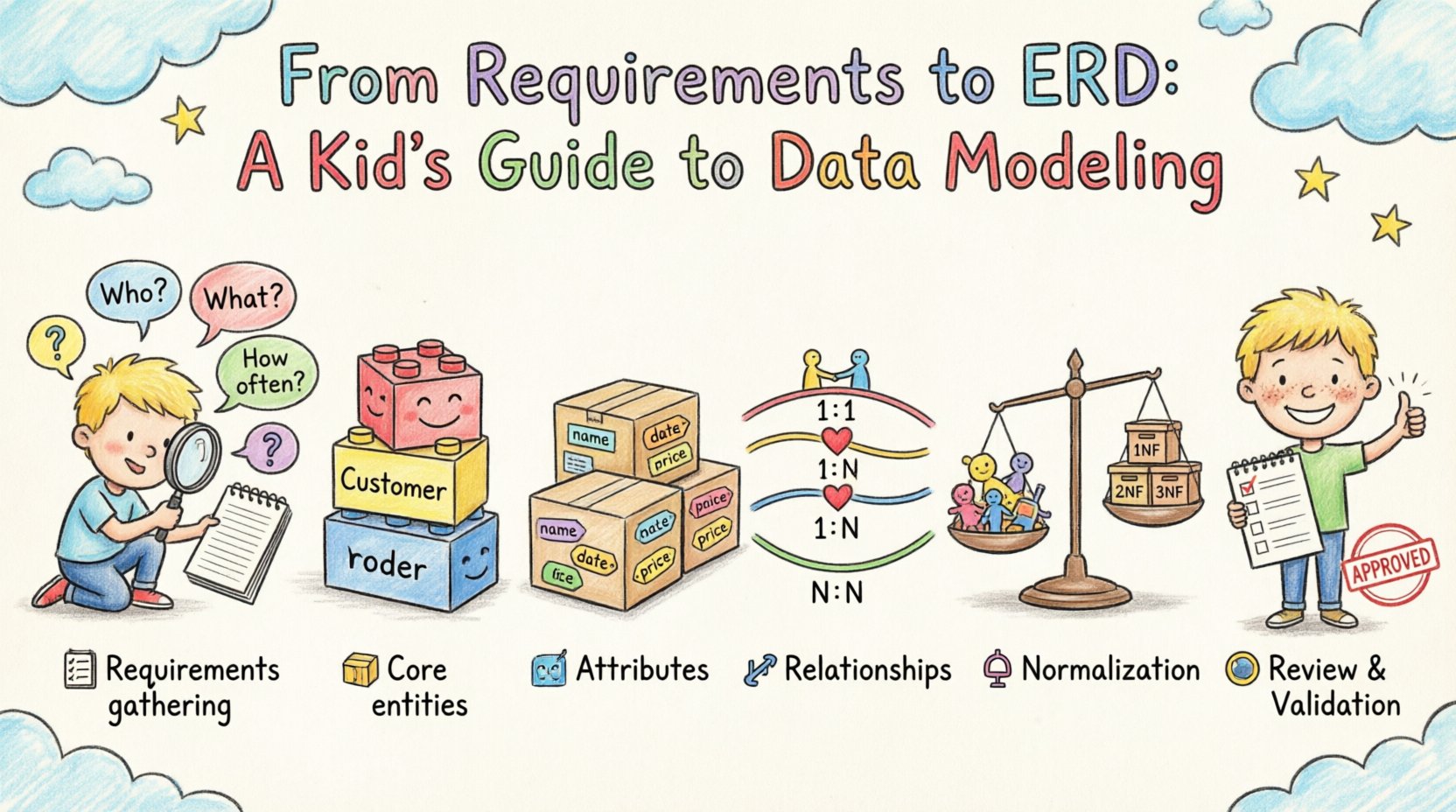
1. Understanding the Input: Gathering and Analyzing Requirements 📋
The foundation of any database design lies in the requirements. These are often vague, conflicting, or incomplete when initially presented. The goal is to extract the what and the why before worrying about the how.
Identifying Business Processes
Begin by mapping out the workflows. Ask stakeholders to describe their daily operations. Listen for actions that involve storing information. For example, a logistics manager might say, “We need to track where every package is at any given time.” This sentence contains several data points: the package, its location, and the timeline.
- Interview Stakeholders: Schedule sessions with end-users, not just managers. They often reveal edge cases that high-level summaries miss.
- Document Rules: Write down business rules explicitly. “A customer cannot have more than one active subscription.” This is a constraint, not just a feature.
- Review Existing Systems: If migrating from an old system, analyze the legacy data. What fields are actually used? Which are deprecated?
Qualitative vs. Quantitative Requirements
Not all requirements are equal. You must distinguish between the nature of the data and the volume of the data.
- Qualitative: Defines the meaning and type. Is a date a birth date or a transaction date? Is a name a single string or split into first and last?
- Quantitative: Defines limits. How many records per day? What is the retention period?
Confusion here leads to poor schema design. For instance, treating a phone number as a text string allows for formatting characters, but treating it as an integer might strip necessary prefixes. Decisions must be documented early.
2. Identifying Core Entities 🏗️
Once the requirements are clear, the next step is to identify the entities. An entity represents a real-world object or concept about which data must be stored. In an ERD, these are typically represented as rectangles.
Techniques for Discovery
To find entities, scan the requirements for nouns. However, not every noun is an entity. You must filter for nouns that require storage and have unique identity.
- Direct Nouns: Customer, Product, Invoice. These are obvious candidates.
- Implicit Nouns: Sometimes entities are hidden in verbs. “Assign a project to a team.” Here, Project and Team are entities. Assignment might be a relationship or a separate entity if it has its own attributes (like a date of assignment).
- Excluded Nouns: Words like System, User (in a generic sense), or Data are often too abstract. Be specific. Is it a Registered User or a Guest?
Defining Entity Identity
Every entity must have a way to distinguish one instance from another. This is the Primary Key. In the conceptual phase, you do not need to decide if this key is an auto-incrementing number or a UUID, but you must acknowledge that identity is required.
- Natural Keys: Do the real-world attributes provide unique identification? (e.g., a Social Security Number or a Vehicle Identification Number).
- Surrogate Keys: If no natural key exists or if the key changes often, a system-generated unique ID is necessary.
Consider the entity Employee. Is the Employee ID the key, or is the combination of Name and Department unique? Usually, a unique ID is safer to prevent issues with name changes or duplicate names.
3. Defining Attributes and Data Types 🏷️
Attributes are the properties that describe an entity. They fill in the details. If an Entity is a box, Attributes are the labels on the box.
Categorizing Attributes
Attributes should be grouped logically. Some are required, some are optional, and some are derived.
- Required Attributes: Data that must exist for the entity to be valid. (e.g., Order Date for an Order).
- Optional Attributes: Data that may or may not be present. (e.g., Secondary Email for a User).
- Derived Attributes: Data calculated from other attributes. (e.g., Age derived from Date of Birth). Usually, these are not stored physically to avoid update anomalies, but they are important for the model.
Choosing Data Types
While the ERD is conceptual, thinking about storage types prevents future errors. Mismatched types cause performance issues and data loss.
| Attribute Concept | Recommended Type | Reasoning |
|---|---|---|
| Names, Addresses | VARCHAR / Text | Variable length, non-numeric characters. |
| Counts, Prices | Integer / Decimal | Mathematical operations, precision requirements. |
| Dates, Times | Date / DateTime | Allows for sorting, filtering, and duration calculations. |
| Yes/No Flags | Boolean | Clear logic for true/false states. |
| Large Documents | BLOB / File Reference | Stores binary data or links to external storage. |
Normalization of Attributes
Before drawing lines between entities, ensure attributes are atomic. An attribute should hold only one value. Avoid storing multiple phone numbers in a single field like Phone_1, Phone_2, Phone_3. Instead, create a separate entity for Contact Information linked to the Customer.
- Why Atomic? It simplifies queries. Searching for a specific phone number is impossible if they are concatenated.
- Flexibility: If a customer gets a second phone number, a separate entity allows infinite expansion without altering the schema.
4. Mapping Relationships and Cardinality 🔗
Entities rarely exist in isolation. They interact. The lines connecting entities in an ERD represent relationships. Defining these correctly is the most critical part of the modeling process.
Types of Relationships
Relationships describe how instances of one entity relate to instances of another.
- One-to-One (1:1): One instance of Entity A is associated with exactly one instance of Entity B. Example: Employee to Employee Badge.
- One-to-Many (1:N): One instance of Entity A relates to many instances of Entity B, but the B relates to only one A. Example: Author to Book.
- Many-to-Many (M:N): Many instances of A relate to many instances of B. Example: Student to Class. Note: In physical implementation, this often requires an intermediate entity (junction table).
Cardinality and Modality
Cardinality defines the count (One, Many). Modality defines the requirement (Must, Optional). Visualizing these is essential for data integrity.
- Zero or One: The relationship is optional, and only one is allowed.
- One and Only One: The relationship is mandatory, and only one is allowed.
- Zero or Many: The relationship is optional, and multiple are allowed.
- One or Many: The relationship is mandatory, and multiple are allowed.
Consider the Order and Customer relationship. A Customer must place at least one Order (Mandatory). An Order must belong to one Customer (Mandatory). This defines the foreign key constraints in the database.
5. Ensuring Data Integrity and Normalization ⚖️
Once the diagram is drawn, it must be checked for logical consistency. This phase involves applying normalization rules to eliminate redundancy and ensure stability.
First Normal Form (1NF)
Ensure every column contains atomic values and there are no repeating groups. Every row must be unique.
- Check: Are there lists in cells? Are there multiple values for a single field?
- Fix: Split lists into separate rows or separate tables.
Second Normal Form (2NF)
Ensure that all attributes are fully dependent on the primary key. If you have a composite key, no attribute should depend on only part of that key.
- Example: In a table storing Student ID, Course ID, and Student Name, the Student Name depends only on the Student ID, not the combination. Move Student Name to a Student table.
Third Normal Form (3NF)
Ensure there are no transitive dependencies. Non-key attributes should not depend on other non-key attributes.
- Example: If City depends on Zip Code, and Zip Code is in the Customer table, you should move Zip Code and City to a Location table. This prevents updates to city names from being inconsistent across thousands of customer records.
6. Review and Validation 🧐
The model is not complete until it is validated against the original requirements. This is a sanity check to ensure nothing was missed or misinterpreted.
Walkthrough Scenarios
Run through specific use cases to see if the model supports them. Ask questions like:
- “Can we create an Order without a Customer?” If the model allows this but business rules forbid it, the relationship cardinality is wrong.
- “Can we delete a Product that is currently in an Order?” If the answer is no, you need referential integrity constraints (cascading deletes).
- “What happens if a Customer changes their Name?” If the Name is stored in the Order table as well, you have a data consistency risk. It should only be in the Customer table.
Stakeholder Sign-off
Present the ERD to the business users. They may not understand the technical terms, but they understand the logic. Ask them to confirm that the entities and relationships match their mental model of the business.
- Visual Confirmation: Use the diagram to show them where their data lives.
- Gap Analysis: Ask if any critical data points are missing from the attributes list.
- Future Proofing: Discuss potential changes. If the business plans to expand to a new region, does the model support that?
Common Challenges in Translation 🛑
Even experienced modelers face hurdles when translating requirements. Being aware of these pitfalls helps avoid them.
- Over-Modeling: Trying to anticipate every possible future need leads to a complex, rigid schema. Design for the current requirements, but leave room for extension (e.g., using a JSON column for flexible metadata if appropriate).
- Under-Modeling: Ignoring constraints leads to messy data. If a field is required, do not make it optional in the model.
- Confusing Entities with Relationships: Sometimes a relationship has so many attributes that it becomes an entity itself. (e.g., Enrollment between Student and Course might have a Grade and Date). Treat it as an entity if it needs its own history or attributes.
- Ignoring Case Sensitivity: In some systems, “New York” and “new york” are different. Decide on standardization rules early.
- Assuming Hardware Performance: Do not optimize for speed at the cost of integrity. A slow query is better than incorrect data.
Best Practices for Sustainable Models ✅
To maintain a healthy database over years, follow these guidelines during the design phase.
- Consistent Naming Conventions: Use singular nouns for entities (e.g., Customer not Customers). Use lowercase with underscores for columns (e.g., customer_id). This reduces ambiguity.
- Documentation: Comment your diagram. Explain why a relationship exists, not just that it exists. This helps future developers understand the business logic.
- Version Control: Treat your ERD like code. Save versions as requirements change. This allows you to revert if a design decision proves unworkable.
- Standardization: Use standard data types where possible. Avoid custom types unless absolutely necessary.
- Security Considerations: Identify sensitive data (PII, financial info) early. Ensure the model allows for encryption or masking at the column level.
Final Thoughts on the Translation Process 🎯
Moving from requirements to an ERD is not a linear path. It is iterative. You will identify new entities while defining relationships. You will refine attributes as you normalize. The goal is not perfection in the first draft, but a solid foundation that can be refined.
A strong data model reduces technical debt. It prevents the need to rebuild systems because the data structure could not support new features. By focusing on the logic of the business and applying rigorous translation techniques, you create a system that is reliable, scalable, and maintainable.
Take your time with the analysis. The hours spent refining the diagram save weeks of debugging and refactoring during development. Treat the ERD as the contract between the business and the technology.