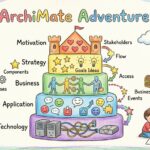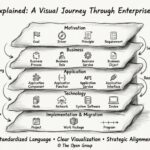


Enterprise architecture often feels like a theoretical exercise detached from daily operations. However, the reality involves complex systems, shifting strategies, and tangible data flows. ArchiMate provides the standard language to bridge this gap. It allows architects to visualize the connection between business strategy and technical implementation without relying on proprietary tools or jargon.
This guide explores how ArchiMate functions in actual scenarios. We examine business architecture restructuring, data lineage challenges, and the integration of application layers. The focus remains on modeling logic and stakeholder communication rather than software capabilities.
🔍 Why ArchiMate Matters for Modern Architects
Architects face a constant challenge: translating high-level strategy into executable components. Without a common language, business stakeholders speak in goals, while technical teams speak in databases and servers. ArchiMate acts as the translator.
Key benefits include:
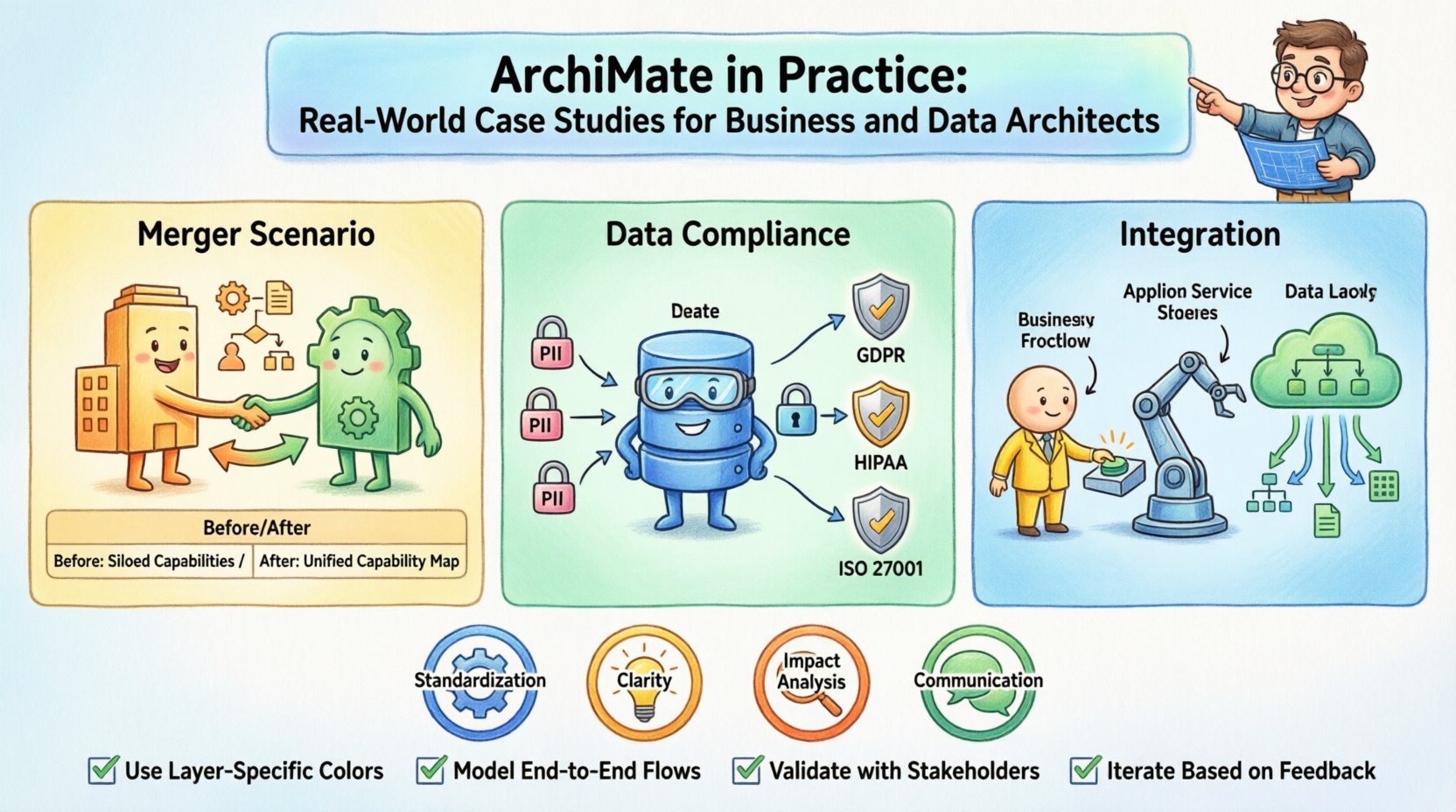
- Standardization: A unified notation ensures consistency across departments.
- Clarity: Visual models reduce ambiguity in requirements.
- Impact Analysis: Changes in one layer can be traced to others.
- Communication: Diagrams serve as a single source of truth.
It is not about drawing pretty pictures. It is about establishing relationships between capabilities, processes, and data objects. The following case studies demonstrate this utility.
🔄 Case Study 1: Business Architecture in a Merger Scenario
Consider a large financial institution merging with a regional competitor. The strategic goal is to consolidate back-office operations to reduce overhead while maintaining service levels for clients. This requires a clear view of current capabilities and processes.
🏢 Modeling the Current State
The business architecture team began by mapping the organizational structure. They identified key roles, such as “Loan Officer” and “Risk Manager.” Using ArchiMate business objects, they defined the entities these roles interact with, such as “Customer Application” and “Credit Score.”
Key modeling steps included:
- Capability Mapping: Defined capabilities like “Credit Assessment” and “Customer Onboarding.” This helps identify which capabilities are duplicated across the two merging entities.
- Process Flow: Mapped the “Loan Approval” process. This revealed bottlenecks where manual handovers occurred between departments.
- Organizational Units: Linked processes to specific teams. This highlighted which teams held critical knowledge.
📉 Identifying Gaps and Redundancies
By overlaying the models, the architects spotted significant overlap. Both entities had separate capabilities for “Identity Verification.” Instead of maintaining two systems, the model suggested a unified service realization.
The impact analysis showed that consolidating this capability would require changes to the application layer. Specifically, the legacy systems needed to expose services that could be consumed by the new unified process.
🎯 Defining the Target State
The target model removed redundant capabilities. It introduced new business roles to manage the integrated service. The transition plan was derived directly from the difference between the current and target models.
| Current Capability | Target Capability | Action |
|---|---|---|
| Loan Assessment (Entity A) | Unified Credit Scoring | Merge |
| Customer Support (Entity B) | Centralized Helpdesk | Consolidate |
| Risk Reporting | Real-time Risk Dashboard | Enhance |
This structured approach ensured that the merger did not disrupt client services. It provided a roadmap for IT teams to decommission legacy systems and build new ones only where necessary.
🗃️ Case Study 2: Data Architecture for Compliance
Data governance is increasingly critical. A retail company needed to comply with new privacy regulations. The challenge was understanding where sensitive customer data lived and how it flowed through the organization.
🔒 Mapping Data Objects
Data architects focused on the Data Layer of the framework. They defined data objects such as “Customer PII” and “Transaction History.” Unlike business objects, these entities represent the information itself, not the process.
The modeling effort revealed several issues:
- Shadow Data: Spreadsheets were storing data outside the official database.
- Redundancy: The same customer data was stored in marketing and sales systems.
- Access Control: There was no clear link between users and the data they could view.
📊 Establishing Relationships
To fix this, architects used specific relationships to define data flow:
- Access Relationship: Defined which applications access which data objects. This helped identify unauthorized access points.
- Flow Relationship: Mapped how data moved from creation to archival. This was crucial for retention policies.
- Association: Linked data objects to business objects. For example, “Invoice Data” is associated with the “Billing Process.”
🛠️ Implementing Governance
The model became the basis for governance rules. Policies were attached to specific data objects. For instance, “Customer PII” required encryption at rest. The architecture model made these requirements visible to developers.
Without this visualization, compliance audits would have been manual and error-prone. The model allowed for automated checks against the deployed infrastructure.
🧩 Case Study 3: Integrating Business and Data Layers
The true power of ArchiMate lies in connecting layers. A logistics company wanted to implement a real-time tracking system. This required business processes to trigger data updates automatically.
🔗 The Service Realization Relationship
The business process “Track Shipment” needed to be realized by a service. This service was implemented by an application component. The application component accessed a database to retrieve location data.
This chain of realization ensures traceability:
- Business Goal: Improve customer satisfaction.
- Business Process: Track Shipment.
- Business Service: Delivery Update.
- Application Service: Location API.
- Data Object: GPS Coordinates.
📈 Analyzing Dependencies
When the GPS provider changed their API, the impact was immediate. The architecture model showed exactly which business processes would fail. The “Track Shipment” process could no longer retrieve data.
Because the dependency was modeled, the team prepared a contingency plan before the change occurred. They updated the “Location API” service layer first, ensuring the business process remained stable.
🛠️ Best Practices for Implementation
Success in architecture modeling depends on discipline. Here are practical strategies for teams adopting this framework.
📏 Start with the Right Granularity
Models can become too complex quickly. Avoid modeling every single field in a database. Focus on the entities that drive business value.
- High Level: Use for strategic planning and executive communication.
- Medium Level: Use for project planning and IT design.
- Low Level: Use for detailed technical specifications.
🤝 Engage Stakeholders Early
Do not build the model in isolation. Business users should review the business layer models. Technical teams should review the application and data layers. This ensures the model reflects reality.
🔄 Maintain Version Control
Architecture is not static. Changes happen constantly. Version control is essential to track how the model evolves over time. This helps in auditing and understanding historical decisions.
🚫 Avoid Tool Dependency
Focus on the concepts, not the software. The value comes from the logic and relationships, not the drawing tools. Exporting models to standard formats ensures longevity.
📊 Common Pitfalls and Solutions
Even experienced teams face challenges. Recognizing these pitfalls helps in avoiding delays.
| Pitfall | Solution |
|---|---|
| Over-Modeling | Focus on critical paths and high-value objects. |
| Disconnected Layers | Ensure explicit realization relationships between layers. |
| Static Models | Schedule regular reviews to update the model. |
| Lack of Standards | Define naming conventions and modeling rules. |
📈 Measuring Success
How do you know the architecture effort is paying off? Metrics should reflect business outcomes, not just diagram counts.
- Alignment Score: Percentage of IT projects aligned with business strategy.
- Change Velocity: Time taken to assess impact of changes.
- Redundancy Reduction: Number of duplicate capabilities removed.
- Compliance Rate: Percentage of data objects with defined governance rules.
🔮 Future Considerations
The landscape of enterprise architecture continues to evolve. Cloud computing and microservices introduce new layers of complexity. The framework adapts to these changes by allowing new extension mechanisms.
For instance, cloud infrastructure can be modeled in the Technology Layer. Microservices can be represented as Application Components. This flexibility ensures the language remains relevant as technology shifts.
Data architecture is also moving towards data mesh and data fabric concepts. The core principles of object definition and relationship mapping remain valid, even if the implementation details change.
🧩 Final Thoughts on Practical Application
ArchiMate is a tool for thinking, not just for drawing. It forces architects to define relationships explicitly. It exposes assumptions about how the business works. It connects the “what” with the “how”.
By focusing on real-world case studies, we see that the framework is practical. It handles mergers, compliance, and system integration effectively. The key is consistent application and stakeholder engagement.
Architects who master the logic of the framework can drive significant value. They reduce risk, improve efficiency, and ensure technology serves business goals. This is the essence of effective enterprise architecture.