

Welcome to the foundational guide for understanding the ArchiMate modeling language. If you are stepping into the world of enterprise architecture, you likely have questions about structure, layers, and relationships. This article addresses the most common inquiries to help you build a solid mental model of the framework. We will explore the core concepts without relying on specific software tools, focusing purely on the theoretical and practical application of the language itself.
What is ArchiMate? 🏗️
ArchiMate is a modeling language designed to describe, analyze, and visualize business architecture, information systems architecture, and technology architecture. It serves as a standard for enterprise architecture (EA) to ensure that different parts of an organization align with strategic goals.
- Origin: Developed by The Open Group, it is an open standard used globally.
- Purpose: To provide a common language for architects and stakeholders to communicate complex changes.
- Scope: It covers business processes, applications, data, and infrastructure.
Think of ArchiMate as a blueprint for an organization. Just as an architect uses blueprints to ensure a building is safe and functional, enterprise architects use ArchiMate to ensure the business runs efficiently and technology supports the mission.
Why Use ArchiMate Instead of UML? 🤷♂️
A frequent question concerns the difference between ArchiMate and Unified Modeling Language (UML). While UML is excellent for software engineering and system design, ArchiMate is specialized for the broader enterprise context.
- UML: Focuses on software components, class structures, and dynamic behavior of systems.
- ArchiMate: Focuses on business value, organizational structure, and the relationship between business and IT.
When you need to model a database schema, UML is appropriate. When you need to map how a business process influences a specific application, ArchiMate is the preferred choice.
Understanding the Layers 🌐
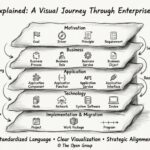
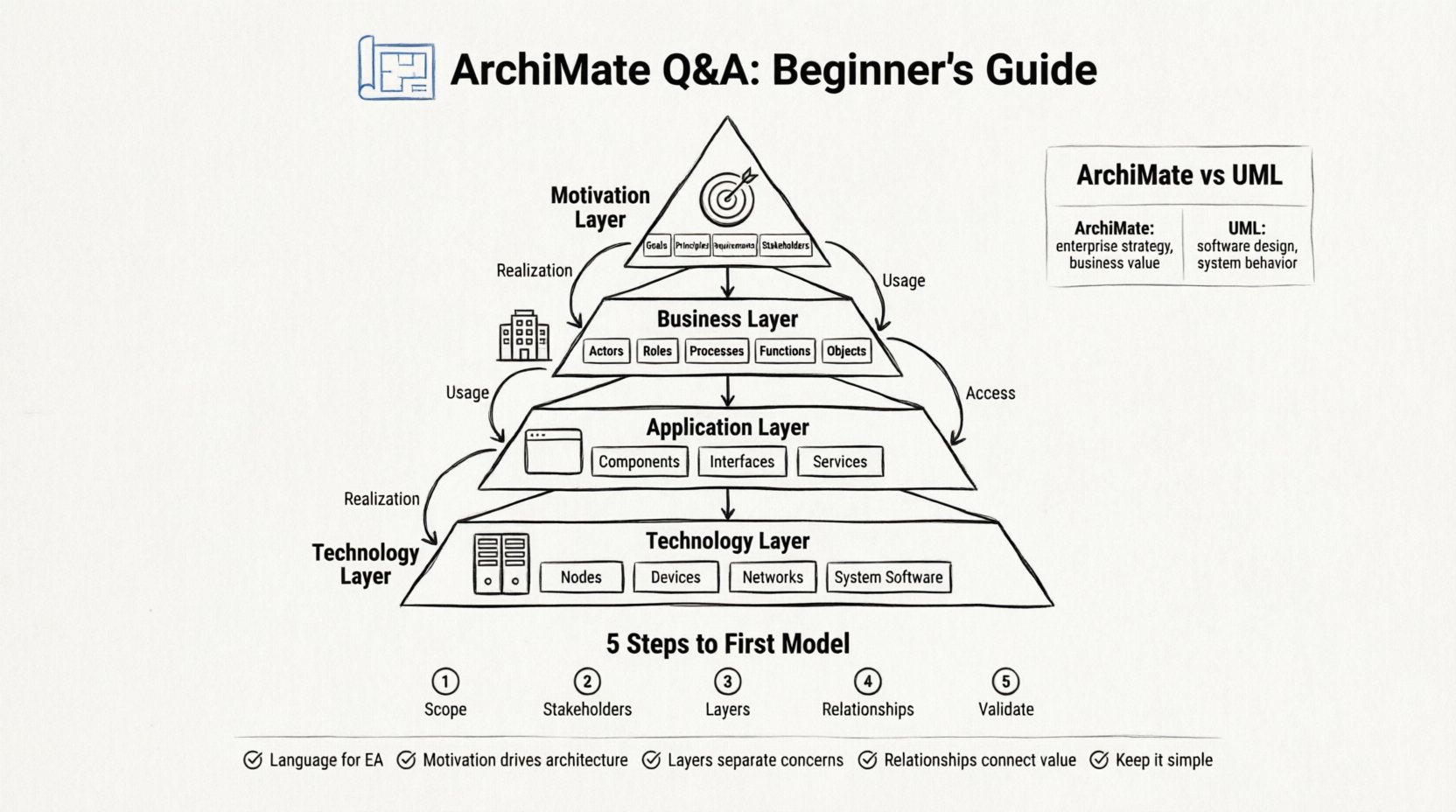
The core structure of ArchiMate consists of layers. These layers separate concerns, allowing architects to focus on specific aspects of the enterprise without getting overwhelmed. The standard layers include the Motivation, Business, Application, and Technology layers.
1. The Motivation Layer 🎯
This layer answers the “Why?” question. It is often the starting point for any architectural initiative.
- Goal: A desired outcome that drives the architecture.
- Principle: A rule or guideline that constrains the architecture.
- Requirement: A condition or capability that must be met.
- Stakeholder: A person or group with an interest in the outcome.
Without the motivation layer, the architecture lacks direction. It ensures that every business process or technology implementation ties back to a strategic objective.
2. The Business Layer 🏢
The business layer represents the organization’s core operations. It is independent of how these operations are supported by technology.
- Business Actor: A human or organization performing an activity.
- Business Role: A part of the business structure that plays a specific function.
- Business Process: A collection of activities that deliver value.
- Business Function: A group of activities with a specific business purpose.
- Business Object: Information objects created and used by business processes.
This layer is crucial for understanding workflows and organizational hierarchy before considering software solutions.
3. The Application Layer 💻
The application layer describes the software systems that support the business layer.
- Application Component: A software unit that is deployed and run.
- Application Interface: A point of access to the functionality of an application.
- Application Service: A functional unit provided by an application component.
Architects use this layer to map which software supports which business processes. This helps in identifying redundancies and gaps in the application portfolio.
4. The Technology Layer 🖥️
The technology layer represents the physical and virtual infrastructure required to run the applications.
- Node: A computational resource that hosts applications.
- Device: A computational resource that is capable of hosting applications.
- System Software: Software that controls hardware and provides services to applications.
- Network: A communication medium between nodes.
- Device: A computational resource that is capable of hosting applications.
The Layering Relationship 🔗
Understanding how these layers connect is vital. ArchiMate defines specific relationships that allow elements in one layer to relate to elements in another.
| Relationship Type | Description | Example |
|---|---|---|
| Realization | One element implements another. | A Business Process realizes a Business Function. |
| Usage | One element uses the functionality of another. | A Business Process uses an Application Service. |
| Access | One element accesses another. | An Application Component accesses a Business Object. |
| Association | A general relationship between elements. | A Business Actor is associated with a Business Process. |
| Specialization | One element is a more specific version of another. | A Manager is a specialization of a Business Actor. |
These relationships ensure that the architecture is not just a collection of isolated diagrams but a connected system of value delivery.
Common Misconceptions ❌
Beginners often struggle with certain assumptions about the framework. Clarifying these points early saves time and effort.
- Misconception 1: It is only for IT.
False. While it includes technology, the Business and Motivation layers are equally important. It is primarily a business tool that happens to include IT. - Misconception 2: You need a tool to start.
False. You can start by drawing on paper or using a whiteboard. The concepts matter more than the software used to visualize them. - Misconception 3: It is too complex.
False. You do not need to use every element in every model. Start with the basics (Process, Actor, Application) and expand as needed. - Misconception 4: It replaces TOGAF.
False. TOGAF is a method for building an architecture. ArchiMate is the language used to describe it. They work best together.
Deep Dive: The Motivation Layer 🧠
The Motivation layer is frequently overlooked by beginners who jump straight into Business or Technology. However, this layer provides the justification for the entire model.
Why is it important? 📊
Stakeholders need to understand the value proposition. If a new technology is introduced, the Motivation layer explains why. It connects high-level strategy to low-level implementation.
- Drivers: Internal or external forces that necessitate change.
- Goals: What the organization wants to achieve.
- Principles: Rules that must be followed during the change.
- Requirements: Specific needs that must be satisfied.
By modeling the motivation layer, you create a traceability path from a strategic goal down to a specific technology component. This is essential for auditing and compliance.
Deep Dive: Implementation and Migration 🚀
Architecture is not static. It evolves over time. The Implementation and Migration layer helps plan the transition from the current state to the future state.
- Work Package: A set of activities to be performed to achieve a goal.
- Deliverable: A tangible result of a work package.
- Phase: A grouping of work packages.
- Gap: A difference between the current state and the future state.
This layer answers the question: “How do we get from here to there?” It is critical for project management and roadmap planning.
Frequently Asked Questions 📋
Here are detailed answers to specific questions that often arise during the learning process.
| Question | Answer |
|---|---|
| Do I need to model every single element? | No. Use the “just enough” principle. Model only what is relevant to the specific architecture work at hand. |
| Can ArchiMate model non-software systems? | Yes. The Business layer models human activities, organizational units, and physical objects. |
| How do I handle change over time? | Use the Implementation and Migration layer to define work packages and phases that bridge the gap between states. |
| Is ArchiMate a programming language? | No. It is a modeling language used for documentation and communication, not for writing executable code. |
| Can it be used for DevOps? | Yes. It can model the pipeline, the infrastructure, and the deployment processes within the technology layer. |
| What if my organization is small? | The principles apply regardless of size. You may simplify the layers, but the logic remains valid. |
Building Your First Model 🛠️
When you begin your journey, follow a structured approach to avoid confusion.
Step 1: Define the Scope 🎯
Determine what you are modeling. Is it a specific department? A whole application? A strategic initiative? Keep the scope manageable.
Step 2: Identify Stakeholders 👥
Who needs to see this model? Business leaders? Developers? This determines the level of detail required.
Step 3: Select the Layers 🌍
Decide which layers are necessary. Do you need the Motivation layer? Or just Business and Technology? Start simple.
Step 4: Draw Relationships 🖍️
Ensure that your elements connect logically. Use the correct relationship types (Usage, Realization, etc.) to maintain semantic accuracy.
Step 5: Review and Validate ✅
Walk through the model with a stakeholder. Does it accurately reflect the current reality? Does it align with the goals?
The Importance of Semantics 🔤
ArchiMate relies on precise definitions. Using the wrong element type can lead to misinterpretation.
- Actor vs. Role: An Actor is a person or organization. A Role is a function within the organization. A person (Actor) plays a Role.
- Process vs. Function: A Process is a sequence of activities. A Function is a capability. Processes realize Functions.
- Component vs. Service: A Component is the implementation. A Service is the exposed functionality. A Component realizes a Service.
Understanding these distinctions is key to creating a model that is both accurate and useful.
Integration with Other Frameworks 🔄
ArchiMate is often used alongside other frameworks. Understanding these connections helps in a broader organizational context.
- TOGAF: The most common pairing. ArchiMate describes the architecture artifacts defined in the TOGAF Architecture Development Method (ADM).
- ITIL: Focuses on IT service management. ArchiMate can model the services and processes defined in ITIL.
- ISO 42010: Describes architecture description. ArchiMate provides the notation for the descriptions.
Learning Path Suggestions 📚
To become proficient, consider the following steps.
- Read the Official Specification: The documentation provided by The Open Group is the definitive source of truth.
- Practice Modeling: Use a whiteboard or a tool to draw models of your current workplace.
- Join Communities: Engage with other architects to discuss challenges and solutions.
- Certification: Consider official certification to validate your knowledge, though practical experience is paramount.
Future Trends 📈
The landscape of enterprise architecture is evolving. ArchiMate continues to adapt to new technologies and methodologies.
- Cloud Architecture: Modeling cloud-native services and serverless functions within the technology layer.
- Agile: Aligning architecture models with iterative development cycles.
- Data Governance: Increased focus on data objects and their flows across the enterprise.
Summary of Key Takeaways 💡
- ArchiMate is a language for enterprise architecture, not just IT.
- The Motivation layer is critical for strategic alignment.
- Layers (Business, Application, Technology) help separate concerns.
- Relationships define how elements interact and depend on each other.
- Keep models simple and relevant to the scope.
- Use ArchiMate to communicate, not just to document.
Mastering this framework takes time, but the clarity it brings to complex organizational structures is invaluable. By focusing on the layers and relationships, you can create models that drive real business value.
Continue to practice and refine your skills. The more you model, the more intuitive the process becomes. Use this guide as a reference point when you encounter new challenges in your architectural work.