

Digital transformation is not merely a technology upgrade; it is a fundamental shift in how an organization operates, delivers value, and interacts with its stakeholders. In this complex landscape, clear visibility into the connections between business goals and technical capabilities is essential. This is where the ArchiMate modeling language proves indispensable. It provides a structured way to describe, analyze, and visualize the architecture of an enterprise.
When leaders embark on a journey to modernize their operations, they often face siloed information and misaligned initiatives. Without a unified framework, digital efforts can become fragmented, leading to wasted resources and missed opportunities. ArchiMate offers a standardized approach to bridge these gaps. It allows stakeholders to see the big picture while drilling down into specific details when necessary.
This guide explores how this framework supports strategic planning, governance, and execution. We will examine the core layers, the motivation layer, and how these elements combine to drive successful change.
🧭 Understanding the Architecture Framework
Before diving into the specifics of transformation, it is important to define what this modeling language actually is. It is not a software product or a specific tool you buy. Rather, it is an open standard for enterprise architecture. It provides a vocabulary and a set of concepts that help professionals communicate complex structures.
Think of it as a common language for architects, business analysts, and IT managers. When everyone speaks the same language, misunderstandings decrease, and collaboration increases. The framework is designed to be vendor-neutral, ensuring that the models you create remain valid regardless of the technology stack or the specific software solutions you choose to implement.
Core Principles of the Language
- Standardization: It uses a consistent set of symbols and definitions.
- Integration: It connects business strategy with technical implementation.
- Flexibility: It can be applied to different types of organizations and projects.
- Clarity: It reduces ambiguity in architectural descriptions.
By adhering to these principles, organizations can maintain a clear view of their architecture over time. This consistency is vital for long-term digital transformation initiatives that span years rather than months.
🏗️ The Layers of Enterprise Architecture
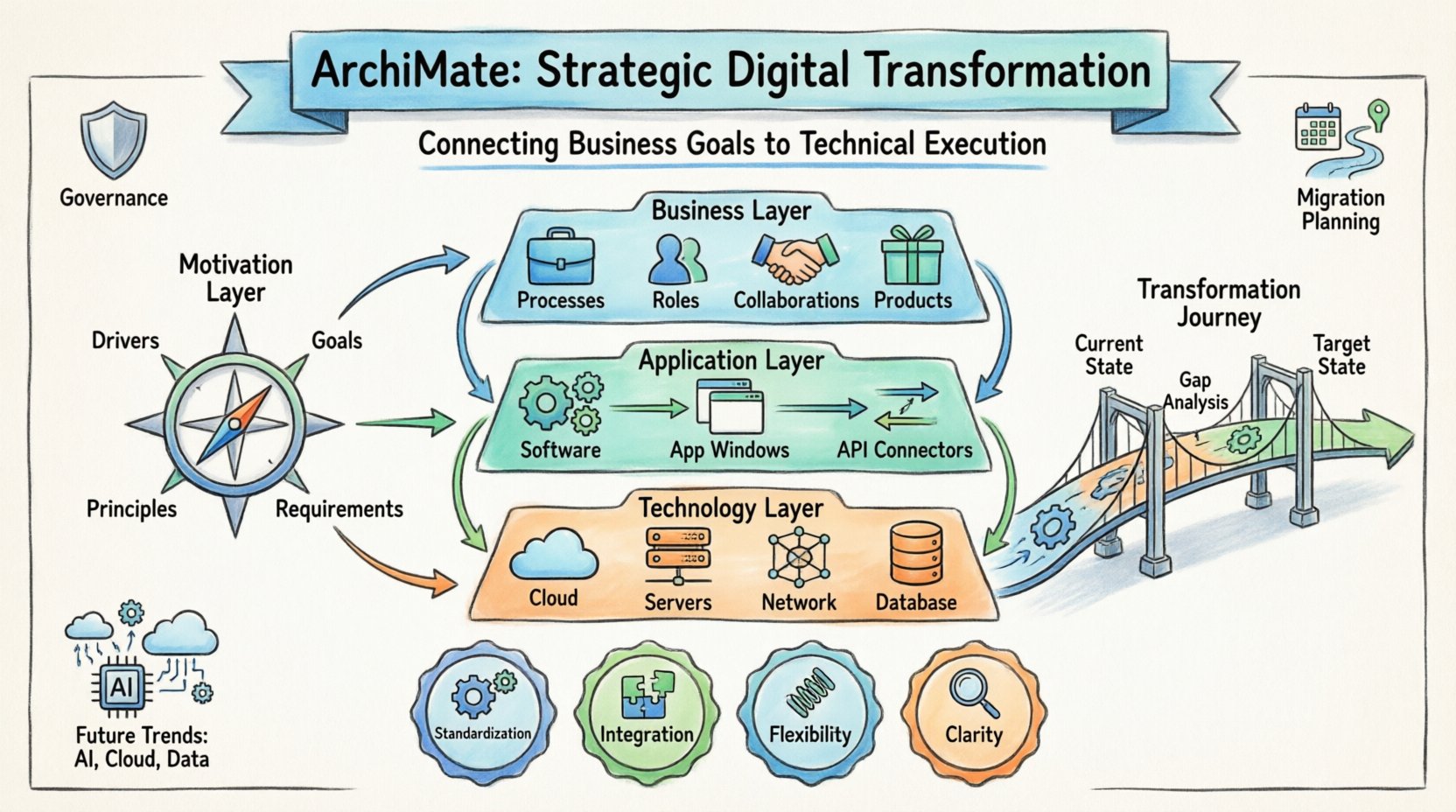
The framework divides the enterprise into distinct layers. This separation helps manage complexity by grouping related concepts together. In the context of digital transformation, understanding these layers is critical because change rarely happens in isolation. A change in technology often impacts business processes, and a change in strategy impacts applications.
1. The Business Layer
This layer represents the outermost face of the organization. It deals with the activities, roles, and organizational structures that define how value is created. In a transformation project, this is where the “why” and the “what” are defined.
- Processes: The workflows that deliver products or services.
- Roles: The people or groups responsible for executing tasks.
- Collaborations: How different parts of the organization work together.
- Products: The outcomes delivered to customers.
During digital transformation, the business layer is often the starting point. Leaders ask how processes need to change to support new customer expectations. For example, moving from manual order processing to automated workflows requires a clear definition of the new business processes before any code is written.
2. The Application Layer
Once the business requirements are clear, the application layer comes into focus. This layer describes the software capabilities that support the business processes. It is the bridge between human activity and technical infrastructure.
- Application Functions: The capabilities provided by software.
- Application Services: The services exposed to business processes.
- Application Components: The building blocks of the software systems.
A key challenge in transformation is application sprawl. As organizations grow, they accumulate many different software solutions. Mapping these applications to business processes helps identify redundancies and gaps. It ensures that every application has a clear purpose and supports a specific business need.
3. The Technology Layer
The final layer describes the physical and logical infrastructure that hosts the applications. This includes servers, networks, databases, and cloud services. While often seen as the domain of IT operations, the technology layer is crucial for transformation because it dictates performance, scalability, and security.
- Devices: Hardware such as servers and mobile devices.
- Networks: Communication infrastructure.
- Data Storage: Databases and data lakes.
- Software: Operating systems and middleware.
In modern digital transformation, this layer often shifts toward cloud-native architectures. Understanding how applications depend on specific technology components allows for better migration planning and risk management.
Layer Interaction Table
| Layer | Focus | Transformation Impact |
|---|---|---|
| Business | Strategy, Processes, Roles | Defines the goals and value proposition. |
| Application | Software Capabilities | Enables automation and integration. |
| Technology | Infrastructure, Hardware | Ensures performance and scalability. |
🎯 The Motivation Layer: Driving Strategic Change
One of the most powerful features of this framework is the Motivation Layer. Often overlooked, this layer explains why an architecture exists. It connects abstract strategic concepts to concrete architectural artifacts. Without this layer, transformations often lack direction and fail to align with business goals.
Key Concepts in the Motivation Layer
- Drivers: The internal or external factors pushing for change (e.g., market pressure, regulatory requirements).
- Goals: The desired outcomes the organization wants to achieve.
- Principles: The rules and guidelines that constrain decision-making.
- Requirements: Specific conditions that must be met.
- Assessments: Evaluations of the current state versus the future state.
When planning a digital transformation, leaders must identify the drivers. Are we moving to the cloud to reduce costs or to improve agility? The answer dictates the architectural decisions. If the goal is cost reduction, the architecture might focus on consolidation. If the goal is agility, it might focus on modularity.
Principles act as guardrails. For example, a principle might state “Cloud-first” or “Data Ownership by Business.” These principles guide every decision made during the implementation phase. By documenting these motivations, organizations ensure that every change supports the overarching strategy.
🔗 Alignment and Consistency
A common pitfall in large organizations is the disconnect between strategy and execution. The business strategy says one thing, but the technology implementation says another. This framework provides mechanisms to ensure alignment across all layers.
Dependency Mapping
Architects use relationships to map how elements in one layer depend on elements in another. For instance, a business process depends on an application service, which in turn runs on a specific server. When a dependency is broken or changed, the impact can be traced back through the layers.
- Realization: How an element in a lower layer realizes an element in a higher layer.
- Dependency: How a change in one element affects another.
- Assignment: How a role is assigned to an artifact.
This visibility allows for impact analysis. If a technology vendor is decommissioning a server, architects can see which business processes will be affected. This proactive approach prevents disruptions and allows for better planning.
Governance and Control
Transformations involve many teams and many projects. Without governance, these projects can drift apart. The framework supports governance by providing a central repository of architectural knowledge. It serves as the source of truth for what exists and what is planned.
- Change Management: Tracking how architecture evolves over time.
- Compliance: Ensuring designs meet regulatory and security standards.
- Communication: Providing visualizations for stakeholders at all levels.
Governance is not about bureaucracy; it is about ensuring that the transformation stays on track. Regular reviews of the architecture against the motivation layer ensure that the organization is still moving toward its goals.
🚀 Implementation and Migration
Digital transformation is rarely a “big bang” event. It is usually a journey of incremental improvements. The framework supports this through the Implementation and Migration Layer. This layer describes the projects and initiatives needed to move from the current state to the target state.
Gap Analysis
Before starting, organizations must understand the gap between where they are and where they want to be. This involves comparing the current architecture with the target architecture.
- Identify Missing Elements: What processes or technologies are absent?
- Identify Redundancies: What elements can be removed or combined?
- Identify Risks: What dependencies create potential points of failure?
This analysis forms the basis of the migration plan. It breaks down a massive transformation into manageable projects. Each project addresses a specific gap or improvement area.
Migration Planning
Once gaps are identified, the team creates a roadmap. This roadmap sequences the projects based on dependencies and value. Some projects must happen before others. For example, you cannot move to a new cloud infrastructure if the application is not compatible with the cloud environment.
- Phasing: Breaking the transformation into stages.
- Resource Allocation: Ensuring the right teams are assigned.
- Timeline: Setting realistic deadlines for completion.
The framework helps visualize this roadmap. Stakeholders can see how early wins lead to long-term benefits. This transparency builds trust and keeps momentum going throughout the transformation lifecycle.
⚠️ Common Challenges and Pitfalls
While the framework offers significant benefits, using it effectively requires discipline. There are common pitfalls that organizations encounter when trying to implement this approach.
1. Over-Engineering
It is easy to create models that are too detailed. While thoroughness is good, excessive detail can slow down decision-making. The goal is clarity, not perfection. Models should be fit for purpose. If a simple diagram explains the concept, do not create a complex matrix.
2. Lack of Maintenance
Architecture models become stale quickly if they are not updated. A transformation is a dynamic process, and the models must reflect the current reality. If the architecture documentation does not match the actual systems, it loses value and trust.
- Assign ownership for model updates.
- Integrate updates into the project lifecycle.
- Review models regularly during governance meetings.
3. Siloed Usage
Often, the framework is used only by the IT department. For digital transformation to succeed, business leaders must engage with the models. The business layer must be populated by business analysts, not just IT architects. Collaboration ensures that the architecture reflects actual business needs.
🌐 Future Trends and Adaptation
The landscape of enterprise architecture is evolving. New technologies like artificial intelligence, blockchain, and advanced cloud computing are changing how organizations operate. The framework is adaptable enough to accommodate these changes.
Agility and DevOps
Modern development practices like DevOps emphasize speed and automation. The framework supports this by defining the boundaries and interfaces between systems. This clarity allows development teams to work independently while understanding how their components fit into the larger system.
Data-Centric Architecture
Data is increasingly becoming the core asset of an organization. The framework can model data entities and flows alongside business processes. This holistic view ensures that data governance is integrated into the transformation from the start.
Cloud-Native Designs
As more workloads move to the cloud, the technology layer is becoming more abstract. Microservices and containers require a different modeling approach. The framework allows for the representation of these dynamic environments, ensuring that architecture remains relevant in a cloud-first world.
📊 Summary of Key Takeaways
Digital transformation is a complex endeavor that requires a structured approach. This modeling language provides that structure. It connects business strategy to technical execution through a standardized set of layers and concepts.
- Standardization: It creates a common language for stakeholders.
- Visibility: It reveals dependencies and impacts across layers.
- Alignment: It ensures technology supports business goals.
- Planning: It facilitates gap analysis and migration roadmaps.
Organizations that adopt this framework are better equipped to navigate change. They can anticipate risks, manage complexity, and deliver value more consistently. The journey to digital maturity is not just about adopting new tools; it is about understanding the system as a whole.
By investing in architectural understanding, leaders create a foundation for sustainable growth. The framework does not guarantee success on its own, but it provides the map necessary to find the way. With clear vision and disciplined execution, digital transformation becomes a manageable process rather than a chaotic scramble.