

Understanding Inheritance in UML Class Diagrams
In the realm of software architecture and system modeling, few concepts are as fundamental or as powerful as inheritance. Within the Unified Modeling Language (UML), this relationship is formally defined as Generalization. It serves as the backbone of object-oriented design, allowing developers to create robust, reusable, and maintainable systems by establishing clear taxonomic hierarchies.
This article provides a deep-dive analysis of inheritance within UML Class Diagrams, exploring its semantic meaning, visual notation, and practical application through the classic Shapes example.
The Core Concept: Generalization
At its essence, a generalization is a taxonomic relationship between two classifiers: a more general classifier and a more specific classifier. This relationship dictates a hierarchy where knowledge and behavior are passed down from the top of the hierarchy to the bottom.
Key Principle: Each instance of the specific classifier is also an indirect instance of the general classifier. Consequently, the specific classifier inherits the features (attributes and operations) of the more general classifier.
This mechanism allows for code reuse and logical consistency. Instead of defining common attributes like color or size in every single class, they are defined once in a parent class and automatically available to all its children.
Semantics: The “Is-A” Relationship
The most critical rule for understanding inheritance is the “is-a” relationship. This is a logical test: if you can say “X is a Y,” then X should inherit from Y.
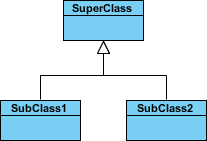
- SubClass1 is a SuperClass.
- SubClass2 is a SuperClass.
This is distinct from an “has-a” relationship (which represents composition or aggregation). In inheritance, the child class is a type of the parent class. This semantic distinction ensures that the hierarchy makes logical sense and prevents modeling errors where unrelated concepts are forced into a parent-child structure.
Visual Notation and Symbols
In UML Class Diagrams, the generalization relationship is represented with specific graphical elements that convey direction and meaning instantly to the reader.
1. The Connector Line
The relationship is depicted as a solid line. This solid stroke signifies a strong, structural connection between the classes.
2. The Arrowhead
The line terminates with a hollow arrowhead (an open triangle). This is the standard symbol for inheritance in UML.
3. Directionality
Crucially, the arrowhead points from the child element to the parent element. This visual cue often confuses beginners who expect arrows to point from the “source” to the “target.” In generalization, the flow of definition is from the specific to the general, indicating that the child looks up to the parent for its definition.
Note on Notation Variations: While the standard notation uses a straight line, some tools or styles may use a curved line or a slightly different angle. However, as long as the arrowhead is hollow and points to the parent, the semantics remain equivalent.
Visualizing Abstract Classes
Not all classes in a hierarchy are meant to be instantiated directly. In UML, an abstract class is used to define a common interface or set of attributes that cannot exist on its own.
To denote an abstract class in a diagram, the class name is displayed in italics. This serves as a visual warning to developers: “Do not create instances of this class; you must instantiate one of its subclasses.”
Case Study: The Inheritance Hierarchy of Shapes
To illustrate these concepts, consider the classic example of geometric shapes. This scenario perfectly demonstrates how a general class can serve as a foundation for multiple specific specializations.
The Hierarchy Structure
- SuperClass (Parent): Shape (Abstract). This class defines common properties like position, color, and area.
- SubClass1 (Child): Circle. This class inherits from Shape and adds specific properties like radius.
- SubClass2 (Child): Rectangle. This class inherits from Shape and adds specific properties like width and height.
In this hierarchy, both Circle and Rectangle are derived from Shape. They automatically possess the attributes of Shape but are specialized to handle their unique geometric calculations.
Stylistic Equivalence
When modeling this hierarchy, you may encounter different drawing styles. For instance, some diagrams might draw the lines connecting the subclasses to the superclass as a single “Y” shape, while others might draw two separate lines originating from each subclass. Although the connectors are drawn differently, they are semantically equivalent. The visual representation does not change the underlying logic: both children inherit from the same parent.
Foundational Principles of Generalization
Understanding inheritance goes beyond just drawing lines on a diagram. It requires adherence to several foundational principles to ensure a healthy system architecture.
1. The Liskov Substitution Principle
Subclasses must be usable wherever the superclass is expected. If a method expects a Shape object, it should work seamlessly with a Circle or a Rectangle without modification. This ensures that the inheritance hierarchy is robust and predictable.
2. Extensibility vs. Rigidity
Generalization promotes extensibility. If a new shape, such as a Polygon, is introduced, it can be added to the hierarchy as a new subclass without altering the existing Shape class or the code that uses it. This adheres to the Open/Closed Principle: open for extension, closed for modification.
3. Avoiding Deep Hierarchies
While inheritance is powerful, deep hierarchies (where a child is many levels removed from the root) can become difficult to maintain. A well-designed class diagram typically limits the depth of inheritance to keep the system understandable and modular.
Conclusion
Inheritance, or Generalization, is the mechanism that allows software systems to model real-world taxonomies accurately. By utilizing the solid line with a hollow arrowhead pointing to the parent, developers create a visual language that clearly communicates the “is-a” relationship.
Whether modeling abstract concepts like Shape or concrete entities like Customer and Employee, mastering the principles of generalization is essential for building scalable, maintainable, and logically sound software architectures.