
Mastering the Sales Architecture: A Deep Dive into Visual Paradigm VPasCode Class Diagrams
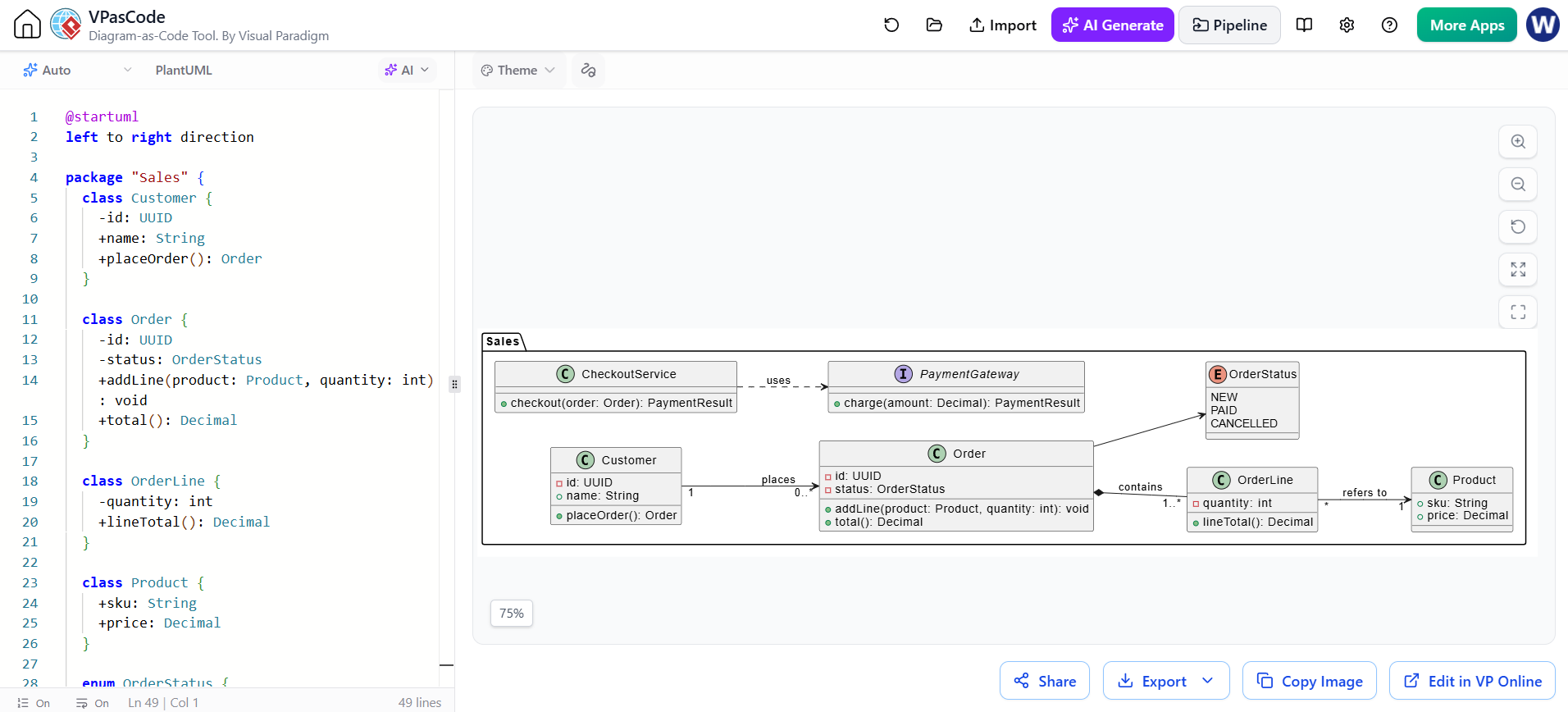
In the realm of software architecture, clarity is paramount. Visual Paradigm’s VPasCode tool offers a powerful way to bridge the gap between abstract code and concrete visual models. This tutorial explores a comprehensive Class Diagram example that encapsulates a robust “Sales” system architecture. By analyzing the code-to-diagram transformation, we will dissect how visibility, data types, methods, enums, multiplicities, composition, and dependencies are modeled to represent a real-world e-commerce scenario.
The Blueprint: Defining the Sales Package
Every robust system begins with a defined boundary. In our example, we encapsulate the entire logic within a package named “Sales”. This acts as a namespace, preventing naming conflicts and organizing related components.
package "Sales" {
    // ... internal components
}
Furthermore, the diagram utilizes left to right direction. This directive instructs the rendering engine to lay out the elements horizontally rather than the default vertical stack, which is often more intuitive for flow-based processes like sales transactions.
Core Entities: Classes and Methods
The backbone of this system consists of several key classes. Let’s examine how they are defined using standard UML syntax.
The Customer and Order Relationship
The Customer class represents the actor initiating the transaction. It contains a private identifier -id: UUID and a public name +name: String. Crucially, it exposes a public method +placeOrder(): Order, which acts as the entry point for the business logic.
class Customer {
    -id: UUID
    +name: String
    +placeOrder(): Order
}
The Order class serves as the central transaction record. It holds a status of type OrderStatus and provides methods to manage the contents of the order. Note the method signature for addLine, which accepts a Product object and an int quantity, returning void.
class Order {
    -id: UUID
    -status: OrderStatus
    +addLine(product: Product, quantity: int): void
    +total(): Decimal
}
Line Items and Products
To maintain a clean design, the system separates the OrderLine from the Order. The OrderLine class contains the quantity and calculates the lineTotal. The Product class is a simple data holder with a sku and price.
Advanced Concepts: Enums and Interfaces
Modern software development relies heavily on type safety and decoupling. VPasCode makes this easy through Enums and Interfaces.
Enum: OrderStatus
Instead of using strings or integers to track the lifecycle of an order, we use an enum. This restricts the possible states to a predefined set, preventing invalid data entry.
enum OrderStatus {
    NEW
    PAID
    CANCELLED
}
Interface: PaymentGateway
For the checkout process, the system defines a PaymentGateway interface. Interfaces define a contract—what a class must do—without specifying how it does it. Here, the interface dictates that any implementation must have a charge method.
interface PaymentGateway {
    +charge(amount: Decimal): PaymentResult
}
Mapping Relationships and Multiplicities
Diagrams are not just boxes; they are maps of relationships. The VPasCode syntax allows for precise definition of how these classes interact.
Composition: Order and OrderLine
The relationship Order -- "1.." OrderLine : contains represents a strong “Has-A” relationship known as Composition. The filled diamond indicates that OrderLine objects cannot exist independently of an Order; if the order is deleted, the lines are gone too. The multiplicity "1.." means an order must contain at least one line item.
Association: Customer and Order
The relationship Customer "1" --> "0.." Order : places shows that one customer can place zero or many orders. The arrow indicates the direction of the relationship (who initiates the link).
Dependency: Service to Gateway
Finally, the CheckoutService interacts with the PaymentGateway. The dashed line with an open arrow ..> : uses signifies a Dependency. The service relies on the gateway to perform its job but does not own it.
CheckoutService ..> PaymentGateway : usesConclusion
This example demonstrates the power of “Diagram as Code.” By writing structured text in VPasCode, you gain the ability to version control your architecture, automate diagram generation, and ensure consistency across your documentation. Whether you are defining the lifecycle of an order or the structure of a payment system, mastering these syntax rules will elevate your system design capabilities.