
Enterprise architecture is not merely about drawing diagrams; it is about ensuring that technology serves business intent. For application architects, the challenge lies in bridging the gap between high-level strategic goals and the concrete implementation of software systems. ArchiMate provides a standardized language to model these relationships without ambiguity. This guide explores how application architects can leverage ArchiMate to align system design with organizational strategy, ensuring clarity and coherence across the enterprise landscape.
Understanding the Role of Application Architecture 🧩
Application architecture defines the structure of software systems within an enterprise. It determines how applications interact, how data flows between them, and how they support business processes. Without a structured approach, application landscapes often become fragmented, leading to redundancy and integration issues. ArchiMate offers a structured framework to visualize these complexities.
- Scope: Focuses on the application layer while maintaining connections to business and technology layers.
- Goal: Ensure applications meet functional requirements and support business capabilities.
- Benefit: Provides a common vocabulary for stakeholders across IT and business units.
When architects utilize this language effectively, they move beyond isolated system designs. They create a holistic view where every application has a defined purpose and relationship within the broader context.
Core Principles of ArchiMate Modeling 📐
The effectiveness of ArchiMate relies on a set of core principles that guide the modeling process. These principles ensure consistency and prevent the model from becoming overly complex or abstract.
1. Abstraction Layers
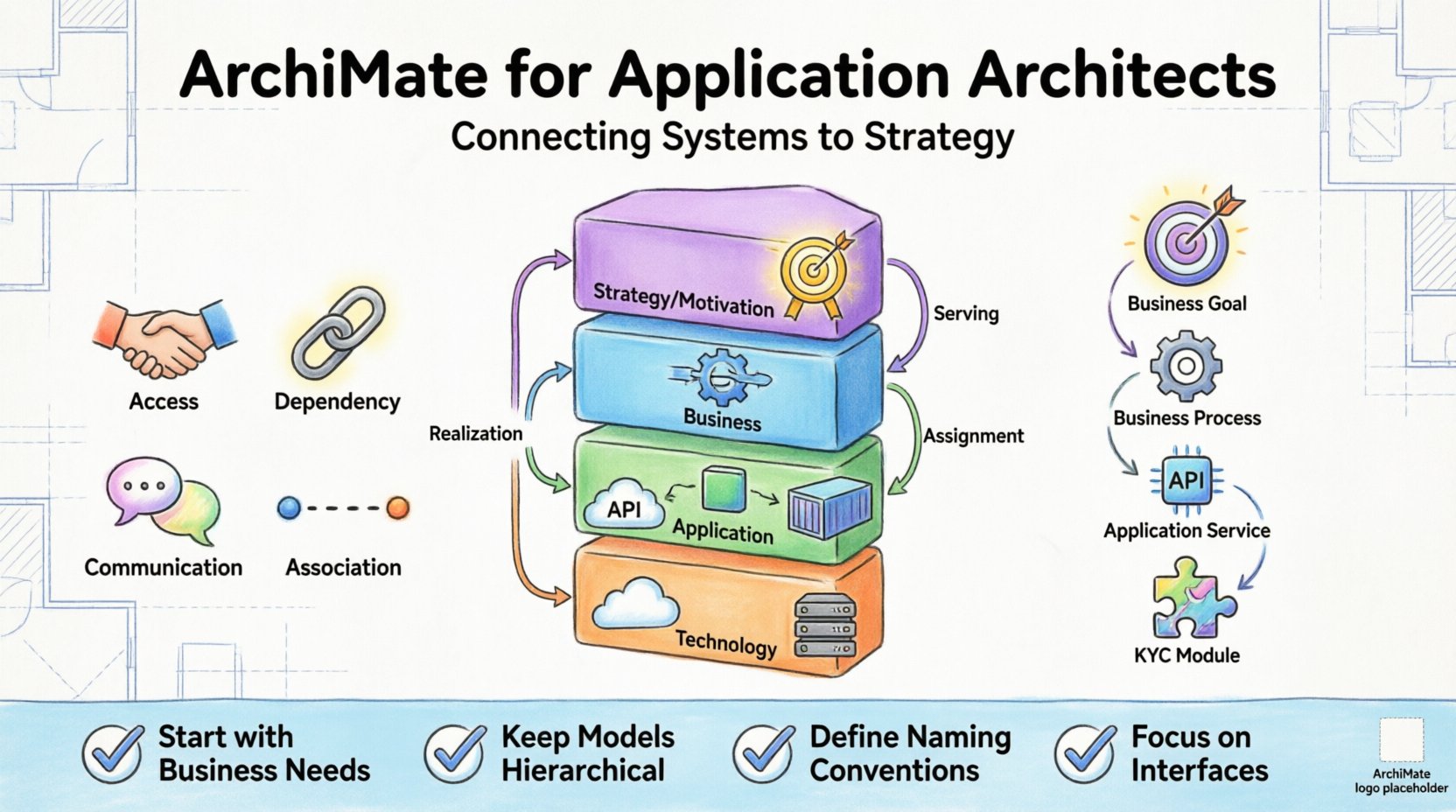
ArchiMate organizes architecture into distinct layers. Each layer represents a specific view of the enterprise. Understanding these layers is crucial for application architects.
| Layer | Focus | Key Elements |
|---|---|---|
| Strategy (Motivation) | Goals, Principles, Drivers | Business Goals, Business Drivers |
| Business | Processes, Functions, Capabilities | Business Process, Business Function |
| Application | Applications, Services, Interfaces | Application Component, Application Service |
| Technology | Infrastructure, Networks, Devices | System Software, Network |
2. Layering and Cross-Layer Relationships
One of the most powerful aspects of ArchiMate is the ability to model relationships between layers. An application service might support a business process, which in turn realizes a business goal. These cross-layer connections are vital for tracing requirements from strategy to implementation.
- Realization: How an element satisfies another element (e.g., a process realizes a function).
- Assignment: How an actor is assigned to a business process.
- Serving: How an application service serves a business process.
The Application Layer in Detail 🖥️
The application layer is the primary domain for application architects. It consists of software systems and the services they provide. Modeling this layer requires precision regarding boundaries, interfaces, and interactions.
Key Elements in the Application Layer
- Application Service: A behavior that is exposed to the outside world. This defines what the application does for the user or another system.
- Application Function: A behavior that is internal to the application. It represents a specific capability within the software.
- Application Component: A modular part of an application that encapsulates functionality. Components are the building blocks of the architecture.
- Application Interface: The point of interaction between an application and an actor or another application.
- Application Interaction: The communication between two application components or functions.
Architects should avoid over-modeling every internal function. Focus on the services and interfaces that matter to the business and external systems. This keeps the model manageable and relevant.
Connecting Systems to Strategy 🎯
The true value of ArchiMate lies in its ability to trace the lineage of an application back to strategic intent. Without this traceability, investments in software may not align with organizational needs.
Tracing from Motivation to Application
To ensure alignment, architects must establish clear links between the Motivation layer and the Application layer.
- Identify Strategic Drivers: What market forces or regulatory requirements are driving change?
- Define Business Goals: What specific outcomes does the organization seek?
- Map Capabilities: Which business capabilities are required to achieve these goals?
- Link Applications: Which applications support these capabilities?
This chain of relationships allows stakeholders to understand the impact of removing or modifying an application. If an application is decommissioned, does it break a business capability? Does that capability impact a strategic goal?
Example Scenario: Customer Onboarding 📝
Consider a business goal to improve customer onboarding speed. The architecture might look like this:
- Business Goal: Reduce onboarding time by 50%.
- Business Process: Customer Verification.
- Business Service: Identity Check.
- Application Service: Validate ID.
- Application Component: KYC Module.
This clear path demonstrates how a specific software module contributes directly to a business outcome. It justifies the existence of the component and highlights dependencies.
Relationships and Dependencies 🔗
Understanding how elements relate to one another is critical for change management. ArchiMate defines specific relationship types that clarify these dependencies.
| Relationship Type | Direction | Meaning |
|---|---|---|
| Access | Actor to Function | An actor uses a function. |
| Association | Element to Element | A logical relationship without strict dependency. |
| Communication | Element to Element | Data or control flow between elements. |
| Dependency | Element to Element | The source element needs the target to function. |
| Serving | Service to Process | A service supports a process. |
When analyzing impact, architects should prioritize Dependency and Access relationships. These indicate hard constraints that, if broken, will cause failure. Association relationships are softer and often represent data links or optional integrations.
Best Practices for Application Architects 🛡️
To maintain a useful and sustainable architecture model, follow these guidelines.
- Start with Business Needs: Do not begin with technology. Start with the business processes and capabilities that require support.
- Keep Models Hierarchical: Use multiple views for different audiences. A high-level view for executives and a detailed view for developers.
- Define Naming Conventions: Consistent naming reduces confusion. Ensure “Customer Service” means the same thing everywhere.
- Validate Regularly: Architecture is not static. Review models during major project phases to ensure they reflect reality.
- Focus on Interfaces: Clearly define how applications interact. This is where integration issues often arise.
Common Challenges and Pitfalls ⚠️
Even with a solid framework, architects encounter obstacles. Recognizing these early helps mitigate risks.
1. Over-Modeling
Creating a model that includes every detail of the system makes it unreadable and unmanageable. Focus on the elements that matter for decision-making. Ignore implementation details that do not affect the architecture.
2. Ignoring the Strategy Layer
Models that stop at the Application layer lack context. Without linking to business goals, the architecture becomes a technical inventory rather than a strategic asset. Always attempt to trace elements back to the Motivation layer.
3. Inconsistent Layering
Placing a technology element in the application layer, or a business process in the technology layer, creates confusion. Strict adherence to layer definitions ensures clarity.
4. Lack of Stakeholder Engagement
An architecture model is only useful if stakeholders understand and trust it. Involve business leaders and developers in the modeling process to ensure the model reflects actual operations.
Governance and Evolution 🔄
Architecture models must evolve alongside the enterprise. Governance processes ensure that changes are controlled and documented.
- Change Management: Establish a review board for significant architectural changes.
- Version Control: Treat the model like code. Maintain versions to track history and enable rollback.
- Metrics: Define metrics to measure the health of the application landscape. Examples include complexity scores or dependency counts.
Governance is not about restriction; it is about ensuring stability and alignment. It prevents the landscape from becoming chaotic as new systems are introduced.
Integration with Other Frameworks 🔌
ArchiMate is often used in conjunction with other frameworks. It provides the visual language to represent concepts defined elsewhere.
- TOGAF: ArchiMate is the standard modeling language within the TOGAF framework. It provides the detail to the ADM phases.
- ITIL: Align application services with IT service management processes to ensure operational readiness.
- DevOps: Use the architecture to define deployment boundaries and microservice relationships.
This integration ensures that architectural decisions are supported by operational and delivery frameworks.
Measuring Success 📊
How do you know if the application architecture is effective? Look for these indicators.
- Clarity: Can stakeholders understand the system landscape without extensive explanation?
- Agility: Can new requirements be mapped to existing capabilities quickly?
- Reduced Redundancy: Are duplicate applications identified and eliminated?
- Alignment: Does the IT spend match the strategic priorities?
Future Trends in Application Architecture 🚀
The landscape of application architecture is shifting. Cloud computing, microservices, and artificial intelligence are changing how systems are designed.
- Cloud-Native Design: Models need to account for elasticity and managed services.
- Data-Centric Architecture: The focus is shifting from applications to data flows and governance.
- Automation: Model-driven development uses architecture models to generate code or configurations.
ArchiMate provides the flexibility to adapt to these trends. By focusing on relationships and services rather than specific technologies, the models remain relevant even as underlying platforms change.
Summary of Key Takeaways 💡
- Standardization: ArchiMate provides a common language for IT and business.
- Traceability: Link applications to business goals to justify investment.
- Layering: Maintain clear boundaries between business, application, and technology.
- Relationships: Understand dependencies to manage change effectively.
- Pragmatism: Model what is needed, not everything. Focus on value.
Application architects play a pivotal role in translating strategy into reality. By using ArchiMate effectively, they ensure that systems are robust, aligned, and capable of supporting the organization’s long-term goals. This approach requires discipline and continuous engagement, but the result is an enterprise landscape that is resilient and adaptable.
Start by reviewing your current models. Check the links between your applications and your business capabilities. Identify gaps where strategy is disconnected from implementation. Addressing these gaps is the first step toward a truly integrated enterprise architecture.