


Enterprise architecture is often perceived as a luxury reserved for large corporations with vast budgets. However, the complexity of modern business operations requires structure at every scale. Small and medium enterprises (SMEs) face unique challenges. Rapid growth, shifting market demands, and limited resources mean that ad-hoc decisions can quickly lead to technical debt. This guide explores how ArchiMate, a standardized modeling language, provides the necessary framework for SMEs to scale their architecture effectively. 📈
Understanding the SME Context 🏢
SMEs operate differently than multinational conglomerates. Agility is their primary advantage. Yet, as they grow, this agility can become a liability if not managed. Without a clear view of how business capabilities connect to applications and technology, organizations risk creating silos. ArchiMate offers a common language. It bridges the gap between strategic planners and technical implementers.
For an SME, the goal is not to create a massive repository of diagrams. The objective is clarity. A clear model allows teams to:
- Understand the impact of changes before they happen.
- Communicate technical constraints to business stakeholders.
- Align IT investments with long-term business goals.
- Onboard new team members faster through documented knowledge.
Scaling architecture does not mean scaling complexity. It means scaling understanding. ArchiMate provides the visual vocabulary to do exactly that.
Why SMEs Need a Structured Approach 🧩
Many small businesses start with a “build as you go” mentality. This works when the team is small. As the team grows, communication becomes harder. Decisions made by one developer may conflict with the infrastructure choices of another. ArchiMate helps mitigate these risks.
The following challenges are common in growing SMEs:
- Fragmented Systems: Different departments adopt different tools without integration.
- Shadow IT: Teams bypass central IT to solve problems quickly, creating security risks.
- Dependency Blindness: Teams are unaware of how a change in one service affects another.
- Cost Overruns: Lack of visibility leads to redundant licenses and infrastructure.
Addressing these issues requires a holistic view. ArchiMate organizes this view into specific layers. This structure ensures that every change is evaluated in context.
The Core Layers of ArchiMate 🌐
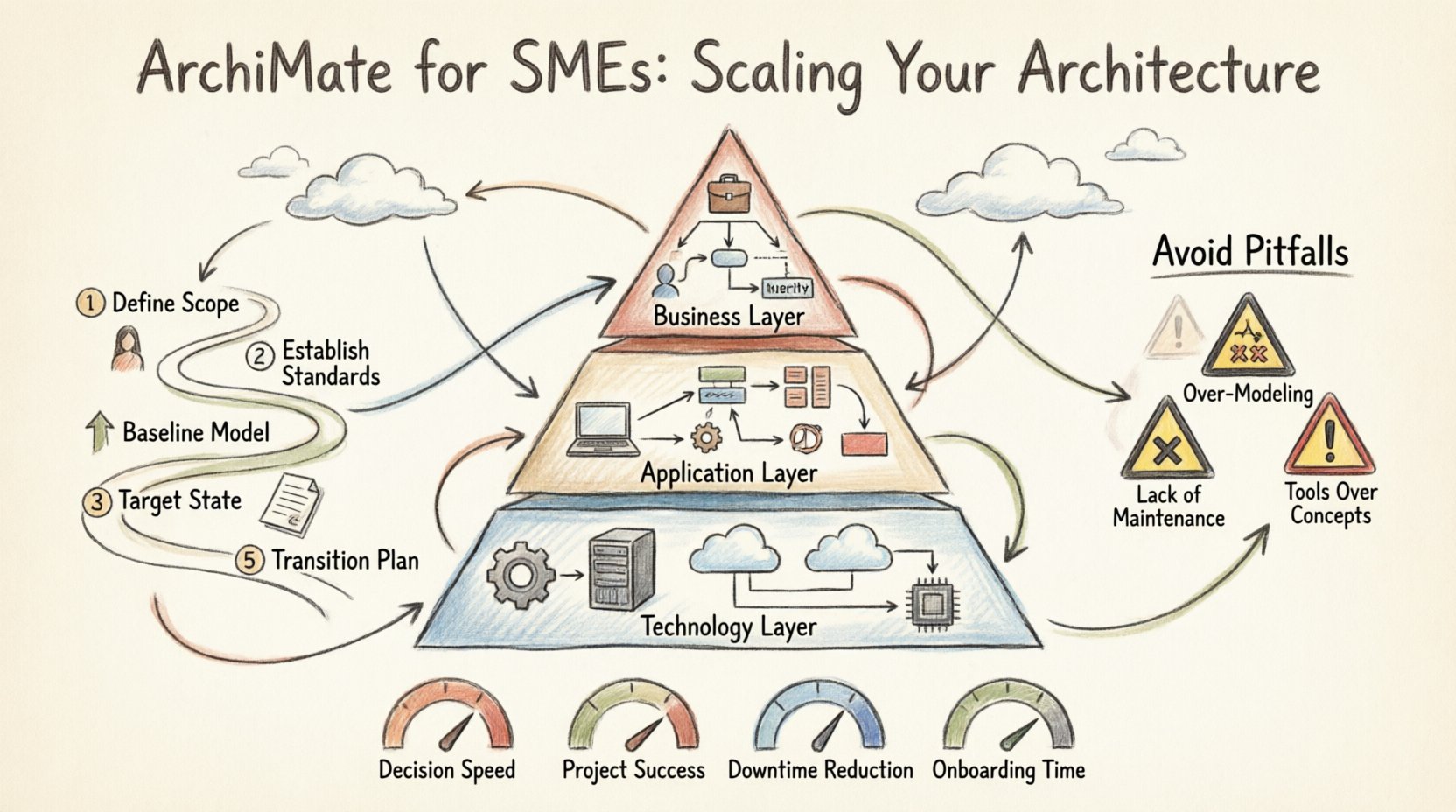
ArchiMate divides an organization into three primary layers. Understanding these is essential for any SME looking to scale. Each layer represents a different aspect of the business, from high-level strategy down to physical hardware.
1. The Business Layer 💼
This layer represents the business itself. It focuses on capabilities, processes, and actors. It answers the question: “What does the business do?”
- Business Capabilities: What the organization is capable of doing (e.g., Customer Service, Order Processing).
- Business Processes: The activities that realize the capabilities.
- Business Actors: People or roles that perform the processes.
- Business Objects: Information or items managed by the processes.
For an SME, mapping these elements helps identify where value is created. It highlights redundant processes that can be automated.
2. The Application Layer 💻
The application layer describes the software systems that support the business layer. It connects business processes to the technology that executes them.
- Application Services: The functions provided by the software (e.g., User Authentication, Reporting).
- Application Components: The internal building blocks of the software.
- Interface: How different applications interact with each other.
When an SME considers a new software purchase, this layer ensures it fits the existing ecosystem. It prevents buying tools that duplicate functionality already present.
3. The Technology Layer ⚙️
The technology layer defines the infrastructure. This includes servers, networks, and cloud platforms. It is the foundation upon which applications run.
- Infrastructure Services: Network, storage, and compute services.
- Hardware: Physical devices or virtual machines.
- Software: Operating systems and middleware.
Scaling infrastructure requires planning. This layer helps visualize capacity needs and ensures that hardware choices support the application requirements.
Strategic Alignment and Planning 🎯
One of the most significant benefits of using ArchiMate is the ability to link strategy to execution. SMEs often struggle to translate high-level goals into technical tasks. The framework provides mechanisms to show how a business goal is realized by a specific capability, which is supported by an application, which runs on hardware.
This traceability is crucial for budget justification. When leadership asks why a certain technology investment is needed, the model provides the evidence.
The Motivation Layer 🧠
While the three core layers describe the “What” and “How”, the motivation layer explains the “Why”. This includes:
- Goal: What the organization wants to achieve.
- Principle: Rules or guidelines that constrain the architecture.
- Assessment: Evaluation of the current state versus the target state.
For an SME, understanding the motivation behind a change prevents scope creep. It keeps the team focused on the value being delivered.
Implementation Steps for SMEs 🛠️
Implementing an architecture framework does not require a massive team. It requires a disciplined approach. The following steps outline a practical path for adoption.
Step 1: Define the Scope 📏
Do not attempt to model the entire organization immediately. Start with a specific domain. For example, focus on the “Customer Onboarding” process. Define the boundaries of this scope clearly.
- Identify key business capabilities involved.
- List the critical applications supporting them.
- Map the underlying technology dependencies.
Step 2: Establish Standards 📝
Consistency is key. Define naming conventions for all elements. If one team calls a process “Order Processing” and another calls it “Order Fulfillment”, confusion will arise.
- Create a glossary of terms.
- Define standard icons for actors, processes, and applications.
- Set rules for how connections are drawn.
Step 3: Create the Baseline Model 🗺️
Document the current state. This is often referred to as the “As-Is” model. It does not need to be perfect, but it must be accurate enough to understand current dependencies.
Step 4: Design the Target State 🎨
Visualize the future. What does the architecture look like after scaling? This “To-Be” model guides the migration path.
Step 5: Plan the Transition 🔄
Define the projects required to move from “As-Is” to “To-Be”. This includes identifying gaps and estimating resources. The model serves as the roadmap for these projects.
Common Pitfalls to Avoid 🚫
Many organizations fail to gain value from architecture frameworks because they fall into common traps. SMEs are particularly vulnerable due to resource constraints.
Pitfall 1: Over-Modeling 📉
Creating detailed diagrams for every single process is unnecessary. Focus on the critical paths. If a diagram does not help decision-making, it is noise.
Pitfall 2: Lack of Maintenance 🧹
An architecture model is a living document. If it is not updated, it becomes obsolete quickly. Assign ownership for keeping the model current.
Pitfall 3: Ignoring the Business 🤝
Architecture should not be an IT-only exercise. Business stakeholders must be involved. If the business layer is ignored, the technical layer will not support actual needs.
Pitfall 4: Focusing on Tools Over Concepts 🛠️
The value lies in the thinking, not the software used to draw the diagrams. Do not get distracted by features of modeling tools. Focus on the quality of the relationships and the logic.
Measuring Success and ROI 📊
How do you know if ArchiMate is working for your SME? You need measurable indicators. These metrics demonstrate the value of the architectural effort.
| Metric | Definition | Target |
|---|---|---|
| Decision Speed | Time taken to evaluate a change request | Decrease by 20% |
| Project Success Rate | Percentage of projects meeting scope and budget | Increase by 15% |
| System Downtime | Unplanned outages due to integration issues | Reduce by 30% |
| Onboarding Time | Time for new engineers to understand the system | Reduce by 25% |
Tracking these metrics over time provides evidence of the framework’s impact. It justifies the continued investment in architecture practices.
Scaling with Cloud and Modern Tech ☁️
Modern SMEs often rely heavily on cloud services. ArchiMate adapts well to this environment. The technology layer can represent cloud instances, serverless functions, and managed databases.
Key considerations for cloud scaling include:
- Vendor Lock-in: Document dependencies on specific cloud providers to mitigate risk.
- Cost Management: Map applications to infrastructure costs to identify waste.
- Security: Ensure security controls are modeled alongside technical components.
- Compliance: Track regulatory requirements against data flows.
By modeling cloud architecture, SMEs can plan for migration and scaling without losing visibility.
Maintaining the Architecture Culture 🌱
Architecture is not just a set of diagrams; it is a culture. It requires a mindset where people think about connections and consequences. For an SME, this culture must be embedded in the daily workflow.
- Regular Reviews: Schedule quarterly architecture reviews to discuss changes.
- Training: Invest in training so team members understand the modeling language.
- Documentation: Keep documentation accessible and linked to the models.
- Feedback Loops: Encourage feedback on the models from developers and business users.
When the culture shifts, the architecture becomes a tool for collaboration rather than a bureaucratic burden. It becomes the shared language of the organization.
Conclusion 🚀
Scaling an SME requires more than just hiring more people or buying more servers. It requires a structured approach to how the organization operates and grows. ArchiMate provides the necessary structure to manage this complexity. It aligns business goals with technical execution.
By adopting this framework, SMEs can navigate growth with confidence. They reduce risk, improve communication, and ensure that technology investments deliver real value. The journey toward maturity is continuous. The framework supports this journey by providing a stable foundation for change.
Start small. Focus on clarity. Build the model that matters. Over time, the cumulative effect of these disciplined practices will create a resilient, scalable, and efficient enterprise. This is the path to sustainable growth.