
Enterprise architecture often faces a critical disconnect: the strategic vision defined by leadership rarely translates cleanly into the operational reality on the ground. Business architects serve as the essential link in this chain, ensuring that high-level goals manifest as tangible processes, services, and capabilities. ArchiMate provides a standardized language and modeling framework to facilitate this translation. By utilizing this framework, architects can create a coherent view that connects motivation to execution without ambiguity.
This guide explores how business architects leverage ArchiMate to align strategy with operations. It covers core concepts, layering structures, modeling patterns, and practical applications. The focus remains on the structural integrity of the architecture rather than specific tooling implementations.
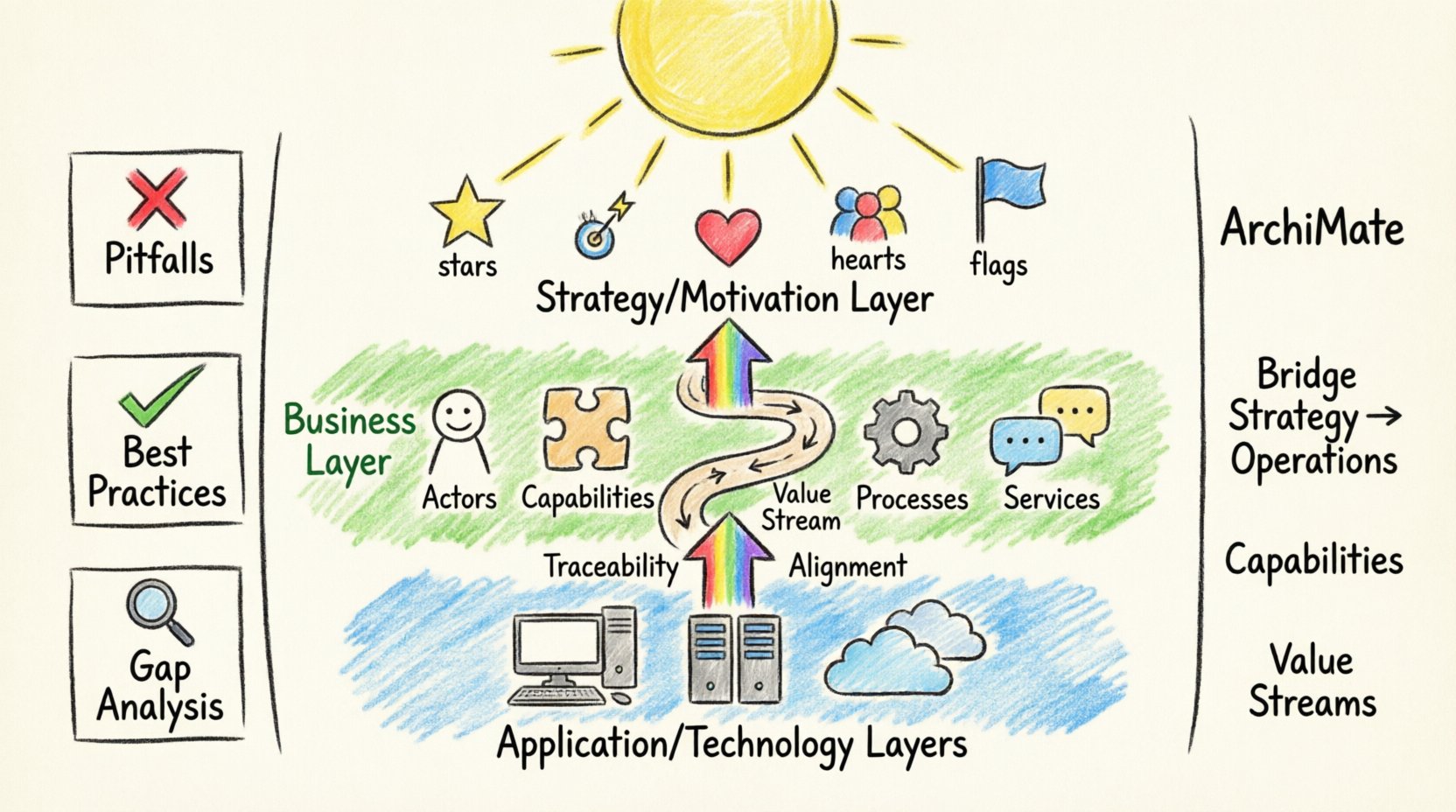
Understanding the Core Structure 🧩
ArchiMate is an open and independent enterprise architecture modeling language. It enables the visualization, analysis, and documentation of enterprise architectures. For business architects, understanding the layered structure is fundamental. The framework divides the enterprise into distinct domains, each with specific focus areas.
- Motivation Layer: Deals with the drivers behind the architecture. This includes goals, principles, requirements, and stakeholders.
- Business Layer: Describes the business organization, including strategy, governance, and business processes.
- Application Layer: Represents the applications that support the business processes and services.
- Information Layer: Covers the data and information objects that are managed by the applications.
- Technology Layer: Describes the physical infrastructure and software that supports the applications.
- Physical Layer: Represents the physical environment where technology components are deployed.
Business architects primarily operate within the Motivation and Business layers, but they must understand the dependencies extending into the Application and Technology layers. This cross-layer visibility ensures that strategic decisions are feasible and operationally sound.
The Business Layer in Detail 🔍
The Business Layer is the heart of business architecture. It defines how the organization functions. Within ArchiMate, this layer is composed of specific building blocks that describe the static structure and dynamic behavior of the enterprise.
Static Structure
Static elements define the components of the business and their relationships.
- Business Actor: An entity, such as a person, department, or organization, that plays a role in business processes.
- Business Role: A collection of business actors that share the same responsibilities.
- Business Function: A specific activity that a business unit performs. It is often stable and does not change frequently.
- Business Process: A sequence of activities that delivers a specific result. Unlike functions, processes are dynamic and flow.
- Business Service: A collection of functions that are exposed to business actors. This is what the organization offers to its stakeholders.
- Business Object: An entity that represents data or information within the business context.
- Business Interaction: A communication between two business actors.
Dynamic Behavior
Dynamic elements describe how the business operates over time.
- Business Event: Something that happens at a specific point in time, triggering an activity.
- Business Process: As mentioned, this defines the flow of activities.
- Business Scenario: A sequence of interactions between actors and objects.
Understanding the distinction between a Function and a Process is crucial. A Function describes what the organization does (e.g., Order Management). A Process describes how it does it (e.g., The Order Fulfillment Workflow). This distinction allows architects to model stability alongside variability.
Bridging Strategy and Operations 🔗
The primary value proposition for business architects using ArchiMate is the ability to trace requirements from the top down. This traceability ensures that every operational activity contributes to a strategic goal. The Motivation Layer plays a pivotal role here.
The Motivation Layer
Before modeling business capabilities, architects must understand the why. The Motivation Layer defines:
- Stakeholders: Who is affected by the change?
- Drivers: Internal or external factors prompting change.
- Goals: Desired states or outcomes.
- Principles: Rules that guide decision-making.
- Requirements: Conditions that must be met.
By linking these motivation elements to business capabilities and processes, architects create a clear line of sight. If a process is modified, the architect can immediately assess the impact on the associated goals and principles.
Value Streams
A key concept in aligning strategy and operations is the Value Stream. A value stream describes the sequence of activities that create value for a customer or stakeholder. It bridges the gap between strategic intent and operational execution.
- Strategy: Defines the desired value proposition.
- Operations: Executes the steps to deliver that value.
Using ArchiMate, a business architect maps the value stream to specific capabilities and processes. This mapping reveals gaps where value is not being delivered or inefficiencies where costs are incurred without value creation.
Mapping Patterns and Relationships 📐
Effective modeling relies on understanding the relationships between elements. ArchiMate defines specific relationship types that govern how elements interact. Below is a table outlining common relationships used in business architecture.
| Relationship Type | Source Element | Target Element | Purpose |
|---|---|---|---|
| Assignment | Business Actor | Business Function | Indicates which actor performs the function. |
| Realization | Business Process | Business Capability | Shows how a capability is realized through a process. |
| Triggering | Business Event | Business Process | Indicates that an event starts a process. |
| Serving | Business Service | Business Role | Indicates which roles consume the service. |
| Access | Business Process | Business Object | Indicates that a process creates or uses an object. |
Using these relationships consistently creates a robust model. For instance, if a business capability is marked as critical for strategy, the architect can trace down to the specific processes that realize it. This allows for targeted impact analysis during change management.
Business Capability Mapping 🧠
Business capabilities represent what an organization needs to be able to do to achieve its goals. Unlike processes, capabilities are relatively stable. They do not change every time a workflow is updated. This stability makes them ideal for strategic planning.
Why Capabilities Matter
- Stability: They remain constant even when organizational structures change.
- Clarity: They provide a clear view of organizational strengths and weaknesses.
- Alignment: They link directly to value streams and strategic goals.
When mapping capabilities, architects should avoid creating a static list. Instead, they should model the dependencies between capabilities. For example, a capability like Customer Relationship Management might depend on Data Analytics and IT Infrastructure. This dependency graph highlights critical areas of risk.
Operationalizing the Model 🛠️
Once the model is created, the focus shifts to operational use. A static diagram is useful, but the model must drive decision-making. Here are ways to utilize the architecture model in daily operations.
Impact Analysis
When a change is proposed, such as a new regulatory requirement, the architecture model allows for rapid impact analysis. By tracing the requirement through the motivation layer to the business processes, architects can identify which processes, applications, and technologies will be affected.
- Identify Dependencies: See what relies on the affected component.
- Assess Cost: Estimate the effort required to implement changes.
- Prioritize: Determine which changes offer the most value.
Gap Analysis
Comparing the current state model against the target state model reveals gaps. This is essential for roadmapping. Gaps can exist in capabilities, processes, or technology.
- Capability Gaps: Areas where the organization lacks necessary skills or functions.
- Process Gaps: Areas where processes are missing or inefficient.
- Technology Gaps: Areas where systems do not support the required capabilities.
Common Pitfalls to Avoid ⚠️
Even experienced architects encounter challenges when working with ArchiMate. Recognizing these pitfalls early can save significant time and effort.
1. Over-Modeling
It is easy to create models that are too detailed. A model that includes every single transaction is often too complex to be useful. Focus on the level of detail required for the specific business question. If the goal is strategic alignment, high-level capabilities are sufficient. If the goal is system implementation, detailed process flows are needed.
2. Ignoring the Motivation Layer
Many architects jump straight to the business layer. Without the motivation layer, the model lacks context. Stakeholders may not understand why a process exists or why a change is necessary. Always link processes to goals and drivers.
3. Static Modeling
Architecture is not a one-time activity. Models must evolve. If a model is not updated regularly, it becomes a source of misinformation. Establish a governance process to ensure the architecture remains current.
4. Confusing Process and Function
As noted earlier, confusing these two concepts leads to a confused model. Functions are stable; processes are dynamic. Ensure the distinction is clear in the documentation.
Best Practices for Implementation ✅
To ensure success, business architects should adopt a disciplined approach to modeling.
- Standardize Notation: Ensure all team members use the same terminology. Consistency is key for collaboration.
- Focus on Value: Every element in the model should serve a purpose related to business value. Remove elements that do not contribute.
- Iterate: Build the model in iterations. Start with the core capabilities and expand outward. Avoid trying to model the entire enterprise in one go.
- Engage Stakeholders: Architecture is a collaborative effort. Regularly review models with business leaders to ensure accuracy and alignment.
- Document Assumptions: If a model relies on assumptions, document them clearly. This helps in future reviews and updates.
Integration with Other Frameworks 🤝
ArchiMate is often used alongside other frameworks. It is designed to be interoperable. For example, it can complement methodologies used for project management or IT governance. The key is to map the concepts correctly.
When integrating, avoid redundancy. Do not model the same concept in multiple frameworks. Instead, use ArchiMate as the unifying language that connects different perspectives. This ensures that the business view remains consistent with the IT view.
Future-Proofing the Architecture 🔮
The business landscape is constantly changing. To remain relevant, architecture models must be adaptable. This requires a focus on modularity.
- Modular Capabilities: Design capabilities so they can be swapped or updated independently.
- Flexible Processes: Design processes that can accommodate variations without breaking the model.
- Scalable Motivation: Ensure goals and drivers can be updated as market conditions shift.
By building with modularity in mind, the architecture remains a living asset rather than a static document. This adaptability is crucial for long-term success.
Summary of Key Takeaways 📝
- ArchiMate provides a structured language for visualizing enterprise architecture across multiple layers.
- The Business Layer is central to connecting strategy with operations.
- Motivation Layer elements provide the context and justification for architectural decisions.
- Value Streams offer a clear path from strategic intent to operational delivery.
- Capability Mapping helps identify gaps and strengths within the organization.
- Consistency and Governance are required to maintain model accuracy over time.
- Avoiding Over-Modeling ensures the architecture remains practical and usable.
Business architects who master these concepts can effectively drive alignment across the enterprise. They transform abstract strategy into concrete action plans. This role is critical in ensuring that organizations remain agile and responsive to market demands.
The journey from strategy to operations is complex. ArchiMate simplifies this complexity by providing a common framework. By adhering to the principles outlined here, architects can build robust models that support business growth and efficiency.