
Enterprise architecture requires a structured approach to align business strategy with IT capabilities. The ArchiMate modeling language provides a standardized way to describe, analyze, and visualize architectural design. However, single-framework usage often limits the scope of architectural visibility. To achieve comprehensive governance and clarity, integration with other established frameworks becomes necessary. This guide explores how to effectively combine ArchiMate with complementary methodologies to create a cohesive enterprise architecture ecosystem.
Why Integration Matters for Enterprise Architecture 🤝
Organizations operate within complex environments where different departments rely on different standards. Business analysts may prefer process modeling, while IT managers focus on infrastructure. Without integration, these views remain siloed, leading to misalignment and inefficiency. Integrating ArchiMate allows for a unified view that spans multiple layers of the enterprise.
Key benefits of this integration include:
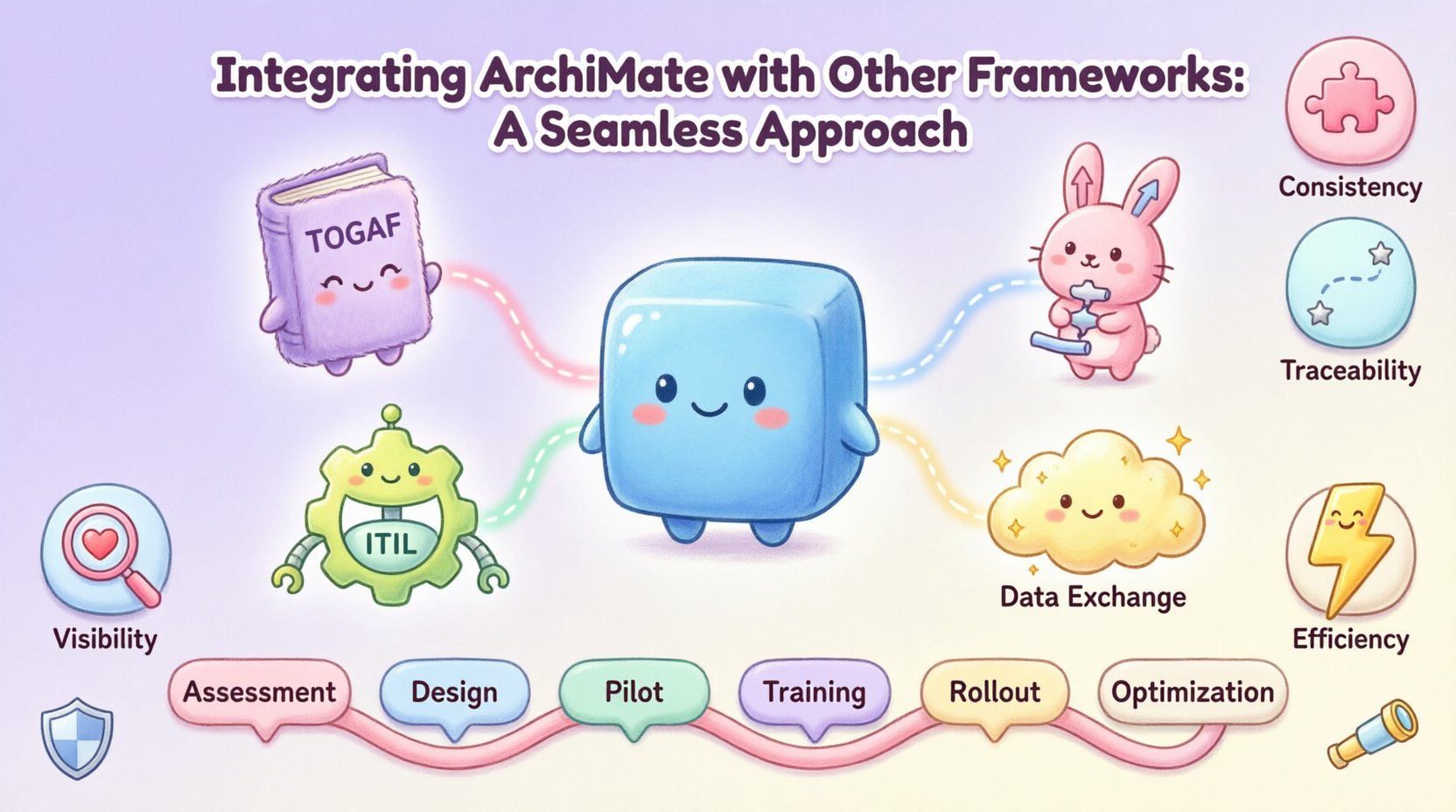
- Consistency: Ensures terminology and definitions remain uniform across business and technology domains.
- Traceability: Links high-level strategy to specific technical implementation details.
- Visibility: Provides stakeholders with clear insights into how changes in one area impact another.
- Efficiency: Reduces duplication of effort when documenting requirements and solutions.
When planning integration, it is vital to establish clear boundaries and interaction points. This prevents model complexity from becoming unmanageable. A structured approach ensures that the architecture remains a living asset rather than a static document.
Aligning with TOGAF: The Foundation of Enterprise Architecture 📋
The Open Group Architecture Framework (TOGAF) is widely recognized as the standard for enterprise architecture. ArchiMate often serves as the modeling language within the TOGAF ecosystem. Understanding the relationship between these two is crucial for effective implementation.
The TOGAF ADM Cycle
The Architecture Development Method (ADM) consists of several phases. ArchiMate models are typically created and updated during the specific phases where architectural artifacts are defined.
- Phase A (Architecture Vision): Define the scope and stakeholders using business architecture concepts.
- Phase B (Business Architecture): Model business processes, organizations, and goals using ArchiMate business layer elements.
- Phase C (Information Systems Architectures): Utilize data and application layers to define information flows and software services.
- Phase D (Technology Architecture): Map infrastructure and network components to the technical layer.
- Phase E & F (Opportunities & Solutions): Assess gaps and plan migration using combined models.
Integration ensures that the TOGAF deliverables align with the visual representations in ArchiMate. This alignment helps architects communicate the progression from business needs to technical realization.
Mapping TOGAF Content Metamodel to ArchiMate
Both frameworks define content structures. Mapping these structures reduces ambiguity.
| TOGAF Concept | ArchiMate Equivalent | Usage Context |
|---|---|---|
| Business Actor | Business Actor | Stakeholder representation in business processes |
| Business Process | Business Process | Workflow and activity sequencing |
| Application Service | Application Service | Functional capabilities provided by software |
| Technology Node | Device / Node | Hardware and infrastructure components |
By maintaining this mapping, architects can ensure that documentation generated for TOGAF governance meetings reflects the detailed models created in the ArchiMate repository.
Connecting Business Processes with BPMN 🔄
Business Process Model and Notation (BPMN) is the industry standard for describing business processes. While ArchiMate includes business process elements, BPMN offers more granular detail regarding control flows, events, and gateways.
Integration Strategy
Architects often find that ArchiMate captures the what (business capabilities and value streams), while BPMN captures the how (detailed process steps). Integrating these two allows for a complete picture of operational execution.
- Value Stream Mapping: Use ArchiMate to define high-level value streams. Link these to BPMN diagrams that detail the specific activities.
- Process to Architecture: Map BPMN tasks to ArchiMate business functions. This validates whether the process supports the required capability.
- Exception Handling: Use ArchiMate event triggers to manage exceptions defined in the BPMN control flow.
This dual-modeling approach ensures that process improvements are reflected in the underlying architectural capabilities. When a process changes, the architectural impact is immediately visible.
Service Management: Integrating ITIL and ISO Standards ⚙️
IT service management frameworks like ITIL focus on the delivery and support of IT services. ArchiMate provides a robust way to model the architecture that supports these services.
Service Mapping
In the ITIL context, services are delivered to customers. ArchiMate models these services using the Application and Business layers.
- Service Definition: Define IT services in ArchiMate as Application Services. Link them to Business Processes that consume them.
- SLA Alignment: Map Service Level Agreements (SLAs) to the technical infrastructure supporting the service.
- Incident Management: Identify architectural bottlenecks that lead to incidents by analyzing the application infrastructure relationships.
By connecting ITIL processes to the architectural model, organizations can predict how infrastructure changes affect service availability. This proactive approach reduces downtime and improves reliability.
Data Exchange and Interoperability Standards 📡
Integrating frameworks requires more than just conceptual alignment. Data exchange is necessary to keep models synchronized across different platforms. Standardized formats ensure that information moves without loss or corruption.
Common Exchange Formats
- XMI (XML Metadata Interchange): A widely supported format for exchanging architectural models. It allows models to be imported and exported between different repositories.
- JSON Schema: Modern tools often use JSON for lightweight data exchange, particularly for web-based architecture platforms.
- CSV Import/Export: Useful for bulk data updates or simple table-based architecture inventories.
Best Practices for Data Exchange
When setting up data exchange, consider the following protocols:
- Version Control: Maintain version history for all exchanged files to track changes over time.
- Validation: Validate models against the schema before import to prevent errors.
- Automation: Use scripts or workflows to automate the exchange process where possible.
- Conflict Resolution: Define rules for resolving conflicts when the same element is updated in multiple frameworks.
Reliable data exchange ensures that the architecture remains accurate regardless of the tools used for specific modeling tasks.
Governance and Maintenance of Integrated Models 🛡️
Once integration is established, governance becomes critical. Without oversight, models can drift apart, leading to inconsistencies.
Establishing Governance Rules
Define clear rules for who can modify which parts of the architecture. This includes:
- Access Control: Limit editing rights to senior architects for core elements.
- Review Cycles: Schedule regular reviews to ensure all frameworks remain aligned.
- Change Management: Require impact analysis before updating integrated models.
Keeping Models Current
Architecture is not a one-time activity. It evolves with the organization. To maintain relevance:
- Automated Alerts: Set up notifications when dependencies change.
- Regular Audits: Periodically check if business processes still match the documented architecture.
- Feedback Loops: Allow end-users to report discrepancies between the model and reality.
Governance ensures that the integrated framework remains a trusted source of truth for decision-making.
Common Challenges and Solutions 🚧
Integration is not without obstacles. Understanding potential pitfalls helps in planning mitigation strategies.
Challenge 1: Semantic Differences
Frameworks often use similar terms with different meanings. For example, “Service” might mean a business function in one context and an IT component in another.
- Solution: Create a glossary that defines terms specifically for your organization. Map these definitions to each framework.
Challenge 2: Tool Complexity
Managing multiple models can become overwhelming if tools are not interoperable.
- Solution: Use a centralized repository or a platform that supports multiple standards natively.
Challenge 3: Resistance to Change
Teams may resist adopting new integration standards if they perceive increased workload.
- Solution: Demonstrate the value of integration through pilot projects. Show how it reduces rework and clarifies requirements.
Implementation Roadmap 🗺️
Adopting an integrated approach requires a phased plan. Rushing the process often leads to failure.
- Assessment: Evaluate current frameworks in use and identify gaps.
- Design: Define the integration strategy and mapping rules.
- Pilot: Select a specific project to test the integrated approach.
- Training: Train architects and stakeholders on the new workflows.
- Rollout: Expand the integration to the wider enterprise.
- Optimization: Continuously refine the process based on feedback.
Future Trends in Architecture Integration 🔮
The landscape of enterprise architecture continues to evolve. Keeping pace with trends ensures long-term relevance.
- Cloud-Native Architectures: As organizations move to the cloud, integration must account for dynamic infrastructure.
- AI-Driven Modeling: Artificial intelligence can assist in detecting inconsistencies between integrated models.
- Real-Time Synchronization: Future tools may offer live synchronization between different modeling environments.
- Agile Architecture: Integrating architecture into agile delivery pipelines requires lighter, more iterative modeling techniques.
Staying informed about these trends allows organizations to adapt their integration strategies proactively.
Summary of Integration Benefits 💡
Integrating ArchiMate with other frameworks creates a robust foundation for enterprise architecture. It bridges the gap between strategy and execution, ensuring that technology decisions support business goals.
Key takeaways for success include:
- Standardization: Use common standards for data exchange and terminology.
- Alignment: Ensure TOGAF, BPMN, and ITIL concepts map correctly to ArchiMate elements.
- Governance: Maintain strict control over model changes to preserve integrity.
- Adaptability: Be ready to adjust integration patterns as the organization grows.
By following these principles, organizations can achieve a seamless architectural environment that supports growth and innovation without unnecessary friction.