データベース正規化の自動化:Visual Paradigm AI DB Modelerを用いたステップバイステップガイド

AI駆動型正規化の紹介

データベース正規化は、データを整理する重要なプロセスであり、整合性を確保し、重複を排除する伝統的に複雑でミスを起こしやすい作業でしたが、現代のツールはこの「重い作業」を自動化するように進化しました。Visual Paradigm AI DB Modelerは知的なブリッジとして機能し、抽象的な概念を技術的に最適化され、本番環境対応の実装に変換します。
Desktop AI Assistant

このツールの価値を理解するには、自動車の製造を例に考えてみましょう。もしクラス図が初期のスケッチであり、エンティティ関係図(ERD)が機械的な設計図であるならば、正規化正規化は、緩んだボルトや不要な重量がないことを確認するためにエンジンの調整を行うプロセスです。AI DB Modelerは、最大の効率を実現するためにこの調整を実行する「自動化工場」として機能します。このチュートリアルでは、AI DB Modelerを使ってデータベーススキーマを効果的に正規化するプロセスを紹介します。

Doc Composer

ステップ1:ガイド付きワークフローへのアクセス

AI DB Modelerは、専用の7ステップガイド付きワークフローを使用して動作します。正規化はステップ5で中心的な役割を果たします。この段階に到達する前に、ツールは高レベルの概念的クラスを入力できるようにします。その後、知的なアルゴリズムを使用して最適化のための構造を準備し、ユーザーが手動で行わずに概念からテーブルへと移行できるようにします。

ステップ2:正規形への段階的進展

正規化段階に到達すると、AIは繰り返しデータベーススキーマを、アーキテクチャ成熟度の3つの主要段階を通じて最適化します。この段階的な進展により、データベースが信頼性に関する業界基準を満たすことが保証されます。

第一正規形(1NF)の達成

最適化の第一段階は、データの原子性に注目します。AIはスキーマを分析して、以下の点を確認します:

  • 各テーブルセルには単一の原子的値が含まれている。
  • テーブル内のすべてのレコードは一意である。

第二正規形(2NF)への進展

1NFの構造を基盤として、AIはキーと属性の間の強い関係を確立するためにさらなる分析を行います。この段階では、ツールがすべての非キー属性が主キーに完全に機能的かつ依存していることを保証し、部分的依存を効果的に排除します。

第三正規形(3NF)による最終化

プロフェッショナルな最適化の標準レベルに到達するため、AIはスキーマを3NFへと進化させます。これには、すべての属性がのみ主キー上で。これにより、ツールは推移的依存関係を削除し、これはデータの異常の一般的な原因となる。

ステップ3:自動エラー検出の確認

正規化プロセス全体を通じて、AI DB Modelerは知能あるアルゴリズムよく設計されていないシステムにしばしば見られる設計上の欠陥を検出する。特に、以下のような異常を特定する:

  • 更新エラー
  • 挿入エラー
  • 削除エラー

この検出を自動化することで、ツールは潜在的な整合性の問題を手動で探す負担を解消し、アプリケーションの堅牢な基盤を確保する。

ステップ4:アーキテクチャの変更の理解

AI DB Modelerの特徴の一つはその透明性である。従来のツールが背景でテーブルを単に再編成するのとは異なり、このツールは教育的リソースとして機能する。

1NF、2NF、3NFの各ステップで行われた変更ごとに、AIは教育的な根拠と説明。これらの洞察は、冗長性を低減するために必要な特定のアーキテクチャの変更を理解するのに役立ち、データベース設計.

ステップ5:インタラクティブプレイグラウンドによる検証

AIがスキーマを3NFに最適化した後、ワークフローはステップ6に移行し、実際のデプロイメントの前に設計を確認できる。ツールは最終検証用のユニークなインタラクティブプレイグラウンドを提供する。

機能 説明
ライブテスト ユーザーは選択した正規化レベル(初期、1NF、2NF、または3NF)に基づいて、ブラウザ内でのデータベースインスタンスを起動できる。
現実的なデータのシーディング 環境は現実的でAI生成されたサンプルデータ、INSERT文を含むDMLスクリプト.

この環境では、正規化された構造に対してクエリをテストし、即座にパフォーマンスを検証できます。シードされたデータと相互作用することで、スキーマが情報を正確かつ効率的に処理できることを確認でき、車が道路に出る前に「エンジン」が完璧に調整されていることを保証します。

プロセス最適化の変革:AIバリューストリームマッピングの包括的ガイド

現代のプロセスマッピング入門

バリューストリームマッピング(VSM)は長年にわたり、リーン手法の基盤として認識されてきました。組織がプロセスの効率性、物資の流れ、情報のやり取りに関する重要な視覚的インサイトを提供します。しかし、従来のマップ作成および分析のアプローチは、常に手作業で行われ、ホワイトボードやステッカー、静的図面ソフトウェアを用いるなど、人的負荷が非常に高いものでした。この手作業によるプロセスは、チームがワークフローの改善を迅速に繰り返すことを妨げる障壁となることがよくあります。

プロセス最適化のあり方は、AIを活用したツールの導入によって変化しつつあります。特に、AIバリューストリームマッピングエディタ大きな飛躍を示しています。この技術により、実務家は自然言語でプロセスを説明するだけで、完全でデータ豊富なバリューストリームマップを生成できます。手作業による図面作成から知能的な自動化への移行により、企業は数分で原始的なアイデアから実行可能なインサイトへと移行できるようになります。

AIを活用したバリューストリームマッピングとは何か?

そのAIバリューストリームマッピング(VSM)エディタは単なる図面作成ツールにとどまらず、ワークフローを可視化・分析・最適化するための高度で知的なプラットフォームです。その核となるのは、自然言語処理(NLP)を用いて、プロセスの簡単なテキスト記述を完全で編集可能な図に変換することです。この機能により、技術的スキルの異なるユーザーがプロフェッショナルレベルのマップを作成できるようになり、リーンツールへのアクセスが民主化されます。

可視化を超えて、これらのツールは、細部まで微調整可能な図面作成エンジンを統合しています。ユーザーは直感的なドラッグアンドドロップインターフェースを使って、プロセスステップの調整、データポイントの編集、フローの再配置が可能です。さらにAIアナリストの統合により、ツールは仮想コンサルタントとして機能し、VSMデータを分析して洞察豊富なレポートを生成し、ボトルネックを特定し、戦略的な改善策を自動的に提案します。

AI VSMエディタの主な機能

プロセス最適化を真に変革するため、現代のVSMツールは自動化と深い分析機能を統合しています。以下の機能がこの技術の特徴を形作っています:

1. テキストから図への生成

AI VSMツールの最も即効的な利点は、平易な英語からマップを生成できる点です。ユーザーはワークフローを説明します——作業の順序、在庫ポイント、情報の流れを詳細に記述し、VSMジェネレータは即座に詳細な図を生成します。これにより、「白紙状態」のパラリシスが解消され、すぐに作業に取りかかれる構造が提供されます。

2. 自動タイムラインと指標計算

リーン指標の手動計算は人為的ミスのリスクが高くなります。AI駆動のエディタはこれを完全に自動化します。ユーザーがマップを変更するたびに、ツールはリアルタイムで重要な指標を自動計算し、以下のものを含みます:

  • 総リードタイム:プロセスが開始から完了までにかかる合計時間。
  • 価値追加時間(VAT):顧客に実際に価値をもたらす活動に費やされる時間の割合。
  • プロセス効率パーセンテージ:ワークフローがどれだけスムーズにされているかを示す派生指標。

3. AI駆動の分析とレポート作成

おそらく最も変革的な機能は、内蔵されたAIコンサルタントです。ユーザーは現在の状態マップの分析を依頼できます。AIはデータ構造、タイムライン、フローを検討し、プロフェッショナルなレポートを生成します。このレポートは主要な発見を強調し、パフォーマンス指標を特定し、無駄を排除し、スループットを向上させるための戦略的提案を提供します。

4. 高精細なエクスポートオプション

VSMが効果的であるためには、伝達可能でなければなりません。このツールは完成したマップを高解像度のPNG画像としてエクスポートできるようにします。これにより、発見内容が視覚的品質を損なうことなく、経営レポートやステークホルダー向けプレゼンテーション、チーム会議などに簡単に統合できます。

対象ユーザーと活用事例

AIを活用したプロセスマッピングは多目的で、組織の効率化に関与する幅広い専門家に適しています。以下の表は、誰が最も恩恵を受けるか、そしてその方法を示しています:

役割 主な利点
オペレーションマネージャー 生産ラインにおける無駄(ムダ)を特定し削減することで、コストを削減し、スピードを向上させる。
プロセス改善コンサルタント クライアント向けに迅速にVSMを作成・分析し、エンゲージメント中に迅速に価値を提供する。
ソフトウェア開発チーム Leanの原則をDevOpsおよびAgileワークフローに適用し、CI/CDパイプラインを最適化する。
ビジネスアナリスト 複雑なカスタマージャーニーと内部ビジネスプロセスを可視化し、ユーザーエクスペリエンスを向上させる。

可視化から実行可能なインサイトへ

の最終的な目的はバリューストリームマッピングマップそのものではなく、それを通じて実現できる最適化である。AIを活用することで、組織は描画に時間を費やすのをやめ、分析に時間を割けるようになる。これらのツールが提供する自動化されたインサイトにより、チームは低レベルのフォーマット作業ではなく、ハイレベルな戦略に集中できる。

製造工場でのサイクルタイムの短縮、またはカスタマーサービスチケットシステムの簡素化といった目標にかかわらず、AIバリューストリームマッピングデータドリブンな意思決定に必要な明確さを提供する。現在の状態と将来の状態のギャップを埋め、プロセス改善が継続的で正確かつ効率的になることを保証する。

スケッチの先へ:なぜカジュアルなAIはプロフェッショナルなビジュアルモデリングに失敗するのか(そしてVisual Paradigmがどのように解決するか)

ソフトウェアアーキテクチャにおけるAIの時代

急速に進化する環境においてソフトウェア工学ソフトウェア工学およびエンタープライズアーキテクチャにおいて、抽象的な要件を正確で実行可能な設計に変換する能力は、極めて重要なスキルである。ChatGPTやClaudeのような汎用的大規模言語モデル(LLM)は、アイデア出しや文章生成の方法を革命的に変化させた。しかし、プロフェッショナルなビジュアルモデリングの文脈では、これらのツールはしばしば不足している。それらは「スケッチ」と呼べるような粗い近似を生成する——設計図としての厳密さを欠いたものである。


この包括的なガイドは、カジュアルなAIによる図面作成とプロフェッショナルなニーズとの間にある大きなギャップを検証し、Visual Paradigm(VP)AIエコシステム標準対応性、持続性、反復可能な図面作成機能を提供することで、このギャップを埋めている。

1. 「スケッチアーティスト」問題:カジュアルなAI LLMの限界

カジュアルなAIツールは、図面作成を主にテキスト生成の延長として扱う。図面の作成を依頼されると、通常はMermaidやPlantUMLのようなフォーマットのコードを出力する。MermaidまたはPlantUML迅速な可視化には印象的だが、プロフェッショナルなエンジニアリング文脈には必要な深さが欠けている。

ネイティブなレンダリングまたは編集エンジンなし

LLMはテキストベースの構文(例:Mermaidのフローチャートコード)を生成するが、高品質なベクターグラフィックス(SVG)用の組み込みビューアーやエディタを提供しない。ユーザーはコードを外部のレンダラーに貼り付けざるを得ず、即座にインタラクティブ性を失う。変更が必要な場合、ユーザーはコードの完全な再生成を依頼しなければならず、結果として完全に異なるレイアウトが生成されることが多い。

意味的不正確さと標準違反

汎用モデルはUMLやArchiMateのような厳格なモデリング標準を頻繁に誤解する。一般的な誤りには以下がある:

  • 「集約」(共有所有)と「コンポジション」(排他的所有)を混同する。集約(共有所有)とコンポジション(排他的所有)。
  • 無効な継承矢印や関係性の方向を描画する。
  • 技術的に単方向であるべき関連性を双方向に作成する。

結果が視覚的に魅力的であっても、システムアーキテクチャを規定する意味的ルールに従っていないため、エンジニアリングの成果物として機能しない。

永続的な状態の欠如

おそらく最もストレスになる制限は、視覚的構造に関する記憶の欠如である。各プロンプトごとに図面が完全に再生成される。たとえば、「このシーケンス図にエラー処理を追加して」と依頼しても、既存のレイアウトが崩れたり、接続線が切断されたり、以前の要素を完全に忘れることがある。モデルの進化を追跡するための永続的な状態がない。

2. 決して軽視できない、カジュアルなAI図面作成に依存するリスク

一般的なLLMを本格的なアーキテクチャ作業に使用すると、プロジェクトの品質やスケジュールを損なうリスクが生じます。

設計と実装のギャップ

曖昧な、または意味的に誤ったビジュアルは、コードの整合性を損ないます。開発チームは、正確さに欠ける図面の意図を明確にするために、会議で貴重な時間を浪費します。技術的に誤った「見た目は良い図」は、何も図がないよりも悪いのです。

構文依存性

皮肉なことに、図面作成に「AIアシスト」ツール(例:ChatGPT)を使用する場合、エラーを手動で修正するために専門的な構文(Mermaid/PlantUML)を学ぶ必要があることが多くあります。これにより、AIの効率性の利点が相殺される専門知識の壁が生じます。

ワークフローの孤立

LLMによって生成された図は静的な画像やコードスニペットです。バージョン管理やコラボレーションプラットフォーム、コード生成やデータベーススキーマ作成といった後続タスクとは切り離されています。プロジェクトと共に進化できない、孤立した状態で存在します。

3. Visual Paradigm AIがプロフェッショナルレベルのモデリングを実現する方法

Visual Paradigmは図面作成を対話型で、標準に準拠し、統合されたプロセスに変革しました。テキストベースのLLMとは異なり、VP AIは以下の下位メタモデルを理解しています。UML 2.5,ArchiMate3, C4, BPMN、およびSysMLを理解し、準拠性があり編集可能なモデルを生成します。

「図面の微調整」技術による持続的構造

Visual Paradigmは図を生きているオブジェクトとして維持します。ユーザーは図の特定部分を更新するために自然言語の命令を発行でき、完全な再生成を引き起こさずに済みます。

たとえば、ユーザーは次のように命令できます:「ログイン後に二段階認証のステップを追加」または「カスタマー・アクターをユーザーに名前を変更してください。」システムは、モデルの残りの部分の整合性を保ちながら、レイアウト、接続線、意味を即座に調整します。これにより、カジュアルなツールでよく見られるリンクの断絶やレイアウトの混乱が解消されます。

標準準拠のインテリジェンス

正式な記法で訓練されたVP AIは、ルールを積極的に適用し、以下の点を確保します:

  • 関連における正しい多重性。
  • スタereotypeの適切な使用。
  • 有効なArchiMateの視点(例:能力マップ、テクノロジー利用)。

その結果、開発者やアーキテクトの両方にとって信頼できる技術的に妥当な仕様図が得られます。

4. 要件から設計への橋渡し:高度なAIワークフロー

Visual Paradigmは単なる生成を越えて、抽象的なアイデアから具体的な設計へとユーザーを導く構造化されたアプリケーションを提供します。

AI駆動のテキスト解析

この機能は、要件文書やユーザーストーリーなどの非構造化テキストを分析し、候補となるクラス、属性、操作、関係を抽出します。解析に基づいて初期のクラス図を自動生成できます。
AI Diagram Generator | Visual Paradigm

例のシナリオ:以下のような記述を入力してください:「eコマースプラットフォームは、顧客が商品を閲覧し、カートに追加し、決済ゲートウェイを使ってチェックアウトし、注文を追跡できるようにします。」AIはクラス(顧客、商品、カート、注文、決済ゲートウェイ)、属性(価格、数量)、関連(顧客が注文を発注)を特定します。

10ステップAIウィザード

複雑な図式、たとえばUML クラスモデル、VPはガイド付きウィザードを提供します。このツールは、目的の定義 → 範囲の設定 → クラス → 属性 → 関係 → 操作 → レビュー → 生成という論理的な段階をユーザーに導きます。この人間が関与するアプローチにより、プロンプトベースの生成でよく見られる「一度の生成」による誤りを防ぎます。

5. 比較:カジュアルなLLM vs. Visual Paradigm AI

機能 カジュアルなLLM(ChatGPT、Claude) Visual Paradigm AI
出力形式 テキストベースのコード(Mermaid、PlantUML) 編集可能なネイティブモデルおよびベクターグラフィックス
状態と永続性 なし(再生成) 永続的(インクリメンタル更新をサポート)
標準準拠 低(構文/ルールの誤生成を起こす) 高(UML/BPMN/ArchiMateルールを強制)
編集性 手動でのコード編集を必要とする 会話型UIとドラッグアンドドロップ
統合 独立したスニペット フルライフサイクル(コード生成、DBスキーマ、チームワーク)

結論:手作業による彫刻から知能的なエンジニアリングへ

従来の図面作成は、大理石を彫るようなもの——遅く、ミスを起こしやすく、元に戻せない。カジュアルなAI LLMはスケッチの速度を向上させたが、一貫性があり、永続的で、設計されたビジュアルを生成できないという限界がある。

Visual Paradigm AIソフトウェアアーキテクチャの高精度3Dプリンターのようである。ユーザーは平易な英語による仕様を入力し、標準準拠で編集可能な構造を取得できる。会話型の反復をサポートし、コード生成とデータベース統合を通じて実装を直接推進する。

AI Diagram Generation Guide: Instantly Create System Models with Visual  Paradigm's AI - Visual Paradigm Guides

壊れたMermaidスニペットの繰り返し生成にうんざりしているソフトウェアアーキテクト、企業チーム、開発者にとって、Visual Paradigmは次の進化を象徴する:標準を尊重し、意図を保持し、開発を加速する知能的なモデリング。

ユースケース駆動開発におけるUMLシーケンス図の包括的ガイド:何であるか、なぜ重要か、どのように作成するか、そしてAIがそれを簡単にすること

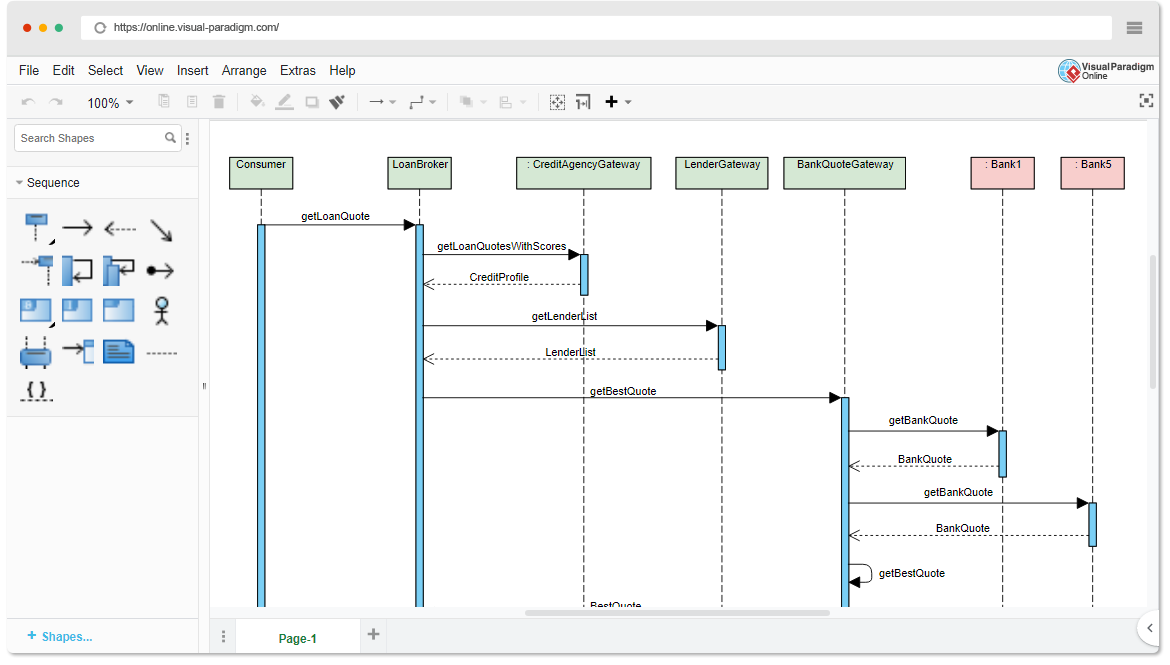
現代のソフトウェア開発において、ユースケース駆動設計は効果的なシステムモデリングの基盤です。実際のシナリオを通じて、ユーザーの目的システムの振る舞いを捉えることに注力しています。このアプローチの中心には、UMLシーケンス図—ユースケースを実際の動きとして可視化する強力な視覚的ツールで、オブジェクトが時間とともにどのように相互作用するかを示します.

Online Sequence Diagram Tool

この包括的なガイドは、初心者およびチームが次を理解したい場合に設計されています:

  • シーケンス図とは何か、なぜ重要なのか

  • どのようにユースケース駆動アプローチを使って作成するかユースケース駆動アプローチ

  • 重要な概念と実際の例

  • どのようにVisual ParadigmのAIシーケンス図生成ツールが全体のプロセスを加速する——モデリングをより速く、よりスマートで、より協働的に行えるようにします。


🎯 ユースケース駆動アプローチとは何か?

あるユースケース駆動アプローチはシステム設計をユーザーの目的を中心に据えます。各ユースケースは、ユーザー(アクター)とシステムとの間で、意味のある成果を得るために行われる特定の相互作用を記述します。

例:
「顧客として、注文履歴を確認できるように、アカウントにログインしたい。」

ユースケースは単なる文書化ではなく、機能のための設計図、そしてシーケンス図は、そのユースケースがリアルタイムでどのように展開されるかを可視化する理想的な方法です。


🧩 ユースケース駆動開発においてシーケンス図を使う理由は?

シーケンス図はユースケースモデリングを支援するのに特に適しており、それは以下の通りです:

✅ 動的なフローを示す相互作用の
✅ メッセージのタイミングと順序を強調するメッセージの
✅ オブジェクト間の責任を明確にするオブジェクト間の
✅ エッジケースを明らかにする(例:無効な入力、タイムアウトなど)
✅ 設計およびテスト段階でのユースケースの検証を支援するユースケースの検証を設計およびテスト段階で
✅ 開発者、テスト担当者、ステークホルダー間のコミュニケーションを改善する開発者、テスト担当者、ステークホルダー間の

🔍 シーケンス図がなければ、ユースケースは抽象的なままになる可能性がある。それらがあることで、実行可能な設計図となる。実行可能な設計図.


📌 UMLシーケンス図のキーパラメータ(初心者向け)

ユースケースに飛び込む前に、基本的な構成要素を習得しましょう:

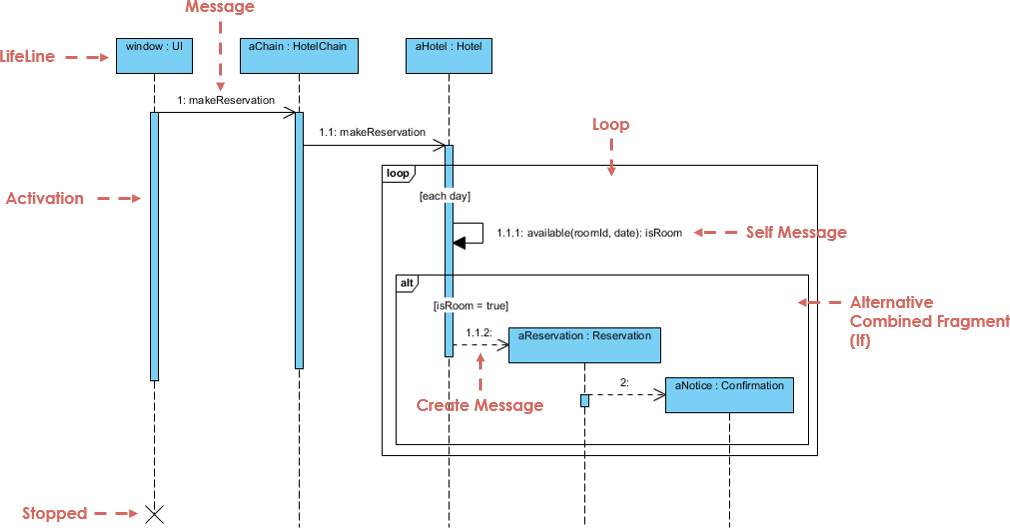
Sequence Diagram Example

要素 説明 視覚
ライフライン 縦方向の破線で、オブジェクトまたはアクターを表す。時間の経過に伴う存在を示す。 ───────────────
メッセージ ライフラインの間の水平矢印。通信を示す。
  • 同期 実線の矢印で先端が塗りつぶされている。呼び出し元は応答を待つ。
  • 非同期 実線の矢印で先端が空洞。待たない。
  • 返信 破線の矢印(応答)。
  • 自己メッセージ 同じライフラインに戻る矢印(内部処理)。
活性バー ライフライン上の細い長方形で、オブジェクトがアクティブなタイミングを示す。 ▯▯▯
結合断片 制御論理を表すボックス:
  • alt 選択肢(if/else) alt: 成功 / 失敗
  • オプション オプション(発生する場合もあれば、発生しない場合もある) opt: 証明書を印刷
  • ループ 繰り返し(例:whileループ) loop: 3回再試行
  • 並列 並列実行 par: 支払いと在庫を確認
作成/削除 作成ライフラインの終端にあるメッセージまたは「X」 create: ユーザーまたはX

💡 ヒント:常に から始めましょうユースケース、次に それをシーケンス図にマッピングする.


🔄 ユースケースからシーケンス図を作成する方法(ステップバイステップ)

実際に、 を使って現実世界の例を確認しましょうユースケース駆動型アプローチ.

Free AI Sequence Diagram Refinement Tool - Visual Paradigm AI


📌 例:ユースケース – 「ユーザーがシステムにログインする」

ユースケースのテキスト:

ユーザーとして、自分のプロフィールにアクセスできるように、ユーザー名とパスワードを使ってアカウントにログインしたい。

ステップ1:アクターとオブジェクトの特定

  • アクターユーザー

  • オブジェクトログインビューログインコントローラデータベース

ステップ2:メインフローの定義

  1. ユーザー → ログインビュー: ユーザー名/パスワードを入力

  2. ログインビュー → ログインコントローラ: 認証情報を送信

  3. ログインコントローラ → データベース: ユーザーが存在するか確認

  4. データベース → ログインコントローラ: 結果を返却

  5. ログインコントローラ → LoginView: 成功/失敗を送信

  6. LoginView → ユーザー: メッセージを表示

ステップ3:結合された断片を使用して制御論理を追加

次のものを使用する:alt断片を表示するために:

  • 成功パス: 「ログイン成功」

  • 失敗パス: 「無効な資格情報」

✅ これは使用ケース内の意思決定ポイントを捉えています。

ステップ4:アクティベーションバーを追加

  • 次のものにアクティベーションバーを追加:LoginControllerおよびDatabase処理時間の表示

ステップ5:最終図

これで完全な、使用ケースに合わせたシーケンス図が完成しました。これは実際のシステム動作を反映しています。

🔗 実際の動作を見る:AI駆動のUMLシーケンス図


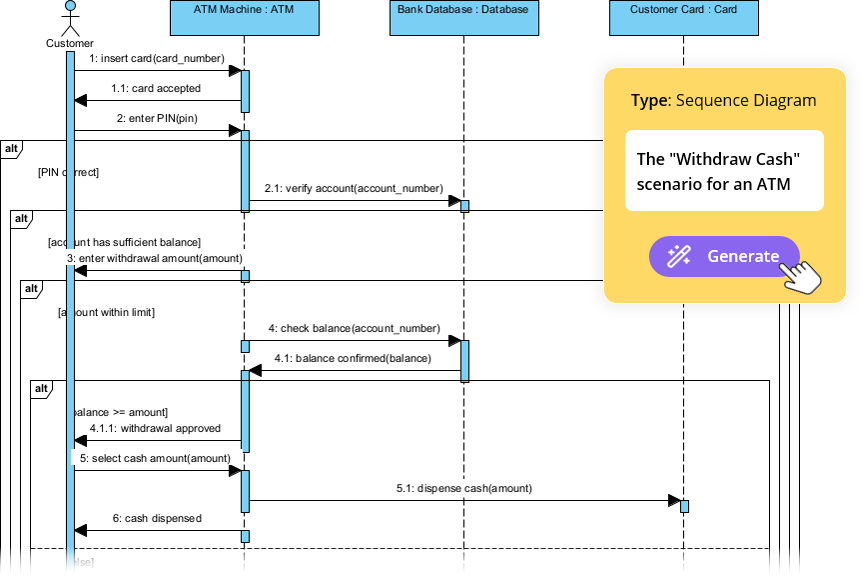
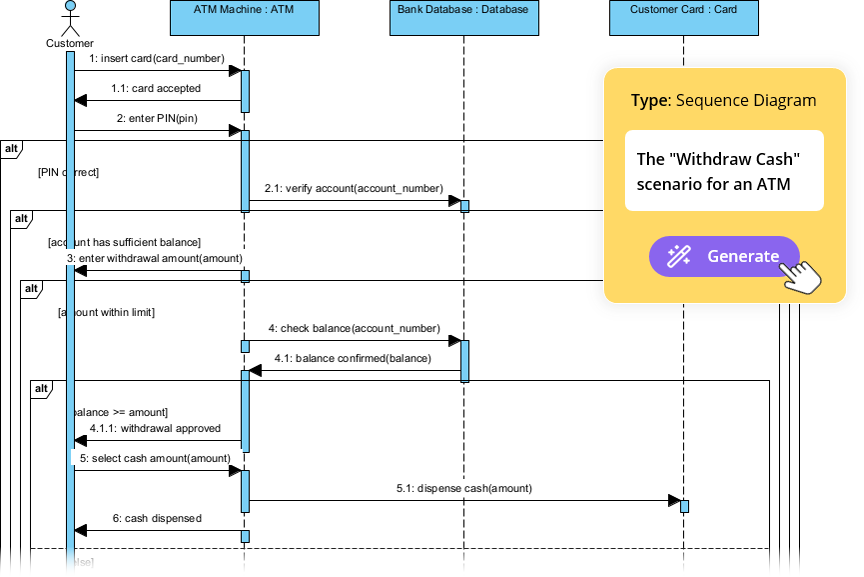
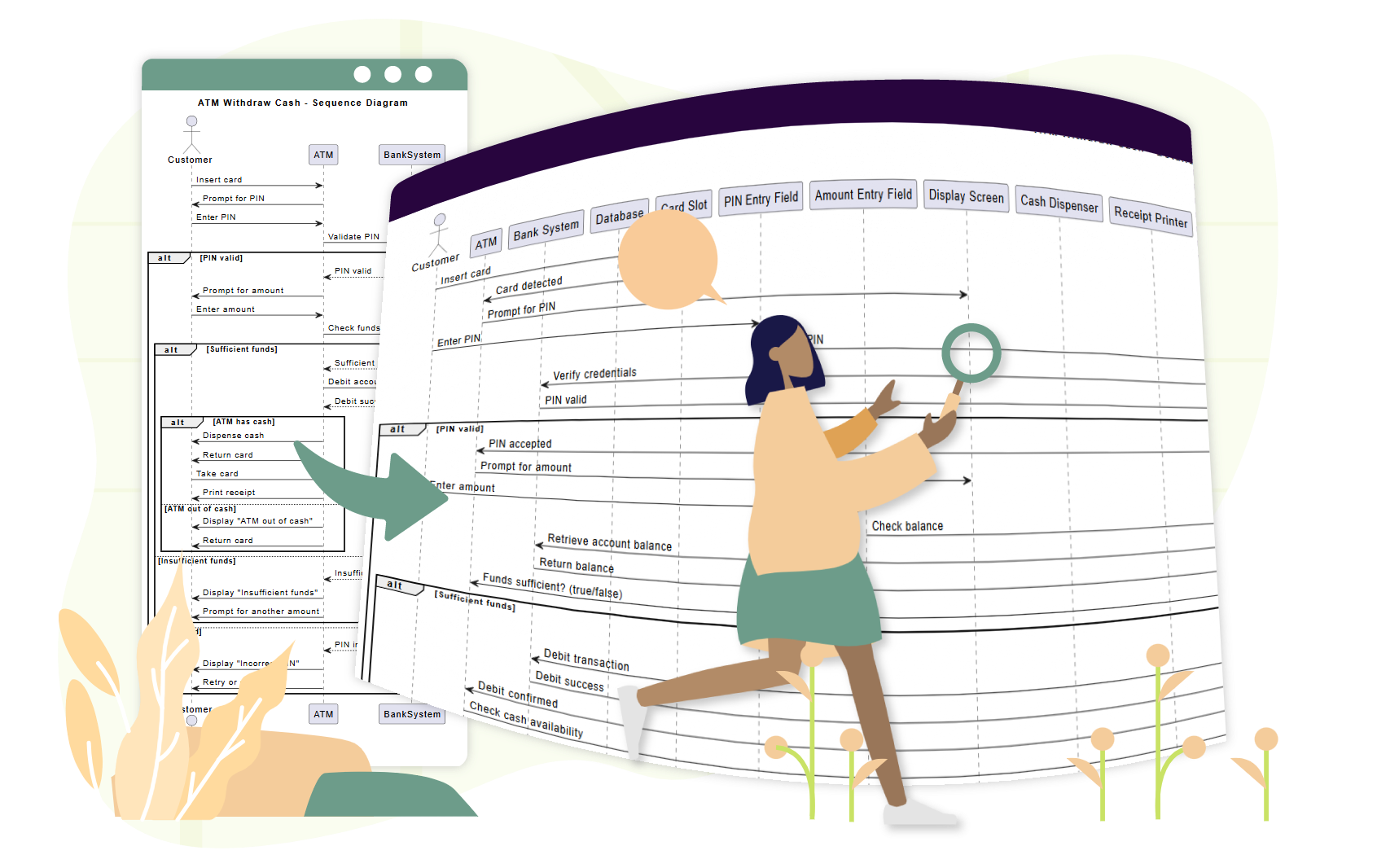
📌 例2:ユースケース – 「顧客がATMから現金を引き出す」

ユースケースの説明:

顧客として、自分のお金を引き出せるようにATMから現金を引き出したい。残高が不足している場合は、通知を受けたい。

ステップ1:参加者を特定する

  • アクター顧客

  • オブジェクトATMカードリーダー銀行サーバー現金出金装置

ステップ2:メインフロー

  1. 顧客 → ATM: カードを挿入

  2. ATM → カードリーダー: カードを読み取り

  3. ATM → 顧客: PINの入力を促す

  4. 顧客 → ATM: PINを入力

  5. ATM → 銀行サーバー: PINを検証

  6. 銀行サーバー → ATM: 有効であることを確認

  7. ATM → 顧客: 金額の入力を促す

  8. 顧客 → ATM: 金額を入力

  9. ATM → 銀行サーバー: 残高を確認

  10. 銀行サーバー → ATM: 残高を返す

  11. ATM → 現金自動出金機: 現金を出金する

  12. ATM → 顧客: 明細書の選択肢を表示する

ステップ3:断片を追加する

  • ループ: 間違ったPIN後の再試行用

  • オプション: 明細書印刷用

  • 代替: 「残高不足」対「成功」用

🔗 AIがこれをどう処理するかを見る:AIシーケンス図ツールで複雑なワークフローを簡素化する


📌 例3:ユースケース – 「顧客がEC購入を完了する」

ユースケースの本文:

顧客として、買い物かごに商品を追加し、チェックアウトを進め、支払いを完了して注文を受け取りたい。

ステップ1:参加者

  • 顧客ショッピングカート決済ゲートウェイ在庫管理システム注文確認

ステップ2:並列処理を含むフロー

  1. 顧客 → ショッピングカート: 商品を追加 →ループ複数の商品用

  2. ショッピングカート → 顧客: 合計を表示

  3. 顧客 → 決済ゲートウェイ: 支払いを開始

  4. 顧客 → 在庫システム: 在庫確認を要求

  5. 決済ゲートウェイ → 銀行: 支払いを処理 →パラ在庫確認付き

  6. 在庫システム → 決済ゲートウェイ: 在庫の可用性を確認

  7. 決済ゲートウェイ → ショッピングカート: 注文を確認

  8. ショッピングカート → 注文確認: 確認を送信

✅ 使用するpar フラグメント 並行処理を示すために

🔗 完全なチュートリアルを見る:AIチャットボットでシーケンス図をマスターする:ECケーススタディ


🤖 Visual ParadigmのAIシーケンス図ジェネレータがチームをどう支援するか

従来のモデリングツールは、ユーザーがライフラインを手動でドラッグし、メッセージを描画し、フラグメントを配置する必要がある—時間のかかる上にミスも起こりやすい。

AI Diagram Generation Guide: Instantly Create System Models with Visual Paradigm's AI - Visual Paradigm Guides

Visual ParadigmのAI駆動のツール これらのボトルネックを解消し、特にユースケース駆動アプローチ.

✨ 1. AIチャットボット:ユースケーステキストから数秒で図を生成

手で描く代わりに、ユースケースを平易な英語で記述する:

📝 プロンプト:
「ユーザーがユーザー名/パスワードでログインするためのシーケンス図を生成し、エラー処理と3回の失敗後の再試行を含める。」

AIの処理:

  • アクターとオブジェクトを特定

  • ユースケースのフローをライフラインとメッセージにマッピング

  • 適用するaltloop、およびoptフラグメントを自動で追加

  • クリーンでプロフェッショナルな図を出力10秒未満で

🔗 今すぐ試してみる:AI駆動のUMLシーケンス図


✨ 2. AIシーケンス図の最適化ツール:ドラフトをプロフェッショナルなモデルに変換

粗いスケッチから始めても、AIシーケンス図の最適化ツールがそれを向上させます:

  • 追加します:アクティビティバー必要な場所に

  • 提案します:正しいフラグメントの使用法 (altlooppar)

  • 強制します:デザインパターン(例:MVC:View → Controller → Model)

  • 欠落しているエラーパスやエッジケースを検出

  • 可読性と一貫性を向上

🔗 方法を学ぶ:包括的なチュートリアル:AIシーケンス図の精緻化ツールの使い方


✨ 3. Use Case記述から図へ:手動翻訳ゼロ

手作業でUse Caseのテキストを図に変換する必要はもうありません。

AIテキスト形式のUse Caseを正確なシーケンス図に自動変換、以下を削減:

  • 手作業の負担

  • 誤解

  • 不整合

🔗 実際の動作を見る:Use Case記述からAI駆動のシーケンス図の精緻化


✨ 4. 会話型AIによる反復的精緻化

図を改善したいですか?AIとチャットするだけです:

  • 「3回のログイン失敗後に『パスワードを忘れた場合』のオプションを追加。」

  • 「『User』を『Customer』に変更。」

  • 「エラーメッセージを赤色で表示。」

各プロンプトで図がリアルタイムで更新されます—再描画もストレスもありません。

🔗 インターフェースを探索:AIシーケンス図精緻化ツールのインターフェース


✨ 5. チーム協働を簡単に

  • 非技術系のステークホルダー(プロダクトマネージャー、クライアント)は自然言語で貢献できます。

  • 開発者はスプリント中に図を迅速に精緻化できます。

  • テスト担当者図を用いてテストケースを記述できます。

  • デザイナーコーディング前にフローを検証できます。

✅ 理想的な用途:アジャイルチームユーザーストーリーとユースケースを使用して。


🚀 チームがVisual ParadigmのAIによるユースケースモデリングを愛する理由

利点 影響
⏱️ スピード 数秒で図を生成可能。数時間かかるのではなく。
🧠 低いスキル障壁 開始にはUMLの専門知識は不要
🔄 反復的設計 チャットを通じてリアルタイムで図を改善
🛠️ エラー削減 AIが欠落しているフロー、無効な断片を検出
📦 エクスポートと共有 PNG、SVG、PDFにエクスポート、またはConfluence/Notionに埋め込み可能
🤝 協働 誰もが貢献でき、技術的な知識のないメンバーも含む

📚 初心者およびチーム向けのトップリソース

リソース URL
AI駆動のUMLシーケンス図 https://blog.visual-paradigm.com/generate-uml-sequence-diagrams-instantly-with-ai/
AI駆動のシーケンス図の最適化ツール https://www.visual-paradigm.com/features/ai-sequence-diagram-refinement-tool/
包括的なチュートリアル:AIシーケンス図最適化ツールの使い方 https://www.archimetric.com/comprehensive-tutorial-using-the-ai-sequence-diagram-refinement-tool/
ユースケース記述からのAI駆動のシーケンス図の最適化 https://www.cybermedian.com/refining-sequence-diagrams-from-use-case-descriptions-using-visual-paradigms-ai-sequence-diagram-refinement-tool/
AIシーケンス図ツールで複雑なワークフローを簡素化 https://www.cybermedian.com/🚀-simplify-complex-workflows-with-visual-paradigm-ai-sequence-diagram-tool/
AIシーケンス図最適化ツールのインターフェース https://ai.visual-paradigm.com/tool/sequence-diagram-refinement-tool/
初心者向けチュートリアル:数分でプロフェッショナルなシーケンス図を作成 https://www.anifuzion.com/beginners-tutorial-create-your-first-professional-sequence-diagram-in-minutes-using-visual-paradigm-ai-chatbot/
シンプルから洗練へ:AI駆動のモデリングの進化 https://guides.visual-paradigm.com/from-simple-to-sophisticated-what-is-the-ai-powered-sequence-diagram-refinement-tool/
AIチャットボットでシーケンス図をマスター:eコマースの事例研究 https://www.archimetric.com/mastering-sequence-diagrams-with-visual-paradigm-ai-chatbot-a-beginners-tutorial-with-a-real-world-e-commerce-case-study/
AIシーケンス図の例:動画ストリーミング再生の開始 https://chat.visual-paradigm.com/ai-diagram-example/ai-sequence-diagram-video-streaming-playback/

✅ ユースケース駆動設計を採用するチームへの最終アドバイス

  1. 明確なユースケースから始めましょう – まずユーザーの目的を定義してください。

  2. シーケンス図を使って検証しましょう コード化する前にフローを確認します。

  3. ステークホルダーを早期に参加させましょう – 図を使ってフィードバックを収集しましょう。

  4. AIを活用して手作業を減らしましょう – ツールに重い作業を任せましょう。

  5. 図を最新の状態に保ちましょう – 要件が変化するたびに見直しを行いましょう。


🎁 無料で始める

AI駆動のモデリングの力を体験するには有料ライセンスは必要ありません。


📌 結論

ユースケース駆動型のアプローチ はユーザー中心のソフトウェア設計の基盤です。 UMLシーケンス図 それらのユースケースを具現化します—誰がいつ何をどのように行うかを示します 誰がいつ何をどのように行うか.

With Visual ParadigmのAIシーケンス図生成ツール、チームは次のようにできます:

  • 自然言語から図を生成する

  • リアルタイムで改善する

  • 一貫性と正確性を確保する

  • 役割を超えて協働する

🚀 ユースケースから図まで数秒で—UMLの専門知識は不要です。

👉 今日から始めましょう 以下の 無料のコミュニティエディション そしてチームのモデリングワークフローを変革しましょう。


🌟 システム設計の未来は視覚的であるだけでなく、知能的でもあります。
AIをあなたのモデリングパートナーとしてください。

Beyond the Sketch: Why Casual AI Fails at Professional Visual Modeling (and How Visual Paradigm Fixes It)

The Era of AI in Software Architecture

In the rapidly evolving landscape of software engineering and enterprise architecture, the ability to transform abstract requirements into precise, actionable designs is a critical skill. General-purpose Large Language Models (LLMs) like ChatGPT and Claude have revolutionized how we brainstorm and generate text. However, when it comes to professional visual modeling, these tools often fall short. They produce what can best be described as “sketches”—rough approximations that lack the rigor of engineered blueprints.


This comprehensive guide explores the significant gap between casual AI diagramming and professional needs, and how the Visual Paradigm (VP) AI ecosystem bridges this divide by delivering standards-aware, persistent, and iterative diagramming capabilities.

1. The “Sketch Artist” Problem: Limitations of Casual AI LLMs

Casual AI tools treat diagramming primarily as an extension of text generation. When prompted to create a diagram, they typically output code in formats like Mermaid or PlantUML. While impressive for quick visualizations, this approach lacks the depth required for professional engineering contexts.

No Native Rendering or Editing Engine

LLMs generate text-based syntax (e.g., Mermaid flowchart code) but offer no built-in viewer or editor for high-quality vector graphics (SVG). Users are forced to paste code into external renderers, instantly losing interactivity. If a change is needed, the user must request a full regeneration of the code, often resulting in a completely different layout.

Semantic Inaccuracies and Standard Violations

Generic models frequently misinterpret strict modeling standards like UML or ArchiMate. Common errors include:

  • Confusing aggregation (shared ownership) with composition (exclusive ownership).
  • Drawing invalid inheritance arrows or relationship directions.
  • Creating bidirectional associations where unidirectional ones are technically correct.

While the results may look aesthetically pleasing, they fail as engineering artifacts because they do not adhere to the semantic rules that govern system architecture.

Lack of Persistent State

Perhaps the most frustrating limitation is the lack of memory regarding visual structure. Each prompt regenerates the diagram from scratch. For example, asking an LLM to “add error handling to this sequence diagram” often breaks the existing layout, disconnects connectors, or forgets prior elements entirely. There is no persistent state to track the evolution of the model.

2. Real-World Risks of Relying on Casual AI Diagramming

Using general LLMs for serious architectural work introduces risks that can undermine project quality and timeline.

The Design-Implementation Gap

Vague or semantically incorrect visuals lead to misaligned code. Development teams waste valuable time in meetings trying to clarify the intent behind a diagram that lacks precision. A “pretty picture” that is technically wrong is worse than no diagram at all.

Syntax Dependency

Ironically, using “AI-assisted” tools like ChatGPT for diagrams often requires the user to learn specialized syntax (Mermaid/PlantUML) to manually fix errors. This creates an expertise barrier that negates the efficiency gains of using AI.

Workflow Isolation

Diagrams generated by LLMs are static images or code snippets. They are disconnected from version control, collaboration platforms, and downstream tasks like code generation or database schema creation. They exist in a silo, unable to evolve with the project.

3. How Visual Paradigm AI Delivers Professional-Grade Modeling

Visual Paradigm has transformed diagramming into a conversational, standards-driven, and integrated process. Unlike text-based LLMs, VP AI understands the underlying meta-models of UML 2.5,ArchiMate3, C4, BPMN, and SysML, producing compliant and editable models.

Persistent Structure with “Diagram Touch-Up” Technology

Visual Paradigm maintains diagrams as living objects rather than disposable scripts. Users can issue natural language commands to update specific parts of a diagram without triggering a full regeneration.

For example, a user can command: “Add a two-factor authentication step after login” or “Rename the Customer actor to User.” The system instantly adjusts the layout, connectors, and semantics while preserving the integrity of the rest of the model. This eliminates the broken links and layout chaos common in casual tools.

Standards-Compliant Intelligence

Trained on formal notations, VP AI actively enforces rules, ensuring:

  • Correct multiplicity in associations.
  • Proper use of stereotypes.
  • Valid ArchiMate viewpoints (e.g., Capability Maps, Technology Usage).

This results in technically sound blueprints that can be trusted by developers and architects alike.

4. Bridging Requirements to Design: Advanced AI Workflows

Visual Paradigm goes beyond simple generation by providing structured applications that guide users from abstract ideas to concrete designs.

AI-Powered Textual Analysis

This feature analyzes unstructured text—such as requirements documents or user stories—to extract candidate classes, attributes, operations, and relationships. It can generate an initial class diagram automatically based on the analysis.
AI Diagram Generator | Visual Paradigm

Example Scenario: Input a description like “An e-commerce platform allows customers to browse products, add to cart, checkout with payment gateway, and track orders.” The AI identifies classes (Customer, Product, Cart, Order, PaymentGateway), attributes (price, quantity), and associations (Customer places Order).

The 10-Step AI Wizard

For complex diagrams like UML Class models, VP offers a guided wizard. This tool leads users through a logical progression: Define Purpose → Scope → Classes → Attributes → Relationships → Operations → Review → Generate. This human-in-the-loop approach validates the design at every step, preventing the “one-shot” errors common in prompt-based generation.

5. Comparison: Casual LLMs vs. Visual Paradigm AI

Feature Casual LLMs (ChatGPT, Claude) Visual Paradigm AI
Output Format Text-based code (Mermaid, PlantUML) Editable Native Models & Vector Graphics
State & Persistence None (Regenerates from scratch) Persistent (Supports incremental updates)
Standards Compliance Low (Hallucinates syntax/rules) High (Enforces UML/BPMN/ArchiMate rules)
Editability Requires manual code edits Conversational UI & Drag-and-Drop
Integration Isolated Snippets Full Lifecycle (Code Gen, DB Schema, Teamwork)

Conclusion: From Manual Chiseling to Intelligent Engineering

Traditional diagramming often feels like chiseling marble—slow, error-prone, and irreversible. Casual AI LLMs improved the speed of sketching but remain limited by their inability to produce consistent, persistent, and engineered visuals.

Visual Paradigm AI acts like a high-precision 3D printer for software architecture. It allows users to input plain English specifications and receive standards-compliant, editable structures. It supports conversational iteration and drives implementation directly through code generation and database integration.

AI Diagram Generation Guide: Instantly Create System Models with Visual  Paradigm's AI - Visual Paradigm Guides

For software architects, enterprise teams, and developers tired of regenerating broken Mermaid snippets, Visual Paradigm represents the next evolution: intelligent modeling that respects standards, preserves intent, and accelerates delivery.

Transforming Process Optimization: A Comprehensive Guide to AI Value Stream Mapping

Introduction to Modern Process Mapping

Value Stream Mapping(VSM) has long been recognized as a cornerstone of Lean methodology. It provides organizations with essential visual insights into process efficiency, material flows, and information exchanges. However, the traditional approach to creating and analyzing these maps has historically been a manual, labor-intensive effort involving whiteboards, sticky notes, and static drawing software. This manual process often creates a barrier to entry, preventing teams from rapidly iterating on their workflow improvements.

The landscape of process optimization is shifting with the introduction of AI-powered tools. Specifically, the emergence of theAI Value Stream Mapping Editorrepresents a significant leap forward. This technology allows practitioners to generate complete, data-rich Value Stream Maps simply by describing a process in natural language. By transitioning from manual drafting to intelligent automation, businesses can move from raw ideas to actionable insights in minutes rather than hours.

What is AI-Powered Value Stream Mapping?

The AI Value Stream Mapping (VSM) Editor is not merely a drawing tool; it is a sophisticated, intelligent platform designed to visualize, analyze, and optimize workflows. At its core, it utilizes natural language processing (NLP) to transform simple text descriptions of processes into full-fledged, editable diagrams. This capability democratizes access to Lean tools, allowing users with varying levels of technical expertise to create professional-grade maps.

Beyond visualization, these tools incorporate diagramming engines that allow for granular refinement. Users can adjust process steps, edit data points, and rearrange flows using intuitive drag-and-drop interfaces. The integration of an AI analyst further elevates the tool, acting as a virtual consultant that examines VSM data to generate insightful reports, uncover bottlenecks, and suggest strategic improvements automatically.

Key Features of the AI VSM Editor

To truly revolutionize process optimization, modern VSM tools combine automation with deep analytical capabilities. Below are the critical features that define this technology:

1. Text-to-Diagram Generation

The most immediate benefit of AI VSM tools is the ability to generate a map from plain English. Users describe their workflow—detailing the sequence of operations, inventory points, and information flows—and the VSM generator instantly creates a detailed diagram. This eliminates the “blank canvas” paralysis and provides an immediate structure to work with.

2. Automated Timeline and Metric Calculation

Manual calculation of Lean metrics is prone to human error. AI-driven editors automate this entirely. As users modify the map, the tool automatically calculates critical metrics in real-time, including:

  • Total Lead Time: The total time it takes for a process to be completed from start to finish.
  • Value-Added Time (VAT): The portion of time spent on activities that actually add value to the customer.
  • Process Efficiency Percentage: A derived metric indicating how streamlined the workflow is.

3. AI-Powered Analysis and Reporting

Perhaps the most transformative feature is the built-in AI consultant. Users can request an analysis of their current state map. The AI reviews the data structure, timelines, and flow to generate a professional report. This report highlights key findings, identifies performance metrics, and offers strategic recommendations to eliminate waste and improve throughput.

4. High-Fidelity Export Options

For a VSM to be effective, it must be communicable. The tool facilitates the export of finished maps as high-resolution PNG images. This ensures that findings can be easily integrated into management reports, stakeholder presentations, or team discussions without loss of visual quality.

Target Audience and Use Cases

AI-powered process mapping is versatile, catering to a wide array of professionals involved in organizational efficiency. The table below outlines who benefits most and how:

Role Primary Benefit
Operations Managers Identify and eliminate waste (Muda) in production lines to reduce costs and improve speed.
Process Improvement Consultants Rapidly create and analyze VSMs for clients, delivering value faster during engagements.
Software Development Teams Apply Lean principles to DevOps and Agile workflows to streamline CI/CD pipelines.
Business Analysts Map complex customer journeys and internal business processes to enhance user experience.

From Visualization to Actionable Insight

The ultimate goal of Value Stream Mapping is not the map itself, but the optimization it enables. By leveraging AI, organizations can stop spending time drawing and start spending time analyzing. The automated insights provided by these tools allow teams to focus on high-level strategy rather than low-level formatting.

Whether the goal is to reduce cycle time in a manufacturing plant or streamline a customer service ticket system, AI Value Stream Mapping provides the clarity required to make data-driven decisions. It bridges the gap between the current state and the future state, ensuring that process improvement is continuous, accurate, and efficient.

Automating Database Normalization: A Step-by-Step Guide Using Visual Paradigm AI DB Modeler

Introduction to AI-Driven Normalization

Database normalization is the critical process of organizing data to ensure integrity and eliminate redundancy. While traditionally a complex and error-prone task, modern tools have evolved to automate this “heavy lifting.” The Visual Paradigm AI DB Modeler acts as an intelligent bridge, transforming abstract concepts into technically optimized, production-ready implementations.
Desktop AI Assistant

To understand the value of this tool, consider the analogy of manufacturing a car. If a Class Diagram is the initial sketch and an Entity Relationship Diagram (ERD) is the mechanical blueprint, then normalization is the process of tuning the engine to ensure there are no loose bolts or unnecessary weight. The AI DB Modeler serves as the “automated factory” that executes this tuning for maximum efficiency. This tutorial guides you through the process of using the AI DB Modeler to normalize your database schema effectively.

Doc Composer

Step 1: Accessing the Guided Workflow

The AI DB Modeler operates using a specialized 7-step guided workflow. Normalization takes center stage at Step 5. Before reaching this stage, the tool allows you to input high-level conceptual classes. From there, it uses intelligent algorithms to prepare the structure for optimization, allowing users to move from concepts to tables without manual effort.

Step 2: Progressing Through Normal Forms

Once you reach the normalization phase, the AI iteratively optimizes the database schema through three primary stages of architectural maturity. This stepwise progression ensures that your database meets industry standards for reliability.

Achieving First Normal Form (1NF)

The first level of optimization focuses on the atomic nature of your data. The AI analyzes your schema to ensure that:

  • Each table cell contains a single, atomic value.
  • Every record within the table is unique.

Advancing to Second Normal Form (2NF)

Building upon the structure of 1NF, the AI performs further analysis to establish strong relationships between keys and attributes. In this step, the tool ensures that all non-key attributes are fully functional and dependent on the primary key, effectively removing partial dependencies.

Finalizing with Third Normal Form (3NF)

To reach the standard level of professional optimization, the AI advances the schema to 3NF. This involves ensuring that all attributes are dependent only on the primary key. By doing so, the tool removes transitive dependencies, which are a common source of data anomalies.

Step 3: Reviewing Automated Error Detection

Throughout the normalization process, the AI DB Modeler employs intelligent algorithms to detect design flaws that often plague poorly designed systems. It specifically looks for anomalies that could lead to:

  • Update errors
  • Insertion errors
  • Deletion errors

By automating this detection, the tool eliminates the manual burden of hunting for potential integrity issues, ensuring a robust foundation for your applications.

Step 4: Understanding the Architectural Changes

One of the distinct features of the AI DB Modeler is its transparency. Unlike traditional tools that simply reorganize tables in the background, this tool functions as an educational resource.

For every change made during the 1NF, 2NF, and 3NF steps, the AI provides educational rationales and explanations. These insights help users understand the specific architectural shifts required to reduce redundancy, serving as a valuable learning tool for mastering best practices in database design.

Step 5: Validating via the Interactive Playground

After the AI has optimized the schema to 3NF, the workflow moves to Step 6, where you can verify the design before actual deployment. The tool offers a unique interactive playground for final validation.

Feature Description
Live Testing Users can launch an in-browser database instance based on their chosen normalization level (Initial, 1NF, 2NF, or 3NF).
Realistic Data Seeding The environment is populated with realistic, AI-generated sample data, including INSERT statements and DML scripts.

This environment allows you to test queries and verify performance against the normalized structure immediately. By interacting with seeded data, you can confirm that the schema handles information correctly and efficiently, ensuring the “engine” is tuned perfectly before the car hits the road.

Comprehensive Guide to ERD Levels: Conceptual, Logical, and Physical Models

The Importance of Architectural Maturity in Database Design

Entity Relationship Diagrams (ERDs) serves as the backbone of effective system architecture. They are not static illustrations but are developed at three distinct stages of architectural maturity. Each stage serves a unique purpose within the database design lifecycle, catering to specific audiences ranging from stakeholders to database administrators. While all three levels involve entities, attributes, and relationships, the depth of detail and the technical specificity vary significantly between them.

To truly understand the progression of these models, it is helpful to use a construction analogy. Think of building a house: a Conceptual ERD is the architect’s initial sketch showing the general location of rooms like the kitchen and living room. The Logical ERD is the detailed floor plan specifying dimensions and furniture placement, though it does not yet dictate the materials. Finally, the Physical ERD acts as the engineering blueprint, specifying the exact plumbing, electrical wiring, and the specific brand of concrete for the foundation.

Engineering Interface

1. Conceptual ERD: The Business View

The Conceptual ERD represents the highest level of abstraction. It provides a strategic view of the business objects and their relationships, devoid of technical clutter.

Purpose and Focus

This model is primarily utilized for requirements gathering and visualizing the overall system architecture. Its main goal is to facilitate communication between technical teams and non-technical stakeholders. It focuses on defining what entities exist—such as “Student,” “Product,” or “Order”—rather than how these entities will be implemented in a database table.

Level of Detail

Conceptual models typically lack technical constraints. For example, many-to-many relationships are often depicted simply as relationships without the complexity of cardinality or join tables. Uniquely, this level may utilize generalization, such as defining “Triangle” as a sub-type of “Shape,” a concept that is abstracted away in later physical implementations.

2. Logical ERD: The Detailed View

Moving down the maturity scale, the Logical ERD serves as an enriched version of the conceptual model, bridging the gap between abstract business needs and concrete technical implementation.

Purpose and Focus

The logical model transforms high-level requirements into operational and transactional entities. While it defines explicit columns for each entity, it remains strictly independent of a specific Database Management System (DBMS). It does not matter at this stage whether the final database will be in Oracle, MySQL, or SQL Server.

Level of Detail

Unlike the conceptual model, the logical ERD includes attributes for every entity. However, it stops short of specifying technical minutiae like data types (e.g., integer vs. float) or specific field lengths.

3. Physical ERD: The Technical Blueprint

The Physical ERD represents the final, actionable technical design of a relational database. It is the schema that will be deployed.

Purpose and Focus

This model serves as the blueprint for creating the database schema within a specific DBMS. It elaborates on the logical model by assigning specific data types, lengths, and constraints (such as varchar(255), int, or nullable).

Level of Detail

The physical ERD is highly detailed. It defines precise Primary Keys (PK) and Foreign Keys (FK) to strictly enforce relationships. Furthermore, it must account for the specific naming conventions, reserved words, and limitations of the target DBMS.

Comparative Analysis of ERD Models

To summarize the distinctions between these architectural levels, the following table outlines the features typically supported across the different models:

Feature Conceptual Logical Physical
Entity Names Yes Yes Yes
Relationships Yes Yes Yes
Columns/Attributes Optional/No Yes Yes
Data Types No Optional Yes
Primary Keys No Yes Yes
Foreign Keys No Yes Yes

Streamlining Design with Visual Paradigm and AI

Creating these models manually and ensuring they remain consistent can be labor-intensive. Modern tools like Visual Paradigm leverage automation and Artificial Intelligence to streamline the transition between these levels of maturity.

ERD modeler

Model Transformation and Traceability

Visual Paradigm features a Model Transitor, a tool designed to derive a logical model directly from a conceptual one, and subsequently, a physical model from the logical one. This process maintains automatic traceability, ensuring that changes in the business view are accurately reflected in the technical blueprint.

AI-Powered Generation

Advanced features include AI capabilities that can instantly produce professional ERDs from textual descriptions. The AI automatically infers entities and foreign key constraints, significantly reducing manual setup time.

Desktop AI Assistant

Bi-directional Synchronization

Crucially, the platform supports bi-directional transformation. This ensures that the visual design and the physical implementation stay in sync, preventing the common issue of documentation drifting away from the actual codebase.

Mastering Database Validation with the Interactive SQL Playground

Understanding the Interactive SQL Playground

The Interactive SQL Playground (often called the Live SQL Playground) acts as a critical validation and testing environment within the modern database design lifecycle. It bridges the gap between a conceptual visual model and a fully functional, production-ready database. By allowing users to experiment with their schema in real-time, it ensures that design choices are robust before any code is deployed.

DBModeler AI showing domain class diagram

Think of the Interactive SQL Playground as a virtual flight simulator for pilots. Instead of taking a brand-new, untested airplane (your database schema) directly into the sky (production), you test it in a safe, simulated environment. You can add simulated passengers (AI-generated sample data) and try out various maneuvers (SQL queries) to see how the plane handles the weight and stress before you ever leave the ground.

Key Concepts

To fully utilize the playground, it is essential to understand the foundational concepts that drive its functionality:

  • Schema Validation: The process of verifying the structural integrity and robustness of a database design. This involves ensuring that tables, columns, and relationships function as intended under realistic conditions.
  • DDL (Data Definition Language): SQL commands used to define the database structure, such as CREATE TABLE or ALTER TABLE. The playground uses these to build your schema instantly.
  • DML (Data Manipulation Language): SQL commands used for managing data within the schema, such as SELECT, INSERT, UPDATE, and DELETE. These are used in the playground to test data retrieval and modification.
  • Architectural Debt: The implied cost of future reworking required when a database is designed poorly in the beginning. Identifying flaws in the playground significantly reduces this debt.
  • Normalization Stages (1NF, 2NF, 3NF): The process of organizing data to reduce redundancy. The playground allows you to test different versions of your schema to observe performance implications.

Guidelines: Step-by-Step Validation Tutorial

The Interactive SQL Playground is designed to be Step 6 of a comprehensive 7-step DB Modeler AI workflow, serving as the final quality check. Follow these steps to validate your database effectively.

Step 1: Access the Zero-Setup Environment

Unlike traditional database management systems that require complex local installations, the playground is accessible entirely in-browser. Simply navigate to the playground interface immediately after generating your schema. Because there is no software installation required, you can begin testing instantly.

Step 2: Select Your Schema Version

Before running queries, decide which version of your database schema you wish to test. The playground allows you to launch instances based on different normalization stages:

  • Initial Design: Test your raw, unoptimized concepts.
  • Optimized Versions: Select between 1NF, 2NF, or 3NF versions to compare how strict normalization affects query complexity and performance.

Step 3: Seed with AI-Powered Data

A comprehensive test requires data. Use the built-in AI-Powered Data Simulation to populate your empty tables.

  1. Locate the “Add Records” or “Generate Data” feature within the playground interface.
  2. Specify a batch size (e.g., “Add 10 records”).
  3. Execute the command. The AI will automatically generate realistic, AI-generated sample data relevant to your specific tables (e.g., creating customer names for a “Customers” table rather than random strings).

Step 4: Execute DDL and DML Queries

With a populated database, you can now verify the schema’s behavior.

  • Run Structural Tests: Check if your data types are correct and if the table structures accommodate the data as expected.
  • Run Logic Tests: Execute complex SELECT statements with JOIN clauses to ensure relationships between tables are correctly established.
  • Verify Constraints: Attempt to insert data that violates Primary Key or Foreign Key constraints. The system should reject these entries, confirming that your data integrity rules are active.

Tips and Tricks for Efficient Testing

Maximize the value of your testing sessions with these practical tips:

  • Iterate Rapidly: Take advantage of the “Instant Feedback” loop. If a query feels clunky or a relationship is missing, return to the visual diagram, adjust the model, and reload the playground. This typically takes only minutes and prevents hard-to-fix errors later.
  • Stress Test with Volume: Don’t just add one or two rows. Use the batch generation feature to add significant amounts of data. This helps reveal performance bottlenecks that aren’t visible with a small dataset.
  • Compare Normalization Performance: Run the exact same query against the 2NF and 3NF versions of your schema. This comparison can highlight the trade-off between data redundancy (storage) and query complexity (speed), helping you make an informed architectural decision.
  • Validate Business Logic: Use the playground to simulate specific business scenarios. For example, if your application requires finding all orders placed by a specific user in the last month, write that specific SQL query in the playground to ensure the schema supports it efficiently.

Mastering Database Normalization with Visual Paradigm AI DB Modeler

Database normalization is a critical process in system design, ensuring that data is organized efficiently to reduce redundancy and improve integrity. Traditionally, moving a schema from a raw concept to the Third Normal Form (3NF) required significant manual effort and deep theoretical knowledge. However, the Visual Paradigm AI DB Modeler has revolutionized this approach by integrating normalization into an automated workflow. This guide explores how to leverage this tool to achieve an optimized database structure seamlessly.

ERD modeler

Key Concepts

To effectively use the AI DB Modeler, it is essential to understand the foundational definitions that drive the tool’s logic. The AI focuses on three primary stages of architectural maturity.

Engineering Interface

1. First Normal Form (1NF)

The foundational stage of normalization. 1NF ensures that the table structure is flat and atomic. In this state, each table cell contains a single value rather than a list or set of data. Furthermore, it mandates that every record within the table is unique, eliminating duplicate rows at the most basic level.

2. Second Normal Form (2NF)

Building upon the strict rules of 1NF, the Second Normal Form addresses the relationship between columns. It requires that all non-key attributes are fully functional and dependent on the primary key. This stage eliminates partial dependencies, which often occur in tables with composite primary keys where a column relies on only part of the key.

3. Third Normal Form (3NF)

This is the standard target for most production-grade relational databases. 3NF ensures that all attributes are only dependent on the primary key. It specifically targets and removes transitive dependencies (where Column A relies on Column B, and Column B relies on the Primary Key). Achieving 3NF results in a high degree of architectural maturity, minimizing data redundancy and preventing update anomalies.

Guidelines: The Automated Normalization Workflow

Visual Paradigm AI DB Modeler incorporates normalization specifically within Step 5 of its automated 7-step workflow. Follow these guidelines to navigate the process and maximize the utility of the AI’s suggestions.

Step 1: Initiate the AI Workflow

Begin by inputting your initial project requirements or raw schema ideas into the AI DB Modeler. The tool will guide you through the initial phases of entity discovery and relationship mapping. Proceed through the early steps until you reach the optimization phase.

Step 2: Analyze the 1NF Transformation

When the workflow reaches Step 5, the AI effectively takes over the role of a database architect. It first analyzes your entities to ensure they meet 1NF standards. Watch for the AI to decompose complex fields into atomic values. For example, if you had a single field for “Address,” the AI might suggest breaking it down into Street, City, and Zip Code to ensure atomicity.

Step 3: Review 2NF and 3NF Refinements

The tool iteratively applies rules to progress from 1NF to 3NF. During this phase, you will observe the AI restructuring tables to handle dependencies correctly:

  • It will identify non-key attributes that do not depend on the full primary key and move them to separate tables (2NF).
  • It will detect attributes that depend on other non-key attributes and isolate them to eliminate transitive dependencies (3NF).

Step 4: Consult the Educational Rationales

One of the most powerful features of the Visual Paradigm AI DB Modeler is its transparency. As it modifies your schema, it provides educational rationales. Do not skip this text. The AI explains the reasoning behind every structural change, detailing how the specific optimization eliminates data redundancy or ensures data integrity. Reading these rationales is crucial for verifying that the AI understands the business context of your data.

Step 5: Validate in the SQL Playground

Once the AI claims the schema has reached 3NF, do not immediately export the SQL. Utilize the built-in interactive SQL playground. The tool seeds the new schema with realistic sample data.

Run test queries to verify performance and logic. This step allows you to confirm that the normalization process hasn’t made data retrieval overly complex for your specific use case before you commit to deployment.

Tips and Tricks

Maximize your efficiency with these best practices when using the AI DB Modeler.

Desktop AI Assistant

  • Verify Context Over Syntax: While the AI is excellent at applying normalization rules, it may not know your specific business domain quirks. Always cross-reference the “Educational Rationales” with your business logic. If the AI splits a table in a way that hurts your application’s read performance, you may need to denormalize slightly.
  • Use the Sample Data: The sample data generated in the SQL playground is not just for show. Use it to check for edge cases, such as how null values are handled in your newly normalized foreign keys.
  • Iterate on Prompts: If the initial schema generation in Steps 1-4 is too vague, the normalization in Step 5 will be less effective. Be descriptive in your initial prompts to ensure the AI starts with a robust conceptual model.