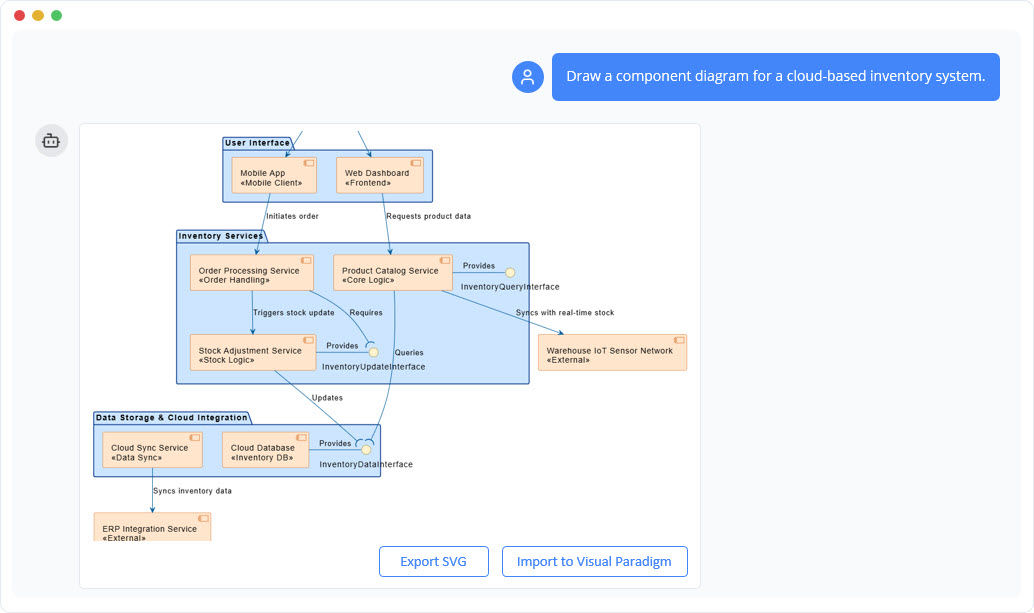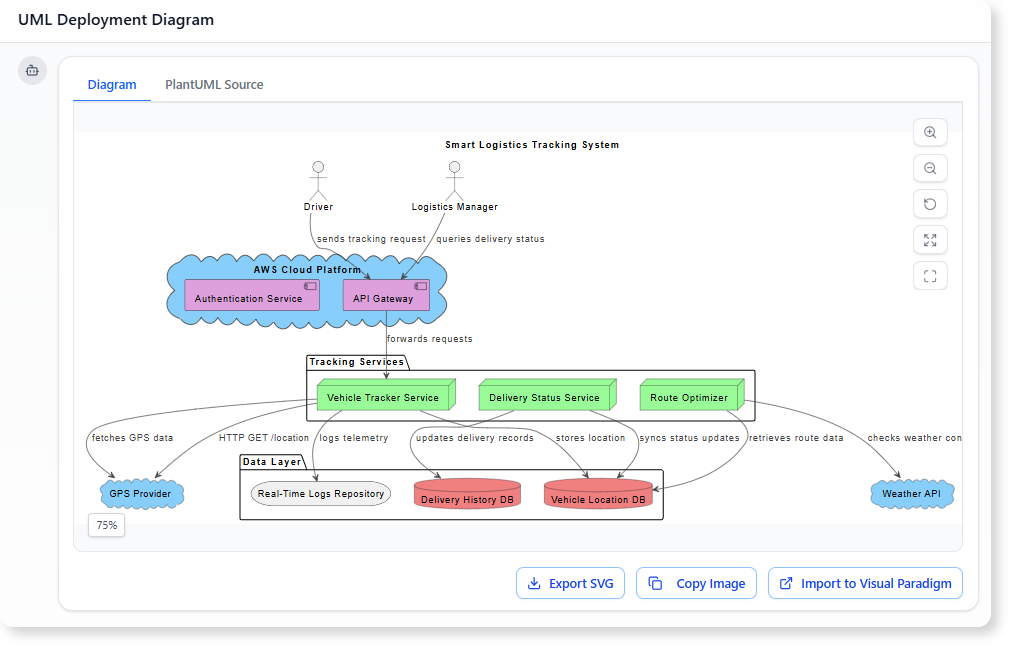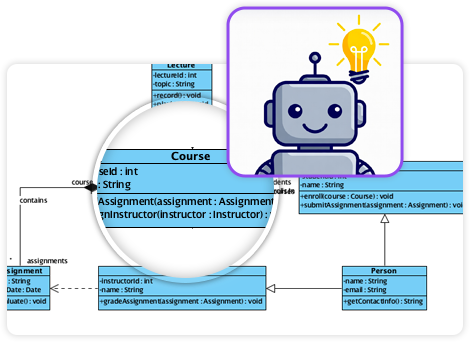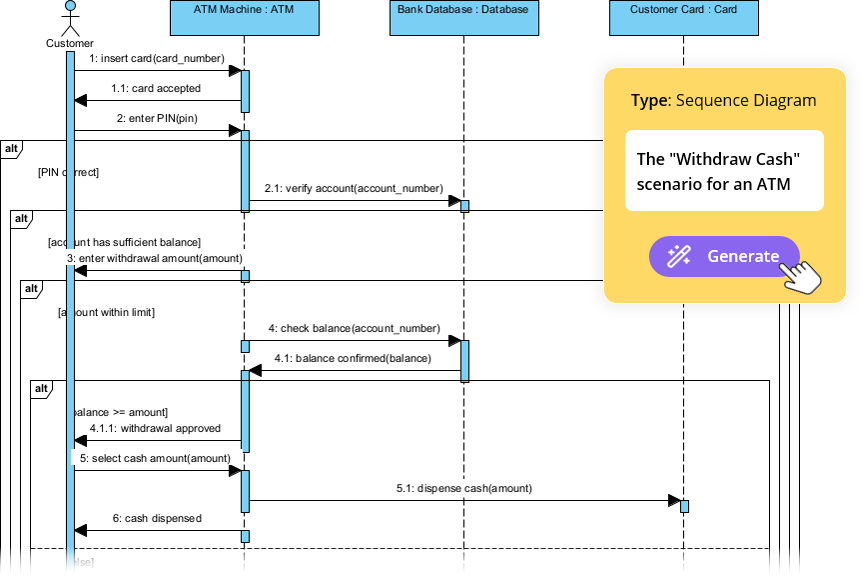
轉變流程優化:人工智能價值流圖的全面指南

現代流程圖的介紹

價值流圖(VSM) 長期以來被視為精益方法論的基石。它為組織提供了關於流程效率、物料流動和資訊交換的重要視覺洞察。然而,傳統上創建和分析這些圖表的方法一直是一項手動且耗時的工作,涉及白板、便利貼和靜態繪圖軟體。這種手動流程常常構成進入門檻,阻止團隊快速迭代其工作流程的改進。

流程優化的格局正隨著人工智能工具的引入而發生轉變。具體而言,人工智能價值流圖編輯器代表了一次重大進步。這項技術使實務工作者僅需以自然語言描述流程,即可生成完整且資料豐富的價值流圖。透過從手動繪製轉向智能自動化,企業可將原始構想迅速轉化為可執行的洞察,時間從數小時縮短至數分鐘。

什麼是人工智能驅動的價值流圖?

這項人工智能價值流圖 (VSM) 編輯器不僅僅是繪圖工具;它是一個複雜且智能的平台,專為視覺化、分析和優化工作流程而設計。其核心運用自然語言處理(NLP)技術,將流程的簡單文字描述轉化為完整且可編輯的圖表。此功能使精益工具的使用更加普及,讓不同技術水平的使用者都能創建專業級的圖表。

除了視覺化功能外,這些工具還整合了圖表引擎,允許進行細緻的調整。使用者可透過直覺的拖放介面調整流程步驟、編輯資料點並重新排列流程。整合人工智能分析師進一步提升了工具的效能,如同一位虛擬顧問,分析價值流圖資料,生成有洞見的報告,揭露瓶頸,並自動提出戰略性改進建議。

人工智能價值流圖編輯器的主要功能

要真正革新流程優化,現代價值流圖工具結合了自動化與深度分析能力。以下是定義此技術的關鍵功能:

1. 文字轉圖表生成

人工智能價值流圖工具最直接的好處,是能夠從普通英文生成圖表。使用者描述其工作流程——包括操作順序、庫存節點和資訊流動——價值流圖生成器即可立即創建詳細圖表。這消除了「空白畫布」的困擾,提供立即可用的結構。

2. 自動化時間軸與指標計算

手動計算精益指標容易出現人為錯誤。由人工智能驅動的編輯器可完全自動化此過程。當使用者修改圖表時,工具會即時自動計算關鍵指標,包括:

  • 總前置時間: 從開始到結束完成整個流程所需的總時間。
  • 增值時間(VAT): 用於實際為客戶創造價值的活動所耗費的時間。
  • 流程效率百分比: 一個衍生指標,用以反映工作流程的流暢程度。

3. 人工智能驅動的分析與報告

或許最具變革性的功能是內建的人工智能顧問。使用者可請求對當前狀態圖進行分析。人工智能會審查資料結構、時間軸與流程,生成專業報告。該報告會突出關鍵發現,識別績效指標,並提供戰略性建議,以消除浪費並提升吞吐量。

4. 高保真導出選項

要使價值流圖發揮效用,必須具備良好的傳播性。該工具可將完成的圖表以高解析度PNG影像格式導出。這確保分析成果能輕鬆整合至管理報告、利害關係人簡報或團隊討論中,且不會損失視覺品質。

目標受眾與應用情境

人工智能驅動的流程圖具有高度彈性,適用於廣泛的組織效率相關專業人士。下表列出了最受益的對象及其應用方式:

角色 主要效益
運營經理 識別並消除生產線中的浪費(Muda),以降低成本並提升速度。
流程改進顧問 快速為客戶創建並分析價值流圖(VSM),在合作過程中更快交付價值。
軟體開發團隊 將精益原則應用於 DevOps 與敏捷工作流程,以優化 CI/CD 管道。
業務分析師 繪製複雜的客戶旅程與內部業務流程,以提升使用者體驗。

從可視化到可操作的洞察

最終目標是價值流圖價值流圖的最終目標並非圖本身,而是其所帶來的優化。透過運用人工智慧,組織可以停止花費時間繪製圖表,轉而專注於分析。這些工具提供的自動化洞察,讓團隊能專注於高階策略,而非低階的格式設定。

無論目標是縮短製造工廠的週期時間,還是優化客服工單系統,人工智慧價值流圖提供做出資料驅動決策所需的清晰度。它彌合了現狀與未來狀態之間的差距,確保流程改善持續、精確且高效。

使用 AniFuzion 創造一個正念動畫故事

Discover how AniFuzion lets you create calming, professional animations for mindfulness without design skills or expensive software.

想像一下,創造一個令人平靜且引人入勝的動畫故事,引導觀眾踏上正念之旅——無需設計技能或昂貴的軟體。這正是 Visual Paradigm動畫製作工具,也稱為 AniFuzion,讓這一切成為可能。這款線上工具可輕鬆創建專業級的 2D 與 3D 動畫、動畫翻頁書以及文字特效。透過直覺式的拖放介面與 AI 驅動功能,AniFuzion 讓每個人——無論是教育工作者還是行銷人員——都能輕鬆掌握動畫創作。圖片展示的是該工具的一個範例動畫:一位 3D 角色置身於柔和的粉彩環境中,搭配文字「認識正念時刻」,展現了你如何輕鬆創造出舒緩且富有視覺敘事感的作品。無論是製作健康主題影片或安靜的簡報,AniFuzion 都能在數分鐘內呈現驚豔成果。

為什麼 AniFuzion 是你的首選動畫工具

動畫製作工具(AniFuzion)旨在簡化創作流程。它消除了傳統動畫軟體的複雜性,讓你專注於敘事。該工具可無縫融入你的工作流程,無需安裝或下載——只需瀏覽器與網路連接即可使用。這使其成為希望快速高效創建內容的使用者的理想選擇。圖片展示了一段簡潔且視覺上吸引人的動畫,展現了 AniFuzion 如何以最少的努力實現專業級成果。你無需具備設計或動畫背景,也能製作吸引觀眾的內容。

  1. 操作簡單:拖放介面讓你可以像拼圖一樣排列角色、道具與特效。

  2. AI 驅動功能:利用 AI 文字轉語音功能生成配音,並自動同步角色口型,讓角色自然說話。

  3. 現成素材:可存取數千種 3D 角色、動作與場景,快速啟動你的專案。

  4. 多樣輸出選項:可匯出為 MP4 影片,或透過連結與嵌入方式分享互動式翻頁書。

這些功能讓 AniFuzion 成為創造動畫內容的強大一站式解決方案。無論你是想教授正念技巧,還是推廣健康產品,此工具都能提供你所需的一切,讓你的構想栩栩如生。

This is a screenshot of Visual Paradigm's Animation Maker - Professional online diagram maker tool

如何製作你的第一個正念動畫

使用 AniFuzion 開始創作非常簡單。依照以下步驟,製作屬於你自己的正念動畫,就像圖片中所示的那樣:

  1. 啟動新專案:登入 Visual Paradigm Online,點選「新動畫」以開啟空白畫布。

  2. 新增角色:從角色資料庫中,將一個 3D 角色拖曳至畫布上。使用屬性面板自訂其外觀。

  3. 套用動作:選擇預設的動作,例如輕柔揮手或安撫姿勢,為你的角色添加動畫。

  4. 加入音效:使用 AI 文字轉語音功能生成旁白。工具會自動同步角色的嘴部動作與音訊。

  5. 強化場景:加入柔和的背景、道具與文字動畫,營造寧靜氛圍。

  6. 預覽並匯出:即時觀看您的動畫,隨時調整,並以 MP4 格式匯出,或分享為互動式翻頁書。

此工作流程讓您即使作為初學者也能快速製作高品質動畫。工具直覺化的設計確保您能專注於創意,而非技術挑戰。

讓 AniFuzion 獨樹一幟的關鍵功能

多項功能使 AniFuzion 成為動畫創作的首選。此工具結合簡便性與強大功能,確保您的內容脫穎而出。以下是其中一些最具價值的功能:

  • 豐富的 3D 角色資料庫:從大量可自訂的角色中選擇,以符合您的主題。

  • 預設動作:可存取超過 2,000 種動態動作,包括手勢與姿勢,輕鬆為您的角色動畫化。

  • AI 文字轉語音:以多樣語調與情感生成配音,無需外部配音演員。

  • 自動口型同步:確保角色口部動作與音訊完全同步,為您的動畫增添真實感。

  • 形狀特效與動畫預設:將預設動畫套用至文字與物件,快速產生視覺衝擊。

  • 即用場景與範本:從預先設計的環境開始,節省時間並提升創意。

這些功能協同運作,簡化動畫流程,使其更快速且更具樂趣。您可以專注於想傳達的故事,同時放心交由工具處理技術細節。

誰能從 AniFuzion 中受益?

AniFuzion 設計給希望製作引人入勝視覺內容的廣泛使用者。以下是其中受益最大的群體:

  • 教育工作者:製作互動式課程與簡報,吸引學生注意力並提升學習效果。

  • 行銷人員:開發促銷影片、產品示範與社群媒體短片,提升觀眾參與度。

  • 企業專業人士:建立入職教材、培訓模組與內部溝通內容,提升清晰度與記憶效果。

  • 內容創作者:製作 YouTube 影片、說明動畫與個人敘事專案。

  • 初學者與業餘愛好者:嘗試使用 3D 角色與特效,用於娛樂或小型專案。

無論您的背景為何,AniFuzion 都能賦予您以視覺方式有效傳達想法的能力。此工具的多功能性使其適用於各種應用,從個人專案到商業影片皆宜。

最後的想法

Visual Paradigm 的動畫製作工具(AniFuzion)是任何想要創建動態且引人入勝動畫的人的革命性工具。透過直覺式介面、人工智慧驅動的功能以及豐富的素材庫,讓動畫製作對每個人來說都輕而易舉。「專注時刻」動畫的範例展示了您如何輕鬆創作出能與觀眾產生共鳴的專業級內容。無論您是教育工作者、行銷人員還是內容創作者,AniFuzion 都提供您實現創意的必要工具。

準備好創造屬於自己的動畫故事了嗎?立即試用 AniFuzion並在數分鐘內開始製作具有影響力的內容。

相關連結

Visual Paradigm 的Anifuzion套件是一套完整的動畫製作工具專為製作專業級2D 與 3D 動畫, 動態圖形,以及說明影片透過直覺式、基於瀏覽器的介面。這些工具讓各個技能層級的使用者都能透過人工智慧驅動的功能,例如語音合成器,協助快速創建行銷、教育與商業簡報內容。

  1. Visual Paradigm 動畫 – 輕鬆創建專業動畫:介紹用於創建2D/3D 動畫動態圖形的直覺式工具與範本。

  2. 掌握 AniFuzion:創建專業動畫的完整指南:深入探討核心功能與進階技巧,以製作高品質、專業級的動畫.

  3. 動畫影片製作工具:Visual Paradigm Anifuzion 完整指南:完整指南,介紹如何使用 Anifuzion 作為強大的工具來製作動畫影片從概念到最終輸出。

  4. 透過 Visual Paradigm Anifuzion 3D 影片製作工具,讓您的點子成真:一份資源,詳細說明如何製作沉浸式 3D 影片透過可自訂的角色與動作,在線上製作。

  5. 2D 動畫製作工具 – 在線製作動畫影片:專為製作生動的 2D 動畫無需程式碼,並具備富有表現力的角色家族。

  6. 使用 Visual Paradigm 創作動態圖形影片:專注於設計動態圖形使用可自訂範本,適用於企業與行銷用途。

  7. AniFuzion 完整指南:Visual Paradigm Online 的動畫影片工具:探討 AniFuzion 的功能,包括其人工智慧驅動的功能以及用於數位敘事的整合功能。

  8. 使用 Visual Paradigm Online 的 Anifuzion 完整指南:詳細步驟說明,將動畫製作工具整合至無縫的製作流程.

  9. Anifuzion 功能概覽:進階動畫功能:互動式功能概覽,包括動作重定向以及互動式動畫製作。

  10. 介紹 Visual Paradigm 的動畫說明影片: 一款旨在簡化的工具公告複雜概念透過引人入勝、動態的視覺敘事。

超越草圖:為什麼輕量級 AI 在專業視覺建模上會失敗(以及 Visual Paradigm 如何解決此問題)

軟體架構中的 AI 時代

在快速演變的軟體工程在快速演變的軟體工程與企業架構領域,將抽象需求轉化為精確且可執行設計的能力是一項關鍵技能。通用型大型語言模型(LLM),如 ChatGPT 和 Claude,已徹底改變了我們進行腦力激盪與文字生成的方式。然而,當涉及專業視覺建模時,這些工具往往無法達成預期效果。它們產生的成果可被最恰當地描述為「草圖」——缺乏工程藍圖嚴謹性的粗略近似。


本全面指南探討了輕量級 AI 繪圖與專業需求之間的顯著差距,以及Visual Paradigm(VP)AI 生態系統如何透過提供符合標準、具備持久性與迭代能力的繪圖功能來彌合這道鴻溝。

1. 「草圖畫家」問題:輕量級 AI LLM 的限制

輕量級 AI 工具主要將繪圖視為文字生成的延伸。當收到建立圖表的提示時,它們通常會輸出 Mermaid 或 PlantUML 等格式的程式碼。MermaidPlantUML雖然在快速視覺化方面令人印象深刻,但這種方法缺乏專業工程環境所需的深度。

缺乏原生渲染或編輯引擎

LLM 產生基於文字的語法(例如 Mermaid 流程圖程式碼),但並未提供高品質向量圖形(SVG)的內建檢視器或編輯器。使用者被迫將程式碼貼入外部渲染工具,瞬間失去互動性。若需修改,使用者必須要求重新生成完整程式碼,通常導致整體佈局完全改變。

語義錯誤與標準違規

通用模型經常誤解 UML 或 ArchiMate 等嚴格的建模標準。常見錯誤包括:

  • 混淆聚合(共用擁有權)與組合(獨佔擁有權)。
  • 繪製無效的繼承箭頭或關係方向。
  • 在技術上應為單向關聯的情況下,建立雙向關聯。

儘管結果在外觀上可能令人滿意,但它們作為工程實體卻失敗了,因為它們未遵循支配系統架構的語義規則。

缺乏持久狀態

或許最令人挫折的限制是對視覺結構缺乏記憶。每次提示都會從頭開始重新生成圖表。例如,要求 LLM「在此序列圖中加入錯誤處理」,通常會破壞現有的佈局、斷開連接線,或完全遺忘先前的元件。並無持久狀態來追蹤模型的演進過程。

2. 依賴隨意 AI 繪圖的現實風險

使用通用的大型語言模型進行嚴肅的架構工作會帶來風險,可能損害專案品質與時程。

設計與實現之間的差距

模糊或語義錯誤的視覺圖形會導致程式碼不一致。開發團隊會在會議中浪費寶貴時間,試圖釐清缺乏精確性的圖形背後的意圖。一個技術上錯誤卻看起來漂亮的圖,甚至比沒有圖還糟糕。

語法依賴

諷刺的是,使用像 ChatGPT 這類「AI 輔助」工具繪製圖形時,使用者往往需要學習專門的語法(Mermaid/PlantUML)來手動修復錯誤。這會形成一種專業知識門檻,抵消了使用 AI 所帶來的效率提升。

工作流程隔離

由大型語言模型生成的圖形是靜態影像或程式碼片段。它們與版本控制、協作平台以及下游任務(如程式碼生成或資料庫結構建立)脫節。它們處於孤島狀態,無法隨著專案演進而更新。

3. 如何透過 Visual Paradigm AI 提供專業級的建模

Visual Paradigm 已將繪圖轉化為一種對話式、標準導向且整合性流程。與基於文字的大型語言模型不同,VP AI 理解下列基礎的元模型UML 2.5,ArchiMate3, C4, BPMN,以及SysML,產出符合標準且可編輯的模型。

具備「圖形微調」技術的持久結構

Visual Paradigm將圖形維持為活的物件而非可丟棄的程式碼。使用者可發出自然語言指令,更新圖形的特定部分,而無需觸發完整的重新生成。

例如,使用者可下達指令:「在登入後新增雙因素驗證步驟」「將客戶參與者重命名為使用者。」系統會立即調整佈局、連接線與語義,同時保留模型其餘部分的完整性。這可消除常見於一般工具中的斷裂連結與版面混亂。

符合標準的智慧

基於正式符號訓練,Visual Paradigm AI 會主動執行規則,確保:

  • 關聯中的正確多重性。
  • 正確使用造型符號。
  • 有效的 ArchiMate 觀點(例如:能力地圖、技術使用)。

這將產生技術上可靠的藍圖,開發人員與架構師均可信賴。

4. 橋接需求與設計:進階 AI 工作流程

Visual Paradigm 不僅僅提供簡單的生成,更透過結構化應用,引導使用者從抽象概念轉化為具體設計。

AI 驅動的文本分析

此功能可分析非結構化文字(例如需求文件或使用者故事),提取候選類別、屬性、操作與關係。並可根據分析結果自動產生初始類別圖。
AI Diagram Generator | Visual Paradigm

範例情境: 輸入如下描述:「一個電子商務平台允許客戶瀏覽商品、加入購物車、透過付款網關結帳,並追蹤訂單。」AI 會識別類別(客戶、產品、購物車、訂單、付款網關)、屬性(價格、數量)與關聯(客戶下訂單)。

十步式 AI 導師

針對如下的複雜圖表:UML 類別模型Visual Paradigm 提供引導式精靈。此工具引導使用者依邏輯步驟進行:定義目的 → 範圍 → 類別 → 屬性 → 關聯 → 操作 → 審查 → 產生。這種人機協同的方式在每一步驟驗證設計,避免提示驅動生成常見的「一次生成」錯誤。

5. 比較:一般 LLM 與 Visual Paradigm AI

功能 一般 LLM(ChatGPT、Claude) Visual Paradigm AI
輸出格式 基於文字的程式碼(Mermaid、PlantUML) 可編輯的原生模型與向量圖形
狀態與持久性 無(從頭重新生成) 持久性(支援增量更新)
標準合規性 低(產生語法/規則幻覺) 高(強制執行 UML/BPMN/ArchiMate 規則)
可編輯性 需要手動程式碼編輯 對話式介面與拖放功能
整合 獨立片段 完整生命週期(程式碼產生、資料庫結構、團隊協作)

結論:從手動雕琢到智慧工程

傳統的圖示繪製往往像是雕刻大理石——緩慢、容易出錯且不可逆。一般性的 AI 大型語言模型雖然提升了草圖速度,但仍受限於無法產生一致、持久且具工程性的視覺內容。

Visual Paradigm AI如同軟體架構的高精度 3D 打印機。使用者可輸入自然語言規格,獲得符合標準且可編輯的結構。支援對話式迭代,並透過程式碼產生與資料庫整合直接推動實作。

AI Diagram Generation Guide: Instantly Create System Models with Visual  Paradigm's AI - Visual Paradigm Guides

對於厭倦反覆重建損壞的 Mermaid 片段的軟體架構師、企業團隊與開發人員而言,Visual Paradigm 代表了下一階段的演進:尊重標準、保留意圖且加速交付的智慧建模。

在 Visual Paradigm 中升級至 AI 驅動的建模:全面指南

引言

軟體架構與業務流程建模的格局正經歷著重大轉變。多年來,專業人士一直依賴於傳統的手動繪圖Visual Paradigm——一種以精確控制、拖放機制以及手動定義關係為特徵的方法。雖然有效,但這種方法可能耗時較長,尤其是在複雜系統的初期草圖階段。

截至 2026 年,向AI 驅動的生成式建模標誌著 Visual Paradigm 用戶的生產力實現重大提升。這種轉變將工作流程從機械化過程轉變為對話式、意圖驅動的互動。使用者不再需要手動放置圖形,而是可以使用自然語言描述想法,讓 AI 立即生成、優化並分析圖表。

本全面指南探討如何順利完成此升級,詳細說明傳統方法與 AI 方法之間的關鍵差異、轉換的好處,以及將 AI 整合到您的建模實務中的逐步工作流程。

對比:傳統建模 vs. AI 生成式建模

要理解此升級的規模,必須將傳統工作流程的機制與新的AI 驅動的功能進行對比。雖然傳統方法提供細緻的控制,但 AI 建模則著重於速度、理解與自動化。

功能 傳統建模 AI 生成式建模
輸入方式 透過桌面/線上編輯器進行手動互動(拖放、連接點)。 自然語言提示(例如:「為圖書館系統建立類圖」)。
主要重點 高精度、最終優化與嚴格遵循標準(UML 2.5、BPMN)。 快速原型設計、降低認知負荷,並處理初始結構。
速度 耗時,特別是在建立大型模型或從零開始時。 數秒內即可即時生成複雜圖表。
優化流程 手動迭代和佈局調整。 對話式優化(例如:「在使用者與管理員之間新增繼承關係」)。
支援的符號 全面支援 UML、BPMN、ArchiMate 等。 廣泛支援包括 UML、C4 模型、ArchiMate、SysML、實體關係圖(ERD)及思維導圖。
技能要求 需要對符號語法與工具機制有深入的了解。 降低入門門檻;透過自動化語法來強化現有的技能。

需要注意的是AI 不會取代傳統技能;它會加以強化。能夠理解 UML 符號與架構模式的專業人士最適合使用這些工具,因為他們能更快發現錯誤,撰寫更優質的提示,並有效驗證輸出結果。

為什麼要升級?專業上的優勢

採用AI 生成式建模Visual Paradigm這不僅僅是跟上潮流;更是實質提升工作流程效率與輸出品質。根據使用者反饋與平台功能,以下優勢正驅動專業人士進行升級:

  • 無與倫比的速度:能在數秒內生成複雜圖表,而非數小時,徹底改變專案初期階段。這種速度對於專案啟動會議、腦力激盪會議與快速原型設計極為珍貴。
  • 生產力提升:AI 自動化重複性工作。例如,從文字型需求文件中即時提取類別與關係,讓架構師能專注於高階設計決策。
  • 迭代式協作:類似聊天的介面如同一位「建模夥伴」。在協作會議中可即時調整,使用者可口頭提出變更,AI 立即執行。
  • 一致性與標準:AI 經過訓練,能遵守 UML 與 BPMN 的規則。雖然仍需人工監督,但 AI 會處理基本驗證,確保命名規範與標準關係從一開始就正確應用。
  • 無縫整合:Visual Paradigm 最強大的功能之一是,AI 生成的圖表並非靜態影像。可直接匯出至 Visual Paradigm 專案中,用於程式碼產生、使用 Hibernate/JPA 的物件-關聯映射(ORM)、模擬與往返工程。

使用者一致反映初始建模速度提升 5 至 10 倍特別是在處理大型架構,或將非結構化需求轉換為視覺化模型時。

逐步指南:在 Visual Paradigm 中過渡至 AI

升級您的工作流程並不需要複雜的遷移,也無需為基本功能升級至新的訂閱等級。AI 功能已整合至近期版本(18.0 及以上)中,並VP Online。請依照此指南開始您的過渡。

1. 訪問 AI 工具

有多種進入 AI 功能的途徑,旨在適應不同的工作流程偏好:

  • AI 聊天機器人:這是生成工作的主要入口。它是一個可在特定 Visual Paradigm 子網域(例如:chat.visual-paradigm.com)使用的瀏覽器工具。它可作為獨立工具運作,但也能連結至您的專案。
  • 桌面與線上整合: 在 Visual Paradigm 界面中,導航至工具 > AI 聊天機器人工具 > AI 圖表。您也可能在 AI 工具箱中找到這些功能。
  • 授權: 基本使用通常可享有免費等級。然而,使用 Pro 或企業帳戶登入可解鎖進階功能,例如無限次生成與進階匯出選項。

2. 從簡單開始:第一個提示

為了適應新的意圖驅動流程,請從熟悉的圖表類型開始。避免在首次嘗試時過度複雜化。

範例提示: 「為一個線上購物車系統生成 UML 類圖,包含使用者、產品、購物車與訂單。」

提交此提示後,AI 將生成類別、屬性、操作與關聯,通常會套用乾淨的自動佈局。從此處,您可以練習以對話方式進行細節調整:

  • 「在購物車與產品之間的關聯上加入多重性 1..*。」
  • 「讓訂單繼承一個名為付款的新類別。」
  • 「改善佈局以避免線條重疊。」

3. 善用文字分析

對專業人士而言,最強大的功能之一是AI 驅動的文字分析。您無需手動解析需求文件,可直接將文字輸入 AI。

工作流程: 將需求文件的一段內容貼入聊天機器人中。
提示: 「分析此需求文字並根據所描述的實體與關係生成類圖。」

AI將自動識別領域實體與關係,提供未結構化文字的結構化視覺呈現。

4. 迭代與專業精煉

基礎模型生成後,工作流程將轉向迭代。使用後續指令擴展模型的範圍或功能:

  • 行為建模: 「根據這些類別新增結帳流程的順序圖。」
  • 文件化: 「從此模型生成文件。」
  • 互操作性: 「將此圖表匯出為 PlantUML。」

關鍵的是,您應將 AI 生成的結果重新導入傳統編輯器。這可實現細緻調整、嚴格驗證,並利用進階功能,如程式碼產生。

5. 進階工作流程

針對企業級使用者,AI 工具的應用遠超基本 UML:

  • DBModeler AI:用於資料庫設計。描述您應用程式的資料需求,工具將產生規範化的實體-關係圖(ERD)及對應的類圖。
  • 用例建模工作室:此功能可處理完整流程生成。您可從目標陳述開始,AI 將生成用例、圖表,甚至測試案例。
  • C4 架構: 針對高階軟體架構,可要求分層視圖。範例:「為基於微服務的銀行應用程式建立 C4 组件圖。」

順利過渡的最佳實務

為最大化 AI 在 Visual Paradigm 中的效能,請考慮以下最佳實務:

  1. 提示內容應明確:模糊不清會導致一般性結果。請在初始提示中始終包含圖表類型、關鍵實體與特定關係。
  2. 人機協同驗證: 始終審查 AI 的輸出結果。根據專案需求核對基數、樣式與約束。AI 是提升效率的工具,而非取代架構責任。
  3. 混合工作流程: 最有效的專業人士會將 AI 草圖匯入主專案,以融合不同方法。利用 AI 完成創建的「重活」,再以傳統工具完成精確的最終定稿。
  4. 保留傳統知識: 您對UML和建模理論的理解,使您能夠撰寫出有效的提示,並發現AI邏輯中的細微錯誤。

實用範例

以下是AI生成在這些具體情境中表現出色的範例,與常見的專業查詢相符:

  • UML類圖:貼上問題描述(例如飯店預訂系統),並觀看AI立即提取類別、屬性、方法與關係。
  • C4架構:提示「為電子商務平台生成C4模型(上下文 + 容器 + 元件)」僅需一次互動即可產生分層視圖,節省數小時的設定時間。
  • 狀態機:描述一個生命週期,例如「為3D列印流程建立UML狀態機:閒置 → 列印 → 暫停 → 錯誤處理」以視覺化方式呈現複雜的邏輯流程。
  • 資料庫設計:使用DBModeler AI將應用需求的描述轉換為完全規範化的ERD。

使用者經驗與見證(2025–2026)

這些功能在Visual Paradigm社群中的反應極為正面。來自部落格、教學影片與平台見證的反饋,突顯了其在現實世界中的影響力:

瑪麗亞·湯普森,解決方案架構師:「我過去常常花數小時繪製系統上下文。現在我專注於架構決策,而AI負責繪圖。這徹底改變了我處理專案初期階段的方式。」

丹尼爾·里韋拉,專案經理:「只需一個指令就能將圖表轉換為報告,節省了審查過程中的數小時時間——工作流程變得更加高效。」

教學使用者與開發者都表達了相同看法。初學者欣賞「與專家對話」的感覺,這能引導他們建立具有分支邏輯的複雜時序圖。資深使用者讚揚其迭代優化功能,指出他們可以生成模型、審查後,下達「加入錯誤處理」指令,並在五分鐘內獲得完美的圖表。共識顯示,初始草圖的製作時間可減少「80–90%的時間節省」,且工具的使用感受不再像軟體,而更像一位「知識豐富的同事」。

結論

轉向Visual Paradigm中的AI驅動建模,對任何軟體專業人士而言都是一項戰略性升級。透過結合生成式AI的速度與傳統編輯工具的精確性,使用者能實現既快速又穩健的工作流程。無論您是在建模簡單的圖書館系統,還是複雜的微服務架構,AI工具都能提供一個基礎,讓您專注於高價值的設計決策,而非手動繪圖。

從問題到報告:AI 如何引導您的用例旅程

Discover how AI guides your use case journey from problem to report with Visual Paradigm’s intelligent development assistant.

想像一下,您是一位負責推出新線上課程平台的專案經理。首要挑戰是清楚地闡述問題,然後將其轉化為一個功能性的系統。這正是用例驅動開發助手,這是一款由 Visual Paradigm 推出的 AI 驅動工具,即時介入。它不僅協助您撰寫文件,更引導您完成完整的結構化工作流程,將模糊的想法轉化為詳細且可執行的專案計畫。整個流程極其直覺,彷彿有資深的業務分析師與技術架構師與您並肩作戰。本文深入探討此強大工具的核心功能,並以線上課程平台的實際案例,展示其如何簡化整個用例生命週期。

快速總結:用例驅動開發助手的關鍵收穫

  • 從明確的問題陳述開始,以定義專案的核心目標。

  • 使用 AI 自動產生候選用例與參與者清單。

  • 透過 AI 生成的用例與活動圖.

  • 使用結構化的 MoSCoW 方法來優先排序功能,專注於高價值工作。

  • 產生詳細的用例描述與可執行的 Gherkin 測試情境。

  • 建立完整的報告,以傳達專案範圍與計畫。

  • 透過中央儀表板追蹤進度,並維持單一可信來源。

步驟 1:透過 AI 定義問題

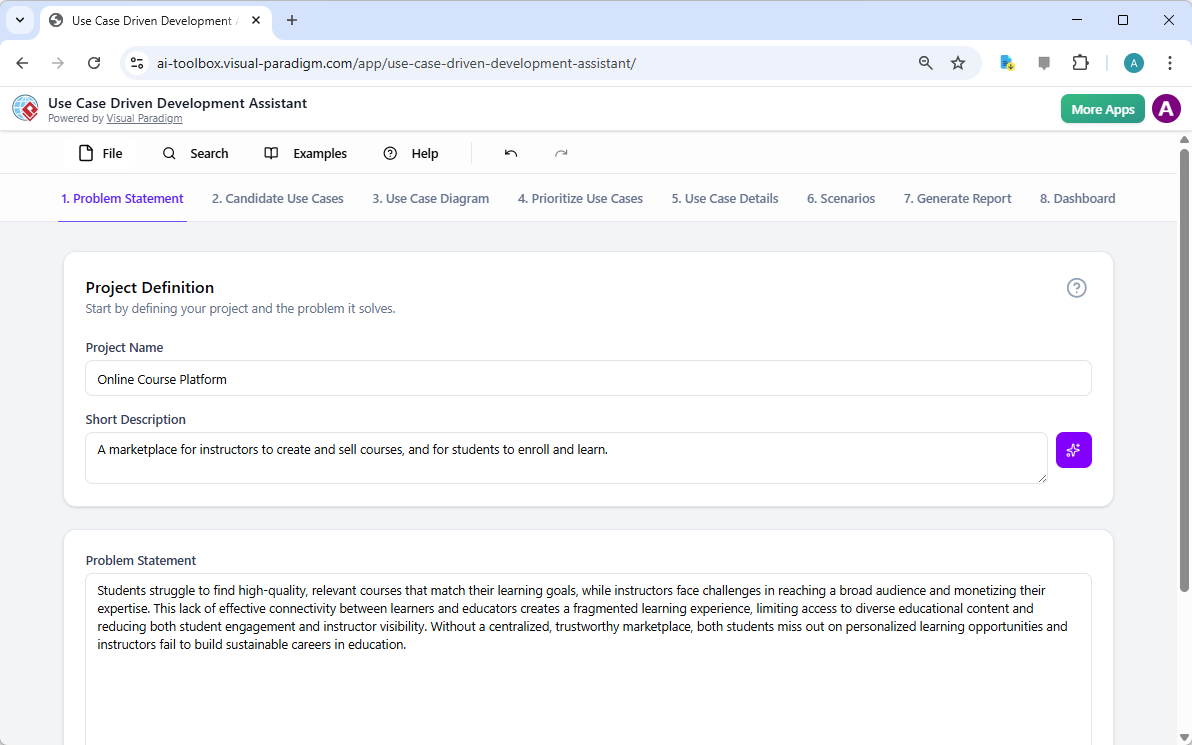
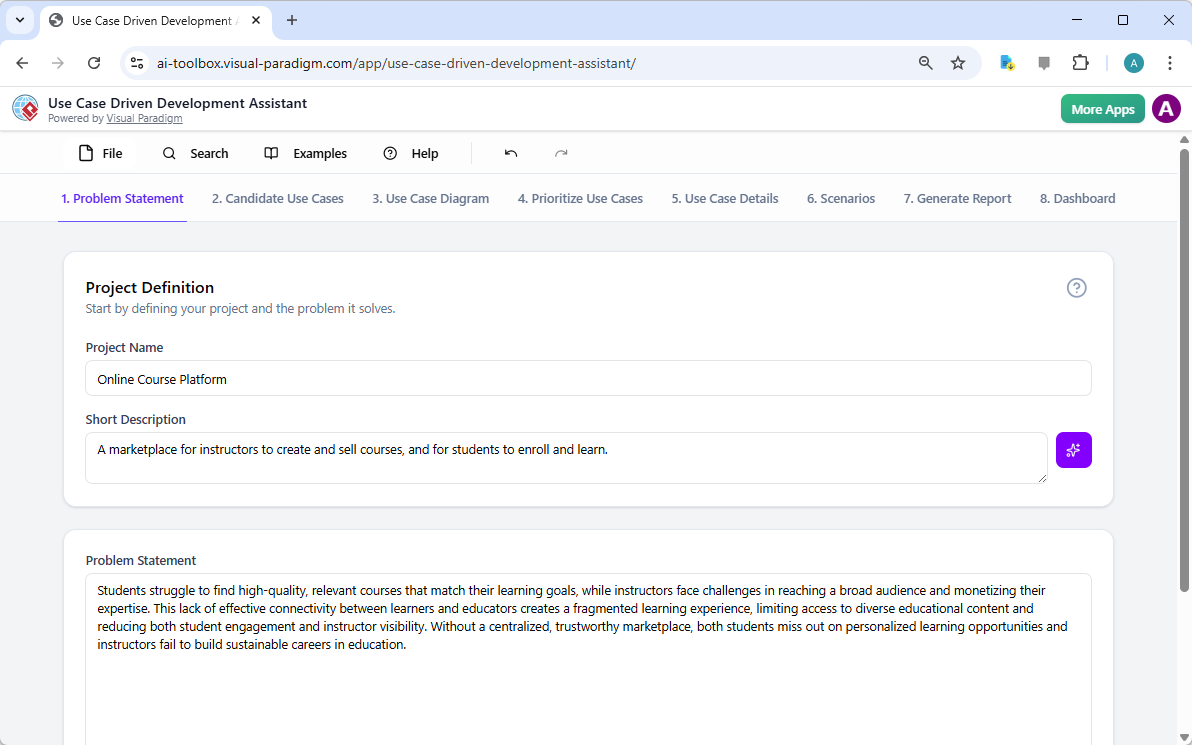
每個成功的專案都始於對其所要解決問題的清晰理解。使用用例驅動開發助手的旅程,從「問題陳述」標籤頁開始。在此處,您輸入專案名稱與簡短描述。AI 隨即利用這些資訊生成一份完整的問題陳述。如圖 1所示,該工具已將專案名稱「線上課程平台」與簡短描述「一個讓講師創建並銷售課程,學生可註冊學習的市場平台」轉化為詳細敘述。該敘述明確指出核心痛點:學生難以找到相關課程,而講師則面臨難以觸及廣泛受眾與將專業知識商品化的挑戰。此由 AI 生成的問題陳述,成為專案的基石,確保團隊成員從一開始就擁有統一的理解。

This is a screenshot of Visual Paradigm's AI Powered Use Case Driven Development Assistant. we are now in step 1. It shows th

步驟 2:在 AI 協助下識別用例

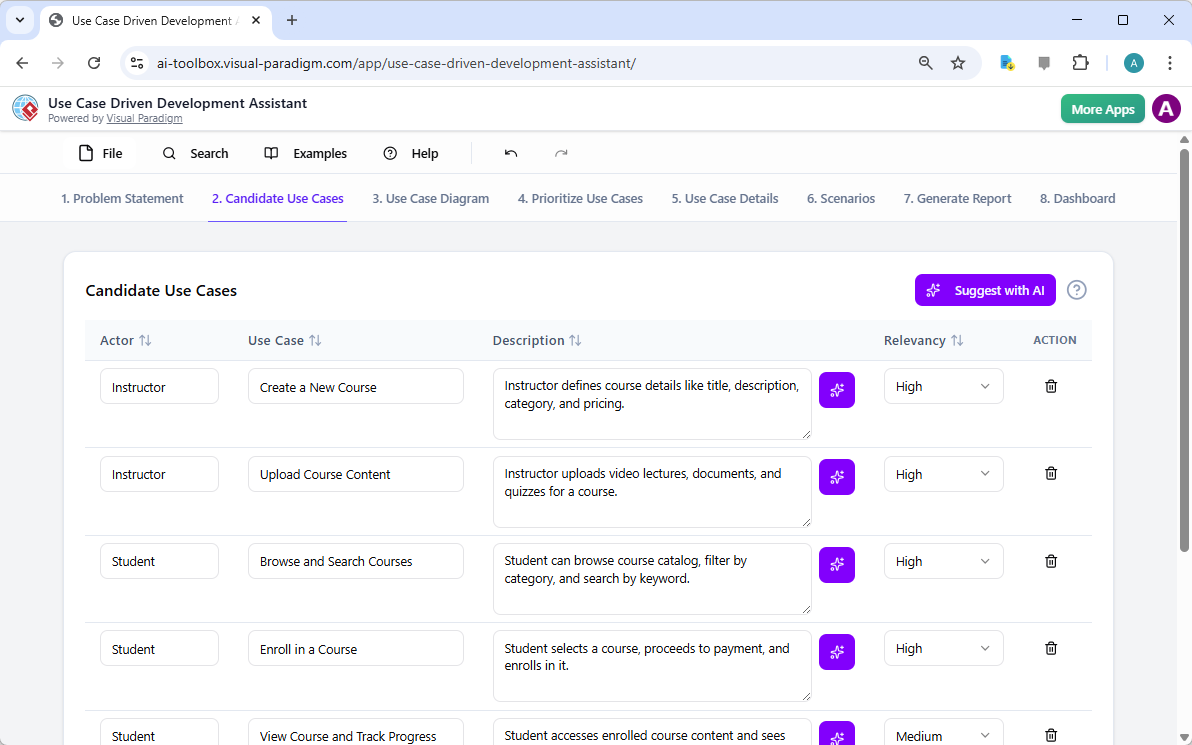
問題明確後,下一步便是識別系統必須提供的關鍵功能。助手的「候選用例」標籤頁,如圖 2所示,自動化此流程。在分析問題陳述後,AI 會建議一組用例,每個用例均與參與者(如講師、學生或管理員)關聯。針對我們的線上課程平台,AI 提出的用例包括「建立新課程」、「上傳課程內容」、「瀏覽與搜尋課程」以及「註冊課程」。此清單提供穩固的起點,節省原本需耗費於腦力激盪會議的大量時間與精力。您可進一步優化這些建議,新增或刪除不相關項目,以建立完整的系統功能清單。

This is a screenshot of Visual Paradigm's AI Powered Use Case Driven Development Assistant. We are now in step 2. It shows a

步驟 3:透過用例圖可視化系統

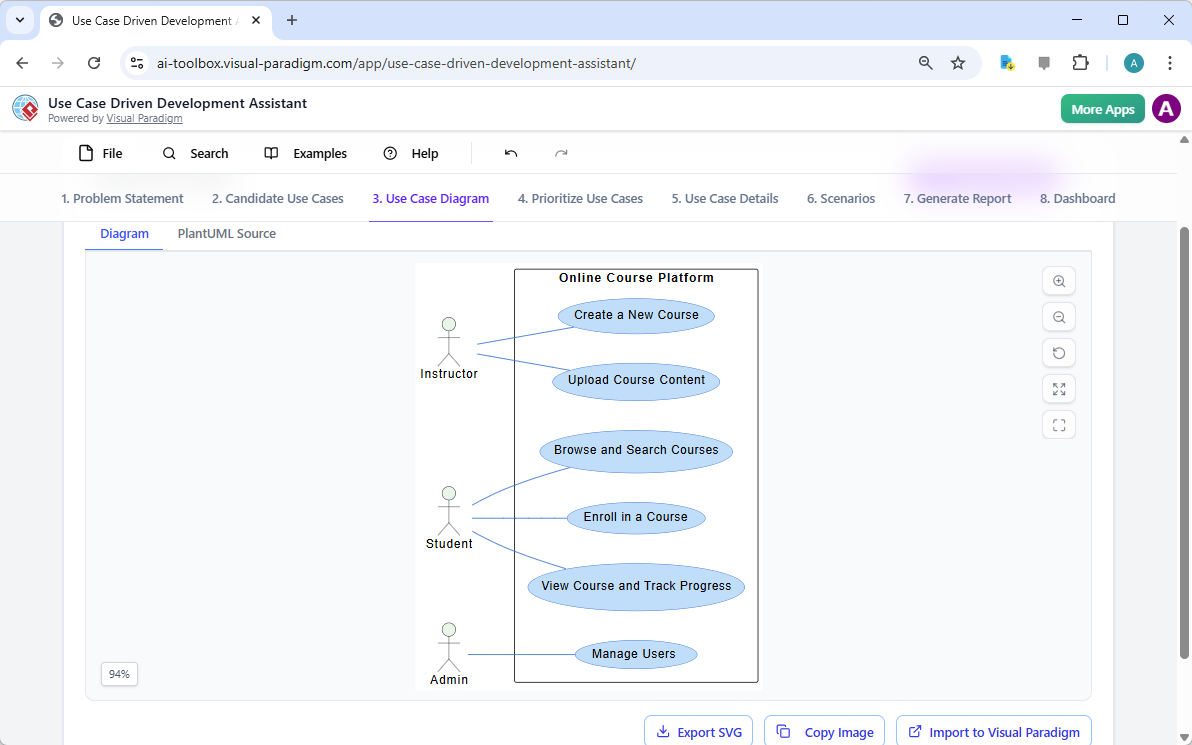
在識別出用例後,關鍵在於可視化它們與系統參與者的互動方式。「用例圖」標籤頁,如圖 3所示,將用例與參與者清單自動轉化為清晰的圖形化呈現。此圖表展現參與者(講師、學生、管理員)與系統功能(如建立新課程等)之間的關係。由 AI 驅動的生成確保圖表準確且格式專業。此視覺化工具對溝通至關重要,讓利害關係人、開發人員與設計師能迅速掌握系統的範圍與功能,無需閱讀冗長的文件。

This is a screenshot of Visual Paradigm's AI Powered Use Case Driven Development Assistant. We are now in step 3. It shows a

步驟 4:優先排序功能以達成最大影響

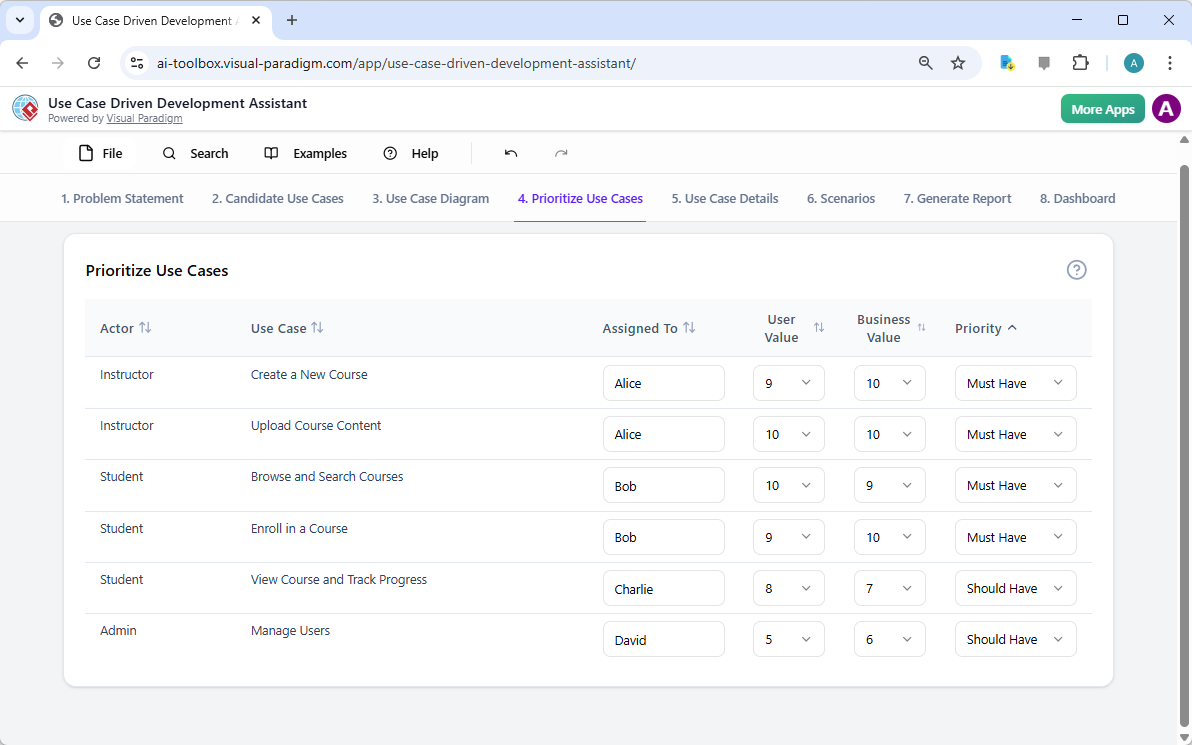
並非所有用例都同等重要。專案的成功往往取決於首先聚焦於最關鍵的功能。如圖像 4,提供了一個強大的框架。它允許您為每個使用案例分配使用者價值和商業價值(在0-10的範圍內),然後應用MoSCoW優先排序方法(必須擁有、應該擁有、可以擁有、不會擁有)。在我們的例子中,AI已幫助識別「建立新課程」和「上傳課程內容」是「必須擁有」的功能,因為它們對平台的核心功能至關重要。這種結構化的優先排序確保開發團隊專注於為使用者和企業提供最高價值,避免在低優先級功能上浪費精力。

This is a screenshot of Visual Paradigm's AI Powered Use Case Driven Development Assistant. We are now in step 4. It shows th

步驟 5:詳細說明使用案例並生成活動圖

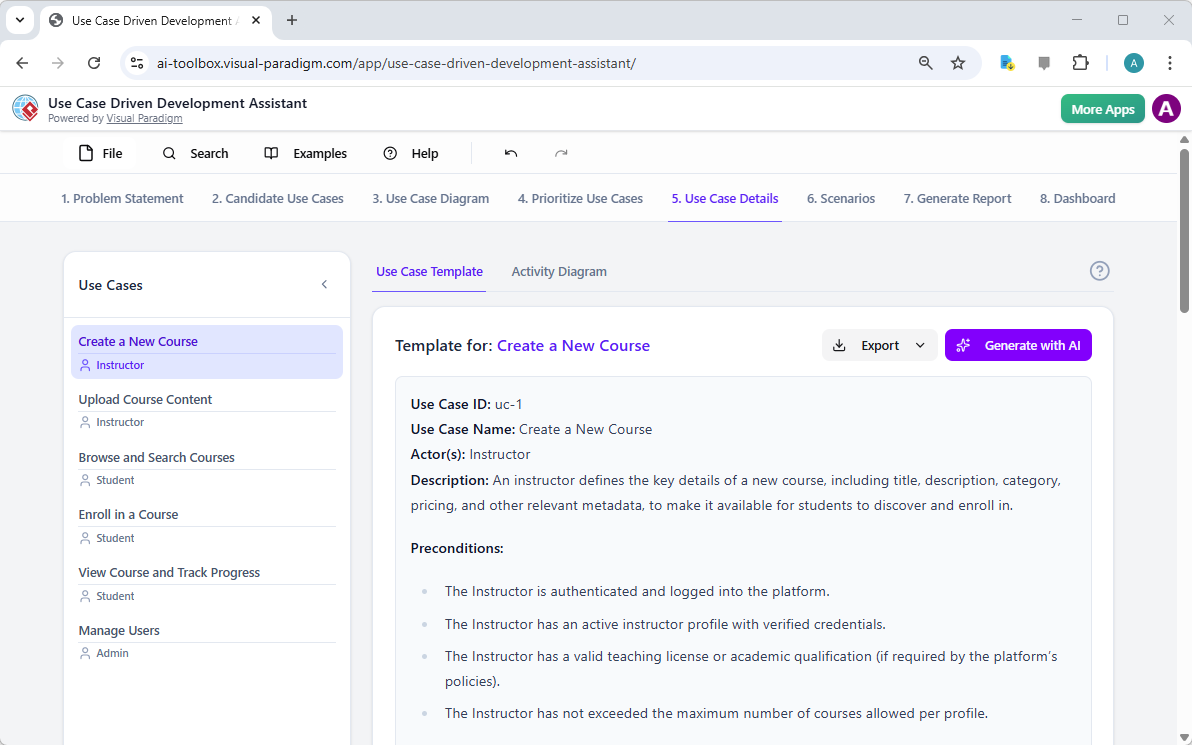
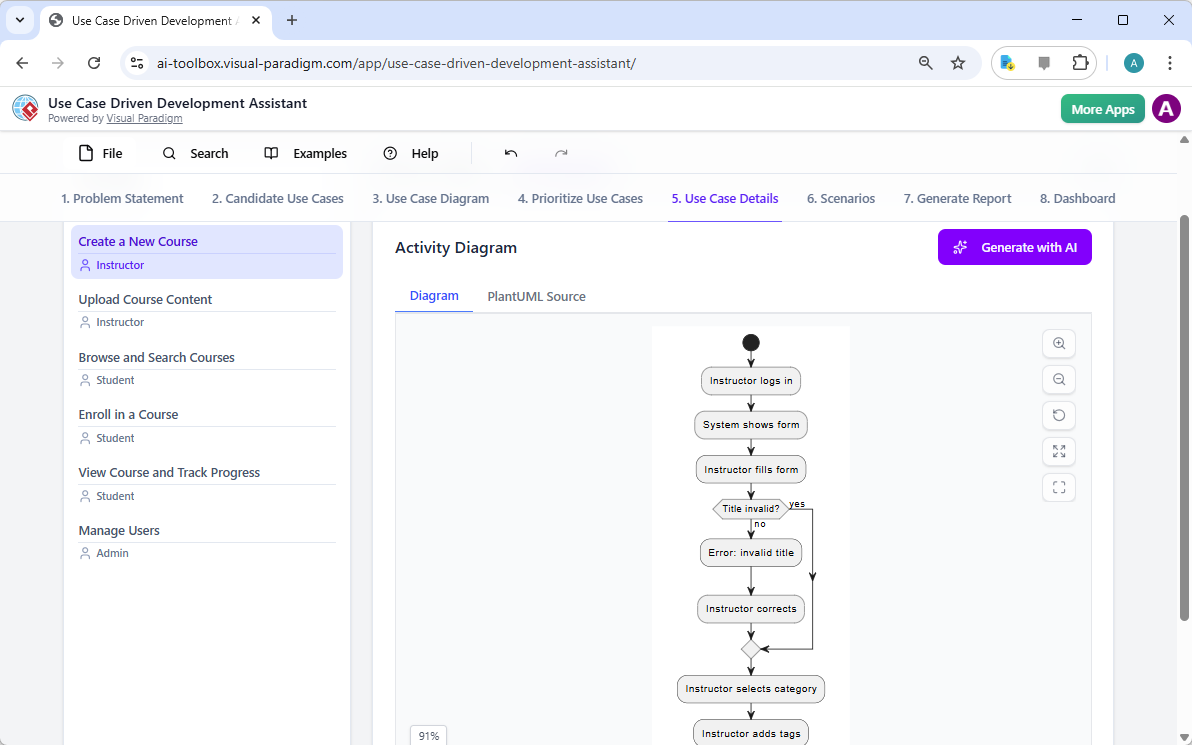
在建立高階視圖後,下一步是深入探討每個使用案例的細節。『使用案例詳情』標籤頁,如圖所示圖像 5,可讓您為所選的使用案例建立完整的範本。AI可生成詳細描述,包括前置條件、主要流程和替代流程。針對「建立新課程」使用案例,AI提供一個結構化範本,明確列出必要步驟。為進一步提升理解,助理可為同一使用案例生成「活動圖」,如圖所示圖像 6。此圖表以視覺方式呈現逐步的工作流程,顯示從講師登入到課程儲存的整個動作序列。這種細節層級對開發人員和品質保證團隊至關重要。

This is a screenshot of Visual Paradigm's AI Powered Use Case Driven Development Assistant. We are now in step 5. It shows thThis is a screenshot of Visual Paradigm's AI Powered Use Case Driven Development Assistant. We are still in step 5. It shows

步驟 6:生成測試情境與序列圖

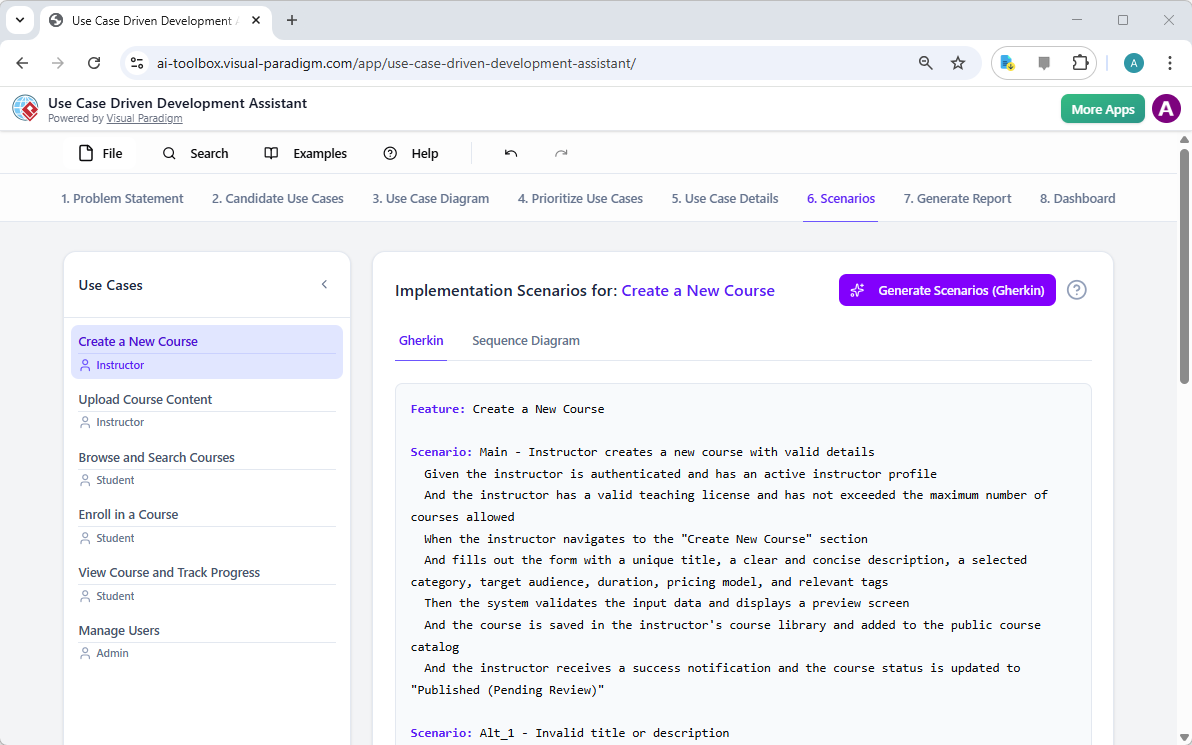
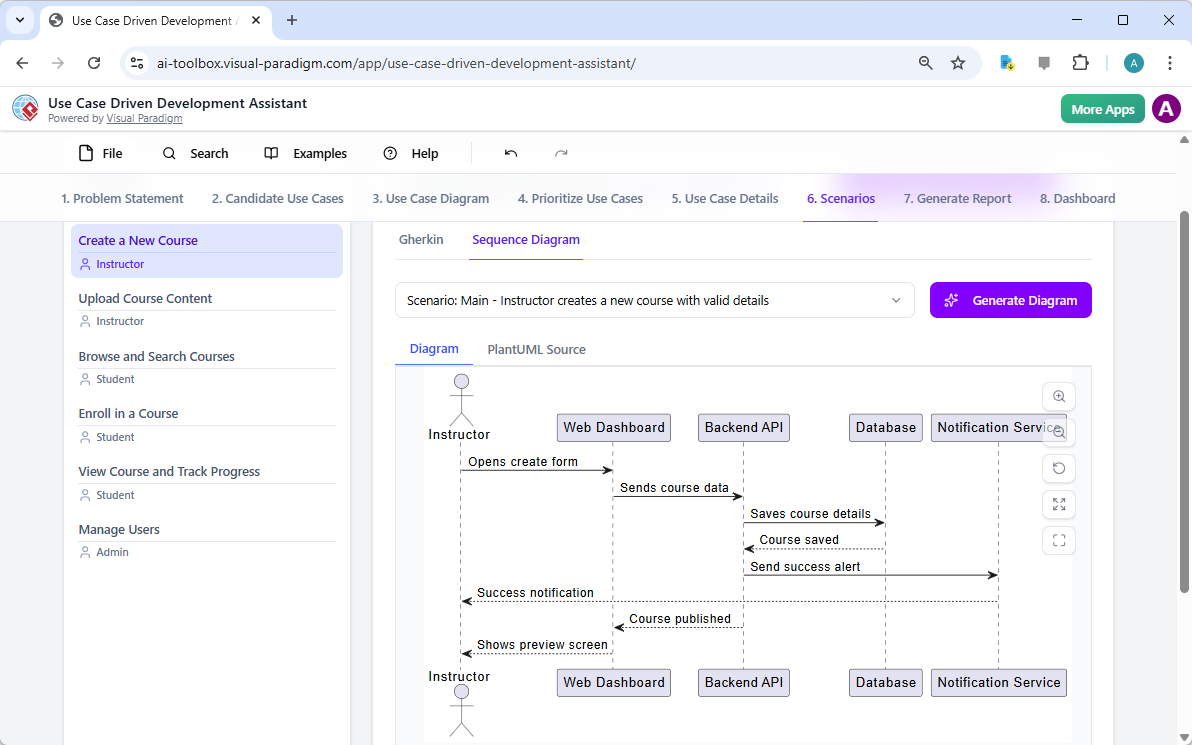
對開發團隊而言,下一步是建立可測試的情境。『情境』標籤頁,如圖所示圖像 7,可讓您直接從使用案例描述中產生可執行的 Gherkin 情境。這些情境以自然語言格式(給定-當-則)撰寫,非常適合自動化測試。AI可生成主要情境與替代情境,例如針對無效標題的情境。為進一步釐清系統內部運作,助理可生成「序列圖」,如圖所示圖像 8。此圖表顯示講師、網頁儀表板、後端 API、資料庫與通知服務之間的互動,清楚呈現系統架構與資料流。

This is a screenshot of Visual Paradigm's AI Powered Use Case Driven Development Assistant. We are in step 6. It shows the AIThis is a screenshot of Visual Paradigm's AI Powered Use Case Driven Development Assistant. We are still in step 6. It shows

步驟 7:建立全面的專案報告

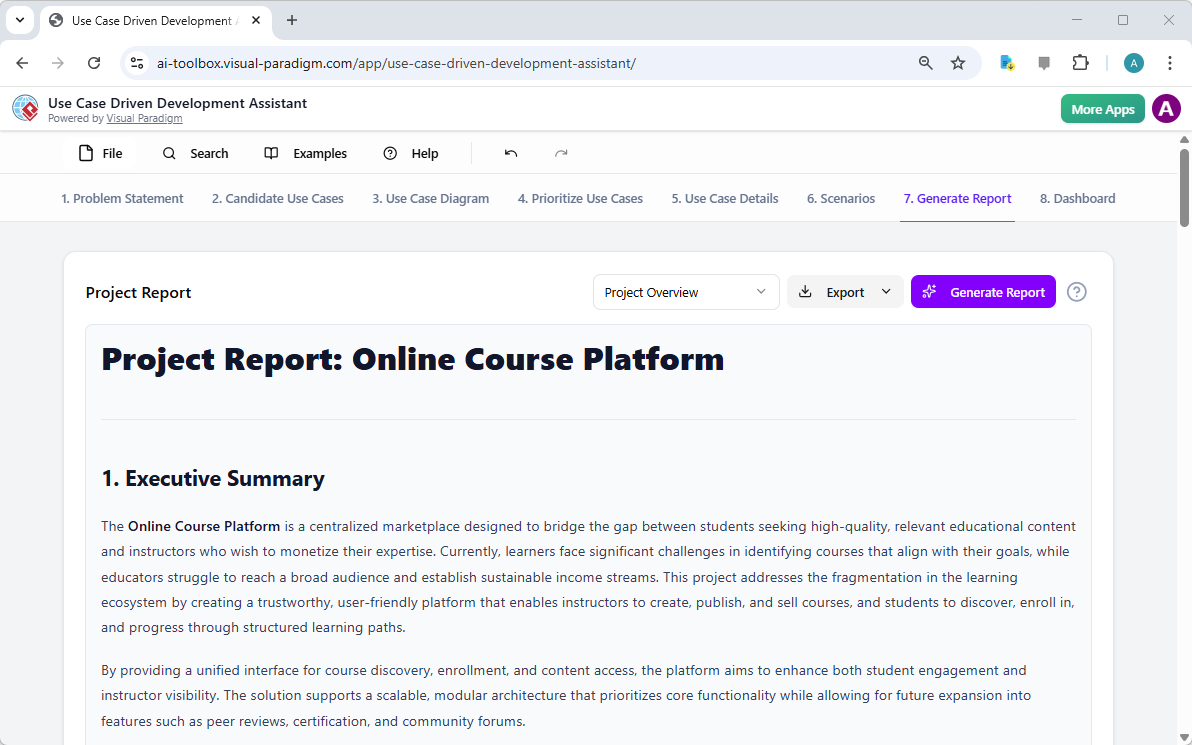
在整個開發過程中,向各類利害關係人溝通專案進度與計畫至關重要。『產生報告』標籤頁,如圖所示圖像 9,讓這變得輕而易舉。您可以產生多種報告,例如「專案概覽」、「執行計畫」、「品質保證測試計畫」或「開發人員任務清單」。這些報告皆由 AI 協助產生,確保內容一致且完整。例如,「專案概覽」報告總結整個專案,包含執行摘要、關鍵功能以及優先排序的 rationale。這份單一來源的資訊確保所有人保持一致並充分了解。

This is a screenshot of Visual Paradigm's AI Powered Use Case Driven Development Assistant. We are in step 7. It shows a repo

步驟 8:透過儀表板追蹤進度

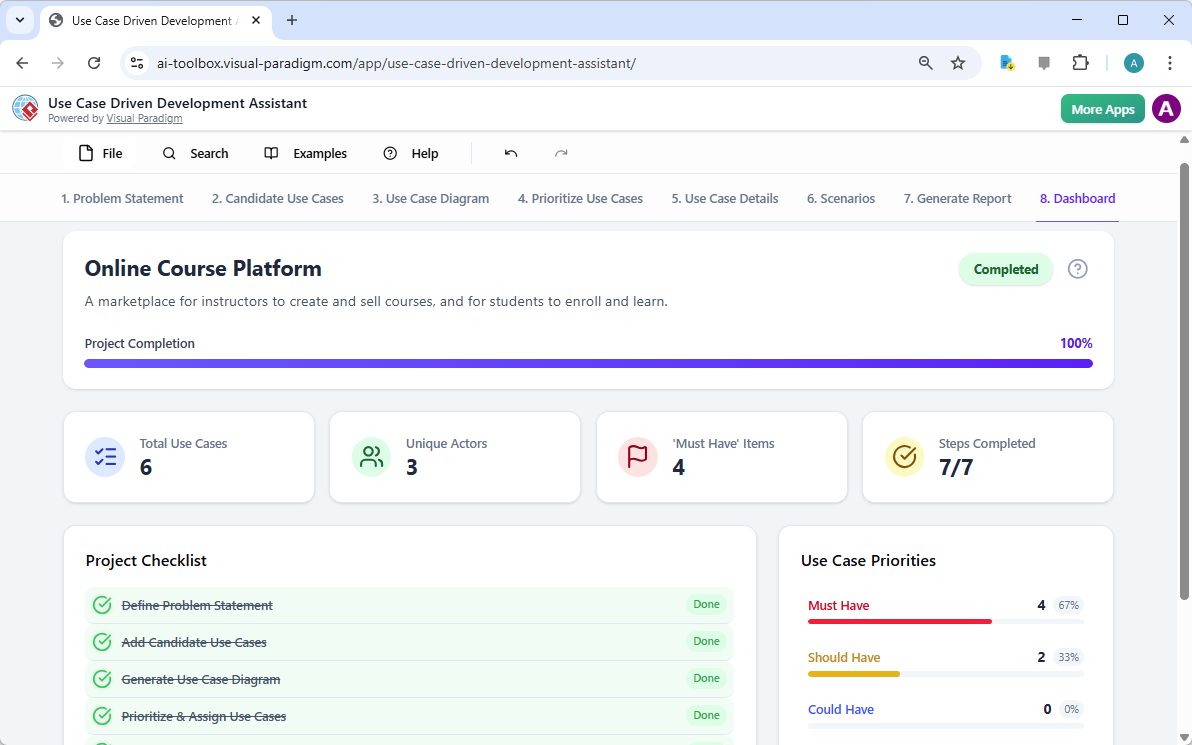
最後,整個流程在「儀表板」中達成終點,如圖所示圖像 10。此中央控制中心提供專案狀態的高階概覽。它顯示專案完成百分比、使用案例總數以及「必須擁有」項目數量。專案清單可讓您追蹤進度,每完成一步即標示為「已完成」。對專案經理與團隊負責人而言,即時掌握專案健康狀況至關重要,有助於識別瓶頸並確保專案按時推進。

This is a screenshot of Visual Paradigm's AI Powered Use Case Driven Development Assistant. We are in step 8. It shows the da

使用案例驅動的開發助理不僅僅是一項工具;它是一套全面的工作流程,為軟體開發過程帶來清晰與效率。透過在每個階段運用 AI——從定義問題到產生報告——它幫助團隊更快、更準確地從需求轉向實作。結果是一個結構良好、文件完整,且與商業目標和使用者需求一致的專案。若您希望簡化使用案例開發流程,這項由 AI 驅動的工具將是強大的解決方案。

準備好了解「使用案例驅動的開發助理」如何改變您的下一個專案嗎?立即試用.

相關連結

用例建模 是一種基本的軟體工程技術,用於捕捉功能需求 透過視覺化外部參與者 與系統內部功能之間的互動。現代平台現在整合了由人工智慧驅動的自動化 以優化圖表、產生完整的用例描述,並將模型轉換為測試案例或活動圖 以維持設計的一致性與可追溯性。先進的工具如事件流程編輯器情境分析器 使開發團隊能夠驗證並記錄結構化的事件序列,以提升整體系統的清晰度。

  1. 什麼是用例圖?——UML建模完整指南:深入介紹涵蓋關鍵元件、目的與最佳實務 用於需求建模。

  2. 逐步用例圖教學——從入門到專家:實用資源,引導使用者進行基礎到進階技術 以建立有效的用例圖。

  3. 關於用例建模的一切你必須知道:全面探討用例建模的原則與應用 在系統設計中的應用。

  4. Visual Paradigm – 用例描述功能: 詳細說明用於精確記錄使用者互動以及結構化的系統行為。

  5. 精通使用 Visual Paradigm 的 AI 驅動使用案例圖: 介紹如何利用 AI 創建智慧且動態的圖表用於現代軟體系統。

  6. 使用 Visual Paradigm 事件流程編輯器的指南: 逐步說明如何記錄結構化的事件序列於使用案例情境中。

  7. 透過使用案例情境分析器解構情境: 介紹如何使用分析器來檢視與優化互動流程以提升系統清晰度。

  8. 將使用案例轉換為活動圖 – AI 驅動的轉換: 介紹自動轉換將使用案例轉換為詳細的系統工作流程。

  9. 使用 AI 從使用案例圖生成情境與測試案例: 探討如何利用 AI 工具自動化建立以需求為導向的測試流程.

  10. 使用案例圖圖庫 – 模板與範例: 精選的真實世界範例以激發靈感、學習與快速原型設計。

建模社交媒體平台資料庫:在 Visual Paradigm 中透過 AI 技術生成實體關係圖

Learn how to use Visual Paradigm’s AI to instantly generate professional ER diagrams for a social media platform database from simple text prompts.

坦白說:從一張白紙開始設計資料庫可能是一項令人卻步的任務。無論你是經驗豐富的軟體架構師,還是學習資料模型的學生,手動繪製實體、定義屬性以及規劃關係線都需要投入大量心力。這正是 AI 實體關係圖(ERD)生成 改變遊戲規則。只需描述你的專案構想——例如「社交媒體平台」——你就可以使用 Visual Paradigm Desktop 將自然語言立即轉換為專業且符合標準的資料模型。

此功能不僅僅是加快流程;更是在商業需求與技術架構之間架起橋樑。在本篇深入探討中,我們將說明如何僅用幾秒鐘,透過這個 智慧資料庫設計工具.

快速總結:重點要點

  • 文字轉模型效率: 將簡單的英文描述立即轉換為複雜的實體關係圖。
  • 智慧辨識: AI 可自動辨識實體、屬性、主要鍵與關係。
  • 標準符號: 產生符合業界標準實體關係圖規範(如鴿子腳符號等)的圖表。
  • 完全可編輯: 結果為原生的 Visual Paradigm 圖表,可進一步優化並產生 SQL。

步驟一:透過自然語言定義範圍

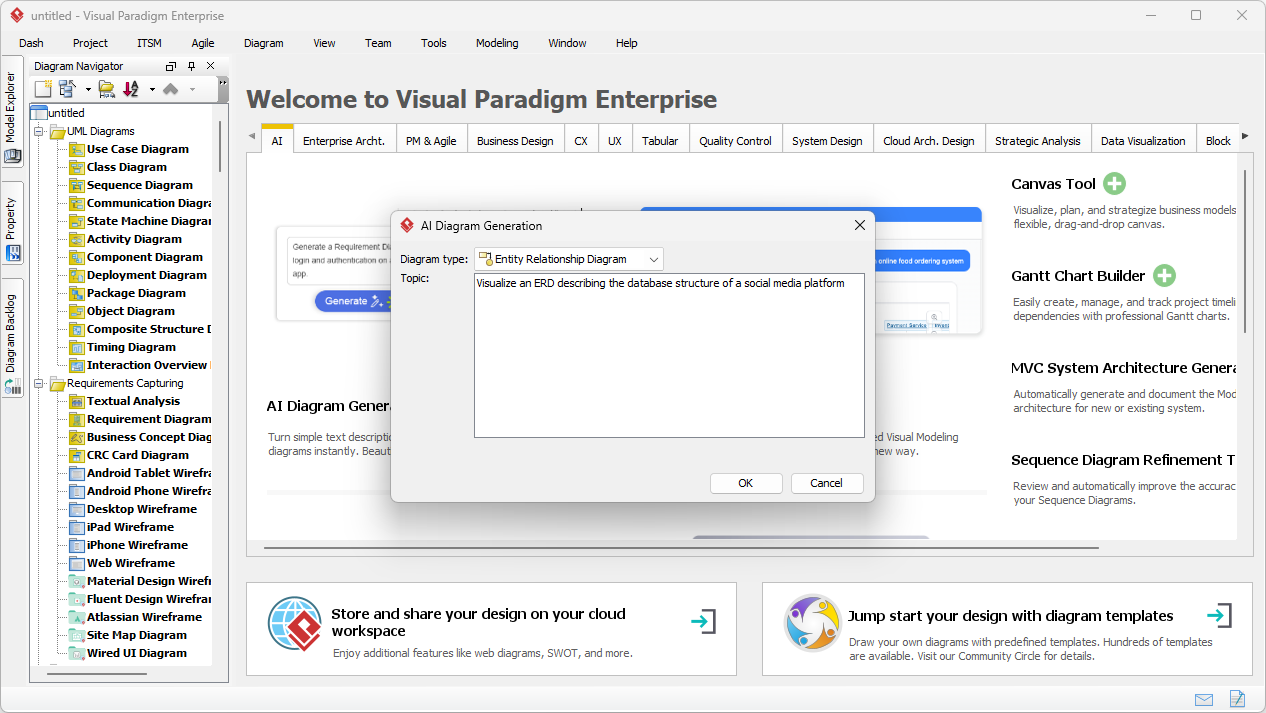
流程從一個簡單的概念開始。你不需要懂 SQL 語法,也不需手動拖曳數十個方框。相反地,你可以使用工具中的 AI 圖表生成 功能。如下方工作流程所示,你只需選擇「實體關係圖」作為目標輸出。真正的關鍵在於提示內容。

在本例中,我們希望呈現社交網路的後端架構。我們輸入了提示:「呈現一個描述社交媒體平台資料庫結構的實體關係圖」。這段純文字已足夠讓 AI 理解領域需求,推斷出社交平台通常需要使用者、內容、互動與通知功能。

This is a screenshot of Visual Paradigm (aka. Visual Paradigm Desktop). It is now showing the use of AI diagram generation to

步驟二:分析 AI 生成的資料模型

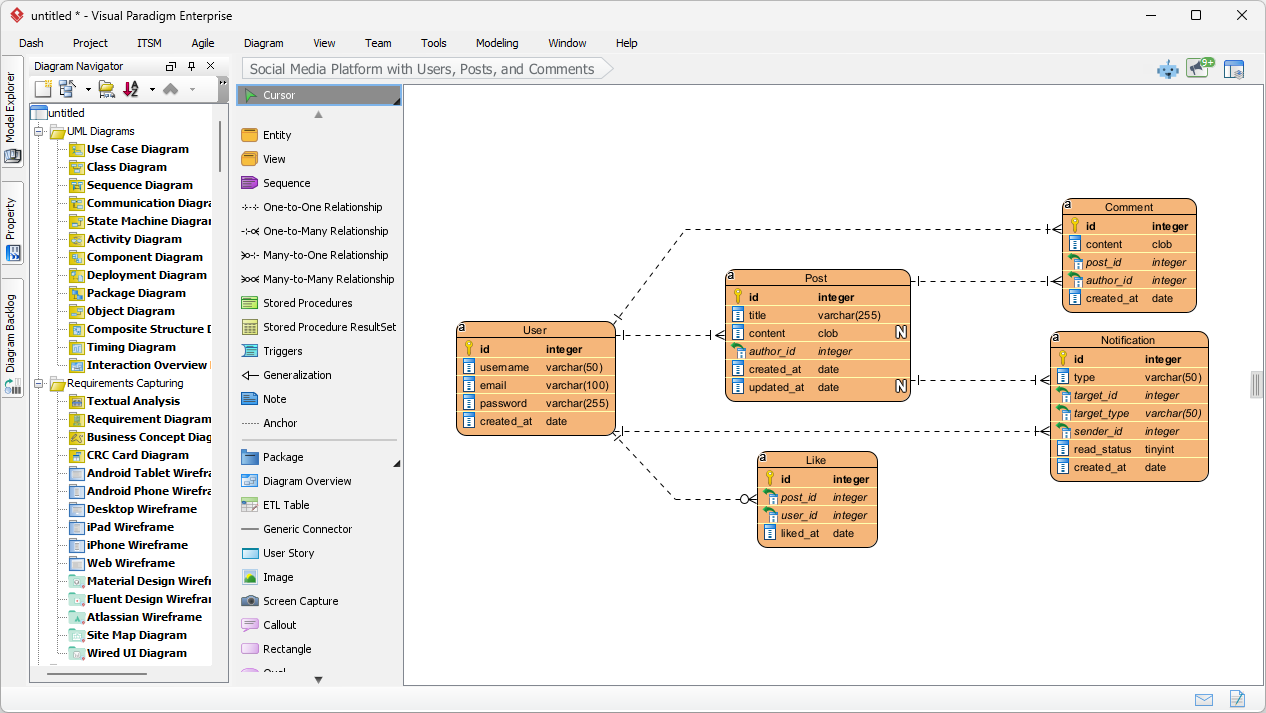
按下「確定」後,AI 會分析你的文字,以辨識核心實體(資料表)及其關聯性。它不會隨意在畫布上放置方框;而是應用 智慧關係與基數辨識 來建構資料邏輯。短短片刻內,你便會看到一份完整的圖表,看起來像是花了數小時手動設計而成。

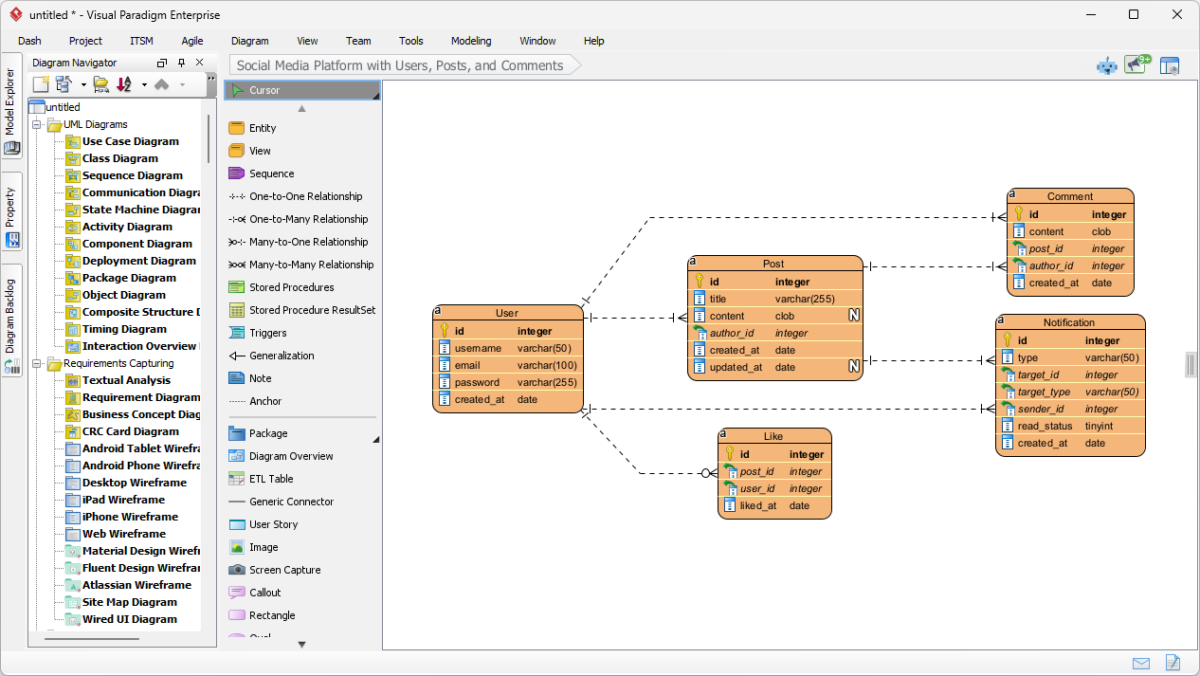
觀察下方結果,你可以看到 AI 成功生成了一個完全適合社交媒體應用的資料結構。它建立了 使用者 具有標準屬性的實體,例如 使用者名稱, 電子郵件,以及 密碼。它在邏輯上將使用者與一個 文章實體(一對多關係),認知到一個使用者會建立多篇文章。它甚至進一步細化了細節,新增了 評論, ,以及 通知實體,並包含外鍵(例如 文章編號, 作者編號),以及適當的資料類型,例如 varchar, clob,以及 整數.

This is the screenshot of Visual Paradigm Desktop. It shows a Entity Relationship Diagram generated by AI, based on the descr

為什麼這個AI功能是模型設計者不可或缺的

使用 由AI驅動的資料庫模型工具其優點在於能處理佈局與組織的繁重工作。如生成的圖示所示,實體被安排以減少線條交叉,使資料結構更易於閱讀與驗證。

自動屬性和鍵分配

請注意,AI 已自動為每個實體分配主鍵(PK),以鑰匙圖示表示。它還對資料類型做出智能猜測——為「文章內容」分配 clob(字元大型物件)類型,因為它知道文章內容可能很長,同時將「使用者名稱」保留為標準的 varchar(50)。這可免除您在概念階段手動設定每一欄屬性的繁瑣工作。

從靜態圖像到功能專案

與簡單的圖像生成器不同,這裡的輸出是一個 完全可編輯的原生圖示。如果您後來決定「文章」也應包含「分類」,只需使用圖示編輯器簡單新增該屬性即可。這種無縫過渡至實作的特性,讓您可將此圖示作為基礎,生成適用於 MySQL、PostgreSQL 或 Oracle 的 DDL 指令碼,從而將一個初步構想快速轉化為實際的資料庫結構,整個流程一氣呵成。

如何建立您自己的 AI ERD

準備好嘗試這個 易於使用的 ERD 建立工具嗎?以下是複製上述結果的簡單工作流程:

  1. 啟動 Visual Paradigm: 開啟一個新專案或現有專案。
  2. 開啟 AI 工具: 導航至 工具 > AI 圖示生成.
  3. 選擇圖示類型: 從下拉式選單中選擇「實體關係圖」。
  4. 輸入描述: 輸入您系統的清晰描述(例如:「一個包含書籍、會員與借閱的圖書館系統」)。
  5. 產生: 點選確定,觀看您的圖示自動生成。
  6. 修訂: 使用編輯器調整關係或依需要新增特定限制。

結論

Visual Paradigm 的 AI 實體關係圖生成功能,徹底改變了我們進行資料模型設計的方式。透過將一句關於「社交媒體平台」的簡單描述轉化為完整且技術精確的 ERD,它消除了資料庫設計的入門障礙。無論您是用來原型設計新應用程式,還是記錄現有系統,此工具都能立即提供堅實且專業的起點。

停止一個一個地繪製方框。立即體驗AI輔助建模的速度。

下載 Visual Paradigm 桌面版,立即試用 AI 圖表生成功能


相關連結

Visual Paradigm 提供一套完整的ERD(實體關係圖)工具可透過傳統視覺編輯器與AI驅動的自動化。這些工具支援多種符號系統,例如陳氏符號,並支援從概念建模到實際資料庫實作以及逆向工程。

  1. Visual Paradigm ERD 工具 – 在線建立實體關係圖:一個基於網路的工具,可實現直覺的拖放設計專業資料庫架構設計。
  2. 使用 ERD 工具進行資料庫設計 – Visual Paradigm 使用指南:專為致力於建立可擴展且穩健的資料庫的架構師提供的資源,並運用資料模型設計的最佳實務。
  3. DBModeler AI:智慧型資料庫建模工具:一款由 AI 驅動的應用程式,專為自動化資料庫建模、架構產生與即時 SQL 測試。
  4. 免費 ERD 工具 – 使用 Visual Paradigm 在線設計資料庫:提供免安裝、基於瀏覽器的解決方案,用於建立專業的實體關係圖且完全免費。
  5. 陳氏符號 ERD 編輯器 – 高階實體關係建模:一款專用編輯器,提供完整的支援實體、屬性、關係與基數 使用精確的陳氏符號。
  6. Visual Paradigm 用於資料庫設計的 ERD 工具 – 完整解決方案:一個全面的工具,供開發人員和架構師使用,以建立模型、視覺化並產生資料庫,並具高效率。
  7. AI 圖表產生器新增圖表類型:資料流程圖與實體關係圖:此版本強調能夠產生實體關係圖,可立即從自然語言提示產生利用人工智慧。
  8. 利用 Visual Paradigm 簡化實體關係建模:一篇文章詳細說明如何簡化從初步概念到最終資料庫部署的建模流程初始概念到最終資料庫部署.
  9. 資料模型入門:實體關係圖、程式碼產生與逆向工程:一份入門指南,涵蓋圖表繪製與逆向工程的必要生命週期圖表繪製與逆向工程資料庫。
  10. 什麼是實體關係圖(ERD)? – Visual Paradigm 使用指南:一份說明性指南,涵蓋核心元件與重要性在資料庫設計的廣泛脈絡中,實體關係圖的重要性。

激活企業風險策略:透過 AniFuzion 提升商業簡報效果

Transform complex risk management data into engaging 3D animations with AniFuzion. Improve corporate communication and stakeholder engagement today.

企業溝通需要絕對清晰,尤其是在討論風險管理或市場衰退等敏感議題時。靜態簡報經常無法在高風險簡報中吸引足夠注意。Visual Paradigm動畫製作工具,也稱為 AniFuzion,為這些時刻提供強大的解決方案。這款由人工智慧驅動的線上動畫工具,讓專業人士能將複雜資料轉化為引人入勝、敘事導向的影片。透過使用3D角色與動態環境,簡報者能確保風險減損的訊息有效傳達給利益相關者。

專業動畫師的關鍵要點

  • 增強參與度:動畫情境比靜態文字或傳統圖表更能長時間吸引觀眾注意力。

  • 快速製作:拖放介面可讓您在數分鐘內完成專業的商業場景製作。

  • 專業資源:可存取龐大的3D角色與辦公用品圖庫,無需依賴外部設計資源。

  • 無縫溝通:視覺敘事能簡化風險回避與戰略規劃等複雜概念。

建構企業敘事場景

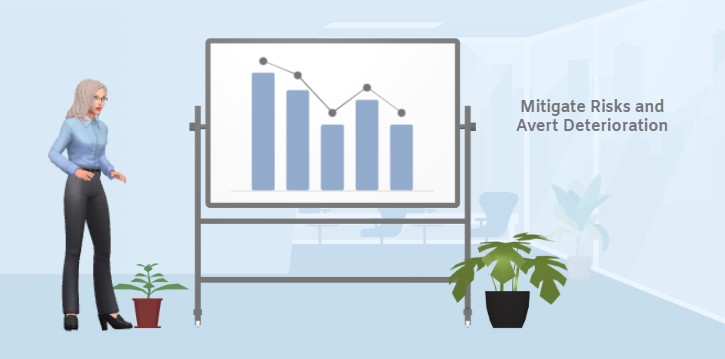
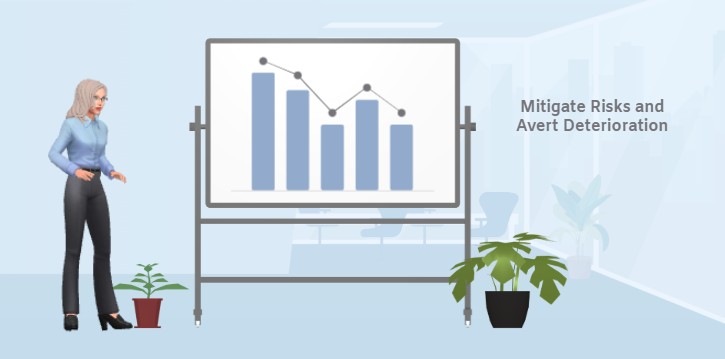
想像一個場景:部門主管必須解釋一個下滑趨勢,以及隨後的策略以避免進一步損失。簡報的視覺效果決定了觀眾對情況緊迫性的認知。下圖清楚展示了AniFuzion如何促進這種特定類型的敘事。一位專業的3D角色自信地站在白板旁,展示一張顯示波動的長條圖。環境模擬出乾淨、現代化的企業辦公室,配備盆栽與環境光線。此佈置立即建立情境與權威感。

A snapshot of an animation developed with Visual Paradigm's animation maker. - Professional online diagram maker tool

此場景捕捉了戰略簡報的精髓。文字「降低風險並避免惡化」清晰地浮現在白板旁,強化了口頭敘事。透過在資料旁放置一個可親近的人類角色,動畫彌補了冰冷數據與人類行動之間的鴻溝。這種結合3D角色動畫與資料視覺化的結合,創造出一致且具說服力的論述。

善用3D角色圖庫

創造一個可親近的主角,是建立此動畫場景的第一步。動畫製作工具提供廣泛的3D角色圖庫,適用於多樣化的專業情境。使用者可透過選擇不同商務服飾(如範例中的藍色襯衫與合身西褲)來建立特定角色。可自訂髮型、配件與服裝材質,確保角色與企業品牌形象一致。這種細節程度能讓觀眾產生信心,因為螢幕上的簡報者看起來專業且得體。

透過拖放道具建構場景

視覺效果的成效在很大程度上取決於環境。空白背景往往顯得呆板且缺乏吸引力。該工具透過直覺式的拖放介面解決此問題。使用者可從道具圖庫中拖取素材來建構真實場景。在風險減損的範例中,白板成為焦點。背景加入辦公椅、桌椅與綠植,增添深度與真實感,同時不分散對核心訊息的注意力。此功能解決了耗時的世界建構問題,簡報者可在瞬間完成完整佈置的辦公室場景,而非耗費數小時。

動態動作與動畫圖庫

靜態角色與照片相比並無太大優勢。AniFuzionAniFuzion真正的力量在於其預設的動作與動畫圖庫。在展示的場景中,角色不僅靜止站立,更積極參與內容。使用者可從超過2,000種動態動作中選擇特定手勢。角色可指向圖表、點頭強調重點,或沉思踱步。這些動作無需手動關鍵幀或複雜的骨骼設定。使用者只需將「簡報」或「指點」動作套用至時間軸即可。這徹底消除了傳統角色動畫所伴隨的陡峭學習曲線。

同步音頻以達到最大影響力

為了充分傳達避免惡化的策略,角色必須說話。內建的AI語音合成(TTS)功能可立即生成專業的配音。使用者將風險分析的腳本輸入面板,工具隨即產生具有適當嚴肅語氣與口音的聲音。關鍵的是,自動口型同步功能可使角色的嘴部動作與音頻同步。這創造出一種逼真的表演,讓角色看起來像是即時發表簡報。視覺提示與同步音頻的結合,確保觀眾能記住所呈現的關鍵資訊。

結論

Visual Paradigm 動畫製作工具使高階商業動畫的創作更加普及。它讓專業人士能夠超越靜態簡報,轉向動態敘事。透過使用可自訂的3D角色、逼真的辦公室環境以及自動化動畫工具,使用者能創造出關於複雜商業策略的引人入勝的故事。結果是,不僅傳達資訊,更能吸引注意力並推動行動。

準備好轉化您的下一次企業簡報嗎?立即開始製作專業的動畫影片吧。

立即試用 Visual Paradigm 動畫製作工具

相關連結

Visual Paradigm 的 AniFuzion 是一個全面的 線上動畫製作工具 旨在幫助專業人士與 非專業動畫師 創作高品質的 2D 與 3D 影片。這個基於雲端的平台透過直覺式介面與預設模板,簡化動畫製作流程,適用於行銷、教育與敘事。主要功能包括 自動動作重定向 以實現逼真的角色動作,以及 由AI驅動的語音合成(TTS)語音產生器,以及用於 3D 角色骨骼設定與場景自訂的進階工具。

  1. 掌握 AniFuzion:打造專業動畫的全面指南:深入探討核心功能與進階技巧,以製作專業等級的動畫內容。

  2. 利用自動動作重定向在 AniFuzion 中創造流暢動畫:詳細說明自動化如何確保在各種角色模型上實現平滑且逼真的動作。

  3. AniFuzion:非專業動畫師的終極動畫工具:探討該平台如何讓無技術背景的使用者將想法付諸實現。

  4. 動畫影片製作工具:Visual Paradigm AniFuzion 完整指南:從最初的構思階段到最終輸出,完整指導動畫專案的製作流程。

  5. 透過 Visual Paradigm AniFuzion 3D 影片製作工具,讓您的創意栩栩如生:強調利用可自訂的角色、道具和動作來製作沉浸式 3D 影片

  6. 使用 Visual Paradigm Online 的 AniFuzion 創造令人驚豔的 2D 動畫:專注於在直覺易用的瀏覽器環境中製作高品質的 2D 角色動畫

  7. AniFuzion 中 3D 角色創作與骨骼設定入門指南:專為初學者設計的指南,介紹 3D 角色的建模、骨骼設定與動畫製作

  8. 2D 動畫製作工具 – 在線創建動畫影片:詳述一款無需程式碼的工具,適合教育工作者與內容創作者輕鬆製作動畫

  9. AniFuzion 功能:強大工具,助力動態動畫創作:介紹創新功能,簡化設計師與開發者的作業流程

  10. AI 動畫簡報工作室:輕鬆創建動態、動畫幻燈片:說明如何運用 AI 驅動的敘事、動態與視覺效果,設計引人入勝的簡報

From Problem to Report: How AI Guides Your Use Case Journey

Discover how AI guides your use case journey from problem to report with Visual Paradigm’s intelligent development assistant.

Imagine you’re a project manager tasked with launching a new online course platform. The first challenge is to articulate the problem clearly and then translate it into a functional system. This is where the Use Case Driven Development Assistant, an AI-powered tool from Visual Paradigm, steps in. It doesn’t just help you write documents; it guides you through a complete, structured workflow to transform a vague idea into a detailed, actionable project plan. The process is so intuitive, it feels like having a seasoned business analyst and a technical architect working side-by-side with you. This deep dive explores the core features of this powerful tool, using a real-world example of an online course platform to show how it streamlines the entire use case lifecycle.

Quick Summary: Key Takeaways from the Use Case Driven Development Assistant

  • Start with a clear problem statement to define the project’s core objective.

  • Use AI to automatically generate a list of candidate use cases and actors.

  • Visualize system functionality with AI-generated Use Case and Activity Diagrams.

  • Prioritize features using a structured MoSCoW method to focus on high-value work.

  • Generate detailed use case descriptions and executable Gherkin test scenarios.

  • Create comprehensive reports to communicate project scope and plans.

  • Track progress and maintain a single source of truth with a central dashboard.

Step 1: Defining the Problem with AI

Every successful project begins with a clear understanding of the problem it aims to solve. The journey with the Use Case Driven Development Assistant starts in the “Problem Statement” tab. Here, you input a project name and a short description. The AI then leverages this information to generate a comprehensive problem statement. As seen in Image 1, the tool has taken the project name “Online Course Platform” and the short description “A marketplace for instructors to create and sell courses, and for students to enroll and learn” to produce a detailed narrative. This narrative identifies the core pain points: students struggle to find relevant courses, while instructors face challenges in reaching a broad audience and monetizing their expertise. This AI-generated problem statement serves as the project’s foundation, ensuring everyone on the team shares a unified understanding from the very beginning.

This is a screenshot of Visual Paradigm's AI Powered Use Case Driven Development Assistant. we are now in step 1. It shows th

Step 2: Identifying Use Cases with AI Assistance

Once the problem is defined, the next logical step is to identify the key functionalities the system must provide. The assistant’s “Candidate Use Cases” tab, shown in Image 2, automates this process. After analyzing the problem statement, the AI suggests a list of use cases, each associated with an actor (like Instructor, Student, or Admin). For our online course platform, the AI proposes use cases such as “Create a New Course,” “Upload Course Content,” “Browse and Search Courses,” and “Enroll in a Course.” This list provides a solid starting point, saving significant time and effort that would otherwise be spent on brainstorming sessions. You can then refine these suggestions, add new ones, or delete irrelevant ones to create a comprehensive list of system functionalities.

This is a screenshot of Visual Paradigm's AI Powered Use Case Driven Development Assistant. We are now in step 2. It shows a

Step 3: Visualizing the System with a Use Case Diagram

After identifying the use cases, it’s crucial to visualize how they interact with the system’s actors. The “Use Case Diagram” tab, illustrated in Image 3, takes the list of use cases and actors and automatically generates a clear, graphical representation. This diagram shows the relationships between the actors (Instructor, Student, Admin) and the system’s functions (Create a New Course, etc.). The AI-powered generation ensures that the diagram is accurate and professionally formatted. This visual aid is invaluable for communication, allowing stakeholders, developers, and designers to quickly grasp the system’s scope and functionality without wading through text-heavy documents.

This is a screenshot of Visual Paradigm's AI Powered Use Case Driven Development Assistant. We are now in step 3. It shows a

Step 4: Prioritizing Features for Maximum Impact

Not all use cases are created equal. A project’s success often hinges on focusing on the most critical features first. The “Prioritize Use Cases” tab, as shown in Image 4, provides a powerful framework for this. It allows you to assign a user value and business value (on a scale of 0-10) to each use case and then apply the MoSCoW prioritization method (Must Have, Should Have, Could Have, Won’t Have). In our example, the AI has helped identify that “Create a New Course” and “Upload Course Content” are “Must Have” features, as they are essential for the platform’s core function. This structured prioritization ensures that the development team focuses on delivering the highest value to users and the business, avoiding wasted effort on low-priority features.

This is a screenshot of Visual Paradigm's AI Powered Use Case Driven Development Assistant. We are now in step 4. It shows th

Step 5: Detailing Use Cases and Generating Activity Diagrams

With the high-level view established, the next step is to dive into the details of each use case. The “Use Case Details” tab, shown in Image 5, allows you to create a comprehensive template for a selected use case. The AI can generate a detailed description, including pre-conditions, main flow, and alternative flows. For the “Create a New Course” use case, the AI provides a structured template that outlines the necessary steps. To further enhance understanding, the assistant can generate an “Activity Diagram” for the same use case, as seen in Image 6. This diagram visually maps out the step-by-step workflow, showing the sequence of actions from the instructor logging in to the course being saved. This level of detail is essential for both developers and QA teams.

This is a screenshot of Visual Paradigm's AI Powered Use Case Driven Development Assistant. We are now in step 5. It shows thThis is a screenshot of Visual Paradigm's AI Powered Use Case Driven Development Assistant. We are still in step 5. It shows

Step 6: Generating Test Scenarios and Sequence Diagrams

For a development team, the next critical step is to create testable scenarios. The “Scenarios” tab, shown in Image 7, allows you to generate executable Gherkin scenarios directly from your use case descriptions. These scenarios, written in a plain-language format (Given-When-Then), are perfect for automated testing. The AI can generate a main scenario and alternative scenarios, such as one for an invalid title. To further clarify the system’s internal workings, the assistant can generate a “Sequence Diagram,” as seen in Image 8. This diagram shows the interaction between the instructor, the web dashboard, the backend API, the database, and the notification service, providing a clear picture of the system’s architecture and data flow.

This is a screenshot of Visual Paradigm's AI Powered Use Case Driven Development Assistant. We are in step 6. It shows the AIThis is a screenshot of Visual Paradigm's AI Powered Use Case Driven Development Assistant. We are still in step 6. It shows

Step 7: Creating Comprehensive Project Reports

Throughout the development process, it’s essential to communicate the project’s status and plans to various stakeholders. The “Generate Report” tab, as shown in Image 9, makes this easy. You can generate a variety of reports, such as a “Project Overview,” “Implementation Plan,” “QA Test Plan,” or a “Developer Task List.” These reports are generated with AI assistance, ensuring they are consistent and comprehensive. For example, the “Project Overview” report summarizes the entire project, including the executive summary, key features, and the rationale behind the prioritization. This single source of truth ensures everyone is aligned and informed.

This is a screenshot of Visual Paradigm's AI Powered Use Case Driven Development Assistant. We are in step 7. It shows a repo

Step 8: Tracking Progress with the Dashboard

Finally, the journey culminates in the “Dashboard,” as seen in Image 10. This central hub provides a high-level overview of the project’s status. It shows the project completion percentage, the total number of use cases, and the number of “Must Have” items. The project checklist allows you to track your progress, with each completed step marked as “Done.” This real-time visibility into the project’s health is invaluable for project managers and team leads, enabling them to identify bottlenecks and ensure the project stays on track.

This is a screenshot of Visual Paradigm's AI Powered Use Case Driven Development Assistant. We are in step 8. It shows the da

The Use Case Driven Development Assistant is more than just a tool; it’s a comprehensive workflow that brings clarity and efficiency to the software development process. By leveraging AI at every stage—from defining the problem to generating reports—it helps teams move from requirements to implementation faster and with greater accuracy. The result is a well-structured, well-documented project that is aligned with business goals and user needs. If you’re looking to streamline your use case development process, this AI-powered tool is a powerful solution.

Ready to see how the Use Case Driven Development Assistant can transform your next project? Try it now.

Related Links

Use case modeling is a fundamental software engineering technique used to capture functional requirements by visualizing the interactions between external actors and a system’s internal functions. Modern platforms now incorporate AI-powered automation to refine diagrams, generate comprehensive use case descriptions, and convert models into test cases or activity diagrams to maintain design consistency and traceability. Advanced tools like the Flow of Events editor and Scenario Analyzer allow development teams to validate and document structured event sequences to improve overall system clarity.

  1. What Is a Use Case Diagram? – A Complete Guide to UML Modeling: An in-depth overview covering essential components, purposes, and best practices for requirements modeling.

  2. Step-by-Step Use Case Diagram Tutorial – From Beginner to Pro: A practical resource that guides users through foundational to advanced techniques for creating effective use case diagrams.

  3. All You Need to Know About Use Case Modeling: A comprehensive exploration of the principles and applications of use case modeling in system design.

  4. Visual Paradigm – Use Case Description Features: Details specialized tools used to precisely document user interactions and structured system behavior.

  5. Mastering AI-Driven Use Case Diagrams with Visual Paradigm: A tutorial on leveraging AI to create intelligent, dynamic diagrams for modern software systems.

  6. Guide to Using the Flow of Events Editor in Visual Paradigm: Step-by-step instructions for documenting structured event sequences within a use case scenario.

  7. Unraveling Scenarios with the Use Case Scenario Analyzer: A guide on using analyzers to examine and refine interaction flows for increased system clarity.

  8. Convert Use Case to Activity Diagram – AI-Powered Transformation: A resource explaining the automated conversion of use cases into detailed system workflows.

  9. Generating Scenarios and Test Cases from Use Case Diagrams Using AI: An exploration of how AI tools automate the creation of requirement-driven test procedures.

  10. Use Case Diagram Gallery – Templates & Examples: A curated collection of real-world examples for inspiration, learning, and rapid prototyping.

Upgrading to AI-Powered Modeling in Visual Paradigm: A Comprehensive Guide

Introduction

The landscape of software architecture and business process modeling is undergoing a significant transformation. For years, professionals have relied on traditional manual diagramming within Visual Paradigm—a method characterized by precise control, drag-and-drop mechanics, and manual definition of relationships. While effective, this approach can be time-intensive, particularly during the initial drafting phases of complex systems.

As of 2026, the transition to AI-powered generative modeling marks a major productivity leap for Visual Paradigm users. This shift moves the workflow from a mechanical process to a conversational, intent-driven interaction. Instead of manually placing shapes, users can now describe ideas in natural language, allowing the AI to generate, refine, and analyze diagrams instantly.

This comprehensive guide explores how to navigate this upgrade, detailing the key differences between traditional and AI approaches, the benefits of making the switch, and a step-by-step workflow for integrating AI into your modeling practices.

Comparison: Traditional vs. AI-Generative Modeling

To understand the magnitude of this upgrade, it is essential to compare the mechanics of the traditional workflow against the new AI-driven capabilities. While traditional methods offer granular control, AI modeling focuses on speed, interpretation, and automation.

Feature Traditional Modeling AI-Generative Modeling
Input Method Manual interaction via desktop/online editor (drag-and-drop, connection points). Natural language prompts (e.g., “Create a class diagram for a library system”).
Primary Focus High precision, final refinements, and strict standards compliance (UML 2.5, BPMN). Rapid prototyping, reducing cognitive load, and handling initial structures.
Speed Time-intensive, especially for large models or starting from scratch. Instant generation of complex diagrams in seconds.
Refinement Process Manual iteration and layout adjustments. Conversational refinement (e.g., “Add inheritance between User and Admin”).
Supported Notations Full support for UML, BPMN, ArchiMate, etc. Extensive support including UML, C4 models, ArchiMate, SysML, ERDs, and Mind Maps.
Skill Requirement Requires deep knowledge of notation syntax and tool mechanics. Lowers barrier to entry; amplifies existing skills by automating syntax.

It is important to note that AI does not replace traditional skills; it amplifies them. Professionals who understand UML notations and architectural patterns are best positioned to use these tools, as they can spot inaccuracies faster, craft superior prompts, and validate outputs effectively.

Why Upgrade? The Professional Benefits

Adopting AI-generative modeling in Visual Paradigm is not just about keeping up with trends; it is about tangible improvements in workflow efficiency and output quality. Based on user feedback and platform capabilities, the following benefits are driving professionals to upgrade:

  • Unmatched Speed: The ability to generate complex diagrams in seconds rather than hours transforms the early stages of a project. This speed is invaluable for kickoff meetings, brainstorming sessions, and rapid prototyping.
  • Productivity Boost: AI automates the boilerplate work. For example, extracting classes and relationships from a text-based requirements document can be done instantly, freeing architects to focus on high-level design decisions.
  • Iterative Collaboration: The chat-like interface acts as a “modeling partner.” It allows for real-time tweaks during collaborative sessions, where changes can be requested verbally and implemented immediately by the AI.
  • Consistency & Standards: The AI is trained to respect UML and BPMN rules. While human oversight is still required, the AI handles basic validation, ensuring that naming conventions and standard relationships are applied correctly from the start.
  • Seamless Integration: One of the strongest features of Visual Paradigm is that AI-generated diagrams are not static images. They can be exported directly into Visual Paradigm projects for code generation, Object-Relational Mapping (ORM) with Hibernate/JPA, simulation, and round-trip engineering.

Users consistently report 5–10x faster initial modeling, particularly when dealing with large-scale architectures or translating unstructured requirements into visual models.

Step-by-Step Guide: Transitioning to AI in Visual Paradigm

Upgrading your workflow does not require a complex migration or a new subscription tier for basic features. AI capabilities are integrated into recent versions (18.0+) and VP Online. Follow this guide to begin your transition.

1. Accessing the AI Tools

There are multiple entry points to the AI features, designed to fit different workflow preferences:

  • The AI Chatbot: This is the primary entry point for generative work. It is a browser-based tool available at specific Visual Paradigm subdomains (e.g., chat.visual-paradigm.com). It works as a standalone tool but links to your projects.
  • Desktop & Online Integration: Within the Visual Paradigm interface, navigate to Tools > AI Chatbot or Tools > AI Diagram. You may also find these features in the AI toolbox.
  • Licensing: A free tier is often available for basic usage. However, logging in with a Pro or Enterprise account unlocks advanced capabilities, such as unlimited generations and advanced export options.

2. Starting Simple: The First Prompt

To acclimate to the new intent-driven process, start with familiar diagram types. Avoid over-complicating your first attempt.

Example Prompt: “Generate a UML class diagram for an online shopping cart system including User, Product, Cart, and Order.”

Upon submitting this prompt, the AI will produce classes, attributes, operations, and associations, often applying a clean auto-layout. From here, you can practice conversational refinement:

  • “Add multiplicity 1..* to the association between Cart and Product.”
  • “Make Order inherit from a new class called Payment.”
  • “Improve the layout to avoid overlapping lines.”

3. Leveraging Textual Analysis

One of the most powerful features for professionals is the AI-Powered Textual Analysis. Instead of manually parsing a requirements document, you can feed the text directly to the AI.

Workflow: Paste a segment of a requirements document into the chatbot.
Prompt: “Analyze this requirements text and generate a class diagram based on the entities and relationships described.”

The AI will identify domain entities and relationships automatically, providing a structured visual representation of the unstructured text.

4. Iteration and Professional Refinement

Once the base model is generated, the workflow shifts to iteration. Use follow-up commands to expand the model’s scope or utility:

  • Behavioral Modeling: “Add a sequence diagram for the checkout process based on these classes.”
  • Documentation: “Generate documentation from this model.”
  • Interoperability: “Export this diagram to PlantUML.”

Crucially, you should import the AI-generated result back into the traditional editor. This allows for fine-tuning, strict validation, and utilization of advanced features like code generation.

5. Advanced Workflows

For enterprise-level users, the AI tools extend beyond basic UML:

  • DBModeler AI: Use this for database design. Describe your application’s data needs, and the tool will generate a normalized Entity-Relationship Diagram (ERD) and corresponding class diagram.
  • Use Case Modeling Studio: This feature handles full flow generation. You can start with a goal statement, and the AI will generate use cases, diagrams, and even test cases.
  • C4 Architecture: For high-level software architecture, prompt for layered views. Example: “Create a C4 component diagram for a microservices-based banking app.”

Best Practices for a Smooth Transition

To maximize the efficacy of AI in Visual Paradigm, consider the following best practices:

  1. Be Specific in Prompts: Ambiguity leads to generic results. Always include the diagram type, key entities, and specific relationships in your initial prompt.
  2. Human-in-the-Loop Validation: Always review AI outputs. Check cardinalities, stereotypes, and constraints against project requirements. The AI is a tool for speed, not a replacement for architectural responsibility.
  3. Hybrid Workflow: The most effective professionals export AI drafts into the main project to blend approaches. Use AI for the “heavy lifting” of creation and traditional tools for the precision of finalization.
  4. Retain Traditional Knowledge: Your understanding of UML and modeling theory is what allows you to craft effective prompts and catch subtle errors in the AI’s logic.

Practical Examples

Here are specific scenarios where AI generation excels, matching common professional queries:

  • UML Class Diagrams: Paste a problem description (e.g., a hotel reservation system) and watch the AI extract classes, attributes, methods, and relationships instantly.
  • C4 Architecture: Prompting “Generate C4 model (Context + Containers + Components) for an e-commerce platform” yields layered views from a single interaction, saving hours of setup time.
  • State Machines: Describe a lifecycle, such as “Create a UML state machine for a 3D printer process: idle → printing → paused → error handling,” to visualize complex logic flows.
  • Database Design: Using DBModeler AI to convert a description of application needs into a fully normalized ERD.

User Experiences & Testimonials (2025–2026)

The reception of these features within the Visual Paradigm community has been overwhelmingly positive. Feedback from blogs, tutorials, and platform testimonials highlights the real-world impact:

Maria Thompson, Solution Architect: “I used to spend hours sketching system contexts. Now I focus on architecture decisions while AI handles the drawing. It has completely changed how I approach the initial phases of a project.”

Daniel Rivera, Project Manager: “Turning diagrams into reports with one command saves hours during reviews—the workflow is much more efficient.”

Tutorial users and developers echo these sentiments. Beginners appreciate the “chat with an expert” feel, which guides them through creating complex sequence diagrams with branching logic. Experienced users praise the iterative refinement capabilities, noting that they can generate a model, review it, command “add error handling,” and arrive at a perfect diagram in under five minutes. The consensus indicates an 80–90% time saving on initial drafts, with the tool feeling less like software and more like a “knowledgeable colleague.”

Conclusion

Transitioning to AI-powered modeling in Visual Paradigm is a strategic upgrade for any software professional. By combining the speed of generative AI with the precision of traditional editing tools, users can achieve a workflow that is both rapid and robust. Whether you are modeling a simple library system or a complex microservices architecture, the AI tools provide a foundation that lets you focus on high-value design decisions rather than manual drawing.

Beyond the Sketch: Why Casual AI Fails at Professional Visual Modeling (and How Visual Paradigm Fixes It)

The Era of AI in Software Architecture

In the rapidly evolving landscape of software engineering and enterprise architecture, the ability to transform abstract requirements into precise, actionable designs is a critical skill. General-purpose Large Language Models (LLMs) like ChatGPT and Claude have revolutionized how we brainstorm and generate text. However, when it comes to professional visual modeling, these tools often fall short. They produce what can best be described as “sketches”—rough approximations that lack the rigor of engineered blueprints.


This comprehensive guide explores the significant gap between casual AI diagramming and professional needs, and how the Visual Paradigm (VP) AI ecosystem bridges this divide by delivering standards-aware, persistent, and iterative diagramming capabilities.

1. The “Sketch Artist” Problem: Limitations of Casual AI LLMs

Casual AI tools treat diagramming primarily as an extension of text generation. When prompted to create a diagram, they typically output code in formats like Mermaid or PlantUML. While impressive for quick visualizations, this approach lacks the depth required for professional engineering contexts.

No Native Rendering or Editing Engine

LLMs generate text-based syntax (e.g., Mermaid flowchart code) but offer no built-in viewer or editor for high-quality vector graphics (SVG). Users are forced to paste code into external renderers, instantly losing interactivity. If a change is needed, the user must request a full regeneration of the code, often resulting in a completely different layout.

Semantic Inaccuracies and Standard Violations

Generic models frequently misinterpret strict modeling standards like UML or ArchiMate. Common errors include:

  • Confusing aggregation (shared ownership) with composition (exclusive ownership).
  • Drawing invalid inheritance arrows or relationship directions.
  • Creating bidirectional associations where unidirectional ones are technically correct.

While the results may look aesthetically pleasing, they fail as engineering artifacts because they do not adhere to the semantic rules that govern system architecture.

Lack of Persistent State

Perhaps the most frustrating limitation is the lack of memory regarding visual structure. Each prompt regenerates the diagram from scratch. For example, asking an LLM to “add error handling to this sequence diagram” often breaks the existing layout, disconnects connectors, or forgets prior elements entirely. There is no persistent state to track the evolution of the model.

2. Real-World Risks of Relying on Casual AI Diagramming

Using general LLMs for serious architectural work introduces risks that can undermine project quality and timeline.

The Design-Implementation Gap

Vague or semantically incorrect visuals lead to misaligned code. Development teams waste valuable time in meetings trying to clarify the intent behind a diagram that lacks precision. A “pretty picture” that is technically wrong is worse than no diagram at all.

Syntax Dependency

Ironically, using “AI-assisted” tools like ChatGPT for diagrams often requires the user to learn specialized syntax (Mermaid/PlantUML) to manually fix errors. This creates an expertise barrier that negates the efficiency gains of using AI.

Workflow Isolation

Diagrams generated by LLMs are static images or code snippets. They are disconnected from version control, collaboration platforms, and downstream tasks like code generation or database schema creation. They exist in a silo, unable to evolve with the project.

3. How Visual Paradigm AI Delivers Professional-Grade Modeling

Visual Paradigm has transformed diagramming into a conversational, standards-driven, and integrated process. Unlike text-based LLMs, VP AI understands the underlying meta-models of UML 2.5,ArchiMate3, C4, BPMN, and SysML, producing compliant and editable models.

Persistent Structure with “Diagram Touch-Up” Technology

Visual Paradigm maintains diagrams as living objects rather than disposable scripts. Users can issue natural language commands to update specific parts of a diagram without triggering a full regeneration.

For example, a user can command: “Add a two-factor authentication step after login” or “Rename the Customer actor to User.” The system instantly adjusts the layout, connectors, and semantics while preserving the integrity of the rest of the model. This eliminates the broken links and layout chaos common in casual tools.

Standards-Compliant Intelligence

Trained on formal notations, VP AI actively enforces rules, ensuring:

  • Correct multiplicity in associations.
  • Proper use of stereotypes.
  • Valid ArchiMate viewpoints (e.g., Capability Maps, Technology Usage).

This results in technically sound blueprints that can be trusted by developers and architects alike.

4. Bridging Requirements to Design: Advanced AI Workflows

Visual Paradigm goes beyond simple generation by providing structured applications that guide users from abstract ideas to concrete designs.

AI-Powered Textual Analysis

This feature analyzes unstructured text—such as requirements documents or user stories—to extract candidate classes, attributes, operations, and relationships. It can generate an initial class diagram automatically based on the analysis.
AI Diagram Generator | Visual Paradigm

Example Scenario: Input a description like “An e-commerce platform allows customers to browse products, add to cart, checkout with payment gateway, and track orders.” The AI identifies classes (Customer, Product, Cart, Order, PaymentGateway), attributes (price, quantity), and associations (Customer places Order).

The 10-Step AI Wizard

For complex diagrams like UML Class models, VP offers a guided wizard. This tool leads users through a logical progression: Define Purpose → Scope → Classes → Attributes → Relationships → Operations → Review → Generate. This human-in-the-loop approach validates the design at every step, preventing the “one-shot” errors common in prompt-based generation.

5. Comparison: Casual LLMs vs. Visual Paradigm AI

Feature Casual LLMs (ChatGPT, Claude) Visual Paradigm AI
Output Format Text-based code (Mermaid, PlantUML) Editable Native Models & Vector Graphics
State & Persistence None (Regenerates from scratch) Persistent (Supports incremental updates)
Standards Compliance Low (Hallucinates syntax/rules) High (Enforces UML/BPMN/ArchiMate rules)
Editability Requires manual code edits Conversational UI & Drag-and-Drop
Integration Isolated Snippets Full Lifecycle (Code Gen, DB Schema, Teamwork)

Conclusion: From Manual Chiseling to Intelligent Engineering

Traditional diagramming often feels like chiseling marble—slow, error-prone, and irreversible. Casual AI LLMs improved the speed of sketching but remain limited by their inability to produce consistent, persistent, and engineered visuals.

Visual Paradigm AI acts like a high-precision 3D printer for software architecture. It allows users to input plain English specifications and receive standards-compliant, editable structures. It supports conversational iteration and drives implementation directly through code generation and database integration.

AI Diagram Generation Guide: Instantly Create System Models with Visual  Paradigm's AI - Visual Paradigm Guides

For software architects, enterprise teams, and developers tired of regenerating broken Mermaid snippets, Visual Paradigm represents the next evolution: intelligent modeling that respects standards, preserves intent, and accelerates delivery.