AI 與手動繪圖:哪一種更適合您的工作流程?

多年來,繪製圖表意味著手動拖曳形狀、對齊連接線並標註元件。雖然精確,但耗時費力。
如今,像 Visual Paradigm Online 的 AI 聊天機器人之類的 AI 工具已改變了圖表的製作方式——僅需幾秒鐘,就能將文字提示轉換為完整的 UML、BPMN 或流程圖。

但哪種方法更適合您的工作流程:AI 還是手動繪圖?讓我們來探討兩者的優缺點,以及如何結合兩者以達到最佳效果。

手動繪圖:完全掌控,但需付出更多努力

手動繪圖長期以來一直是專業人士的標準做法。它提供完全的創作自由——每個元素、版面與連接都可依預期精確打造。

優勢:

  • 完全的設計控制:您決定版面、命名與視覺細節。
  • 更佳的概念理解:手動繪製形狀能加深對系統邏輯的理解。
  • 高度客製化:適合精煉簡報並符合特定視覺標準。

挑戰:

  • 耗時:複雜圖表可能需要數小時才能完善。
  • 重複調整:微小變更可能需要大幅重新排列。
  • 學習曲線陡峭:初學者常在建模符號與最佳實務上感到困難。

手動繪圖對需要精確性的資深建模者仍具價值,但需要更多時間與精力。

AI 繪圖:規模化的速度與簡便性

像 Visual Paradigm Online 的 AI 聊天機器人之類的 AI 驅動繪圖工具,利用自然語言自動生成圖表。
您只需描述所需內容——例如:

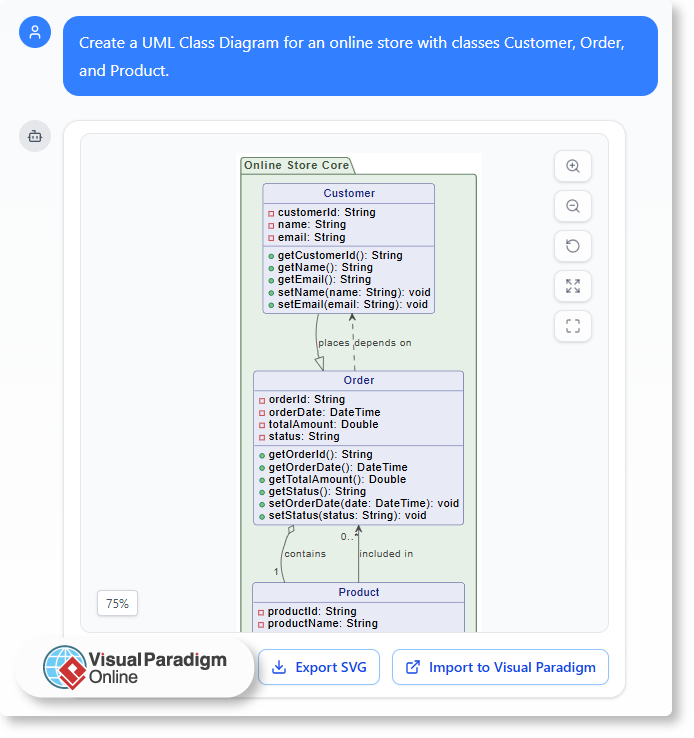
「為一個線上商店建立一個 UML 類別圖,包含 Customer、Order 和 Product 類別。」

幾秒內,工具即可生成結構完整、可立即編輯的圖表。
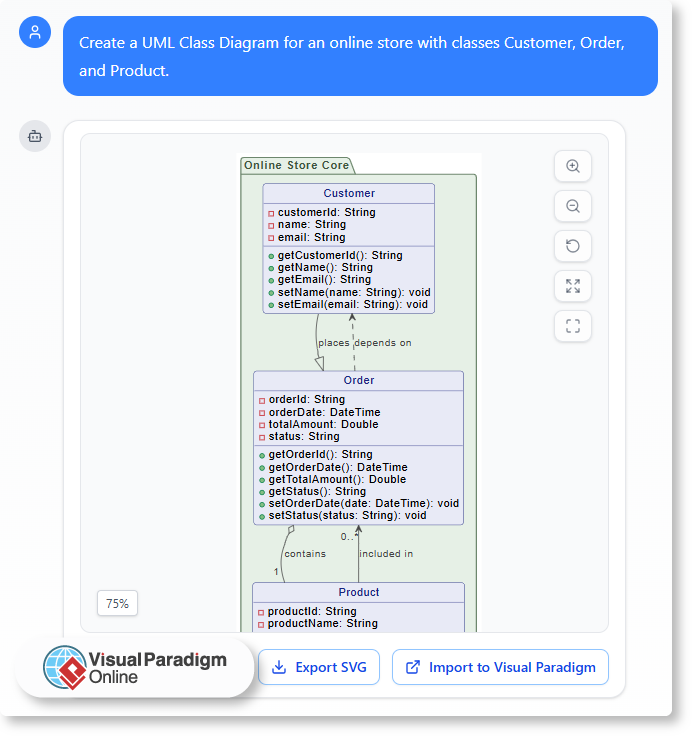
UML Class Diagram for an online store with classes Customer, Order, and Product.

優勢:

  • 即時成果:瞬間生成完整圖表。
  • 無需建模專業知識:AI 自動處理語法與結構。
  • 非常適合腦力激盪:快速呈現初期構想或比較多個版本。

挑戰:

  • 對版面控制較少:AI 重視準確性,而非展示美學。
  • 創造性微調有限:部分客製化仍需手動編輯。
  • 依賴提示清晰度:結果會因請求描述的清晰程度而異。

AI 繪圖在速度、易用性與自動化方面表現出色——尤其適合快速迭代或概念驗證。

尋找平衡:為什麼您需要兩者兼具

与其選擇一種方法,現代工作流程最受益於人工輔助的自動編輯。
Visual Paradigm Online 的 AI 聊天機器人將兩者整合於單一環境中:

從 AI 生成開始——立即從文字創建您的基本圖表。

  • 向 AI 提出調整或說明——例如「新增繼承關係」或「解釋此互動」。
  • 切換至手動編輯——直接在編輯器中優化、重新定位並設定元素樣式。

這種混合方法在保留完全控制權的同時節省時間,讓您從構思到最終文件撰寫都能保持高效。

實際應用案例

  • 軟體設計師:使用 AI 撰寫 UML 圖表,再手動微調以獲得精確的系統文件。
  • 業務分析師:為會議生成 BPMN 或流程圖,再優化關鍵步驟以確保清晰。
  • 學生與教育工作者:透過即時範例與反饋,更快掌握 UML 或流程建模。

每個應用案例都能受益於 AI 的效率,同時不損失手動精確度——這種平衡對專業與教育環境皆為理想之選。

Visual Paradigm Online 為兩者之優勢結合

Visual Paradigm Online 提供一個整合的建模工作區,可順暢支援 AI 輔助創作與手動優化。
您可以:

  1. 從自然語言提示生成圖表。
  2. 請求基於 AI 的說明或改進。
  3. 在視覺編輯器中手動編輯每個元素。
  4. 立即於雲端儲存並分享您的工作。

透過整合自動化與人類創意,確保您的工作流程既快速又靈活——且不犧牲品質或清晰度。

結論

AI 與手動繪圖各有獨特優勢。手動設計提供精確性與控制力;AI 則帶來速度與簡便。
Visual Paradigm Online 的 AI 聊天機器人結合兩者,讓您快速啟動、輕鬆優化,並在更短時間內交付專業成果。
無論您是設計系統、繪製流程,還是學習 UML,這種平衡都能確保您的圖表真正契合您的工作流程。
將AI圖表生成融入您的日常工作流程

現代專案需要清晰、速度與協作——但將想法轉化為視覺圖表往往比預期耗時更長。無論您是在記錄流程、解釋概念,還是規劃新系統,製作圖表都會消耗寶貴時間。這正是AI工具(如Visual Paradigm Online AI聊天機器人)重新定義工作流程之處。

透過理解自然語言並生成可編輯的圖表,聊天機器人改變了您的工作方式——從概念到完成。

更聰明的開始一天的方式

不必從一張空白畫布開始,您可以從對話開始。用簡單語言描述您的想法或工作流程,讓AI為您生成第一版。

例如:

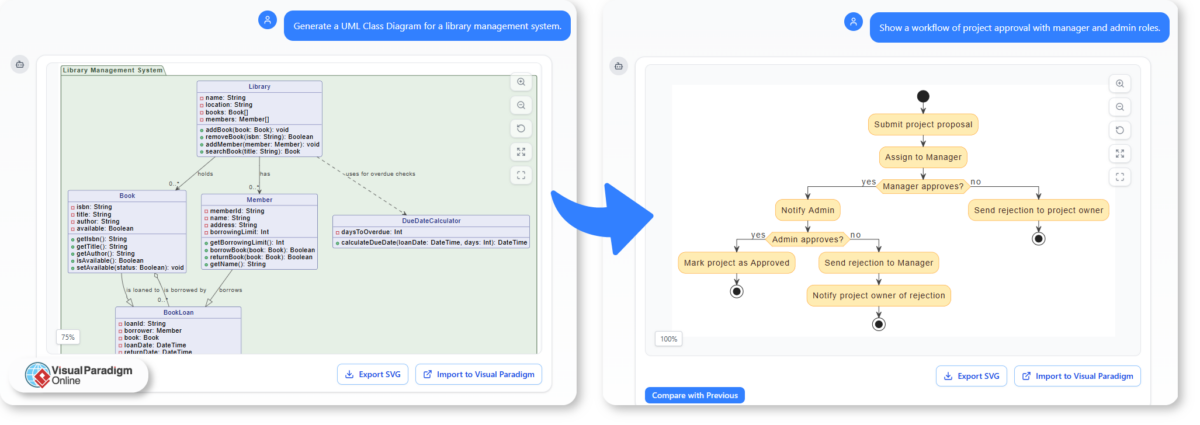
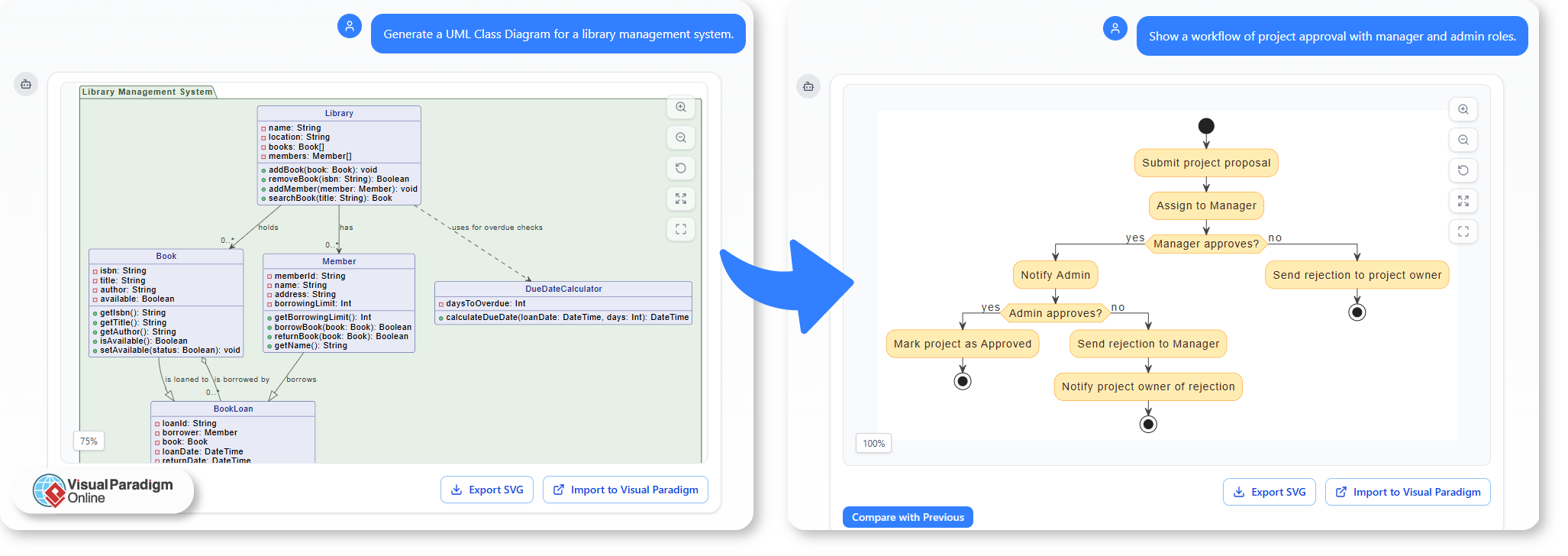
  • 「為圖書館管理系統生成一個UML類圖。」
  • 「展示包含經理與管理員角色的專案核准流程。」

這些提示可立即產生結構化圖表,您可在Visual Paradigm Online圖表編輯器中進一步優化。

A Smarter Way to Start Your Day with AI Chatbot

將AI引入文件編制

文件編制通常涉及解釋複雜的系統或流程。AI圖表生成透過將文字描述轉化為視覺化內容,簡化此過程,提升理解力。

您可以使用它來:

  • 直接從您的書面筆記或報告中呈現系統設計。
  • 在不需手動重繪的情況下,快速生成文件更新的視覺圖示。
  • 透過使用AI生成的範本,維持圖表之間的一致性。

這使得技術或業務文件的維護更快速且更具一致性。

支援教學與學習

教育工作者與訓練師也可將AI生成的圖表融入課程中。透過在數秒內將抽象概念轉化為視覺範例,AI有助於使學習更具互動性與成效。

例如:

  • 教師只需輸入系統描述,即可示範UML序列的運作方式。
  • 學生可以探索更改單一提示如何影響最終圖表——透過實驗學習結構。
  • 訓練教材可透過自動生成且符合課程內容的視覺內容加以豐富。

這種實踐導向的方法,彌合了理論學習與實際應用之間的差距。

加速設計規劃

在規劃系統或工作流程時,AI為團隊提供了更快的視覺化想法方式,無需等到最終定案。您可以自由腦力激盪、測試不同結構,並快速迭代,無需擔心圖表格式問題。

常見情境包括:

  • 專案規劃:視覺化團隊職責與核准流程。
  • 軟體設計:草擬系統結構與關係以供討論。
  • 流程改善:透過快速的AI草圖來繪製工作流程,以識別效率低下的地方。

一旦基礎結構完成,便可在 VP Online 中協作進行微調。

讓AI融入你的日常

將AI融入你的工作流程,並非取代創造力——而是消除障礙。透過自動化結構建立,AI讓你專注於邏輯、流程與溝通。

在日常工作中,這意味著:

  • 花在手動繪圖上的時間更少。
  • 直接從你的語言中產生更清晰的圖表。
  • 文件、課程與設計計畫的完成速度更快。

更高效的工作方式

Visual Paradigm OnlineAI聊天機器人讓繪製圖表成為你日常流程的一部分——快速、靈活且智慧。無論你是教師、分析師或設計師,只需一次簡單對話,就能將日常想法轉化為專業視覺內容。

為什麼自然語言在軟體設計中至關重要

如何透過白話英文讓團隊更緊密——以及人工智慧如何將其轉化為結構化圖表

軟體設計長期依賴專業符號、圖表與技術文件。但在這些東西出現之前,想法通常從簡單的對話開始:「使用者登入並檢視其儀表板。」問題在於,將這些日常描述轉化為正式模型時,經常會產生混淆或不一致。

自然語言——若運用得當——能彌合這道鴻溝,促進跨團隊更順暢的合作與更快的理解。如今,在人工智慧的協助下,白話英文可立即轉化為正式且視覺化的呈現。

軟體設計中的語言障礙

設計師、開發人員與業務利益相關者經常使用不同的「語言」。

  • 開發人員以類別、組件與 API 的觀點思考。
  • 分析師撰寫需求與使用案例。
  • 客戶以白話描述目標與使用者經驗。

若缺乏共通語言,溝通便會支離破碎。技術精確性固然重要,但也可能讓非技術成員感到疏離,而他們需要理解系統行為。自然語言提供了這座橋樑——一種易於理解且中立的媒介,讓所有人能在深入結構之前保持一致。

從白話描述到清晰設計

使用自然語言描述系統能促進清晰度。當團隊成員必須以言語解釋某事物如何運作時以言語,他們經常發現遺漏的步驟、權責不明或隱藏的依賴關係。

例如,將一個流程描述為:

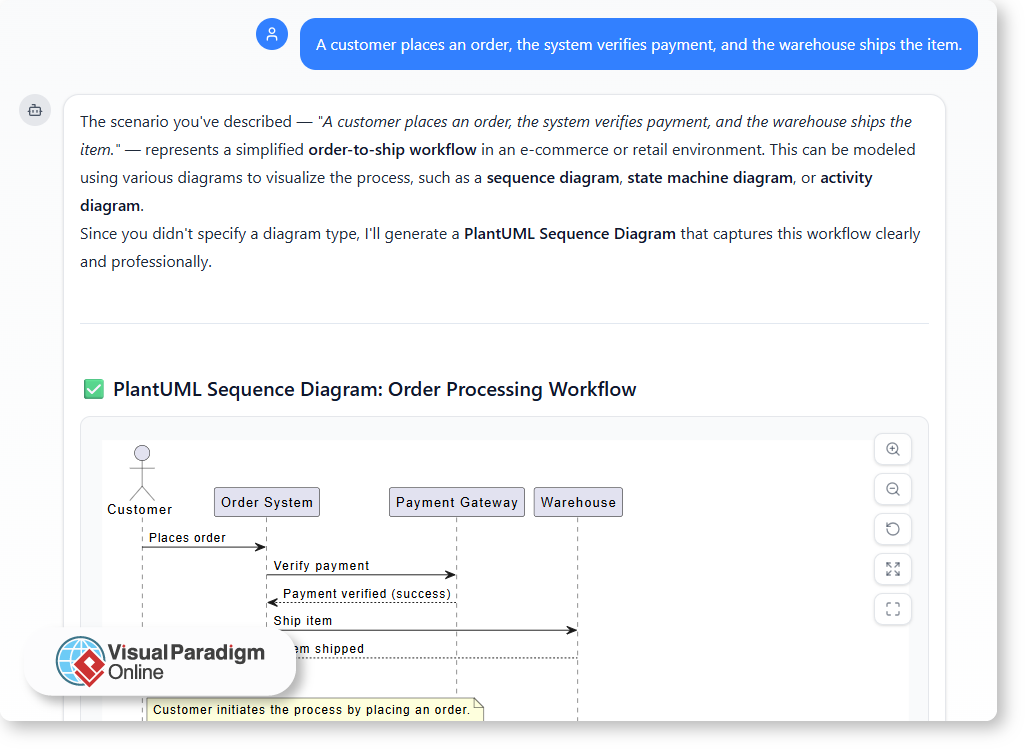
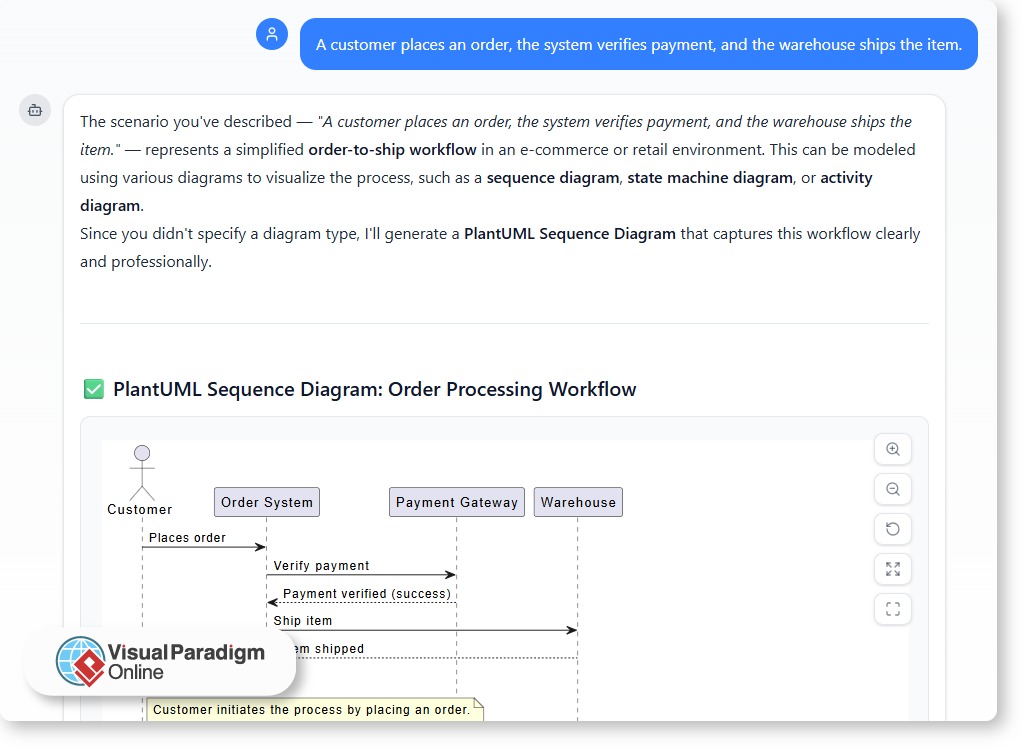
「一位客戶下訂單,系統驗證付款,倉庫發貨。」

這已暗示了流程、角色與動作順序。但要將其轉化為正式圖表——例如使用案例或序列模型——需要進一步解讀。這正是人工智慧驅動工具發揮作用之處。

人工智慧如何解讀自然語言

現代人工智慧建模助手,例如Visual Paradigm Online,利用自然語言處理技術分析白話描述,並生成對應的圖表。你只需用自己的話描述流程,人工智慧便能識別關鍵參與者、關係與互動。

例如:

  • 「使用者登入」→ 建立參與者與使用案例。
  • 「系統發送確認郵件」→ 增加一次互動。
  • 「經理審核報告」→ 引入另一個角色與流程。

短短幾秒內,你就能看到你的文字轉化為符合標準符號的視覺化模型。它讓技術結構清晰可見,同時對所有參與最初描述的人而言都容易理解。

透過共同理解提升協作

當自然語言作為起點時,團隊能更自然地溝通,並減少不必要的假設。AI透過扮演人類意圖與正式結構之間的翻譯者,來支援此過程。

結果顯而易見:

  • 清晰度:每個人都能理解系統,而無需閱讀複雜的規格說明。
  • 一致性:AI確保關係與元件之間邏輯連接。
  • 速度:從構想到視覺化的过程幾乎瞬間完成。
  • 包容性:不同技術層級的利益相關者仍能有效參與。

與AI建模助手合作的另一項優勢在於,完整的對話歷史可以共享每個提示與回應都記錄了模型的演進過程——從最初的構想到精煉的圖表。這個共享的紀錄讓團隊成員更容易回顧過去的討論,理解設計的邏輯,並在不遺失上下文的情況下繼續協作。

圖表的建立不再僅限於技術專家,而成為一個透明且共享的過程,讓每個人都能貢獻並保持一致。

現代設計中對話的力量

軟體設計正變得更具對話性。團隊不再需要填寫模板或手動繪製圖表,而是可以自然地描述想法,並讓AI協助整理結構。這種對話式方法減少摩擦,促進協作,幫助團隊更快達成共識。

在像Visual Paradigm 的 AI 聊天機器人這個概念在這些平台上得以實現。它會聆聽、理解並建模——將您的句子轉化為結構化且符合標準的視覺圖表。

從文字到圖表,從構想到系統

自然語言並非正式建模的替代品——而是其基礎。透過以清晰的文字表達想法,並讓AI負責轉換為視覺形式,團隊既能獲得理解,也能確保精確性。

軟體設計的核心本質是一種溝通過程。在AI工具的支援下,普通英文從未如此強大,能將人與系統緊密連結。

Why Natural Language Matters in Software Design

How plain English brings teams closer — and how AI turns it into structured diagrams

Software design has long relied on specialized notations, diagrams, and technical documentation. But before any of that exists, ideas usually start as simple conversations: “The user logs in and views their dashboard.” The challenge is that translating those everyday descriptions into formal models often introduces confusion or inconsistency.

Natural language — when used effectively — helps bridge that gap, enabling smoother collaboration and faster understanding across diverse teams. And now, with the help of AI, plain English can be instantly transformed into formal, visual representations.

The Language Barrier in Software Design

Designers, developers, and business stakeholders often speak in different “languages.”

  • Developers think in terms of classes, components, and APIs.
  • Analysts write requirements and use cases.
  • Clients describe goals and user experiences in plain terms.

Without a shared language, communication becomes fragmented. Technical precision is important, but it can also alienate non-technical members who need to understand system behavior. Natural language provides that bridge — an accessible, neutral medium that keeps everyone aligned before diving into structure.

From Plain Description to Clear Design

Using natural language to describe systems encourages clarity. When team members must explain how something works in words, they often uncover missing steps, unclear ownership, or hidden dependencies.

For instance, describing a process as:

“A customer places an order, the system verifies payment, and the warehouse ships the item.”

Already suggests a flow, roles, and order of actions. But turning that into a formal diagram — such as a use case or sequence model — requires interpretation. That is where AI-driven tools step in.

Why Natural Language Matters in Software Design

How AI Interprets Natural Language

Modern AI modeling assistants, such as the one in Visual Paradigm Online, use natural language processing to analyze plain descriptions and generate corresponding diagrams. You simply describe the process in your own words, and the AI identifies key actors, relationships, and interactions.

For example:

  • “User logs in” → creates an actor and use case.
  • “System sends confirmation email” → adds an interaction.
  • “Manager reviews report” → introduces another role and process flow.

In seconds, you can see your text transformed into a visual model that follows standard notation. It makes technical structure visible, yet accessible to everyone who contributed to the initial description.

Improving Collaboration Through Shared Understanding

When natural language serves as the starting point, teams communicate more naturally and make fewer assumptions. AI supports this by acting as a translator between human intent and formal structure.

The results are clear:

  • Clarity: Everyone understands the system without needing to read complex specifications.
  • Consistency: The AI ensures relationships and elements are logically connected.
  • Speed: The process from idea to visualization is almost instant.
  • Inclusivity: Stakeholders with different technical levels can still participate meaningfully.

Another advantage of working with an AI modeling assistant is that the entire chat history can be shared. Each prompt and response documents how the model evolved — from initial ideas to refined diagrams. This shared record makes it easier for teammates to review past discussions, understand design rationale, and continue collaboration without losing context.

Instead of being a tool reserved for technical experts, diagram creation becomes a transparent, shared process where everyone can contribute and stay aligned.

The Power of Conversation in Modern Design

Software design is becoming more conversational. Instead of filling templates or manually creating diagrams, teams can now describe ideas naturally and let AI assist in structuring them. This conversational approach reduces friction, encourages collaboration, and helps teams reach consensus faster.

In platforms like Visual Paradigm’s AI Chatbot, that concept comes to life. It listens, understands, and models — turning your sentences into structured, standards-compliant visuals.

From Words to Diagrams, and Ideas to Systems

Natural language is not a replacement for formal modeling — it is the foundation. By expressing ideas clearly in words and allowing AI to handle translation into visual form, teams gain both understanding and precision.

Software design is, at its core, a communication process. And with the support of AI-powered tools, plain English has never been more powerful in bringing people and systems together.

Integrating AI Diagram Generation into Your Daily Workflow

Modern projects demand clarity, speed, and collaboration — but turning ideas into visuals often takes longer than expected. Whether you are documenting a process, explaining a concept, or planning a new system, creating diagrams can consume valuable time. This is where AI-powered tools like the Visual Paradigm Online AI Chatbot redefine the workflow.

By understanding natural language and generating ready-to-edit diagrams, the chatbot transforms how you work — from concept to completion.

A Smarter Way to Start Your Day

Instead of beginning with a blank canvas, you can start with a conversation. Describe your idea or workflow in plain language, and let AI create the first version for you.

For example:

  • “Generate a UML Class Diagram for a library management system.”
  • “Show a workflow of project approval with manager and admin roles.”

These prompts instantly produce structured diagrams that you can refine in the Visual Paradigm Online Diagram Editor.

Integrating AI Diagram Generation into Your Daily Workflow

Bringing AI into Documentation

Documentation often involves explaining complex systems or processes. AI diagram generation simplifies this by turning written descriptions into visuals that enhance understanding.

You can use it to:

  • Illustrate system design directly from your written notes or reports.
  • Generate quick visuals for documentation updates without redrawing manually.
  • Maintain consistency across diagrams by using AI-generated templates.

This makes maintaining technical or business documentation faster and more consistent.

Supporting Teaching and Learning

Educators and trainers can also integrate AI-generated diagrams into their lessons. By turning abstract ideas into visual examples within seconds, AI helps make learning more interactive and effective.

For instance:

  • Teachers can demonstrate how a UML sequence works by simply typing a system description.
  • Students can explore how changing a single prompt affects the resulting diagram — learning structure through experimentation.
  • Training materials can be enriched with automatically generated visuals that match the lesson content.

This hands-on approach bridges theoretical learning and practical application.

Accelerating Design Planning

When planning systems or workflows, AI gives teams a faster way to visualize ideas before finalizing them. You can brainstorm freely, test different structures, and iterate quickly without worrying about diagram formatting.

Common scenarios include:

  • Project planning: Visualize team responsibilities and approval processes.
  • Software design: Draft system structures and relationships for discussion.
  • Process improvement: Identify inefficiencies by mapping workflows through quick AI drafts.

Once the base structure is ready, it can be fine-tuned collaboratively in VP Online.

Making AI Part of Your Routine

Integrating AI into your workflow is not about replacing creativity — it is about removing barriers. By automating structure creation, AI lets you focus on logic, flow, and communication.

In your daily work, that means:

  • Fewer hours spent drawing manually.
  • Clearer diagrams created directly from your own language.
  • Faster turnaround for documentation, lessons, and design plans.

A More Efficient Way to Work

The Visual Paradigm Online AI Chatbot makes diagramming an integrated part of your daily routine — quick, flexible, and intelligent. Whether you are a teacher, analyst, or designer, you can turn everyday ideas into professional visuals with a simple conversation.

AI vs. Manual Diagramming: Which Fits Your Workflow?

For years, creating diagrams meant manually dragging shapes, aligning connectors, and labeling components. It was precise but time-consuming.
Now, AI-powered tools like the Visual Paradigm Online AI Chatbot have transformed how diagrams are made — turning text prompts into complete UML, BPMN, or flow diagrams in seconds.

But which method fits your workflow better: AI or manual diagramming? Let us explore the pros and cons of each, and how combining both delivers optimal results.

Manual Diagramming: Total Control with More Effort

Manual diagramming has long been the standard approach for professionals. It gives full creative freedom — every element, layout, and connection is crafted exactly as intended.

Advantages:

  • Full design control: You decide the layout, naming, and visual details.
  • Better conceptual understanding: Drawing shapes manually deepens comprehension of system logic.
  • High customization: Ideal for refining presentations and meeting specific visual standards.

Challenges:

  • Time-consuming: Complex diagrams can take hours to perfect.
  • Repetitive adjustments: Minor changes may require extensive rearrangement.
  • Steep learning curve: Beginners often struggle with modeling notation and best practices.

Manual diagramming remains valuable for experienced modelers who need accuracy, but it demands more time and effort.

AI Diagramming: Speed and Simplicity at Scale

AI-driven diagramming tools like Visual Paradigm Online’s AI Chatbot use natural language to create diagrams automatically.
You simply describe what you need — for example:

“Create a UML Class Diagram for an online store with classes Customer, Order, and Product.”

Within seconds, the tool generates a structured, ready-to-edit diagram.

AI vs. Manual Diagramming: Which Fits Your Workflow?

Advantages:

  • Instant results: Generate complete diagrams in moments.
  • No modeling expertise required: AI handles syntax and structure automatically.
  • Great for brainstorming: Quickly visualize early-stage ideas or compare multiple versions.

Challenges:

  • Less control over layout: AI focuses on accuracy, not presentation aesthetics.
  • Limited creative fine-tuning: Some customization still requires manual editing.
  • Dependent on prompt clarity: Results vary with how well the request is described.

AI diagramming excels in speed, accessibility, and automation — especially useful for quick iterations or concept validation.

Finding the Balance: Why You Need Both

Rather than choosing one approach, modern workflows benefit most from AI-assisted manual editing.
The Visual Paradigm Online AI Chatbot integrates both worlds in a single environment:

Start with AI generation — instantly create your base diagram from text.

  • Ask AI for adjustments or explanations — such as “Add an inheritance relationship” or “Explain this interaction.”
  • Switch to manual editing — refine, reposition, and style elements directly in the editor.

This hybrid approach saves time while preserving full control, allowing you to stay productive from brainstorming to final documentation.

Real-World Use Cases

  • Software Designers: Use AI to draft UML diagrams, then fine-tune manually for precise system documentation.
  • Business Analysts: Generate BPMN or flowcharts for meetings, then refine key steps for clarity.
  • Students & Educators: Learn UML or process modeling faster with real-time examples and feedback.

Each use case benefits from AI efficiency without losing manual precision — a balance ideal for professional and educational environments alike.

The Best of Both Worlds with Visual Paradigm Online

Visual Paradigm Online provides an integrated modeling workspace that supports AI-assisted creation and manual refinement seamlessly.
You can:

  1. Generate diagrams from natural-language prompts.
  2. Request AI-based explanations or improvements.
  3. Edit every element manually in the visual editor.
  4. Save and share your work in the cloud instantly.

By merging automation and human creativity, it ensures your workflow is both fast and flexible — without sacrificing quality or clarity.

Conclusion

AI and manual diagramming each have unique strengths. Manual design offers precision and control; AI provides speed and simplicity.
The Visual Paradigm Online AI Chatbot combines both, allowing you to start fast, refine easily, and deliver professional results in less time.
Whether you are designing systems, mapping processes, or learning UML, this balance ensures your diagrams truly fit your workflow.