支援 TOGAF ADM 的 ArchiMate 完整教程

ArchiMate 簡介

ArchiMate 是一種開放且獨立的企業架構建模語言,可用於描述、分析和可視化跨業務領域的架構。它旨在為利益相關者提供一種清晰且無歧義的方式來溝通複雜的架構。當與 TOGAF 架構開發方法(ADM)結合使用時,ArchiMate 尤為有用,可提供一種標準化的方式來建模和溝通企業架構。
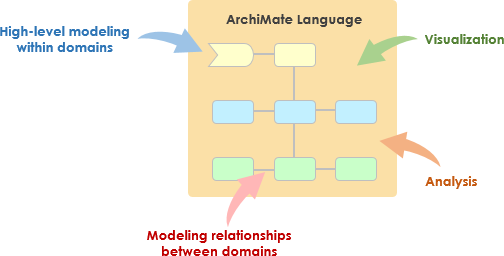
What is ArchiMate?

ArchiMate 的核心概念

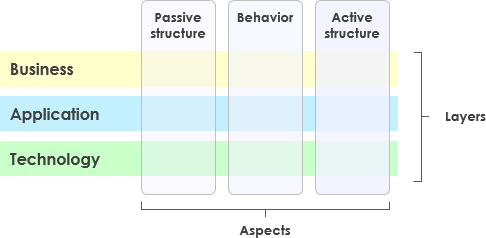
ArchiMate Core Framework

1. ArchiMate 的層級

ArchiMate 將企業架構分為三個主要層級:

  • 業務層:專注於支援組織目標的業務流程、服務和功能。
  • 應用層:處理支援業務層的應用服務、組件及其互動。
  • 技術層:涵蓋技術基礎設施,包括支援應用層的硬體、軟體和網路組件。

2. 核心元素

ArchiMate 定義了若干核心元素,用於建模架構:

  • 主動結構元素:代表執行行為的實體,例如業務參與者、應用組件和裝置。
  • 行為元素:代表架構內的流程、功能、服務和互動。
  • 被動結構元素:代表由行為元素使用或產生的資訊或資料,例如業務物件和資料物件。

3. 關係

ArchiMate 定義了多種關係類型,用於連接各個元素:

  • 結構關係:例如組成、聚合和特殊化。
  • 依賴關係:例如關聯、實現和被使用。
  • 動態關係: 例如觸發和流程。

4. 觀點

ArchiMate 提供多種觀點,以從不同角度呈現架構:

  • 業務流程觀點: 展示業務流程及其互動。
  • 應用合作觀點: 展示應用程式如何合作以支援業務流程。
  • 技術實現觀點: 展示技術元件如何實現應用元件。

ArchiMate 與 TOGAF ADM

TOGAF 架構開發方法(ADM)

TOGAF ADM 是一種全面的企業架構開發方法。它包含多個階段,每個階段專注於架構開發過程的特定方面。ArchiMate 透過提供標準化的方式,在每個階段對架構進行建模與可視化,以支援 TOGAF ADM。
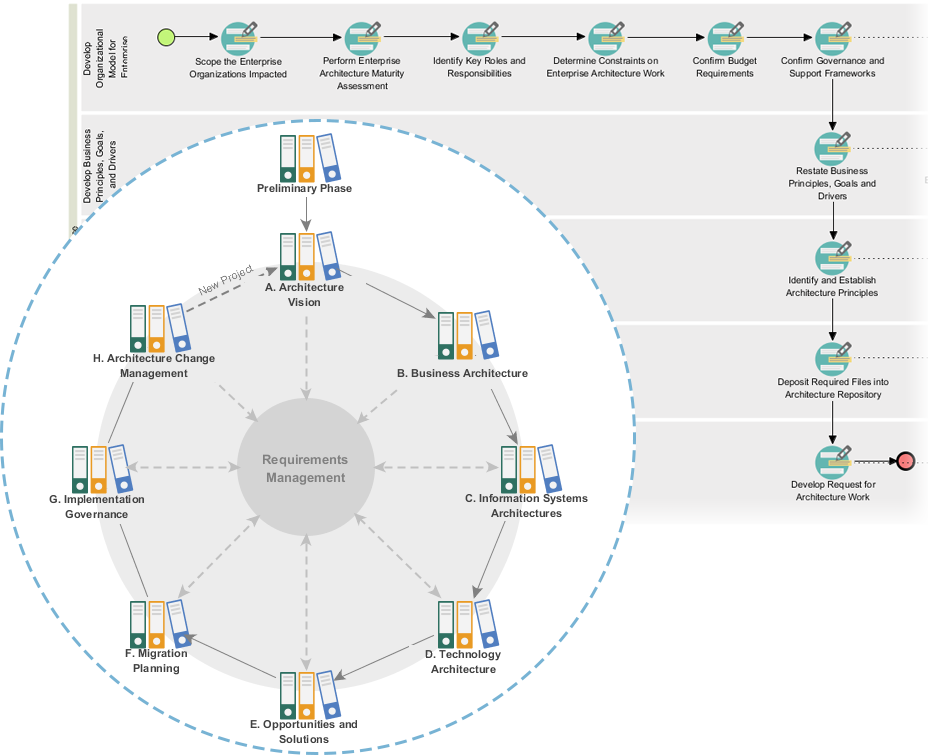
Powerful TOGAF ADM Toolset

TOGAF ADM 的階段

  1. 初步階段: 建立架構原則、架構框架與治理。
  2. 架構願景: 定義範圍、利害關係人、關注事項與業務目標。
  3. 業務架構: 開發業務架構,包括業務流程與服務。
  4. 資訊系統架構: 開發資料與應用架構。
  5. 技術架構: 開發技術架構。
  6. 機會與解決方案: 識別並優先處理架構專案。
  7. 遷移規劃: 制定遷移與實施計畫。
  8. 實施治理: 提供架構實施的治理與支援。

ArchiMate模型範例

此圖示說明了一個醫療管理系統的分層架構,分為兩個主要層級:應用層以及技術層以下是各元件及其互動的詳細說明:
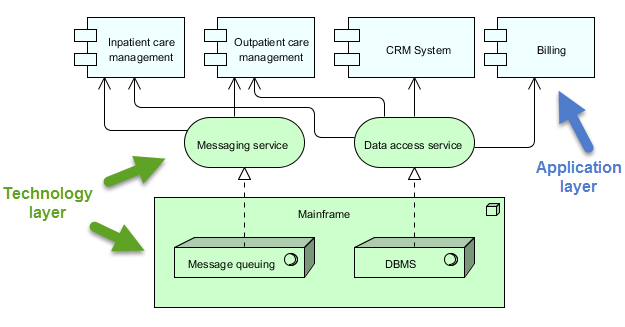
archimate diagram example

應用層(藍色)

此層由各種直接與使用者或其他系統互動以管理醫療服務的應用程式與系統組成。此層的主要元件包括:

  1. 住院照護管理:

    • 管理與住院患者相關的服務與流程。
  2. 門診照護管理:

    • 管理前往醫院接受治療但未住院的患者的服務與流程。
  3. CRM系統(客戶關係管理):

    • 管理與患者的互動,包括溝通、追蹤以及患者關係管理。
  4. 帳單:

    • 處理財務相關事務,包括生成帳單、處理付款以及管理財務紀錄。

技術層(綠色)

此層提供支援應用層中應用程式之基礎架構與服務。此層的主要元件包括:

  1. 訊息服務:

    • 促進醫療管理系統內不同應用程式與系統之間的溝通。
    • 確保訊息能可靠且依正確順序傳遞。
  2. 資料存取服務:

    • 提供一個集中式的資料存取與管理方式,以貫穿整個系統。
    • 確保資料能有效且安全地被存取與儲存。
  3. 主機:

    • 用於主機核心服務和資料的中央運算系統。
    • 包含兩個主要組件:
      • 訊息排隊:管理訊息的排隊與處理,以確保可靠通訊。
      • 資料庫管理系統(DBMS):儲存並管理各應用程式所使用的資料。

互動

  • 住院照護管理門診照護管理客戶關係管理系統,以及計費訊息服務以及資料存取服務以執行各自的功用。
  • 訊息服務以及資料存取服務依賴主機提供核心服務,例如訊息排隊與資料庫管理。
  • 主機確保訊息正確處理且資料有效管理,支援整個系統的運作。

此圖示描述了一種透過將應用層功能與基礎技術基礎設施分離,來管理醫療服務的結構化方法。這種分離使得系統設計更具模組化與可維護性,其中一個層級的變更對另一層級的影響極小。訊息服務資料存取服務作為中介者,促進應用組件與主機之間的通訊與資料管理。

推薦的 ArchiMate EA 工具

Visual Paradigm 廣受認可,被視為企業架構(EA)專案中 ArchiMate 建模的最佳工具之一。以下是它被高度推薦的原因:
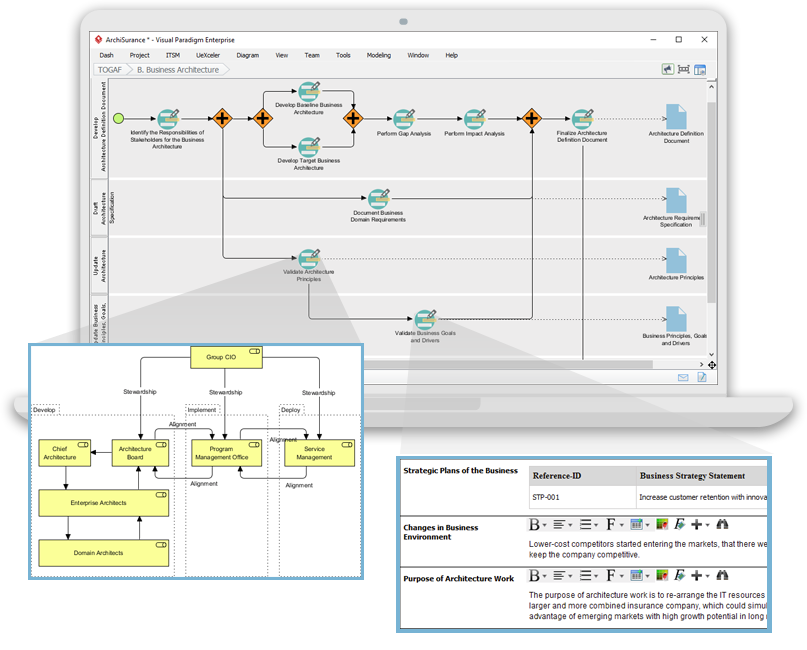
Navigating TOGAF: Your Guide to the ADM Process - Visual Paradigm Guides

1. 全面的 ArchiMate 支援

  • 完整的 ArchiMate 標準:Visual Paradigm 支援最新的 ArchiMate 標準,包括 ArchiMate 3.1,確保您能使用所有官方的 ArchiMate 元素與關係進行建模。
  • 豐富的元素庫:它提供廣泛的 ArchiMate 符號庫,讓您輕鬆建立詳細且精確的模型。

2. 使用者友善介面

  • 直覺設計:該工具提供易於導航的使用者友善介面,即使是初次接觸 ArchiMate 建模的使用者也能輕鬆上手。
  • 拖曳放置:拖曳放置功能可快速且高效地建立模型。

3. 進階建模功能

  • 分層檢視:支援建立分層檢視(例如:業務、應用、技術),以提供企業架構的整體視角。
  • 跨層關係:可輕鬆定義並視覺化架構中不同層級之間的關係。

4. 協作與分享

  • 團隊協作:Visual Paradigm 支援協作工作,允許多個使用者同時在相同專案上進行作業。
  • 版本控制:內建的版本控制功能可協助管理變更並追蹤模型的演進。

5. 整合能力

  • 工具整合:可與其他工具和平台(例如 JIRA、Confluence 和各種資料庫)無縫整合,提升整體企業架構實務。
  • 匯入/匯出:支援以多種格式匯入和匯出模型,包括 ArchiMate 交換檔案格式,確保與其他工具的相容性。

6. 文件編製與報告

  • 自動化文件編製:從您的 ArchiMate 模型自动生成完整文件,節省時間並確保一致性。
  • 自訂報告:允許根據特定利害關係人的需求建立自訂報告。

7. 培訓與支援

  • 豐富的資源:提供大量教學、指南與範例,協助使用者快速上手並精通 ArchiMate 模型設計。
  • 客戶支援:提供強大的客戶支援,協助解決可能出現的任何問題或疑問。

8. 可擴展性

  • 可擴展的解決方案:適用於中小型與大型企業架構專案,是各規模組織的多功能工具。

9. 合規性與標準

  • 產業標準:符合產業標準與最佳實務,確保您的企業架構模型合規且保持最新。

結論

ArchiMate 提供一種強大且標準化的企業架構建模方式,支援 TOGAF ADM 方法論。透過理解 ArchiMate 中的關鍵概念、層級、元素與關係,您能有效建模並向利害關係人傳達複雜的架構。所提供的範例說明了如何運用 ArchiMate 建模業務流程、應用協作與技術實現,以支援 TOGAF ADM 的各個階段。

ArchiMate 工具資源

  1. 免費線上 ArchiMate 圖示工具

    • 描述:使用支援 ArchiMate 3 視覺化模型語言的免費工具,在線上建立 ArchiMate 圖示。內含範例與範本,協助您快速上手。
    • 網址免費線上 ArchiMate 圖示工具 1
  2. 首頁 – 免費的 ArchiMate 資源

    • 描述:提供一種視覺化語言,用於建模與捕捉企業架構,並提供一種方式來視覺化不同領域之間及內部的關係。
    • 網址首頁 – 免費的 ArchiMate 資源 2
  3. Visual Paradigm – UML、敏捷、PMBOK、TOGAF、BPMN 等更多

  4. 第七章. ArchiMate – Visual Paradigm 社群圈

  5. 什麼是 ArchiMate?

    • 描述: 逐步學習指南,介紹如何使用 ArchiMate 進行企業架構建模。
    • 網址什麼是 ArchiMate? 5
  6. ArchiMate 工具

    • 描述: 學習如何使用 Visual Paradigm,這是一款專為敏捷軟體團隊設計的設計與管理工具。
    • 網址ArchiMate 工具 6
  7. 最佳 ArchiMate 軟體

    • 描述: 經認證的 ArchiMate 工具,用於有效的企業架構設計與建模。可快速繪製符合開放組織官方規範的 ArchiMate 圖表。
    • 網址最佳 ArchiMate 軟體 7
  8. 如何格式化 ArchiMate 元素?

  9. ArchiMate 觀點指南 – 資源地圖觀點

  10. ArchiMate 圖示教程

    • 描述: 教程幫助您了解 ArchiMate 圖示、如何創建它們以及何時使用它們。包含範例和技巧。
    • 網址ArchiMate 圖示教程 10

這些資源應能為使用 Visual Paradigm 的 ArchiMate 工具進行企業架構建模提供全面的起點。
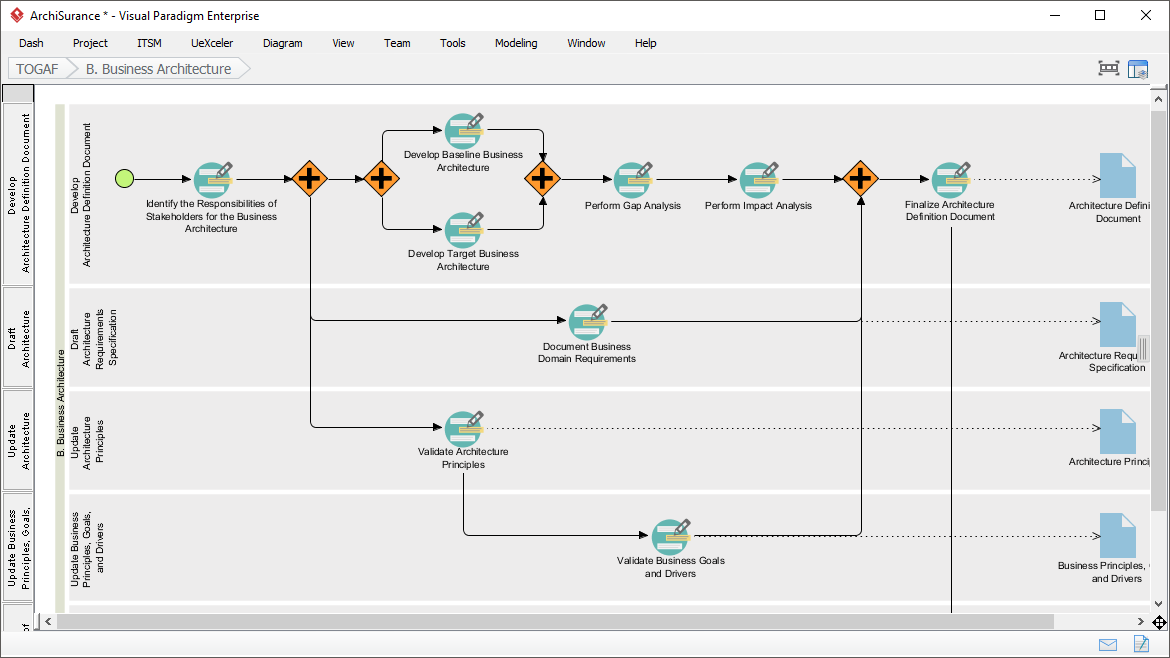
Visual Paradigm 的 TOGAF 導引流程全面指南

簡介

Visual Paradigm 的 TOGAF 導引流程是一項強大的工具,旨在簡化 TOGAF 架構開發方法(ADM)的採用。它提供逐步指導、操作說明和實際案例,以支援企業架構的發展。本全面指南將探討 Visual Paradigm 的 TOGAF 導引流程的關鍵功能、優勢及應用領域,並突出其在企業架構領域中的獨特之處。

Transform Your Business with Visual Paradigm and TOGAF - Visual Paradigm Guides

主要功能

  1. 逐步指導:

    • 導引流程為 TOGAF ADM 的每個階段提供詳細的逐步說明,確保使用者能輕鬆應對企業架構發展的複雜性。1112.
  2. 與 ArchiMate 的整合:

    • Visual Paradigm 支援 ArchiMate 與 TOGAF ADM 的整合,為企業架構計畫提供強大的組合。ArchiMate 3 擁有靈活的符號系統,使架構師能有效表達複雜的模型。1314.
  3. 自動化任務管理:

    • 該工具透過自動化任務管理與通知功能,提升整個流程效率,使使用者能逐步且協作式地開發架構交付成果。15.
  4. 視覺化流程地圖:

    • 該軟體具備視覺化流程地圖,協助使用者輕鬆導航整個企業架構流程。它提供完整的規劃、設計與開發工具,以完成 ADM 活動。14.
  5. 全面工具包:

    • Visual Paradigm 提供一系列專為 ADM 活動設計的工具,包括用於建模企業架構中業務、資訊科技與實體面向的 ArchiMate 圖表。這些工具提供架構的全面視圖,使 TOGAF 的理解與實踐更加容易。14.

優勢

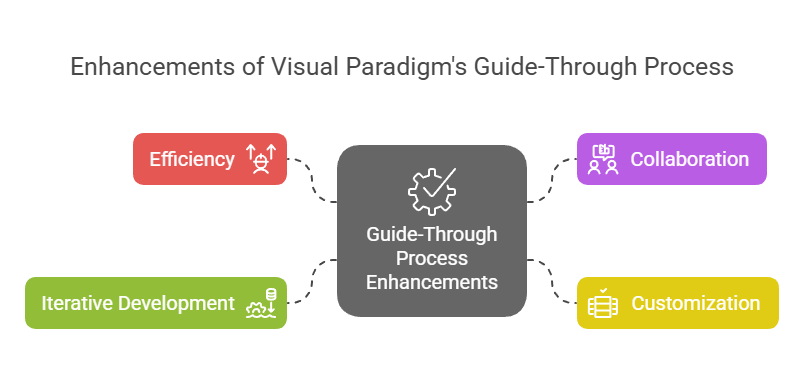
Enhancements of Visual Paradigm's Guide-Through Process: Visual Paradigm

  1. 效率:

    • 導引流程顯著提升了效率,透過提供明確的指示並自動化任務,使使用者能夠專注於戰略決策,而非程序性細節11.
  2. 協作:

    • 該工具促進了不同利益相關者之間的協作,包括專案所有者、業務分析師、企業架構師及IT專業人員。這種協作方式確保所有各方在架構開發過程中始終參與並保持資訊透明15.
  3. 客製化:

    • Visual Paradigm的工具支援客製化,使組織能夠根據自身需求與目標調整ADM流程。這種彈性確保架構開發流程與組織的獨特需求相符11.
  4. 迭代式開發:

    • TOGAF ADM的迭代特性完全由Visual Paradigm的導引流程支援。這使實務人員能夠根據不斷演變的信息需求與利益相關者反饋,調整並優化其工作,確保架構能滿足組織不斷變化的需要16.

應用領域

  1. 企業架構開發:

    • 主要應用領域為企業架構開發,導引流程協助組織設計、規劃、執行與治理其企業架構。它提供一種結構化的方法,有效將業務目標與IT策略對齊17.
  2. 數位轉型:

    • 該工具對於數位轉型計畫至關重要,組織透過實施新技術和流程來提升客戶體驗和營運效率18.
  3. 戰略規劃:

    • Visual Paradigm 的導引流程支援戰略規劃,透過提供一個全面的架構願景發展、定義範圍、識別利害關係人以及制定溝通計畫的架構。這確保架構開發過程與企業目標和戰略動力保持一致19.
  4. 敏捷方法:

    • 該工具整合敏捷方法與 UML,為企業架構開發提供全面的解決方案。此整合確保架構開發過程兼具彈性與效率,支援組織內部的敏捷實踐14.

結論

Visual Paradigm 的 TOGAF 導引流程在支援 TOGAF ADM 方面表現出色,是一套全面且有效的工具。其逐步引導、與 ArchiMate 的整合、自動化任務管理以及協作功能,使其成為企業架構開發的無價資源。透過運用此工具,組織可提升效率、協作、客製化與迭代開發能力,最終達成企業架構目標,推動業務價值與轉型

Comprehensive Guide to Visual Paradigm’s TOGAF Guide-Through Process

Introduction

Visual Paradigm’s TOGAF Guide-Through Process is a powerful tool designed to streamline the adoption of the TOGAF Architecture Development Method (ADM). It provides step-by-step guidance, instructions, and real-life examples to support enterprise architecture development. This comprehensive guide will explore the key features, benefits, and application areas of Visual Paradigm’s TOGAF Guide-Through Process, highlighting why it stands out in the field of enterprise architecture.

Transform Your Business with Visual Paradigm and TOGAF - Visual Paradigm Guides

Key Features

  1. Step-by-Step Guidance:

    • The Guide-Through Process offers detailed, step-by-step instructions for each phase of the TOGAF ADM, ensuring that users can navigate the complexities of enterprise architecture development with ease 1112.
  2. Integration with ArchiMate:

    • Visual Paradigm supports the integration of ArchiMate with TOGAF ADM, providing a powerful combination for enterprise architecture initiatives. ArchiMate 3, with its versatile notation system, allows architects to express complex models effectively 1314.
  3. Automated Task Management:

    • The tool enhances the entire process with automated task management and notifications, enabling users to develop architecture deliverables incrementally and collaboratively 15.
  4. Visual Process Maps:

    • The software features visual process maps that help users navigate through the entire enterprise architecture process easily. It provides a full set of planning, design, and development tools to complete ADM activities 14.
  5. Comprehensive Toolkit:

    • Visual Paradigm offers a range of tools tailored for ADM activities, including ArchiMate diagrams for modeling business, IT, and physical aspects of enterprise architecture. These tools provide a comprehensive view of the architecture, making it easier to understand and implement TOGAF 14.

Benefits

Enhancements of Visual Paradigm's Guide-Through Process: Visual Paradigm

  1. Efficiency:

    • The Guide-Through Process significantly enhances efficiency by providing clear instructions and automating tasks, allowing users to focus on strategic decisions rather than procedural details 11.
  2. Collaboration:

    • The tool facilitates collaboration among different stakeholders, including project owners, business analysts, enterprise architects, and IT professionals. This collaborative approach ensures that all parties are engaged and informed throughout the architecture development process 15.
  3. Customization:

    • Visual Paradigm’s tool allows for customization, enabling organizations to tailor the ADM process to their specific needs and goals. This flexibility ensures that the architecture development process aligns with the organization’s unique requirements 11.
  4. Iterative Development:

    • The iterative nature of the TOGAF ADM is fully supported by Visual Paradigm’s Guide-Through Process. This allows practitioners to adapt and refine their work based on evolving information needs and stakeholder feedback, ensuring that the architecture meets the changing needs of the organization 16.

Application Areas

  1. Enterprise Architecture Development:

    • The primary application area is enterprise architecture development, where the Guide-Through Process helps organizations design, plan, implement, and govern their enterprise architecture. It provides a structured approach to align business goals with IT strategies effectively 17.
  2. Digital Transformation:

    • The tool is crucial for digital transformation initiatives, where organizations seek to enhance customer experience and operational efficiency through the implementation of new technologies and processes 18.
  3. Strategic Planning:

    • Visual Paradigm’s Guide-Through Process supports strategic planning by providing a comprehensive framework for developing architecture visions, defining scope, identifying stakeholders, and creating communications plans. This ensures that the architecture development process is aligned with business goals and strategic drivers 19.
  4. Agile Methodologies:

    • The tool integrates agile methodologies and UML, providing a comprehensive solution for enterprise architecture development. This integration ensures that the architecture development process is both flexible and efficient, supporting agile practices within the organization 14.

Conclusion

Visual Paradigm’s TOGAF Guide-Through Process stands out as a comprehensive and effective tool for supporting the TOGAF ADM. Its step-by-step guidance, integration with ArchiMate, automated task management, and collaborative features make it an invaluable resource for enterprise architecture development. By leveraging this tool, organizations can enhance efficiency, collaboration, customization, and iterative development, ultimately achieving their enterprise architecture goals and driving business value and transformation.

Comprehensive Tutorial for ArchiMate Supporting TOGAF ADM

Introduction to ArchiMate

ArchiMate is an open and independent enterprise architecture modeling language that supports the description, analysis, and visualization of architecture within and across business domains. It is designed to provide a clear and unambiguous way to communicate complex architectures to stakeholders. ArchiMate is particularly useful when used in conjunction with the TOGAF Architecture Development Method (ADM), providing a standardized way to model and communicate enterprise architectures.

What is ArchiMate?

Key Concepts of ArchiMate

ArchiMate Core Framework

1. Layers of ArchiMate

ArchiMate divides the enterprise architecture into three main layers:

  • Business Layer: Focuses on the business processes, services, and functions that support the organization’s goals.
  • Application Layer: Deals with the application services, components, and their interactions that support the business layer.
  • Technology Layer: Covers the technology infrastructure, including hardware, software, and network components that support the application layer.

2. Core Elements

ArchiMate defines several core elements that are used to model the architecture:

  • Active Structure Elements: Represent the entities that perform behavior, such as business actors, application components, and devices.
  • Behavior Elements: Represent the processes, functions, services, and interactions within the architecture.
  • Passive Structure Elements: Represent the information or data used or produced by behavior elements, such as business objects and data objects.

3. Relationships

ArchiMate defines several types of relationships to connect the elements:

  • Structural Relationships: Such as composition, aggregation, and specialization.
  • Dependency Relationships: Such as association, realization, and used-by.
  • Dynamic Relationships: Such as triggering and flow.

4. Viewpoints

ArchiMate provides several viewpoints to visualize the architecture from different perspectives:

  • Business Process Viewpoint: Shows the business processes and their interactions.
  • Application Cooperation Viewpoint: Shows how applications cooperate to support business processes.
  • Technology Realization Viewpoint: Shows how technology components realize application components.

ArchiMate and TOGAF ADM

TOGAF Architecture Development Method (ADM)

TOGAF ADM is a comprehensive methodology for developing enterprise architectures. It consists of several phases, each focusing on a specific aspect of the architecture development process. ArchiMate supports TOGAF ADM by providing a standardized way to model and visualize the architecture at each phase.

Powerful TOGAF ADM Toolset

Phases of TOGAF ADM

  1. Preliminary Phase: Establishes the architecture principles, framework, and governance.
  2. Architecture Vision: Defines the scope, stakeholders, concerns, and business objectives.
  3. Business Architecture: Develops the business architecture, including business processes and services.
  4. Information Systems Architectures: Develops the data and application architectures.
  5. Technology Architecture: Develops the technology architecture.
  6. Opportunities and Solutions: Identifies and prioritizes architecture projects.
  7. Migration Planning: Develops the migration and implementation plan.
  8. Implementation Governance: Provides governance and support for the implementation of the architecture.

Examples of ArchiMate Models

This diagram illustrates a layered architecture for a healthcare management system, divided into two main layers: the Application Layer and the Technology Layer. Here’s a detailed explanation of each component and their interactions:

archimate diagram example

Application Layer (Blue)

This layer consists of the various applications and systems that directly interact with users or other systems to manage healthcare services. The key components in this layer are:

  1. Inpatient Care Management:

    • Manages services and processes related to patients who are admitted to the hospital.
  2. Outpatient Care Management:

    • Manages services and processes for patients who visit the hospital for treatment but are not admitted.
  3. CRM System (Customer Relationship Management):

    • Manages interactions with patients, including communication, follow-ups, and patient relationship management.
  4. Billing:

    • Handles the financial aspects, including generating bills, processing payments, and managing financial records.

Technology Layer (Green)

This layer provides the underlying infrastructure and services that support the applications in the Application Layer. The key components in this layer are:

  1. Messaging Service:

    • Facilitates communication between different applications and systems within the healthcare management system.
    • Ensures that messages are delivered reliably and in the correct order.
  2. Data Access Service:

    • Provides a centralized way to access and manage data across the system.
    • Ensures that data is retrieved and stored efficiently and securely.
  3. Mainframe:

    • The central computing system that hosts core services and data.
    • Includes two main components:
      • Message Queuing: Manages the queuing and processing of messages to ensure reliable communication.
      • DBMS (Database Management System): Stores and manages the data used by the various applications.

Interactions

  • Inpatient Care ManagementOutpatient Care ManagementCRM System, and Billing interact with the Messaging Service and Data Access Service to perform their respective functions.
  • The Messaging Service and Data Access Service rely on the Mainframe for core services like message queuing and database management.
  • The Mainframe ensures that messages are processed correctly and data is managed efficiently, supporting the entire system’s operations.

The diagram depicts a structured approach to managing healthcare services by separating the application-level functions from the underlying technology infrastructure. This separation allows for more modular and maintainable system design, where changes in one layer have minimal impact on the other. The Messaging Service and Data Access Service act as intermediaries, facilitating communication and data management between the application components and the mainframe.

Recommended ArchiMate EA Tool

Visual Paradigm is widely recognized as one of the best tools for ArchiMate modeling in Enterprise Architecture (EA) projects. Here are some reasons why it is highly recommended:

Navigating TOGAF: Your Guide to the ADM Process - Visual Paradigm Guides

1. Comprehensive ArchiMate Support

  • Full ArchiMate Standard: Visual Paradigm supports the latest ArchiMate standards, including ArchiMate 3.1, ensuring that you can model using all the official ArchiMate elements and relationships.
  • Rich Library of Elements: It provides a extensive library of ArchiMate symbols, making it easy to create detailed and accurate models.

2. User-Friendly Interface

  • Intuitive Design: The tool offers a user-friendly interface that is easy to navigate, even for users who are new to ArchiMate modeling.
  • Drag-and-Drop: The drag-and-drop functionality allows for quick and efficient model creation.

3. Advanced Modeling Features

  • Layered Views: Supports the creation of layered views (e.g., Business, Application, Technology) to provide a holistic view of the enterprise architecture.
  • Cross-Layer Relationships: Easily define and visualize relationships across different layers of the architecture.

4. Collaboration and Sharing

  • Team Collaboration: Visual Paradigm supports collaborative work, allowing multiple users to work on the same project simultaneously.
  • Version Control: Integrated version control helps manage changes and track the evolution of your models.

5. Integration Capabilities

  • Tool Integration: Seamlessly integrates with other tools and platforms, such as JIRA, Confluence, and various databases, enhancing the overall EA practice.
  • Import/Export: Supports importing and exporting models in various formats, including ArchiMate Exchange File Format, ensuring compatibility with other tools.

6. Documentation and Reporting

  • Automated Documentation: Generates comprehensive documentation from your ArchiMate models, saving time and ensuring consistency.
  • Custom Reports: Allows for the creation of custom reports tailored to specific stakeholder needs.

7. Training and Support

  • Extensive Resources: Offers a wealth of tutorials, guides, and examples to help users get started and master ArchiMate modeling.
  • Customer Support: Provides robust customer support to assist with any issues or questions that may arise.

8. Scalability

  • Scalable Solutions: Suitable for both small and large-scale EA projects, making it a versatile tool for organizations of all sizes.

9. Compliance and Standards

  • Industry Standards: Aligns with industry standards and best practices, ensuring that your EA models are compliant and up-to-date.

Conclusion

ArchiMate provides a powerful and standardized way to model enterprise architectures, supporting the TOGAF ADM methodology. By understanding the key concepts, layers, elements, and relationships in ArchiMate, you can effectively model and communicate complex architectures to stakeholders. The examples provided illustrate how ArchiMate can be used to model business processes, application cooperation, and technology realization, supporting the various phases of the TOGAF ADM.

ArchiMate Tool Resource

  1. Free Online ArchiMate Diagram Tool

    • Description: Create ArchiMate diagrams online with a free tool that supports ArchiMate 3 visual modeling language. Includes examples and templates to help you get started.
    • URLFree Online ArchiMate Diagram Tool 1
  2. Main Page – ArchiMate Resources for FREE

    • Description: Offers a visual language to model and capture enterprise architecture, providing a means to visualize relationships within and between different domains.
    • URLMain Page – ArchiMate Resources for FREE 2
  3. Visual Paradigm – UML, Agile, PMBOK, TOGAF, BPMN and More!

  4. Chapter 7. ArchiMate – Visual Paradigm Community Circle

  5. What is ArchiMate?

    • Description: Step-by-step learning guide for ArchiMate, including how to use it for enterprise architecture modeling.
    • URLWhat is ArchiMate? 5
  6. ArchiMate tools

    • Description: Learn how to use Visual Paradigm, a design and management tool designed for agile software teams.
    • URLArchiMate tools 6
  7. Best ArchiMate Software

    • Description: Certified ArchiMate tool for effective EA design and modeling. Quickly draw ArchiMate diagrams that conform to The Open Group official specification.
    • URLBest ArchiMate Software 7
  8. How to Format ArchiMate Elements?

  9. ArchiMate Viewpoint Guide – Resource Map Viewpoint

  10. ArchiMate Diagram Tutorial

    • Description: Tutorial that helps you learn about ArchiMate diagrams, how to create them, and when to use them. Includes examples and tips.
    • URLArchiMate Diagram Tutorial 10

These resources should provide a comprehensive starting point for using Visual Paradigm’s ArchiMate tool for enterprise architecture modeling.