

Strategic planning is a core skill for academic success and professional growth. Among the various frameworks available, the PEST Analysis stands out as a fundamental tool for understanding the external environment. For students preparing for capstone projects, internships, or business case studies, this technique provides a structured way to evaluate opportunities and threats. This guide offers a detailed approach to conducting a PEST Analysis, ensuring you gather relevant data and derive actionable insights without relying on complex software.
Understanding the macro-environment is crucial for any project. Whether you are launching a student startup or analyzing a market for a seminar, knowing the external factors at play allows you to make informed decisions. This resource breaks down the framework into manageable steps, providing examples and tables to enhance your learning experience.
Understanding the Framework 🔍
A PEST Analysis is an environmental scanning tool. It helps organizations or individuals assess the key factors that influence their operations. The acronym stands for Political, Economic, Social, and Technological factors. Unlike internal audits, this method focuses exclusively on external forces that the subject cannot control but must adapt to.
For students, this exercise is valuable because it demonstrates critical thinking. It moves beyond simple description and requires you to evaluate how external shifts might impact your specific subject matter. It is often used in conjunction with other models, such as SWOT, to create a comprehensive strategic view.
Why Use This Method?
- Clarity: It simplifies complex external data into four distinct categories.
- Structure: It provides a checklist to ensure no major area is overlooked.
- Context: It places your project within the broader landscape of the industry.
- Future-Proofing: It helps anticipate changes before they become immediate problems.
The Four Pillars Explained 🏛️💰👥🚀
To conduct a robust analysis, you must understand what each letter represents. Below is a detailed breakdown of each component, including specific questions you should ask during your research phase.
1. Political Factors 🏛️
Political factors relate to the extent to which a government intervenes in the economy or industry. These factors often determine the legal framework in which businesses operate. For a student project, this might involve analyzing local regulations or international trade policies.
- Government Stability: Is the current administration stable? Frequent changes can disrupt long-term planning.
- Tax Policy: How do corporate taxes or tariffs affect profitability?
- Labor Laws: What are the regulations regarding hiring, minimum wage, and working conditions?
- Trade Restrictions: Are there tariffs or quotas on imported goods relevant to your topic?
- Environmental Regulations: What compliance standards must be met regarding waste or emissions?
2. Economic Factors 💰
Economic factors determine the purchasing power of potential customers and the cost of capital. These are often the most volatile elements in a business environment. They fluctuate based on global events, inflation rates, and interest rates.
- Economic Growth: Is the economy expanding or contracting? This affects consumer spending habits.
- Inflation Rates: Rising prices can erode margins and reduce demand for non-essential services.
- Interest Rates: High rates make borrowing expensive, which impacts expansion plans.
- Exchange Rates: If your project involves international trade, currency fluctuations matter significantly.
- Disposable Income: How much money do consumers have left after essential expenses?
3. Social Factors 👥
Social factors look at the cultural and demographic aspects of the market. This is often where human behavior comes into play. Understanding the target audience requires deep insight into their lifestyle and values.
- Population Growth: Is the market expanding due to demographics?
- Age Distribution: An aging population requires different products than a youthful one.
- Health Consciousness: Are consumers prioritizing wellness, affecting food or fitness sectors?
- Attitude Towards Work: Is there a shift towards remote work or gig economies?
- Cultural Trends: What are the current social movements or lifestyle changes influencing demand?
4. Technological Factors 🚀
Technological factors involve innovations that can create new markets or render old ones obsolete. This area moves faster than any other pillar. For students in tech or business fields, this section often carries the most weight.
- Automation: How is technology replacing manual labor?
- R&D Activity: Is the industry investing heavily in new product development?
- Access to Technology: Is high-speed internet or specific hardware widely available?
- Innovation Rates: How quickly is the industry adopting new tools?
- Disruption Risks: Are there emerging technologies that could threaten the current model?
Step-by-Step Execution Guide 🛠️
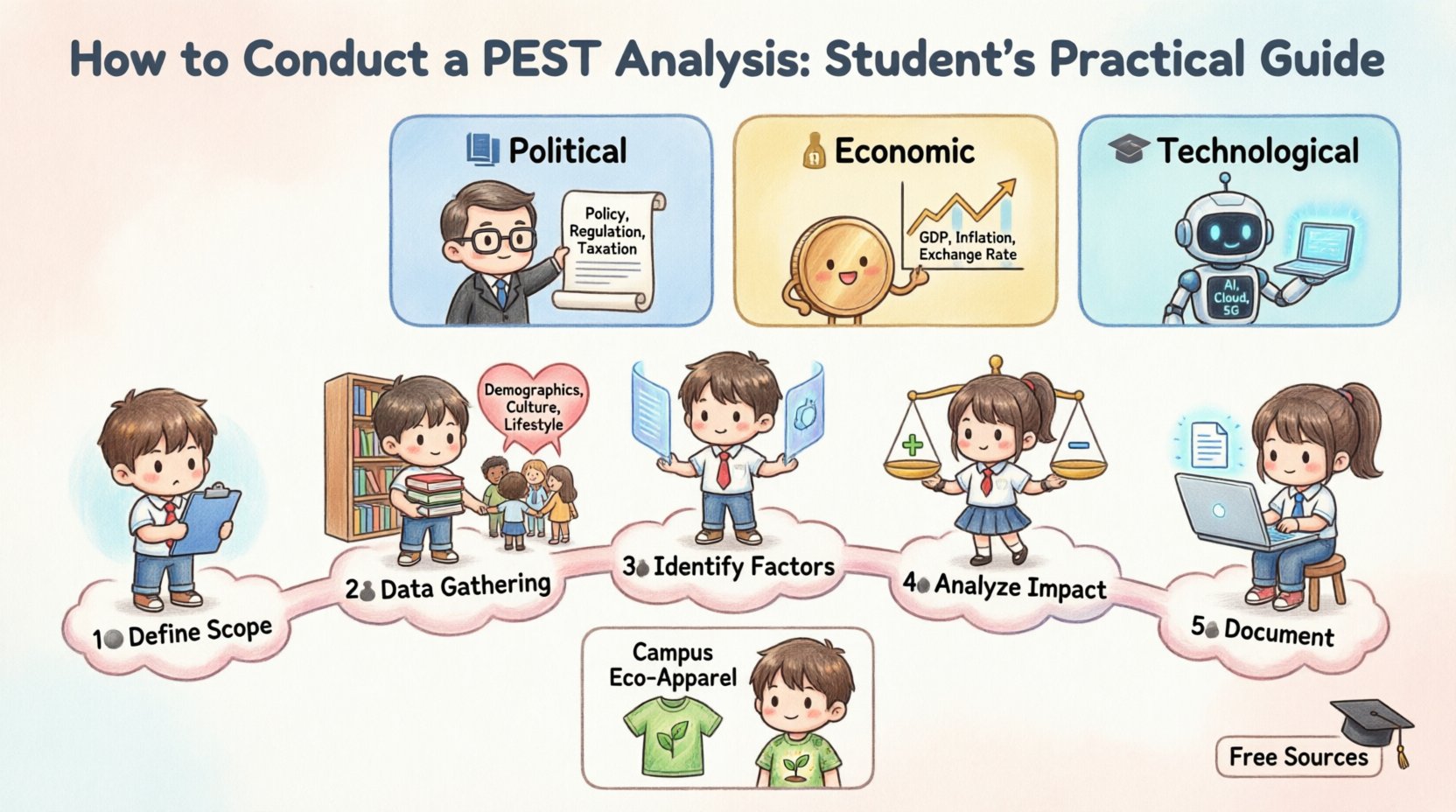
Now that you understand the components, follow this logical process to conduct the analysis. This workflow ensures you move from raw data to strategic insight without skipping steps.
Step 1: Define the Scope 📏
Before gathering information, clearly state the objective. Is this for a specific company, a product launch, or a theoretical market entry? Define the geographic region (local, national, global) and the time horizon (current, 1-year, 5-year). A vague scope leads to vague data.
- Identify the specific industry sector.
- Determine the geographic boundaries.
- Set the timeline for the analysis.
Step 2: Data Gathering 📚
Collect information from reliable sources. Avoid relying on a single news outlet. Look for government reports, academic journals, and industry white papers. You do not need paid software to access this data; many government databases are open to the public.
- Search for census data for social factors.
- Review central bank reports for economic indicators.
- Check legislative databases for political updates.
- Monitor tech news sites for technological trends.
Step 3: Identify Key Factors 🔎
Not every piece of data is relevant. Filter the information you collected to find the top three to five factors for each category. Focus on those with the highest impact on your specific project.
- Ask: “How much does this factor change our operations?”
- Ask: “How quickly is this factor changing?”
- Ask: “Can we influence this factor?” (If no, it is external).
Step 4: Analyze Impact 📊
Once identified, determine if each factor is an opportunity or a threat. Some factors might be neutral, but in a strategic context, most should be categorized as positive or negative.
- Opportunity: A factor that allows for growth or efficiency.
- Threat: A factor that poses a risk to stability or profit.
Step 5: Document Findings 📝
Compile your findings into a clear document. Use tables or bullet points to make the data readable. Ensure your conclusions are supported by the evidence you gathered. This document serves as the basis for your final presentation or report.
Practical Example for Students 🎓
To illustrate this process, consider a student project involving a new eco-friendly clothing brand targeting university students. Here is how the analysis might look.
Scenario: Campus Eco-Apparel Brand
- Political: Government subsidies for sustainable materials make production cheaper. New labor laws require fair wages for workers.
- Economic: Inflation is high, making students price-sensitive. However, disposable income among seniors is stable.
- Social: High awareness of climate change among Gen Z. Shift towards thrifting and sustainability.
- Technological: Social media allows direct marketing without intermediaries. 3D printing allows for on-demand production.
Common Mistakes to Avoid ⚠️
Even with a solid framework, errors can undermine your analysis. Be aware of these common pitfalls to ensure your work remains credible.
- Confusing Internal and External: Do not list internal strengths like “good management” here. Keep this section strictly external.
- Too Much Detail: Do not list every single law or statistic. Focus on the trends that matter.
- Ignoring Interconnectivity: Economic factors often drive Social factors. Acknowledge how they relate.
- Outdated Data: Ensure your sources are recent. A report from five years ago may be irrelevant.
- Subjectivity: Avoid personal opinions. Base every claim on evidence.
PEST vs. Other Tools 🆚
Students often confuse PEST with other frameworks. Understanding the distinction helps you choose the right tool for the job.
| Framework | Focus | Best Used For |
|---|---|---|
| PEST Analysis | External Macro Factors | Market Entry, Long-term Strategy |
| SWOT Analysis | Internal + External | Overall Business Health Check |
| Porter’s Five Forces | Industry Competition | Competitive Landscape Analysis |
| STEEPLE | PEST + Ethical + Legal | Comprehensive Compliance Review |
Use PEST when you need to understand the environment. Use SWOT when you need to combine that environment with your internal capabilities.
Data Gathering Sources 📚
You do not need expensive subscriptions to conduct high-quality research. Several free resources provide the data needed for a robust analysis.
- Government Websites: Census bureaus and economic departments offer free statistics.
- Academic Journals: University libraries provide access to peer-reviewed research.
- Industry Reports: Trade associations often publish free summaries of market trends.
- News Archives: Search for historical trends in major publications.
- Public Databases: Look for open data initiatives from international organizations.
Final Thoughts 💡
Conducting a PEST Analysis is more than an academic exercise. It is a method for thinking clearly about the world around you. By systematically evaluating Political, Economic, Social, and Technological factors, you gain a lens through which to view complex problems.
For students, this skill translates into better grades and better preparedness for the workforce. It shows employers that you can analyze data, identify risks, and plan strategically. Take the time to research thoroughly, keep your data organized, and focus on the factors that truly drive change. With practice, this framework becomes a natural part of your decision-making process.