

Strategic planning requires more than just internal assessment. To navigate the complex external landscape, organizations need a structured approach to environmental scanning. The PESTEL model provides a robust framework for analyzing macro-environmental factors that influence business operations. This tool helps leaders identify opportunities and threats before they become critical issues.
By understanding the Political, Economic, Social, Technological, Environmental, and Legal forces at play, companies can align their long-term goals with market realities. This analysis is not a one-time event but a continuous process that evolves with the global economy. Below, we explore how to apply this framework effectively.
Understanding the Macro-Environment 🧭
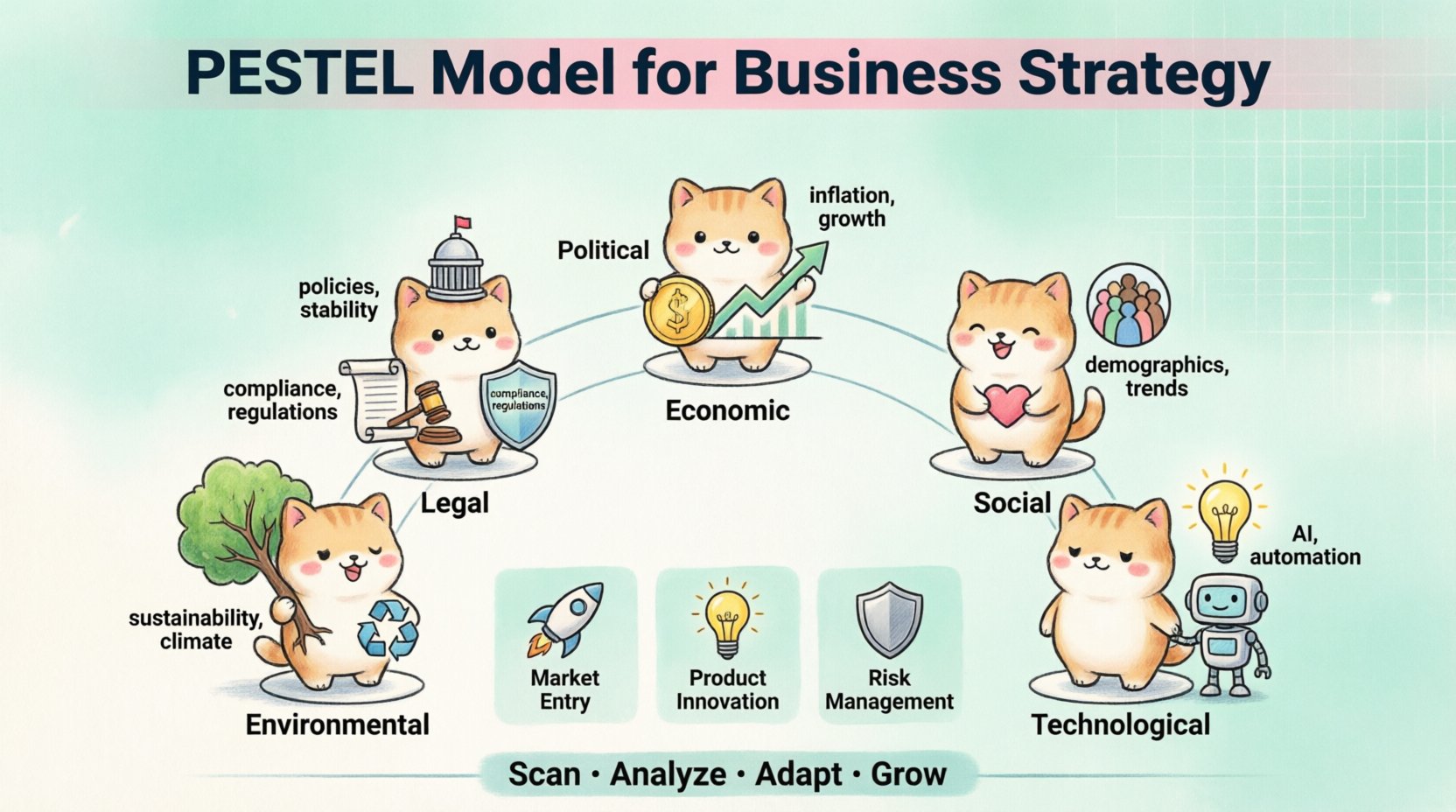
External factors often lie beyond the control of management. However, they dictate the boundaries within which a business must operate. Ignoring these variables can lead to strategic failures. The PESTEL model categorizes these external drivers into six distinct groups.
- Political: Government policies, trade restrictions, and tax policies.
- Economic: Interest rates, inflation, exchange rates, and economic growth.
- Social: Demographics, cultural trends, and lifestyle changes.
- Technological: Innovation rates, automation, and research and development.
- Environmental: Climate change, sustainability, and waste management.
- Legal: Employment laws, health and safety regulations, and consumer protection.
Each category offers a lens through which to view the market. When combined, they provide a holistic view of the operating environment. This comprehensive picture allows for better risk management and resource allocation.
Strategic Applications of the Framework 🎯
Knowing the factors is only half the battle. The real value lies in application. Here is how different organizational functions utilize this analysis.
1. Market Entry and Expansion 🚀
Before entering a new region, companies must assess viability. A PESTEL analysis reveals barriers that might not be immediately obvious.
- Political Stability: Is the government stable? Are there risks of expropriation?
- Regulatory Environment: What are the import duties and compliance costs?
- Consumer Behavior: Do local cultural norms align with the product offering?
For example, a retail chain expanding into a new country must consider local labor laws and tax incentives. If a region offers tax breaks for foreign investment, this could significantly improve the projected return on investment. Conversely, strict import tariffs might make the pricing uncompetitive.
2. Product Development and Innovation 💡
Technology and social trends drive product lifecycles. Understanding these helps teams design offerings that meet future demand.
- Technological Shifts: Are new technologies making current products obsolete?
- Social Trends: Is there a growing demand for sustainable materials?
- Legal Requirements: Are there new safety standards for electronics?
Consider the automotive industry. The push toward electric vehicles is driven by Environmental regulations and Social awareness regarding carbon footprints. Companies that ignore these signals risk losing market share to competitors who adapt faster.
3. Risk Management and Contingency Planning 🛡️
Proactive identification of threats allows for the creation of mitigation strategies. This is crucial for supply chain resilience.
- Economic Volatility: How would a recession impact cash flow?
- Political Unrest: What happens if trade routes are disrupted?
- Legal Changes: How do new compliance laws affect operations?
By simulating different scenarios, leadership can prepare backup plans. This reduces the shock of unexpected external changes.
Deep Dive: The Six Factors Explained 🔍
To apply the model correctly, one must understand the specific nuances of each factor. Below is a detailed breakdown.
Political Factors 🏛️
Government actions directly influence the profitability and stability of business sectors. These factors include:
- Tax Policy: Corporate tax rates affect net income and reinvestment capabilities.
- Labor Laws: Regulations on unions and minimum wage impact operational costs.
- Trade Restrictions: Tariffs and quotas affect international supply chains.
- Political Stability: Elections or regime changes can alter policy direction abruptly.
For a multinational corporation, political risk is a primary concern. A sudden change in administration might lead to stricter environmental regulations or higher corporate taxes. Strategic planning must account for this uncertainty.
Economic Factors 📉
Economic conditions determine the purchasing power of customers and the cost of capital. Key elements include:
- Inflation Rates: High inflation increases input costs and reduces consumer spending power.
- Interest Rates: Higher rates make borrowing expensive, slowing expansion.
- Exchange Rates: Fluctuations impact the cost of imported materials and revenue from exports.
- GDP Growth: A growing economy suggests higher demand for goods and services.
During an economic downturn, businesses often need to pivot toward value-oriented products. Understanding the economic cycle helps in timing major investments or layoffs.
Social Factors 👥
Societal trends shape consumer preferences and workforce expectations. These include:
- Demographics: Age distribution, population growth rates, and migration patterns.
- Cultural Norms: Language, religion, and social values influence marketing.
- Health Consciousness: Trends toward organic food or fitness impact product design.
- Workforce Attitudes: Shifts in work-life balance expectations affect HR policies.
A company targeting Gen Z must understand their digital-first mentality. Marketing strategies that worked for Baby Boomers may fail to engage younger demographics. Social analysis ensures the brand remains relevant.
Technological Factors 🤖
Technology drives efficiency and creates new business models. Factors to monitor include:
- Automation: Robotics and AI can reduce labor costs but require investment.
- R&D Activity: The pace of innovation in the industry dictates competitive advantage.
- Infrastructure: Internet connectivity and logistics networks enable digital commerce.
- Security: Cyber threats require robust protection systems.
Disruptive technologies can render entire industries obsolete. Companies must continuously scan for technological shifts to avoid disruption. Investing in training ensures the workforce can adapt to new tools.
Environmental Factors 🌱
Sustainability is no longer optional. It affects brand reputation and compliance. Key aspects are:
- Climate Change: Extreme weather affects supply chains and production sites.
- Carbon Emissions: Regulations limit the amount of pollution a company can release.
- Waste Management: Laws regarding disposal and recycling impact logistics.
- Resource Scarcity: Availability of raw materials affects production costs.
Businesses are increasingly held accountable for their carbon footprint. Adopting green practices can lower costs in the long run and improve customer loyalty.
Legal Factors ⚖️
Legal obligations must be met to avoid fines and litigation. This includes:
- Employment Law: Contracts, discrimination policies, and termination rules.
- Health and Safety: Standards for workplace conditions and product safety.
- Consumer Protection: Rights regarding warranties and data privacy.
- Intellectual Property: Patents, trademarks, and copyrights.
Compliance is a baseline requirement. Failure to adhere to legal standards can result in severe penalties. Regular audits help ensure ongoing compliance.
Integrating PESTEL with Other Strategic Tools 🔗
While powerful, the PESTEL model works best when combined with other frameworks. It provides the context for deeper analysis.
SWOT Analysis
SWOT (Strengths, Weaknesses, Opportunities, Threats) benefits greatly from PESTEL data. The external factors identified in PESTEL often populate the Opportunities and Threats quadrants of a SWOT matrix. This ensures that the SWOT analysis is grounded in reality rather than speculation.
Porter’s Five Forces
Porter’s model analyzes industry competition. PESTEL adds the layer of macro-environmental pressure. For instance, a new law (Legal) might increase the threat of new entrants. Or, economic downturns (Economic) might increase the bargaining power of buyers.
Conducting a PESTEL Analysis: Step-by-Step 📝
Executing this analysis requires a structured approach. Follow these steps to ensure accuracy.
- Define the Scope: Determine if the analysis is for a specific product, region, or the entire organization.
- Gather Data: Collect information from industry reports, government publications, and news sources.
- Analyze Each Factor: Rate the impact of each factor as High, Medium, or Low.
- Identify Implications: Determine how each factor affects the business strategy.
- Develop Actions: Create specific plans to leverage opportunities or mitigate threats.
Common Pitfalls to Avoid ⚠️
Even with a strong framework, errors can occur. Be mindful of these common mistakes.
- Outdated Data: Using information from five years ago can lead to incorrect conclusions. Markets change rapidly.
- Generalization: Avoid broad statements. Be specific about the impact on your specific industry.
- Ignoring Interconnections: Factors are linked. Political decisions often drive Economic outcomes.
- One-Time Exercise: This is not a quarterly checkbox. It requires continuous monitoring.
Real-World Scenario: The Tech Sector 🖥️
Consider a software company planning to launch a new cloud platform. A PESTEL analysis would reveal:
| Factor | Specific Issue | Strategic Implication |
|---|---|---|
| Political | Data sovereignty laws in Europe | Must build local data centers to comply. |
| Economic | Recession reducing IT budgets | Focus on cost-saving value propositions. |
| Social | Remote work culture growth | Design for collaboration and accessibility. |
| Technological | AI integration demand | Invest in machine learning capabilities. |
| Environmental | Energy consumption of data centers | Pursue renewable energy partnerships. |
| Legal | GDPR and privacy regulations | Implement strict data governance protocols. |
This table illustrates how specific factors translate into actionable business decisions. The company can now prioritize its roadmap based on these insights.
Best Practices for Long-Term Success 🏆
To maintain a competitive edge, organizations should institutionalize environmental scanning.
- Assign Ownership: Designate a team or individual responsible for tracking macro trends.
- Use Multiple Sources: Don’t rely on a single news outlet. Cross-reference data.
- Involve Stakeholders: Get input from sales, HR, and operations. They see different angles.
- Update Regularly: Schedule reviews every quarter or whenever major global events occur.
- Visualize Data: Use charts and graphs to present findings to leadership.
Adopting these practices ensures that the business remains agile. Agility allows for quick pivots when the external environment shifts. This resilience is a key differentiator in volatile markets.
The Future of Strategic Analysis 🌐
The business landscape is becoming increasingly interconnected. Events in one sector can ripple across the globe. The PESTEL model adapts to this complexity by providing a comprehensive checklist. As technology evolves, the weight of certain factors may shift. For instance, Environmental factors are gaining prominence compared to previous decades.
Organizations that treat strategic planning as a dynamic process rather than a static document will thrive. The ability to anticipate change is more valuable than reacting to it. By mastering the nuances of the PESTEL model, leaders can navigate uncertainty with confidence.
This framework serves as a foundation for sustainable growth. It ensures that strategies are not built on assumptions but on verified external realities. Whether for a startup or an enterprise, the principles remain the same: understand the environment, adapt to it, and grow within it.
Continued vigilance is required. New regulations emerge, economies fluctuate, and technologies advance. Staying informed is the responsibility of every strategic leader. The PESTEL model provides the structure needed to manage this responsibility effectively.
Final Thoughts on Implementation 💭
Implementing this model requires discipline. It is easy to focus on internal metrics and neglect the outside world. However, the outside world ultimately determines success. By dedicating time to PESTEL analysis, companies protect their future viability.
Remember that this is a tool for insight, not a crystal ball. It reduces uncertainty but does not eliminate it. The goal is to make informed decisions despite the unknown. With a clear understanding of the macro-environment, businesses can allocate resources wisely and avoid costly missteps.