

An Entity Relationship Diagram (ERD) is not merely a drawing. It is the blueprint of your data infrastructure. When this blueprint is flawed, the resulting system inherits structural weaknesses that manifest as data anomalies, performance bottlenecks, and maintenance nightmares. Many developers begin with a clean slate, only to encounter cascading failures during the implementation phase. The root cause is rarely the technology stack; it is the design logic itself.
Understanding why an ERD fails requires looking beyond simple syntax. It demands a critical examination of relationships, cardinality, normalization, and semantic clarity. This guide dissects the most common pitfalls that compromise database integrity and explains how to identify them before they impact production environments.
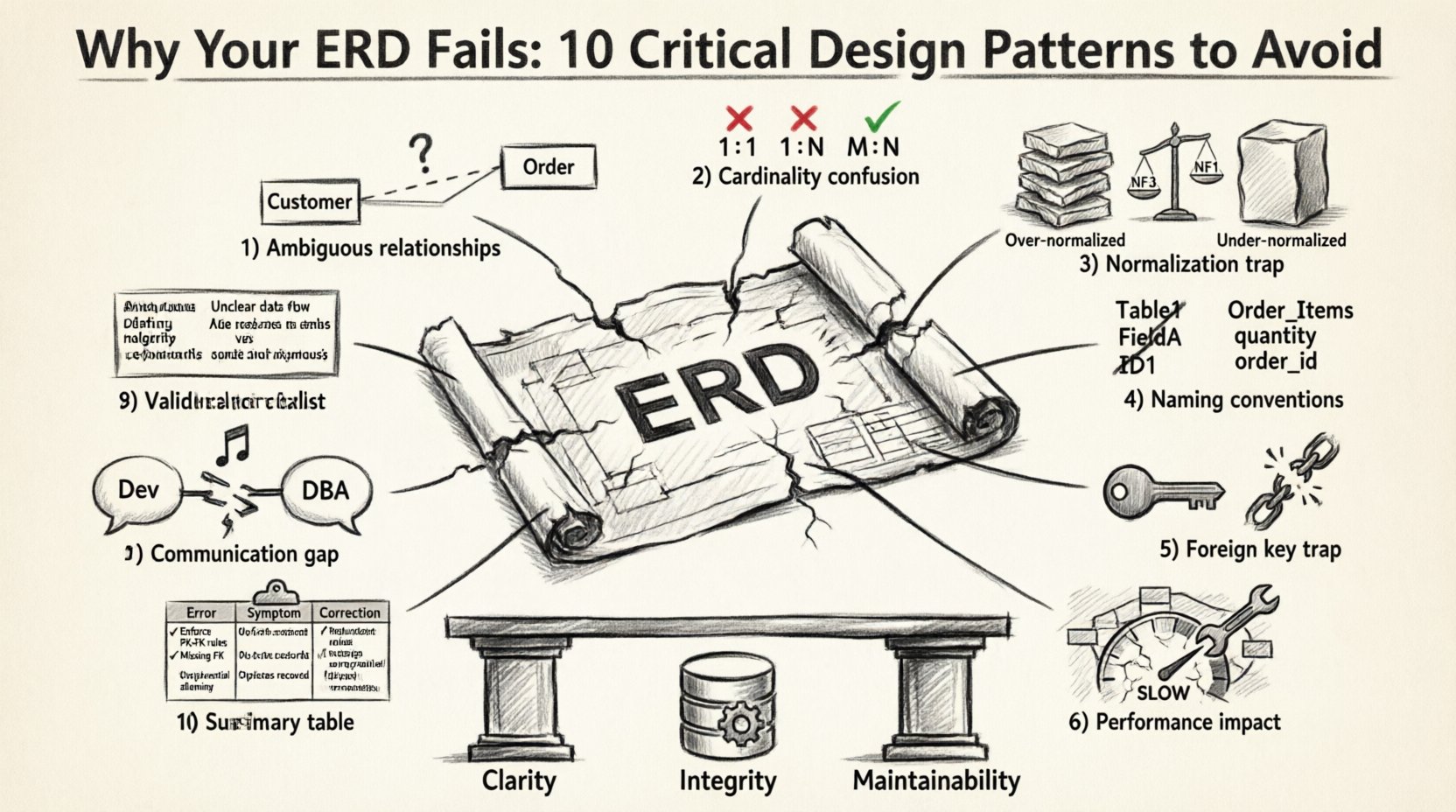
1. The Ambiguity of Relationships 🤔
At the core of every ERD lies the relationship. It defines how data entities interact. The most frequent failure point is ambiguity. When a relationship is not explicitly defined, the database engine must infer intent, often leading to incorrect data associations.
Implicit vs. Explicit Relationships
Explicit relationships are defined through foreign keys and constraints. Implicit relationships rely on application logic to maintain consistency. This separation creates a vulnerability known as the Integrity Gap.
- Explicit: Enforced by the database engine. If a record is deleted, dependent records are handled according to defined rules (CASCADE, SET NULL).
- Implicit: Enforced by code. If the code fails or is bypassed, orphaned data remains.
When your diagram does not clearly mark which side of the relationship holds the foreign key, developers make assumptions. One team might place the key in Table A, while another places it in Table B. This leads to circular dependencies and query complexity.
The Missing Cardinality Label
A relationship without cardinality is a guess. Cardinality specifies the exact number of instances of one entity that can or must relate to instances of another. Without these labels:
- Query Optimizers Struggle: The system cannot determine the join strategy effectively.
- Data Validation Fails: Constraints like NOT NULL are applied incorrectly.
- Business Logic Breaks: A “User” might be allowed to have zero “Orders” when the business rule requires one.
2. Cardinality Confusion: The One-to-Many Trap 📉
Cardinality errors are the most prevalent design flaw. They usually stem from misinterpreting business rules during the modeling phase. The confusion often arises between One-to-One (1:1), One-to-Many (1:N), and Many-to-Many (M:N).
1:1 Relationships and Redundancy
Modeling a 1:1 relationship incorrectly often leads to unnecessary redundancy. If two tables share the exact same primary key, one is usually a candidate for deletion or merging.
| Scenario | Correct Pattern | Poor Pattern |
|---|---|---|
| Employee and Security Badge | Single table with optional columns | Two tables linked 1:1 |
| Product and Price History | One table with timestamp | Two tables linked 1:1 |
In the poor pattern, every update requires joining two tables. In the correct pattern, data is co-located, reducing I/O operations.
1:N Relationships and Foreign Keys
This is the standard pattern. However, the placement of the foreign key is critical. The foreign key belongs on the “Many” side.
- Correct:
Orderstable containsUser_ID. - Incorrect:
Userstable contains a list ofOrder_IDs.
Storing a list of IDs in a single column violates First Normal Form (1NF). It forces string parsing or complex JSON handling, which degrades performance and prevents standard indexing.
Many-to-Many and Associative Entities
Many-to-Many relationships cannot be represented by a single foreign key in either table. They require an associative entity (a bridge table).
Common Failure: Ignoring the bridge table and trying to link two tables directly.
Why it fails: You lose the ability to store attributes on the relationship itself. For example, a Student and a Course relationship needs a grade. You cannot store a grade in the Student table or the Course table alone.
3. Normalization and the Denormalization Trap 🧱
Normalization reduces redundancy by organizing data into logical tables. However, over-normalization can kill performance. Under-normalization creates update anomalies. Finding the balance is a technical challenge.
Update Anomalies
When data is stored in multiple places without a single source of truth, updating it becomes risky.
- Insertion Anomaly: You cannot add a record because a required foreign key is missing.
- Update Anomaly: Changing a value in one row but not another leads to inconsistent data.
- Deletion Anomaly: Deleting a record accidentally removes critical information stored within it.
When to Denormalize
Denormalization is a deliberate choice to improve read performance. It should not be the default state. It is only justified when:
- Read Frequency vastly outweighs write frequency.
- Join Costs are prohibitive due to data volume.
- Reporting Requirements need pre-aggregated data.
Designers often denormalize too early. This introduces the risk of data drift. If the source data changes, the denormalized copy must be updated via triggers or application logic, adding complexity and potential failure points.
4. Naming Conventions and Semantics 🏷️
A schema is read more often than it is written. If the naming is unclear, the cognitive load on the developer increases, leading to bugs. Semantic clarity is as important as structural integrity.
Generic Names
Names like Table1, Column_A, or Data provide no context. They force the developer to look at the application code to understand the database structure.
- Better:
Order_Items,Transaction_Date,Customer_Profiles.
Inconsistent Singular vs. Plural
Some standards prefer singular table names, others plural. Mixing them creates confusion.
| Inconsistent | Consistent |
|---|---|
Users, Order, Products |
Users, Orders, Products |
Consistency allows for predictable query generation. Inconsistency requires manual mapping in the code layer.
Reserved Words
Using keywords like Order, User, or Group as table names can cause syntax errors in the query language. These identifiers often require escaping characters, making queries harder to read and maintain.
5. The Foreign Key Trap 🔑
Foreign keys are the glue of relational integrity. However, they are frequently misconfigured. This section explores the nuances of key implementation.
Self-Referencing Keys
Recursive relationships, such as an Employee managing another Employee, require a foreign key pointing to the same table. If the constraint is not set correctly, you risk infinite loops or orphaned hierarchy nodes.
- Issue: Allowing a manager to be deleted without handling the subordinates.
- Solution: Define
CASCADEorSET NULLconstraints explicitly.
Composite Keys
Composite keys (multiple columns acting as the primary key) are powerful but fragile. If a child table references a composite key, the child must include all columns of the parent key.
Failure Mode: If the parent key changes (e.g., a natural key update), the child table must be updated across multiple rows. This is expensive and prone to race conditions.
Nullable Foreign Keys
A foreign key column should only be nullable if the relationship is optional. If the relationship is mandatory, the column must be NOT NULL.
Warning: Using NULL to represent “no relationship” complicates SQL queries. Every query must check for IS NULL or IS NOT NULL, which prevents index usage in some database engines.
6. Performance Implications of Bad Design 🚀
A poorly designed ERD does not just cause data errors; it causes performance degradation. The physical storage and query execution plan are direct consequences of the logical model.
Index Fragmentation
When foreign keys are not indexed, the database engine performs full table scans to verify referential integrity. This slows down joins significantly as data volume grows.
Join Complexity
Deeply nested relationships require multiple joins. Each join adds computational overhead. A star schema design (centered around a fact table) is often superior to a snowflake schema (highly normalized) for analytical queries.
Lock Contention
Highly normalized designs often require more locks to maintain consistency during updates. In high-concurrency systems, this leads to blocking and timeouts. A slightly denormalized design can reduce the number of rows locked per transaction.
7. Maintenance Nightmares 🛠️
The true cost of a bad ERD is revealed over time. Maintenance is where theoretical flaws become practical failures.
Schema Evolution
When requirements change, a rigid schema is hard to modify. Adding a new relationship might require dropping tables, migrating data, and rewriting application logic. A flexible design anticipates change.
- Example: Adding a new attribute to a relationship that was previously unmodeled.
- Impact: Requires an ALTER TABLE statement that locks the table for hours.
Data Migration
Moving data between systems is risky if the target ERD does not match the source. Incompatible cardinality forces data loss or duplication during the migration process.
8. Checklist for Validation ✅
Before finalizing an ERD, run a systematic audit. Use this checklist to identify potential design flaws.
- Are all relationships explicitly defined? Check for implicit links.
- Is cardinality labeled on all lines? Ensure 1:1, 1:N, or M:N is clear.
- Are primary keys unique and stable? Avoid natural keys that change frequently.
- Are foreign keys indexed? Verify performance for joins.
- Is normalization appropriate? Ensure no update anomalies exist.
- Are naming conventions consistent? Check for singular/plural mix-ups.
- Are reserved words avoided? Check against database keyword lists.
- Is there a plan for recursive relationships? Define self-referencing constraints.
9. The Human Factor: Communication 🗣️
Often, ERD failures are not technical; they are communication failures. The diagram is a contract between the business stakeholders and the technical team.
Missing Business Rules
If the business rule is “A user can have multiple addresses,” but the diagram shows a 1:1 relationship, the data will reject valid business scenarios. The diagram must reflect the reality of the business operations, not just the current database structure.
Version Control for Schemas
Just like code, schemas need version control. Without tracking changes, it is impossible to audit why a relationship was added or removed. This leads to “tribal knowledge” where only one person understands the design.
10. Summary of Critical Patterns 📋
To summarize, the integrity of your data system depends on the precision of your design. Below is a consolidated view of common errors and their corrections.
| Error Category | Symptom | Correction |
|---|---|---|
| Missing Cardinality | Unclear data limits | Add explicit relationship labels |
| Incorrect Foreign Key Placement | Circular dependencies | Place key on the “Many” side |
| Over-Normalization | Slow queries, too many joins | Strategic denormalization |
| Under-Normalization | Data duplication, anomalies | Apply normalization rules |
| Poor Naming | High cognitive load | Adopt consistent naming standards |
| Reserved Words | Syntax errors | Use aliases or escape characters |
11. Moving Forward with Confidence 🚀
Designing a robust Entity Relationship Diagram is a discipline that balances theory with practical constraints. It requires patience, scrutiny, and a deep understanding of how data flows through the system. By avoiding the common patterns discussed in this guide, you build a foundation that supports scalability and reliability.
Remember, the diagram is a living document. It evolves as the business evolves. Regular reviews ensure that the design remains aligned with the operational reality. Do not treat the ERD as a one-time task. Treat it as the core architecture of your data asset.
Focus on clarity. Focus on integrity. Focus on maintainability. These three pillars will prevent the failures that plague so many systems. When you prioritize the design logic over the quick implementation, you save countless hours of debugging and refactoring in the future.
Take the time to validate your relationships. Check your keys. Review your normalization. The effort you invest now pays dividends in system stability later. A well-designed schema is invisible when it works, and obvious when it fails. Choose the design that works.