

Enterprise architecture is the backbone of modern organizational strategy. It bridges the gap between business goals and IT capabilities. At the center of this discipline lies a powerful specification language designed to visualize, analyze, and describe these complex structures. This is ArchiMate. Whether you are a stakeholder, a modeler, or an architect, understanding this framework is essential for aligning technology with business value. This guide provides a deep dive into its structure, purpose, and application.
📜 What Is ArchiMate?
ArchiMate is an open and independent enterprise architecture modeling language. It is maintained by The Open Group, a global consortium that promotes open standards. The language was originally developed in 2001 by the Dutch government and the European Commission to support the implementation of the TOGAF framework. Over time, it evolved into a standalone standard.
The primary goal of ArchiMate is to provide a common language for enterprise architects. It allows teams to describe business and IT architecture in a consistent way. This consistency is crucial when dealing with complex transformations. Without a shared vocabulary, communication breaks down. Different departments often speak different languages. ArchiMate unifies these voices.
🧠 Core Philosophy and Principles
The language is built on a set of fundamental principles that guide its usage. It is not merely a drawing tool; it is a conceptual framework. These principles ensure that models remain clear and useful.
- Separation of Concerns: The architecture is divided into distinct layers. This allows architects to focus on specific aspects without getting overwhelmed by details.
- Relationships: The connections between elements are as important as the elements themselves. These relationships define how value flows through the organization.
- Standardization: By using a standard set of concepts, organizations reduce ambiguity. This makes models reusable and understandable across different projects.
- Abstraction: The language allows for different levels of detail. You can model a high-level strategy or a specific technical implementation.
🧱 The Core Layers
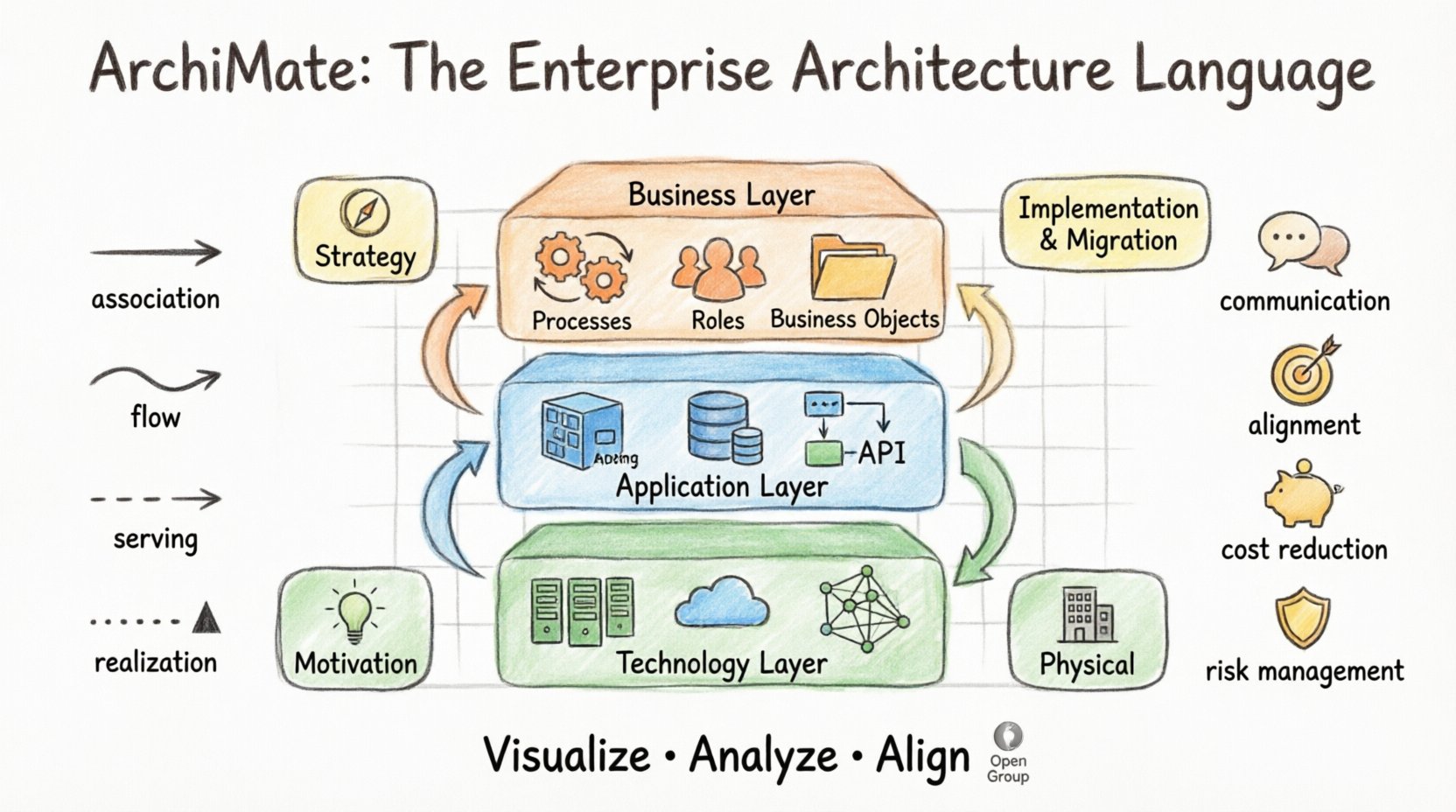
One of the most recognizable features of ArchiMate is its layered structure. This structure helps in organizing the complexity of the enterprise. Each layer represents a different domain of expertise within the organization. Moving from top to bottom, the layers transition from human-centric activities to technical infrastructure.
1. The Business Layer
The Business Layer represents the human side of the enterprise. It describes what the organization does. This includes processes, roles, and organizational structures. It is the “what” of the architecture.
- Business Processes: Sequences of activities that deliver value to a customer or stakeholder.
- Business Roles: Persons or groups that perform activities.
- Business Objects: Things that are relevant to the business processes, such as products or data.
2. The Application Layer
The Application Layer describes the software systems that support the business. It acts as the bridge between business logic and technical infrastructure. This layer defines the functionality provided by applications.
- Application Services: Functionalities provided by the software.
- Application Functions: Distinct capabilities of the software.
- Application Components: The building blocks of the software system.
3. The Technology Layer
The Technology Layer represents the physical infrastructure. It describes the hardware and network components that host the applications. This is where the digital world meets the physical world.
- Technology Services: Services provided by the infrastructure.
- Technology Functions: Capabilities of the hardware or software.
- Technology Components: The actual physical or virtual devices.
🌐 The Domains
Beyond the layers, ArchiMate organizes concepts into domains. These domains represent different perspectives on the architecture. They help in structuring the modeling effort.
| Domain | Focus Area | Key Concepts |
|---|---|---|
| Strategy | Goals and Drivers | Goal, Driver, Requirement |
| Implementation & Migration | Change Management | Project, Portfolio, Deliverable |
| Motivation | Why do we do this? | Stakeholder, Assessment, Principle |
| Physical | Hardware and Site | Device, System Software, Site |
⚡ Key Relationships
Understanding the relationships between elements is critical. These relationships define how the architecture functions. They show dependencies, flows, and connections.
Structural Relationships
Structural relationships describe the static connections between elements. They define the architecture’s shape.
- Association: A general relationship between two elements.
- Specialization: A generalization of an element into a more specific one.
- Aggregation: A part-of relationship where the parts can exist independently.
- Composition: A part-of relationship where the parts cannot exist independently.
Behavioral Relationships
Behavioral relationships describe the dynamic aspects of the architecture. They show how elements interact.
- Access: One element uses or accesses another.
- Flow: The movement of information or material between elements.
- Serving: One element provides a service to another.
- Realization: One element implements or realizes another.
Motivation Relationships
These relationships explain the reasoning behind the architecture. They link business drivers to actual implementation.
- Assignment: Assigning a stakeholder to an element.
- Triggering: One element triggers the execution of another.
- Influence: One element influences the realization of another.
- Realization: One element realizes a goal or requirement.
📈 Why Organizations Adopt This Framework
Organizations do not adopt this standard without a reason. There are tangible benefits to using a structured approach. These benefits span across communication, planning, and execution.
1. Improved Communication 🗣️
When stakeholders from different departments look at a model, they see the same things. This reduces misinterpretation. The visual notation provides a common ground. Technical teams can explain constraints to business leaders without using jargon.
2. Better Alignment 🎯
IT investments often fail because they do not support business goals. This framework helps trace requirements from the strategy layer down to the technology layer. If a technology component does not support a business goal, it can be identified and removed.
3. Cost Reduction 💰
By visualizing the architecture, redundancies become visible. Multiple systems performing the same function can be consolidated. This leads to lower maintenance costs and reduced complexity.
4. Risk Management 🛡️
Understanding dependencies is crucial for risk assessment. If a specific server fails, how does it impact the business process? The model shows these dependencies clearly. This allows for better disaster recovery planning.
🛠️ Modeling Principles and Best Practices
Creating a model is different from drawing a picture. There are rules that ensure the model remains valid. Following these principles helps maintain quality.
- Keep it Simple: Do not model everything at once. Focus on the relevant scope for the current project.
- Use Layers Consistently: Do not mix layers inappropriately. A technology element should not directly serve a business process without an application layer in between.
- Validate Relationships: Ensure that the relationships used are semantically correct. A flow relationship should carry data or material, not a control signal.
- Version Control: Architecture evolves. Keep track of changes over time. This helps in auditing and understanding the history of decisions.
🔄 Integration with Other Frameworks
ArchiMate is often used alongside other standards. It is not an isolated system. It complements existing frameworks.
TOGAF
The TOGAF framework is the most common companion. TOGAF provides the process for enterprise architecture. ArchiMate provides the language to describe the output. When using TOGAF, ArchiMate is the standard notation for the Architecture Repository.
ITIL
IT Service Management processes can be modeled using this language. This helps in understanding how IT services support business services. It bridges the gap between service design and business needs.
ISO Standards
Various ISO standards for security and quality can be mapped to the architecture. This ensures compliance is built into the design phase.
📝 Implementation Steps
Starting a modeling initiative requires a plan. It is not a task that can be completed overnight. A structured approach ensures success.
- Define Scope: Determine which parts of the enterprise will be modeled. Is it the whole organization or a specific division?
- Train the Team: Ensure that all modelers understand the language. Misinterpretation of symbols leads to errors.
- Establish Governance: Define who can change the models. Who approves changes? Who maintains the repository?
- Build Incrementally: Start with the high-level architecture. Add detail gradually as needed.
- Review and Validate: Regularly check the models with stakeholders. Ensure they reflect reality.
🚀 Common Use Cases
There are specific scenarios where this framework shines. Knowing these use cases helps in deciding when to apply it.
- System Integration: Connecting new systems to legacy infrastructure. The model shows data flow and dependencies.
- Cloud Migration: Planning the move from on-premise to cloud. The technology layer helps map hardware to virtual services.
- Business Transformation: Changing business models. The business layer helps visualize the new processes.
- Security Architecture: Identifying critical assets and threats. The motivation layer helps justify security investments.
🔍 Comparison with UML
It is common to compare this language with UML (Unified Modeling Language). While both are modeling languages, they serve different purposes.
- Focus: UML focuses on software system design. ArchiMate focuses on enterprise-wide architecture.
- Layers: ArchiMate explicitly separates business, application, and technology. UML is primarily software-centric.
- Complexity: ArchiMate is often considered more accessible for business stakeholders than complex UML diagrams.
📅 Evolution and Future
The standard is not static. It evolves to meet the changing needs of the industry. Version 3.0 introduced new concepts to handle cloud and digital transformation. Future updates will likely focus on agile methods and sustainability.
Keeping up with the latest version is important. New features provide better ways to model modern architectures. Sticking to outdated versions can lead to gaps in capability.
🧩 Detailed Layer Breakdown
To truly understand the layers, we must look at the specific constructs available in each. This level of detail is necessary for accurate modeling.
Business Layer Constructs
- Business Actor: A person or organization that performs a role.
- Business Role: A collection of responsibilities.
- Business Function: A capability that is necessary to achieve a goal.
- Business Process: A sequence of activities.
- Business Event: Something that happens that triggers a process.
- Business Object: A representation of data or information.
- Business Interface: A point of interaction with the business.
- Business Service: A collection of business functionality.
- Business Collaboration: A group of business actors working together.
Application Layer Constructs
- Application Component: A modular part of an application.
- Application Function: A distinct capability of the software.
- Application Interface: A point of interaction with the software.
- Application Service: A collection of application functionality.
- Application Interaction: The interaction between two application components.
- Data Object: A representation of data within the application.
Technology Layer Constructs
- Technology Component: A physical or virtual device.
- Technology Function: A capability of the device.
- Technology Interface: A point of interaction with the device.
- Technology Service: A collection of technology functionality.
- Network: A set of connected devices.
- Deployment Node: A physical or virtual node for deployment.
- Device: A physical device like a server or router.
- System Software: Software that manages hardware resources.
🎓 Conclusion on Adoption
Adopting this framework is a journey. It requires commitment and discipline. However, the return on investment is significant. Organizations that invest in a structured architecture are better positioned for change. They can adapt faster and with less risk.
The language provides the structure needed to manage complexity. It turns abstract ideas into concrete plans. By following the standards and principles outlined in this guide, teams can create models that drive value. The focus remains on alignment, clarity, and efficiency. This is the essence of enterprise architecture.
As technology continues to evolve, the need for clear architectural guidance will only grow. ArchiMate offers a proven path forward. It is a tool for stability in a changing world. Whether you are starting a new project or refactoring an existing one, these concepts provide the foundation for success.